Evidence teardown · Retatrutide · Zepbound · Sleep apnea · Healthy aging · Updated October 27, 2026
Published · Updated
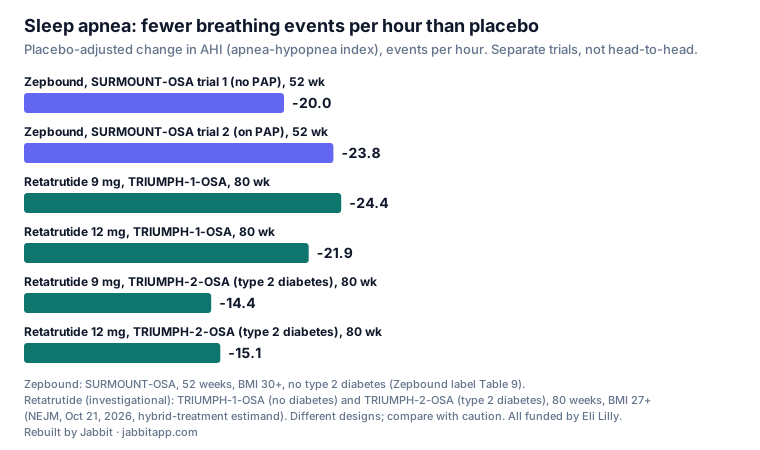
Does retatrutide treat sleep apnea better than Zepbound? Two Lilly trials published October 21, 2026 show it cut breathing events by about 22 to 24 an hour more than placebo in people without diabetes, a similar drop to Zepbound’s trials, and by about 14 to 15 in people with type 2 diabetes. There is no head-to-head trial, and retatrutide is not approved.
Zepbound became the first drug FDA approved for sleep apnea in December 2024,[4] so the first question about Eli Lilly’s next drug is whether it does more. On October 21, 2026, NEJM published Lilly’s two sleep apnea trials of retatrutide, the investigational triple-hormone shot. Our plain answer: retatrutide clearly beat placebo, it is the first drug of this class with sleep apnea trial data in people with type 2 diabetes, and the size of the effect in people without diabetes looks similar to Zepbound’s, not obviously bigger. It is not approved, the trials did not test stopping CPAP, and nobody yet knows whether it prevents heart attacks or strokes in people with sleep apnea.
Why this matters now
The trials, TRIUMPH-1-OSA and TRIUMPH-2-OSA, were published online on October 21 and presented at the European Sleep Research Society congress, October 20–23, 2026.[1] Medscape’s October 26 report put the practical question to sleep doctors: is CPAP still needed?[12] Lilly has said it plans to file retatrutide with FDA in the first quarter of 2027, and that its data package supports submissions that include sleep apnea.[11] An estimated 425 million adults aged 30 to 69 worldwide have moderate-to-severe sleep apnea, according to a 2019 analysis funded by ResMed, a CPAP maker.[13]
Timeline
| Date | Event |
|---|---|
| 2016 | The SAVE trial finds CPAP did not prevent heart attacks or strokes in people with sleep apnea and heart or brain blood-vessel disease, though it eased snoring and sleepiness.[14] |
| June 2024 | SURMOUNT-OSA, Lilly’s tirzepatide sleep apnea trials, is published.[3] |
| Dec 20, 2024 | FDA approves Zepbound as the first drug for moderate-to-severe obstructive sleep apnea in adults with obesity.[4] |
| Apr–Jun 2026 | TRIUMPH-1 and TRIUMPH-2, the parent trials, reach primary completion.[8][9] |
| Jul 23, 2026 | Lilly says it plans to submit retatrutide to FDA in Q1 2027.[11] |
| Oct 21, 2026 | NEJM publishes the TRIUMPH-OSA results.[1] |
| Feb 2029 (est.) | TRIUMPH-Outcomes, the heart and kidney outcomes trial, is due for primary completion, per its registry record.[10] |
What the trials tested
- Who. Adults with moderate-to-severe obstructive sleep apnea (an AHI, or breathing pauses and shallow breaths per hour, of 15 or more) and a BMI of 27 or more: 243 without diabetes in TRIUMPH-1-OSA and 448 with type 2 diabetes in TRIUMPH-2-OSA. Average AHIs were 58.6 and 55.9, well into the severe range.[1]
- How. Weekly retatrutide at one of three trial doses (4, 9 or 12 mg) or placebo for 80 weeks, with lifestyle counseling. Both were nested inside Lilly’s larger weight-loss trials.[1][7][5][6]
- The main result. The change in AHI on the two higher doses after 80 weeks, measured by overnight sleep study.[1]
What they found
- Without diabetes: AHI fell by 34.3 and 31.7 events an hour on 9 and 12 mg, vs 9.9 on placebo. Weight fell 22.2% and 20.6%, vs 4.8%.[1]
- With type 2 diabetes: AHI fell by 24.7 and 25.4, vs 10.3 on placebo, and weight by 17.9% and 18.5%, vs 5.6%.[1][6]
- Remission or mild sleep apnea without daytime sleepiness: 51.6% and 42.3% vs 12.5% without diabetes; 39.5% and 38.9% vs 12.6% with diabetes.[1]
- Oxygen drops during sleep. Sleep apnea-specific hypoxic burden fell 63% to 75% on the higher doses, vs 26% to 30% on placebo.[1]
- The lowest dose. 4 mg reduced AHI too, but the paper says its effects on most secondary measures “did not reach statistical significance under the testing hierarchy.”[1]
- How people felt. A sleep-impairment questionnaire improved significantly vs placebo on the higher doses in the diabetes trial; in the trial without diabetes, those results did not pass the paper’s statistical testing rules.[1]
Retatrutide vs Zepbound for sleep apnea
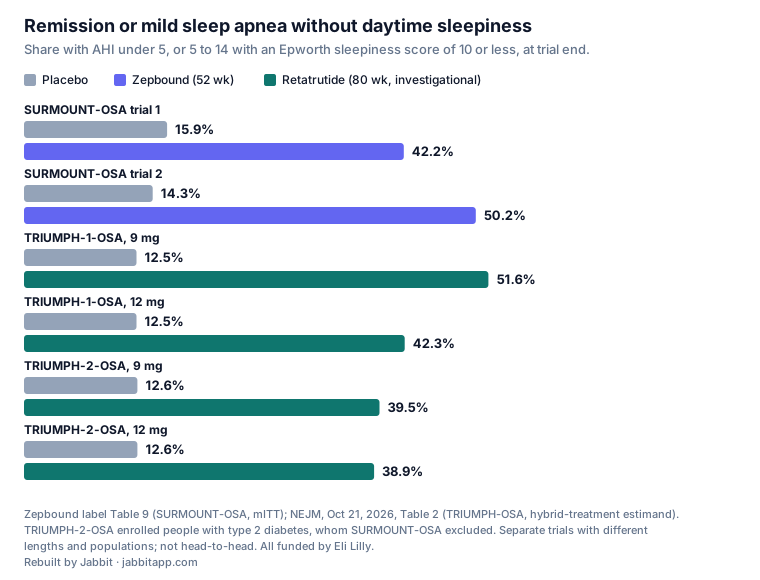
In Zepbound’s two 52-week trials, AHI fell 20.0 and 23.8 events an hour more than placebo, and 42.2% and 50.2% reached remission or mild sleep apnea without sleepiness.[2][3] In TRIUMPH-1-OSA, the most similar retatrutide trial, the placebo-adjusted drops were 24.4 and 21.9, and 51.6% and 42.3% reached that goal.[1]
Jabbit’s analysis: those ranges overlap, even though retatrutide was given for 80 weeks rather than 52 and produced more weight loss. The trials also differ in entry BMI (27 vs 30), statistical method and placebo response, so this is not a head-to-head comparison and cannot rank the drugs. An independent sleep specialist quoted by Medscape made the same point: without head-to-head trials, it is not possible to know whether retatrutide offers advantages over tirzepatide.[12] The authors themselves say the AHI drops are similar to what this much weight loss would be expected to produce.[1] FDA said the same of Zepbound in 2024: its AHI improvement “is likely related to body weight reduction.”[4] What is genuinely new is the diabetes trial: SURMOUNT-OSA excluded people with type 2 diabetes.[2]
Safety: what was reported
- Stomach side effects were the most common, mostly mild to moderate and mostly during dose increases. Diarrhea reached 44% on 9 mg in the trial without diabetes.[1]
- Skin sensations. Dysesthesia, a burning or abnormal skin sensation, was more common on retatrutide: up to 13% vs 2% on placebo without diabetes, and up to 7% vs none with diabetes.[1]
- Serious events and stopping. Serious adverse events: 8% on retatrutide vs 10% on placebo in both trials. Stopping for side effects ranged from 0% to 9% across retatrutide groups vs 4% to 6% on placebo.[1]
- Heart rate rose by a peak of 5 to 7 beats per minute.[1] One case of confirmed pancreatitis occurred on retatrutide.[12]
- Deaths. One person on retatrutide died, from a gastrointestinal cause, and three on placebo. There were no cases of medullary thyroid cancer or drug-induced liver injury.[1]
Does this mean you can stop CPAP?
Not on this evidence alone. The paper says that for people who reach remission or mild sleep apnea without sleepiness, “PAP therapy may no longer be recommended,” but it also says the effect on CPAP use was not measured.[1] The Zepbound label says its trials “did not evaluate the timing or appropriateness of PAP discontinuation.”[2] In the TRIUMPH trials, CPAP users paused it for 7 to 9 days before each sleep study only so the study could measure the drug’s effect.[1] A sleep specialist quoted by Medscape warned against missing residual sleep apnea and recommended repeat sleep testing after significant weight loss.[12] Any change to CPAP is a decision for your sleep doctor, ideally after a new sleep study.
The longevity question
Sleep apnea is linked to heart disease, and the paper notes: “Higher levels of hypoxic burden have been associated with increased cardiovascular morbidity and mortality.” But it also says prospective studies are needed to show whether lower hypoxic burden on retatrutide translates into better long-term heart outcomes.[1] CPAP itself has not proven that in randomized trials: in SAVE, average use was 3.3 hours a night and heart events did not fall (hazard ratio 1.10).[14][1] Retatrutide’s outcomes trial, TRIUMPH-Outcomes, about 10,000 people, is not due to finish until 2029.[10] Our read: treating weight and sleep apnea together is a plausible route to healthier aging, but no trial has shown it yet for retatrutide.
What a careful reader should notice
- Lilly ran everything. The paper says Lilly funded the trials and “designed and oversaw the conduct of the trials,” and Lilly also funded SURMOUNT-OSA.[1][3] That does not make the results wrong, but independent trials would add weight.
- Placebo did a lot. AHI fell about 10 events an hour on placebo, about twice the placebo drop in SURMOUNT-OSA.[1][2]
- Mild symptoms at the start. The authors note participants had a “low-to-mild sleep-related symptom burden” on average, which limits how far the findings generalize, and that people with a BMI under 27 were not included.[1]
- Check the estimand. The main analysis handled dropouts and treatment failure with a “hybrid” method. The paper also reports intention-to-treat results; in TRIUMPH-1-OSA they were nearly identical (−22.8 vs −22.9 events an hour on 4 mg, −34.3 on 9 mg under both).[1]
- It is not approved. Retatrutide is investigational, and FDA has not reviewed these data.[11]
FAQ
- Does retatrutide help sleep apnea?
- In two Lilly-funded phase 3 trials published in NEJM on October 21, 2026, retatrutide reduced breathing events during sleep far more than placebo over 80 weeks, in people with and without type 2 diabetes. It is still investigational and not approved for any use.
- Is retatrutide better than Zepbound for sleep apnea?
- Nobody knows yet. There is no head-to-head trial. Compared across separate trials, the placebo-adjusted drop in breathing events in people without diabetes looks similar for the two drugs, even though the retatrutide trials ran longer and produced more weight loss.
- Does retatrutide work for sleep apnea with type 2 diabetes?
- Yes, in TRIUMPH-2-OSA, but less than without diabetes: about 14 to 15 fewer events an hour than placebo, vs about 22 to 24 in people without diabetes. Zepbound’s sleep apnea trials excluded people with type 2 diabetes.
- Can I stop my CPAP if I lose weight on a GLP-1?
- Talk to your sleep doctor first. The trials did not test stopping CPAP, and sleep specialists recommend a repeat sleep study after major weight loss because mild sleep apnea can persist.
- What side effects did retatrutide cause in the sleep apnea trials?
- Mostly stomach side effects such as diarrhea and nausea, plus more skin burning or tingling sensations (dysesthesia) than placebo and a small rise in heart rate. Serious adverse events were 8% on retatrutide vs 10% on placebo.
- When could retatrutide be approved for sleep apnea?
- Lilly has said it plans to submit retatrutide to FDA in the first quarter of 2027, with sleep apnea among the uses its data support. Any approval would follow FDA review.
Bottom line
Retatrutide works on sleep apnea, and it now has the first trial of this drug class in people with type 2 diabetes, where it worked less well. In people without diabetes, the benefit looks similar to Zepbound’s, which is already approved for this use. The effect appears to come largely from weight loss, CPAP decisions need a sleep study, and the heart-protection question is open until at least 2029.
References
- Grunstein RR, et al. Retatrutide Once Weekly for Treatment of Obstructive Sleep Apnea. N Engl J Med. Published online October 21, 2026. doi:10.1056/NEJMoa2611477. PMID 42904878. Full text and supplement read. Two phase 3 trials nested in TRIUMPH-1 (no diabetes) and TRIUMPH-2 (type 2 diabetes): adults with moderate-to-severe OSA and a BMI of 27 or more, retatrutide 4, 9 or 12 mg or placebo weekly for 80 weeks. “A total of 243 participants underwent randomization in TRIUMPH-1-OSA and 448 in TRIUMPH-2-OSA. The baseline mean AHI was 58.6 and 55.9 events per hour, respectively.” Table 2 (hybrid-treatment estimand): AHI change −22.9, −34.3, −31.7 vs −9.9 (TRIUMPH-1-OSA) and −19.2, −24.7, −25.4 vs −10.3 (TRIUMPH-2-OSA); remission or mild OSA without sleepiness 26.3%, 51.6%, 42.3% vs 12.5% and 24.3%, 39.5%, 38.9% vs 12.6%; weight −12.5%, −22.2%, −20.6% vs −4.8% and −12.1%, −17.9%, −18.5% vs −5.6%; SASHB −56.4%, −75.0%, −70.2% vs −25.5% and −43.9%, −62.8%, −64.1% vs −30.0%. “The effects of retatrutide at a dose of 4 mg did not reach statistical significance under the testing hierarchy in either trial for these end points.” Table 3: dysesthesia 1 (2%), 8 (13%), 5 (8%) vs 1 (2%) and 5 (4%), 5 (5%), 8 (7%) vs 0; diarrhea up to 27 (44%) on 9 mg in TRIUMPH-1-OSA; stopping for adverse events 4 (7%), 0, 5 (8%) vs 4 (6%) and 3 (3%), 10 (9%), 2 (2%) vs 4 (4%). “Serious adverse events were reported by 14 participants (8%) who received retatrutide and 6 participants (10%) who received placebo in TRIUMPH-1-OSA; the corresponding numbers in TRIUMPH-2-OSA were 28 (8%) and 11 (10%).” Pulse: “the peak increase was 5 to 7 beats per minute.” “There were no cases of medullary thyroid cancer or druginduced liver injury.” Discussion: “in such participants, PAP therapy may no longer be recommended”; “The observed reductions in the AHI with retatrutide are similar to those associated with this degree of weight loss in meta-analyses”; limitations: “patients with OSA who had a BMI below 27 were not included,” “low-to-mild sleep-related symptom burden at baseline,” “The current trials do not provide information on long-term cardiovascular outcomes,” “The potential effect of treatment interventions on adherence to PAP treatment was not measured.” “Supported by Eli Lilly.” “The sponsor (Eli Lilly) designed and oversaw the conduct of the trials.” “Presented at the 28th Congress of the European Sleep Research Society, October 20–23, 2026.” https://doi.org/10.1056/NEJMoa2611477 · https://pubmed.ncbi.nlm.nih.gov/42904878/. Checked October 27, 2026.
- Zepbound (tirzepatide) US prescribing information, DailyMed set 487cd7e7-434c-4925-99fa-aa80b1cc776b, version effective August 28, 2026 (read via openFDA). Indicated “to treat moderate to severe obstructive sleep apnea (OSA) in adults with obesity.” Studies 5 and 6 (SURMOUNT-OSA): BMI 30 or more, 52 weeks, “Patients with type 2 diabetes mellitus were excluded”; Table 9 (mITT): AHI change −5.3 vs −25.3 (Study 5, no PAP) and −5.5 vs −29.3 (Study 6, on PAP), differences −20 and −23.8; remission or mild non-symptomatic OSA 15.9% vs 42.2% and 14.3% vs 50.2%; weight −1.6% vs −17.7% and −2.3% vs −19.6%. “The clinical studies for OSA did not evaluate the timing or appropriateness of PAP discontinuation in patients who were previously compliant with PAP therapy.” https://dailymed.nlm.nih.gov/dailymed/drugInfo.cfm?setid=487cd7e7-434c-4925-99fa-aa80b1cc776b. Checked October 27, 2026.
- Malhotra A, Grunstein RR, Fietze I, et al. Tirzepatide for the Treatment of Obstructive Sleep Apnea and Obesity. N Engl J Med. 2024;391(13):1193-1205. PMID 38912654. SURMOUNT-OSA. Abstract: “In trial 1, the mean change in AHI at week 52 was -25.3 events per hour” with tirzepatide, “an estimated treatment difference of -20.0 events per hour”; trial 2, “-23.8 events per hour”; “(Funded by Eli Lilly; SURMOUNT-OSA ClinicalTrials.gov number, NCT05412004.)” Abstract read. https://pubmed.ncbi.nlm.nih.gov/38912654/. Checked October 27, 2026.
- US Food and Drug Administration. “FDA Approves First Medication for Obstructive Sleep Apnea.” News release, December 20, 2024: “Today’s approval marks the first drug treatment option for certain patients with obstructive sleep apnea”; “The improvement in AHI in participants with OSA is likely related to body weight reduction with Zepbound.” https://www.fda.gov/news-events/press-announcements/fda-approves-first-medication-obstructive-sleep-apnea. Checked October 27, 2026.
- Jastreboff AM, Kaplan LM, Davies MJ, et al. Retatrutide, a Triple Hormone Receptor Agonist, for Treatment of Obesity. N Engl J Med. 2026. PMID 42814954. TRIUMPH-1, the parent basket trial. Abstract: “The mean percent change in body weight in the retatrutide groups was -17.6% (4-mg dose), -23.7% (9-mg dose), and -25.0% (12-mg dose) versus -3.9% in the placebo group”; primary outcomes included “the change in the apnea-hypopnea index in the 243 participants with obstructive sleep apnea.” Funded by Eli Lilly. Abstract read. https://pubmed.ncbi.nlm.nih.gov/42814954/. Checked October 27, 2026.
- Bellido V, le Roux CW, Ekinci EI, et al. Retatrutide in adults with obesity and type 2 diabetes (TRIUMPH-2): a double-blind, parallel-group, randomised, placebo-controlled, phase 3 trial. Lancet. 2026;408(10563):1455-1472. PMID 42810372. TRIUMPH-2, the parent trial in type 2 diabetes. Abstract: “We aimed to assess the efficacy and safety of retatrutide in adults with obesity and type 2 diabetes.” Funded by Eli Lilly. Abstract read. https://pubmed.ncbi.nlm.nih.gov/42810372/. Checked October 27, 2026.
- Giblin K, Kaplan LM, Somers VK, et al. Retatrutide for the treatment of obesity, obstructive sleep apnea and knee osteoarthritis: Rationale and design of the TRIUMPH registrational clinical trials. Diabetes Obes Metab. 2026;28(1):83-93. PMID 41090431. TRIUMPH program design paper. Abstract: “A novel basket trial design simultaneously evaluates retatrutide treatment across these multiple adiposity-related disease states.” Abstract read. https://pubmed.ncbi.nlm.nih.gov/41090431/. Checked October 27, 2026.
- ClinicalTrials.gov record NCT05929066 (TRIUMPH-1), API v2, read October 27, 2026: “A Study of Retatrutide (LY3437943) in Participants Who Have Obesity or Overweight”; status Completed; enrollment 2,335; primary completion April 6, 2026; sponsor Eli Lilly. https://clinicaltrials.gov/study/NCT05929066. Checked October 27, 2026.
- ClinicalTrials.gov record NCT05929079 (TRIUMPH-2), API v2, read October 27, 2026: “A Study of Retatrutide (LY3437943) in Participants With Type 2 Diabetes Mellitus Who Have Obesity or Overweight”; status Completed; enrollment 1,152; primary completion June 16, 2026; sponsor Eli Lilly. https://clinicaltrials.gov/study/NCT05929079. Checked October 27, 2026.
- ClinicalTrials.gov record NCT06383390 (TRIUMPH-Outcomes), API v2, read October 27, 2026: “The Effect of Retatrutide Once Weekly on Cardiovascular Outcomes and Kidney Outcomes in Adults Living With Obesity”; event-driven; status Active, not recruiting; estimated enrollment 10,000; estimated primary completion February 2029. https://clinicaltrials.gov/study/NCT06383390. Checked October 27, 2026.
- Eli Lilly and Company. “Lilly’s triple agonist, retatrutide, successful in two additional Phase 3 obesity trials,” July 23, 2026. Company statements: the data package is meant to “support global submissions for retatrutide as a potential treatment for obesity, knee osteoarthritis pain, and obstructive sleep apnea”; Lilly “plans to submit a Biologics License Application (BLA) for retatrutide to FDA in Q1 2027.” https://investor.lilly.com/news-releases/news-release-details/lillys-triple-agonist-retatrutide-successful-two-additional. Quote rechecked October 26, 2026.
- Brooks M. “Investigational Weight-Loss Drug Tied to Substantial Reduction in Sleep Apnea Severity.” Medscape Medical News, October 26, 2026. Reports that Sanjay R. Patel, MD, who was not involved, “noted that without head-to-head trials it’s not possible to know whether retatrutide offers any advantages over tirzepatide”; Indira Gurubhagavatula, MD, MPH: “We don’t want to miss residual OSA,” and “She recommended repeat sleep testing after significant weight loss to guide future treatment decisions”; “One case of adjudication-confirmed pancreatitis occurred with retatrutide.” Disclosures as reported: “Patel reported receiving consulting fees from Apnimed, SleepRes, Bayer Pharmaceuticals, and Powell Mansfield, among other industry relationships. Gurubhagavatula had no relevant disclosures.” https://www.medscape.com/viewarticle/investigational-weight-loss-drug-tied-substantial-reduction-2026a10014d1. Checked October 27, 2026.
- Benjafield AV, Ayas NT, Eastwood PR, et al. Estimation of the global prevalence and burden of obstructive sleep apnoea: a literature-based analysis. Lancet Respir Med. 2019;7(8):687-698. PMID 31300334. Literature-based global estimate. Abstract: “425 million (399-450) adults aged 30-69 years have moderate to severe obstructive sleep apnoea globally.” The abstract lists funding as “ResMed.” Abstract read. https://pubmed.ncbi.nlm.nih.gov/31300334/. Checked October 27, 2026.
- McEvoy RD, Antic NA, Heeley E, et al. CPAP for Prevention of Cardiovascular Events in Obstructive Sleep Apnea. N Engl J Med. 2016;375(10):919-31. PMID 27571048. SAVE randomized trial, 2,717 adults with moderate-to-severe OSA and heart or brain blood-vessel disease. Abstract: “the mean duration of adherence to CPAP therapy was 3.3 hours per night”; “hazard ratio with CPAP, 1.10; 95% confidence interval, 0.91 to 1.32; P=0.34”; CPAP “did not prevent cardiovascular events in patients with moderate-to-severe obstructive sleep apnea and established cardiovascular disease”; “CPAP significantly reduced snoring and daytime sleepiness and improved health-related quality of life and mood.” Abstract read. https://pubmed.ncbi.nlm.nih.gov/27571048/. Checked October 27, 2026.
- Jabbit source extract for this page: NEJM table rows, label text, registry fields, release and news quotes, and chart values, checked against cached copies on October 27, 2026. https://jabbitapp.com/research/sources/retatrutide-sleep-apnea-triumph-osa-2026-10-27.json. Checked October 27, 2026.
This page analyzes published trials, an FDA label and release, trial registries, a company release and news coverage. It is not medical advice and does not recommend any product or dose. Retatrutide is investigational. Cross-trial comparisons are Jabbit’s analysis. Charts were rebuilt by Jabbit from the sources cited in each caption.