Evidence review · Ozempic, Wegovy (semaglutide), Zepbound, Mounjaro (tirzepatide), retatrutide · trials, plateau analyses, 9 US drug labels, ClinicalTrials.gov review · Sources checked October 20, 2026
Published · Updated
Stopped losing weight on Ozempic, Wegovy, Zepbound or Mounjaro? A plateau after about 6 to 8 months is normal. A higher dose or a switch to tirzepatide adds a few points, and retatrutide has never been tested in people switching.
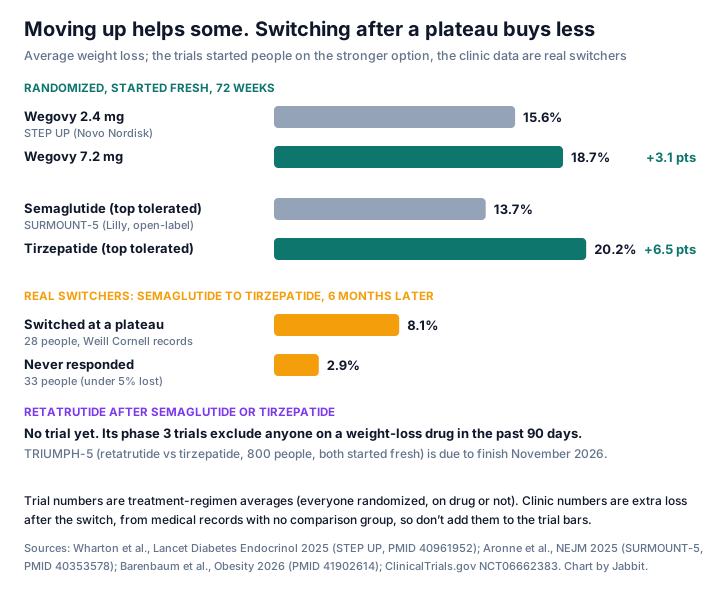
If your weight has stopped moving on a GLP-1 drug, you are in the majority. In Lilly’s analysis of the SURMOUNT-1 trial, half of people on tirzepatide had hit a plateau by 24 to 36 weeks, and 87.6% to 90.2% had by week 72.[5] Moving up helps some people. Wegovy 7.2 mg beat 2.4 mg by 3.1 points in a randomized trial, and tirzepatide beat semaglutide by 6.5 points when people started on it from day one.[13][14] Real switching is weaker. At Weill Cornell, people who moved from semaglutide to tirzepatide at a plateau lost another 8.1% in 6 months; people for whom semaglutide never worked lost 2.9%.[15] Retatrutide, the drug in this week’s headlines, has not been tested in switchers at all. All nine of its phase 3 trials exclude anyone who took a weight-loss drug in the previous 90 days.[21][1]
Why this matters now
On October 20, Medscape asked “Could Retatrutide Break a GLP-1 Weight-Loss Plateau?” Its answer was a careful “we don’t know.” Gevork Tatarian, MD, said: “A promising mechanism is not the same as a proven switching strategy.” He noted that TRIUMPH-1 “excluded patients who had taken weight-loss medications within the preceding 90 days.”[1] The article’s three outside voices are a cosmetic surgeon, the medical chief of a wellness company and a manager at a supplement maker. Medscape says none had relevant disclosures.[1] It quotes 28.3% weight loss at 80 weeks. That’s Lilly’s “efficacy estimand,” which assumes everyone stayed on the drug.[1][3] The peer-reviewed TRIUMPH-1 paper, published September 29, reports 25.0% on 12 mg versus 3.9% on placebo, counting everyone randomized.[2] On X the question is steady rather than viral: English posts pairing “plateau” or “stalled” with a GLP-1 drug name ran 3 to 14 a day last week.[22]
The short answer
- A plateau is expected. Half of people on tirzepatide had plateaued by 24 to 36 weeks, and about 9 in 10 by week 72.[5]
- It doesn’t mean the drug quit. People who stopped at a plateau regained weight; people who stayed on kept a little more off.[11][12]
- A higher dose adds a few points, with more side effects. Wegovy 7.2 mg added 3.1 points over 2.4 mg in STEP UP, and dysesthesia rose from 6.0% to 22.9%.[13]
- Switching to tirzepatide helps plateau-ers more than non-responders. 8.1% versus 2.9% more over 6 months, in 61 real switchers.[15]
- Retatrutide after a plateau is untested. Of 33 registered retatrutide intervention studies, none is built for people coming off semaglutide or tirzepatide.[21]
- The labels barely help. None of 9 US labels uses the word plateau. Only Wegovy says when to step up for more weight loss, and only Saxenda says when to quit.[20]
When does weight loss stall?
Lilly’s analysts went back to SURMOUNT-1 and defined a plateau as less than 5% weight change over 12 weeks and every 12 weeks after. By that definition, the median time to plateau was 24.3 weeks for people starting overweight, 26.0 weeks for class I obesity, and 36.1 weeks for class II and III. By week 72, 87.6% to 90.2% had plateaued. Higher doses, younger age and being female went with a later plateau.[5] Several of the authors work for Lilly.[5]
Semaglutide follows the same shape. In the SELECT heart trial, “weight loss continued over 65 weeks and was sustained for up to 4 years,” at −10.2% versus −1.5% on placebo at 208 weeks.[6] Retatrutide seems to plateau later. In its phase 2 trial, the 12 mg group was down 17.5% at 24 weeks and 24.2% at 48 weeks, still falling.[4] Lilly says people with a BMI of 35 or more in TRIUMPH-1’s extension reached 30.3% at 104 weeks.[3] But that extension took only the 532 people who finished 80 weeks and tolerated their dose, and they started heavier, at 121.7 kg against 112.7 kg for the full trial. So 28.3% to 30.3% doesn’t show the same people losing two more points.[3]
Why it stalls: mostly appetite, not a broken metabolism
The Medscape piece frames the plateau around a body that “downregulates energy expenditure.”[1] The measured data point mostly at appetite. In a 2016 study of 153 people on canagliflozin, which makes you lose calories in urine, eating rose by about 100 kcal a day for every kilogram lost. That was “more than threefold larger than the corresponding energy expenditure adaptations.”[7] Kevin Hall’s 2024 model of the plateau finds that GLP-1 drugs work by weakening that appetite feedback, which stretches out the weight loss before the plateau. Gastric bypass weakens it about twice as much as tirzepatide or semaglutide.[8] In a Lilly-funded trial, tirzepatide “appeared to have no impact on metabolic adaptation but led to increased fat oxidation” in people, though it did blunt the drop in calories burned in mice.[9] In another Lilly study, in type 2 diabetes, tirzepatide 15 mg and semaglutide 1 mg cut appetite and food intake by similar amounts, and test-lunch differences “were not sufficient to explain the different weight outcomes.”[10]
That matters for the retatrutide pitch, which leans on glucagon raising energy use. Lilly ran a phase 1 study to measure exactly that: calorie intake and energy expenditure on retatrutide under calorie restriction, in 85 people. It reached primary completion on August 26, 2025, and has no results posted on ClinicalTrials.gov.[21] Until it does, the “burns more calories” idea is a mechanism, not a measurement in people.
Is a plateau a sign the drug stopped working?
The best tests are trials that took people at or near their plateau and switched half to placebo. In STEP 4, people lost 10.6% on semaglutide in 20 weeks. Over the next 48 weeks, those who stayed on lost another 7.9%, while those switched to placebo regained 6.9%.[11] In SURMOUNT-4, people lost 20.9% on tirzepatide in 36 weeks. Then those who stayed on lost 5.5% more, and those on placebo regained 14.0%.[12] A plateau on the drug is a new set point, not a failure. Our stopping-the-drug review covers the regain data in detail.
Option 1: a higher dose
Wegovy is the only one of 9 current US GLP-1 labels that tells prescribers when to step up for more weight loss. “For patients who tolerate the 2.4 mg dosage for at least 4 weeks and additional weight reduction is clinically indicated, the dosage may be increased to a maximum dosage of 7.2 mg.” Novo sells that dose as Wegovy HD.[20] In STEP UP, 1,407 people were randomized to 7.2 mg, 2.4 mg or placebo from the start. Weight loss at 72 weeks was 18.7%, 15.6% and 3.9%, a 3.1-point gain for the higher dose.[13] The cost was side effects. Stomach side effects hit 70.8% versus 61.2%, and dysaesthesia (tingling, burning or altered skin feeling) 22.9% versus 6.0%. The label reports dysesthesia at 22%, 6% and 0.3%, and hair loss at 6%, 3% and 1%.[13][20]
Zepbound and Mounjaro stop at 15 mg. Zepbound’s label says to “consider treatment response and tolerability when selecting the maintenance dosage” of 5, 10 or 15 mg.[20] Lilly has tested higher tirzepatide doses in 414 people with type 2 diabetes and obesity. That trial reached primary completion on January 8, 2026, with no results posted yet.[21] Saxenda, the older daily drug, is the only label with a stop rule: discontinue if you haven’t lost at least 4% after 16 weeks.[20]
Option 2: switch from semaglutide to tirzepatide
Head to head, tirzepatide wins. In Lilly’s open-label SURMOUNT-5 trial, 751 people started on the highest dose they could tolerate of one drug or the other. At 72 weeks, weight loss was 20.2% on tirzepatide and 13.7% on semaglutide.[14] But that is starting fresh, not switching after a plateau. A Novo-sponsored dose model puts semaglutide 7.2 mg and tirzepatide 15 mg at a 94.8% probability of clinical equivalence in type 2 diabetes, so the higher Wegovy dose and the switch may land in a similar place.[19]
The best real-world switch data we found come from Weill Cornell’s weight clinic. Of 61 people who moved from semaglutide (1.7 mg or more a week) to tirzepatide “due to non-response or plateau,” the average extra loss after 6 months was 5.3%. It split sharply. The 28 who switched at a plateau lost 8.1%; the 33 who had never lost 5% on semaglutide lost 2.9%.[15] The same clinic found people already weight-reduced lost less on tirzepatide than people starting fresh, 7.2% versus 10.3%.[15] These are chart reviews with no comparison group. A smaller Japanese series of 15 type 2 diabetes patients who switched for poor weight loss found a 6.6 kg drop that was not statistically significant.[18] And it can go the other way: a 2026 case report describes a patient who lost under 5% on tirzepatide 15 mg over 6 months, then 20% on semaglutide.[18]
Many switches aren’t about plateaus. A UK telehealth study of 1,033,522 self-paying customers found tirzepatide-to-semaglutide switching jumped 9.26 percentage points after a tirzepatide price rise of up to 170% in September 2025. Several of its authors work for HeliosX, which runs the service.[17]
Option 3: retatrutide
Retatrutide is Lilly’s once-weekly GIP, GLP-1 and glucagon “triple agonist.” In TRIUMPH-1, 2,339 adults without diabetes lost 17.6%, 23.7% and 25.0% on 4, 9 and 12 mg at 80 weeks, versus 3.9% on placebo.[2] Every TRIUMPH participant came in off weight-loss drugs. Of the 33 registered retatrutide intervention studies we reviewed, 16 explicitly exclude recent weight-loss drugs, including all nine TRIUMPH phase 3 trials. None recruits people who are on semaglutide or tirzepatide. TRIUMPH-5, comparing retatrutide with tirzepatide in 800 people who both start fresh, is due to finish in November 2026.[21] PubMed has 3 papers that mention retatrutide with switching, transition or plateau terms, and all 3 are reviews.[22]
The side effects scale with dose. On 12 mg in TRIUMPH-1, nausea hit 42.4% versus 14.8% on placebo, vomiting 25.3% versus 4.8%, and dysesthesia 12.5% versus 0.9%. Stopping because of side effects was 11.3% versus 4.9%.[3] In the phase 2 trial, heart rate rose with dose, peaking at 24 weeks.[4] Retatrutide is not approved, and Lilly says it is “legally available only to participants in Lilly’s clinical trials.”[3] Our retatrutide page and gray-market ER review cover what happens outside trials.
Option 4: switch down to hold the weight
For some people, the plateau is the goal. Lilly’s ATTAIN-MAINTAIN trial took SURMOUNT-5 participants who had reached a weight plateau and moved them to the orforglipron pill (now sold as Foundayo) or placebo. After 52 weeks, people coming off tirzepatide kept 74.7% of their weight loss on orforglipron versus 49.2% on placebo. People coming off semaglutide kept 79.3% versus 37.6%.[16] The trial had no arm that stayed on the injection, so it can’t say how a pill compares with staying put.[16] Five more registered studies, from Pfizer, Massachusetts General, WW and others, test switching or stepping down to hold weight.[21]
What’s being studied
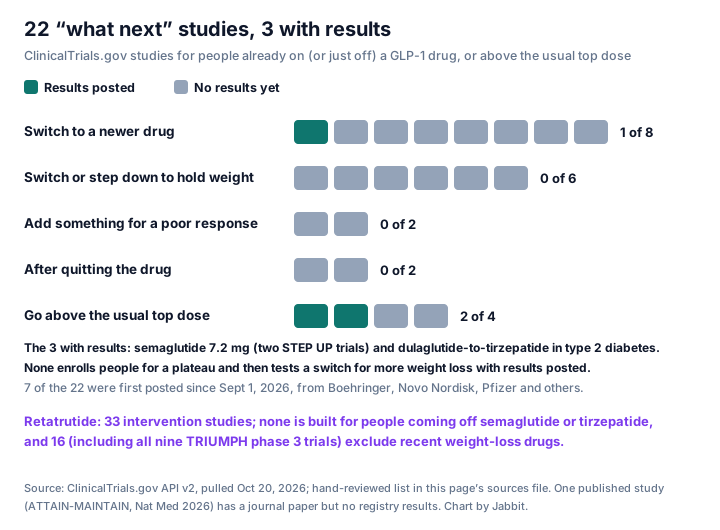
We hand-reviewed ClinicalTrials.gov for studies of people already on, or just off, a GLP-1-class drug, plus trials of doses above the usual maximum. We found 22. Only 3 have posted results: the two STEP UP trials of semaglutide 7.2 mg and SURPASS-SWITCH, which moved people with type 2 diabetes from dulaglutide to tirzepatide.[21] The pipeline is filling fast. Seven of the 22 were first posted since September 1, 2026, including Boehringer Ingelheim’s survodutide trial with a 350-person switch-plus-new-start design and two Novo Nordisk zenagamtide switch studies.[21] Amgen is moving 300 people who lost at least 10% on a weekly GLP-1 to its drug MariTide.[21] Only one study recruits people for a poor response while on the drug: 24 people in Nanjing who lost 10% or less after 12 weeks of tirzepatide, testing ear nerve stimulation. Veru’s 239-person trial is named PLATEAU, but it excludes anyone who used a GLP-1 drug in the past 12 months.[21]
| Study | Purpose | What | People | Status |
|---|---|---|---|---|
| NCT07855900 | Switch to newer drug | Survodutide: switch cohort from semaglutide or tirzepatide plus a new-start cohort; weight at 52 weeks (Boehringer Ingelheim SYNCHRONIZE-START, not randomized) | 350 | Due Jun 2028 |
| NCT07575399 | Switch to newer drug | Maridebart cafraglutide (MariTide) in people who lost at least 10% on a weekly GLP-1; weight at 68 weeks (Amgen) | 300 | Due Jan 2028 |
| NCT07855133 | Switch to newer drug | Zenagamtide after stable semaglutide; side effects primary (Novo Nordisk) | 60 | Due Sep 2028 |
| NCT07868354 | Switch to newer drug | Zenagamtide after stable tirzepatide; side effects primary (Novo Nordisk) | 60 | Due Sep 2028 |
| NCT07812597 | Switch to newer drug | Zovaglutide after titration to semaglutide 2.4 mg inside the trial; switch success primary (Beijing QL Biopharmaceutical) | 210 | Due Jan 2028 |
| NCT07073417 | Switch to newer drug | XW003 (ecnoglutide) vs semaglutide with a switch phase inside the trial; excludes recent weight-loss drugs (Sciwind) | 163 | Due Feb 2027 |
| NCT07713992 | Switch to newer drug | Mazdutide vs staying on semaglutide 1 mg in type 2 diabetes with fatty liver; liver fat primary (Tianjin) | 72 | Due Dec 2027 |
| NCT05564039 | Switch to newer drug | Tirzepatide vs raising dulaglutide in type 2 diabetes; HbA1c primary (Lilly SURPASS-SWITCH) | 282 | Results posted |
| NCT06584916 | Switch or step down to hold weight | Orforglipron pill vs placebo after tirzepatide or semaglutide in SURMOUNT-5 (Lilly ATTAIN-MAINTAIN) | 376 | Completed, no results posted |
| NCT07845500 | Switch or step down to hold weight | Monthly berobenatide vs staying on weekly semaglutide or tirzepatide (Pfizer VESPER-SWITCH) | 660 | Due Feb 2028 |
| NCT07729332 | Switch or step down to hold weight | Orforglipron vs phentermine after injectable GLP-1 drugs (Massachusetts General) | 60 | Due Jul 2031 |
| NCT07832084 | Switch or step down to hold weight | Full dose vs every-other-week taper vs phentermine-topiramate (OFF-RAMP pilot) | 60 | Due Apr 2027 |
| NCT06605703 | Switch or step down to hold weight | Step-down options after stopping semaglutide or tirzepatide (WW International) | 226 | Completed, no results posted |
| NCT07837973 | Switch or step down to hold weight | ALV-100 vs placebo for maintenance after incretin therapy (Alveus) | 220 | Due Aug 2027 |
| NCT07619989 | Add-on for poor response | Ear vagus-nerve stimulation vs sham with tirzepatide 5 mg in people who lost 10% or less after 12+ weeks (Nanjing) | 24 | Due Jun 2027 |
| NCT07446998 | Add-on for poor response | Enobosarm vs placebo with semaglutide; named PLATEAU, but excludes anyone on a GLP-1 drug in the past 12 months (Veru) | 239 | Due Oct 2027 |
| NCT07190794 | After quitting | Endoscopic sleeve gastroplasty vs lifestyle after stopping a GLP-1 drug (Boston Scientific, retrospective) | 18 | Terminated, no results |
| NCT07607587 | After quitting | Cagrilintide vs placebo in people who quit GLP-1 drugs over stomach side effects (Novo Nordisk) | 114 | Due Nov 2027 |
| NCT05646706 | Above usual top dose | Semaglutide 7.2 mg vs 2.4 mg vs placebo (Novo Nordisk STEP UP) | 1,407 | Results posted |
| NCT05649137 | Above usual top dose | Semaglutide 7.2 mg vs 2.4 mg vs placebo in type 2 diabetes (Novo Nordisk STEP UP T2D) | 512 | Results posted |
| NCT06037252 | Above usual top dose | Two investigational higher tirzepatide doses vs standard vs placebo in type 2 diabetes and obesity (Lilly) | 414 | Due Jan 2026 |
| NCT06859268 | Above usual top dose | Retatrutide dose 1 for 80 weeks, then stay, change to dose 2, or placebo (Lilly TRIUMPH-6; doses not named in the record) | 643 | Due Apr 2028 |
Strengths and limits
Strengths. The dose and drug comparisons come from large randomized trials, and the plateau-withdrawal data come from two randomized trials with placebo arms.[13][14][11][12] The label and registry reviews are direct reads of primary records.[20][21]
Limits. Nearly every trial here was funded by the drug’s maker, including the plateau-timing analysis.[5][14][13][2] The only switch-after-plateau data are chart reviews and case reports.[15][18] Our registry search can miss studies that don’t use the words we searched for.[21]
Bottom line
A plateau on Ozempic, Wegovy, Zepbound or Mounjaro is expected; half of people in Lilly’s analysis hit one by about 6 to 8 months. It usually means the drug is holding your weight, not failing.[5][11][12] If you and your prescriber want more, Wegovy 7.2 mg adds about 3 points with more side effects, and switching from semaglutide to tirzepatide looks most useful for people who plateaued rather than never responded.[13][15] Retatrutide may turn out to be the strongest option, but no one has tested it in people coming off another GLP-1, and it isn’t approved.[21][3]
Whatever you try, decide on data, not on two bad weigh-ins. Note the date and dose of each shot, your weight, your appetite and any side effects for 12 weeks. Jabbit keeps that private, dated log on your iPhone, so “I think I’ve stalled” becomes a chart you can show your prescriber.
Frequently asked questions
- Why did I stop losing weight on Ozempic, Wegovy, Zepbound or Mounjaro?
- Almost everyone does. In Lilly’s SURMOUNT-1 trial, half of people on tirzepatide had plateaued by 24 to 36 weeks, depending on starting weight, and about 9 in 10 had by week 72. The main brake is appetite, not metabolism: as you lose weight, the urge to eat rises by roughly 100 calories a day for every kilogram lost, more than three times the drop in calories burned. The drugs weaken that pushback but don’t remove it.
- Does a plateau mean the drug stopped working?
- No. When people who had plateaued were switched to placebo in randomized trials, they regained weight: +6.9% after Wegovy was stopped and +14.0% after Zepbound was stopped, while those who stayed on the drug kept losing a little. A plateau usually means the drug is holding your weight at a new, lower level.
- Will a higher dose break a plateau?
- It can add a few points. Wegovy’s label now allows 7.2 mg if you’ve tolerated 2.4 mg for 4 weeks and more weight loss is clinically indicated. In the STEP UP trial, 7.2 mg gave 18.7% weight loss versus 15.6% on 2.4 mg, but tingling or altered skin sensation hit 22.9% versus 6.0%. Zepbound and Mounjaro top out at 15 mg; Lilly’s trial of higher tirzepatide doses has no posted results.
- Should I switch from Ozempic or Wegovy to Zepbound or Mounjaro?
- It may help if you plateaued rather than never responded. Started fresh in the SURMOUNT-5 trial, tirzepatide beat semaglutide by 6.5 points. In Weill Cornell records, people who switched at a plateau lost another 8.1% over 6 months, but people for whom semaglutide never worked lost 2.9%. Those are 61 patients with no comparison group, so treat them as a hint, not a promise.
- Can retatrutide break a GLP-1 plateau?
- Nobody knows yet. Retatrutide is not approved, and Lilly says it is legally available only in its trials. All nine of its phase 3 TRIUMPH trials exclude people who used a weight-loss drug in the previous 90 days, so its headline numbers (25.0% weight loss counting everyone, 28.3% if everyone stayed on the drug) come from people starting fresh. None of the 33 registered retatrutide studies is built for people coming off semaglutide or tirzepatide.
- Is it safe to buy retatrutide online to get past a plateau?
- It isn’t legal or tested for that. Lilly says retatrutide is available only to people in its clinical trials, so anything sold online is unapproved and of unknown content. Even in Lilly’s trial, the 12 mg dose caused nausea in 42.4% of people and made 11.3% stop because of side effects, versus 4.9% on placebo.
- How do I know if it’s a real plateau?
- Researchers in the SURMOUNT plateau analysis defined it as less than 5% weight change over 12 weeks and every 12 weeks after. Week-to-week bumps are normal. A dated log of weight, dose and side effects over at least 12 weeks gives you and your prescriber something concrete to decide on.
References
- Peck J. “Could Retatrutide Break a GLP-1 Weight-Loss Plateau?” Medscape Medical News, October 20, 2026 (quotes Gevork Tatarian, MD, “a cosmetic surgeon and founder of Elevé Cosmetic Surgery”: “A promising mechanism is not the same as a proven switching strategy” and “TRIUMPH-1 excluded patients who had taken weight-loss medications within the preceding 90 days”; James Chao, MD, “co-founder and chief medical officer of VedaNu Wellness”: “whether it can help break through a plateau, we just don’t know”; Vishal Dubey, MPharm, of “India-based supplement company Nutricult”; cites “average weight loss of 28.3% of body weight at 80 weeks”; “The experts cited in this article had no relevant disclosures”). https://www.medscape.com/viewarticle/could-retatrutide-break-glp-1-weight-loss-plateau-2026a10013ek. Checked October 20, 2026.
- Jastreboff AM, Kaplan LM, Davies MJ, et al. Retatrutide, a triple hormone receptor agonist, for treatment of obesity. N Engl J Med. Published online September 29, 2026. doi:10.1056/NEJMoa2604169. PMID 42814954 (TRIUMPH-1; 2,339 randomized; weight change at 80 weeks −17.6%, −23.7% and −25.0% with 4, 9 and 12 mg vs −3.9% with placebo, counting everyone randomized; “The most common adverse events were gastrointestinal”; funded by Eli Lilly). https://pubmed.ncbi.nlm.nih.gov/42814954/. Checked October 20, 2026.
- Eli Lilly and Company. “Lilly’s triple agonist, retatrutide, delivered powerful weight loss in pivotal Phase 3 obesity trial.” News release, May 21, 2026 (efficacy estimand, which assumes everyone stayed on the drug: −28.3% at 80 weeks on 12 mg vs −2.2% on placebo, from 112.7 kg average; pre-specified extension of 532 participants with BMI 35 or more who “completed the main 80-week study and tolerated their assigned dose,” average baseline 121.7 kg: −30.3% at 104 weeks; nausea 42.4% vs 14.8%, vomiting 25.3% vs 4.8%, dysesthesia 12.5% vs 0.9%, stopping for adverse events 11.3% vs 4.9% on 12 mg vs placebo; “Retatrutide is an investigational molecule that is legally available only to participants in Lilly’s clinical trials”). https://investor.lilly.com/news-releases/news-release-details/lillys-triple-agonist-retatrutide-delivered-powerful-weight-loss. Checked October 20, 2026.
- Jastreboff AM, Kaplan LM, Frías JP, et al. Triple-hormone-receptor agonist retatrutide for obesity — a phase 2 trial. N Engl J Med. 2023;389(6):514-526. PMID 37366315 (12 mg: −17.5% at 24 weeks, −24.2% at 48 weeks; “Dose-dependent increases in heart rate peaked at 24 weeks and declined thereafter”; funded by Eli Lilly). https://pubmed.ncbi.nlm.nih.gov/37366315/. Checked October 20, 2026.
- Horn DB, Kahan S, Batterham RL, et al. Time to weight plateau with tirzepatide treatment in the SURMOUNT-1 and SURMOUNT-4 clinical trials. Clin Obes. 2025;15(3):e12734. PMID 39800653 (plateau defined as “a weight change <5% over a 12-week interval and all subsequent 12-week intervals”; 1,438 SURMOUNT-1 participants; median time to plateau 24.3, 26.0, 36.1 and 36.1 weeks from overweight to class III obesity; 87.6% to 90.2% plateaued by week 72; higher doses, younger age and female sex plateaued later; several authors are Eli Lilly employees and shareholders). https://pubmed.ncbi.nlm.nih.gov/39800653/. Checked October 20, 2026.
- Ryan DH, Lingvay I, Deanfield J, et al. Long-term weight loss effects of semaglutide in obesity without diabetes in the SELECT trial. Nat Med. 2024;30(7):2049-2057. PMID 38740993 (“weight loss continued over 65 weeks and was sustained for up to 4 years”; −10.2% vs −1.5% at 208 weeks). https://pubmed.ncbi.nlm.nih.gov/38740993/. Checked October 20, 2026.
- Polidori D, Sanghvi A, Seeley RJ, Hall KD. How strongly does appetite counter weight loss? Quantification of the feedback control of human energy intake. Obesity (Silver Spring). 2016;24(11):2289-2295. PMID 27804272 (153 patients on canagliflozin; eating rose by about 100 kcal/day per kilogram lost, “more than threefold larger than the corresponding energy expenditure adaptations”). https://pubmed.ncbi.nlm.nih.gov/27804272/. Checked October 20, 2026.
- Hall KD. Physiology of the weight-loss plateau in response to diet restriction, GLP-1 receptor agonism, and bariatric surgery. Obesity (Silver Spring). 2024;32(6):1163-1168. PMID 38644683 (mathematical model; GLP-1 drugs and surgery “substantially weakened the appetite feedback control circuit, resulting in an extended period of weight loss prior to the plateau”; gastric bypass effect about double that of tirzepatide and semaglutide; “The author declares no conflict of interest”). https://pubmed.ncbi.nlm.nih.gov/38644683/. Checked October 20, 2026.
- Ravussin E, Sanchez-Delgado G, Martin CK, et al. Tirzepatide did not impact metabolic adaptation in people with obesity, but increased fat oxidation. Cell Metab. 2025;37(5):1060-1074. PMID 40203836 (“In the clinical trial, tirzepatide appeared to have no impact on metabolic adaptation but led to increased fat oxidation”; in calorie-restricted mice it reduced the drop in energy expenditure; NCT04081337; several authors are Eli Lilly employees and shareholders). https://pubmed.ncbi.nlm.nih.gov/40203836/. Checked October 20, 2026.
- Heise T, DeVries JH, Urva S, et al. Tirzepatide reduces appetite, energy intake, and fat mass in people with type 2 diabetes. Diabetes Care. 2023;46(5):998-1004. PMID 36857477 (tirzepatide 15 mg, 45 people, vs semaglutide 1 mg, 44; most authors from Eli Lilly; “Appetite scores and energy intake reductions did not differ between tirzepatide and semaglutide”; lunch-intake differences “were not sufficient to explain the different weight outcomes”). https://pubmed.ncbi.nlm.nih.gov/36857477/. Checked October 20, 2026.
- Rubino D, Abrahamsson N, Davies M, et al. Effect of continued weekly subcutaneous semaglutide vs placebo on weight loss maintenance in adults with overweight or obesity: the STEP 4 randomized clinical trial. JAMA. 2021;325(14):1414-1425. PMID 33755728 (−10.6% during a 20-week run-in; weeks 20 to 68: −7.9% on semaglutide vs +6.9% after switching to placebo). https://pubmed.ncbi.nlm.nih.gov/33755728/. Checked October 20, 2026.
- Aronne LJ, Sattar N, Horn DB, et al. Continued treatment with tirzepatide for maintenance of weight reduction in adults with obesity: the SURMOUNT-4 randomized clinical trial. JAMA. 2024;331(1):38-48. PMID 38078870 (−20.9% in a 36-week lead-in; then −5.5% on tirzepatide vs +14.0% on placebo; week 0 to 88: −25.3% vs −9.9%). https://pubmed.ncbi.nlm.nih.gov/38078870/. Checked October 20, 2026.
- Wharton S, Freitas P, Hjelmesæth J, et al. Once-weekly semaglutide 7·2 mg in adults with obesity (STEP UP): a randomised, controlled, phase 3b trial. Lancet Diabetes Endocrinol. 2025;13(11):949-963. PMID 40961952 (1,407 randomized; 72 weeks; −18.7% on 7.2 mg vs −15.6% on 2.4 mg, difference −3.1 points, vs −3.9% on placebo; gastrointestinal adverse events 70.8% vs 61.2% vs 42.8%; dysaesthesia 22.9% vs 6.0% vs 0.5%; funded by Novo Nordisk). https://pubmed.ncbi.nlm.nih.gov/40961952/. Checked October 20, 2026.
- Aronne LJ, Horn DB, le Roux CW, et al. Tirzepatide as compared with semaglutide for the treatment of obesity. N Engl J Med. 2025;393(1):26-36. PMID 40353578 (SURMOUNT-5; open-label; 751 randomized; maximum tolerated doses; −20.2% with tirzepatide vs −13.7% with semaglutide at 72 weeks; funded by Eli Lilly). https://pubmed.ncbi.nlm.nih.gov/40353578/. Checked October 20, 2026.
- Barenbaum SR, Gonzalez A, Verzani Z, Zhao AS, Shukla AP. Real-world weight-loss outcomes in weight-reduced patients treated with tirzepatide. Obesity (Silver Spring). 2026;34 Suppl 1:97-101. PMID 41902614 (Weill Cornell records; 293 of 941 charts included; 61 people who switched from semaglutide of at least 1.7 mg weekly “due to non-response or plateau” lost 5.3% at 6 months; plateau switchers (28) 8.1% vs non-responders (33) 2.9%; weight-reduced patients (133) lost 7.2% vs 10.3% (160); no disclosures listed in the PubMed record). https://pubmed.ncbi.nlm.nih.gov/41902614/. Checked October 20, 2026.
- Aronne LJ, Horn DB, le Roux CW, et al. Orforglipron for maintenance of body weight reduction: the double-blind, randomized phase 3b ATTAIN-MAINTAIN trial. Nat Med. 2026;32(7):2679-2687. PMID 42120723 (SURMOUNT-5 participants who reached a weight plateau: from tirzepatide (205) kept 74.7% of their weight reduction on orforglipron vs 49.2% on placebo at week 52; from semaglutide (171) 79.3% vs 37.6%; the authors note the “absence of a comparator arm involving continued use of injectable obesity-management medications”; Eli Lilly authors). https://pubmed.ncbi.nlm.nih.gov/42120723/. Checked October 20, 2026.
- Dix S, Mulligan A, Ficarelli M, et al. Real-world treatment patterns and weight outcomes before and after a tirzepatide price increase in over one million self-paying UK adults with overweight or obesity. Diabetes Obes Metab. Published online October 14, 2026. PMID 42875827 (1,033,522 adults at the MedExpress telehealth service; after a September 2025 tirzepatide list-price increase “of up to 170%,” tirzepatide-to-semaglutide switching rose 9.26 percentage points; 12-month weight loss 19.93% on tirzepatide (30,763 people with follow-up) vs 16.40% on semaglutide (979); several authors are from HeliosX, which runs MedExpress). https://pubmed.ncbi.nlm.nih.gov/42875827/. Checked October 20, 2026.
- La Vignera S, Condorelli RA. Tirzepatide non-response with subsequent semaglutide response in class 2 obesity. JCEM Case Rep. 2026;4(9):luag245. PMID 42670558 (under 5% loss on tirzepatide 15 mg over 6 months, then 20% over 6 months on semaglutide). https://pubmed.ncbi.nlm.nih.gov/42670558/; Kurinami N, et al. Early dose escalation of tirzepatide after switching from semaglutide in type 2 diabetes mellitus. Endocrinol Metab (Seoul). 2025;40(6):1012-1015. PMID 41088952 (15 patients switched for inadequate weight loss; −6.6 ± 5.4 kg, P=0.07, not significant). https://pubmed.ncbi.nlm.nih.gov/41088952/. Checked October 20, 2026.
- Builes-Montaño CE, Suarez-Rodriguez AF, Alzate-Vinasco MA. Dose-response and clinical equivalence of semaglutide and tirzepatide for weight loss in type 2 diabetes: a model-based meta-analysis. Diabetes Ther. 2026;17(7):1067-1083. PMID 42252377 (probability of clinical equivalence, semaglutide 7.2 mg vs tirzepatide 15 mg, 94.8%; “Novo Nordisk, the sponsor of the research project”). https://pubmed.ncbi.nlm.nih.gov/42252377/. Checked October 20, 2026.
- Jabbit scan of 9 current US prescribing labels on DailyMed: Wegovy (v19, https://dailymed.nlm.nih.gov/dailymed/drugInfo.cfm?setid=ee06186f-2aa3-4990-a760-757579d8f77b), Zepbound (v40, https://dailymed.nlm.nih.gov/dailymed/drugInfo.cfm?setid=487cd7e7-434c-4925-99fa-aa80b1cc776b), Saxenda (v22, https://dailymed.nlm.nih.gov/dailymed/drugInfo.cfm?setid=3946d389-0926-4f77-a708-0acb8153b143), Ozempic (v20), Mounjaro (v40), Rybelsus (v14), Victoza (v31), Trulicity (v62) and Foundayo (v10). None uses the word plateau. Wegovy: “For patients who tolerate the 2.4 mg dosage for at least 4 weeks and additional weight reduction is clinically indicated, the dosage may be increased to a maximum dosage of 7.2 mg” (sold as WEGOVY HD); dysesthesia 22% on 7.2 mg vs 6% on 2.4 mg vs 0.3% on placebo; nausea 39% vs 35% vs 13%, vomiting 22% vs 16% vs 6%, hair loss 6% vs 3% vs 1%. Zepbound: “Consider treatment response and tolerability when selecting the maintenance dosage”; maintenance 5, 10 or 15 mg; maximum 15 mg. Saxenda: “discontinue SAXENDA if the patient has not lost at least 4% of baseline body weight” after 16 weeks, the only label with a stop rule. Details: https://jabbitapp.com/research/sources/glp1-plateau-switch-ctgov-labels-2026-10-20.json. Checked October 20, 2026.
- Jabbit review of ClinicalTrials.gov (API v2), pulled October 20, 2026, 2:06 PM ET: obesity, overweight or weight-management conditions crossed with incretin drug and brand names and switch, plateau, inadequate response, higher dose or add-on terms (218 records; 351 with a free-text pull). Hand review found 22 studies for people already on or just off a GLP-1-class drug, or testing doses above the usual top dose; 3 have posted results (NCT05646706, NCT05649137, NCT05564039); 7 were first posted on or after September 1, 2026. Separately, all 34 retatrutide or LY3437943 records (33 interventional, 1 expanded access): 16 explicitly exclude recent weight-loss drugs, including all nine TRIUMPH phase 3 trials, and none is built for people coming off semaglutide or tirzepatide. Lilly’s phase 1 calorie-intake and energy-expenditure study NCT06313528 (85 people, primary completion August 26, 2025) has no posted results. Full list: https://jabbitapp.com/research/sources/glp1-plateau-switch-ctgov-labels-2026-10-20.json. Checked October 20, 2026.
- Jabbit count of posts on X via the recent-counts endpoint (English, no reposts), UTC days: posts pairing plateau, plateaued, stall or stalled with a GLP-1 drug name ran 4, 8, 14, 9, 3 and 8 a day, October 14-19, 2026, and 7 on October 20 through 2:01 PM ET (53 total). We found no posts sharing the Medscape article. PubMed: retatrutide with switch, transition, plateau or prior GLP-1 terms in title or abstract returns 3 records, all reviews. Queries: https://jabbitapp.com/research/sources/glp1-plateau-switch-ctgov-labels-2026-10-20.json. Checked October 20, 2026.
This page analyzes published trials, plateau analyses, press releases, drug labels, registry records and posts on X. It is not medical advice and not a dosing guide. It does not recommend any drug, dose or product. Retatrutide is not approved and is legally available only in clinical trials. Don’t start, stop, switch or change the dose of any of these drugs without your prescriber. The label, registry, PubMed and X reviews are Jabbit’s own; their inputs are cited above.