Evidence teardown · Retatrutide · Ozempic · Semaglutide · Type 2 diabetes · Healthy aging · Updated October 28, 2026
Published · Updated
Is retatrutide better than Ozempic? In Lilly’s first head-to-head trial, announced October 28, 2026, adults with type 2 diabetes lost about 20% of their weight over 80 weeks on retatrutide vs 9.4% on Ozempic’s top dose, and A1C fell 2.2 vs 1.8 points. These are company topline numbers, not yet peer reviewed, and retatrutide is not approved.
The question most people ask about Eli Lilly’s triple-hormone shot is simple: is it better than Ozempic? On October 28, 2026, Lilly announced the first trial to test that directly. Our plain answer: on Lilly’s numbers, retatrutide roughly doubled the weight loss of Ozempic 2 mg, the highest approved dose, and lowered A1C a bit more, with somewhat more people stopping because of side effects. But this is a company press release, not a published paper, it reports only the most flattering of the standard ways to count results, and it says nothing yet about hypoglycemia, serious side effects, heart outcomes or eyes. Retatrutide is not approved anywhere.[1]
Why this matters now
Lilly released the topline results of TRANSCEND-T2D-2 at 6:45 a.m. ET on October 28, calling it “the first Phase 3 trial comparing retatrutide with another incretin medicine.”[1] Business Insider noted the results came out as Lilly prepares to report quarterly earnings on Thursday, October 29.[14] Lilly has said it plans to submit retatrutide to FDA in the first quarter of 2027.[9] Ozempic is the drug many readers already take, so this is the comparison that matters most for them, and it is likely to be quoted widely before any peer-reviewed paper exists.
Timeline
| Date | Event |
|---|---|
| 2021 | SURPASS-2 finds Lilly’s tirzepatide (Mounjaro) beat semaglutide 1 mg on A1C and weight.[5] SUSTAIN FORTE supports the 2 mg Ozempic dose.[4] |
| 2023 | Retatrutide’s phase 2 diabetes trial beats dulaglutide (Trulicity) on A1C in two of its higher-dose groups.[6] |
| Feb 2024 | TRANSCEND-T2D-2 starts; open label, sponsored by Lilly.[2] |
| Aug 27, 2026 | The trial reaches primary completion.[2] |
| Oct 28, 2026 | Lilly announces topline results.[1] |
| Oct 2026 (est.) | TRANSCEND-T2D-3, retatrutide vs placebo in type 2 diabetes with moderate or severe kidney impairment, is due for primary completion, per its registry record.[11] |
| Nov 2026 (est.) | TRIUMPH-5, retatrutide vs tirzepatide, is due for primary completion, per its registry record.[10] |
| Q1 2027 | Lilly’s planned FDA submission.[9] |
| Feb 2029 (est.) | TRIUMPH-Outcomes, the heart and kidney outcomes trial, is due for primary completion.[12] |
What the trial tested
- Who. 1,298 adults with type 2 diabetes not controlled on metformin, with or without an SGLT2 inhibitor, and an A1C of 7.0% to 10.5%. Average A1C at the start was 8.3%, weight 102.4 kg (225.8 lb) and BMI 36.8.[1]
- Arms. Weekly retatrutide at one of two trial doses (9 or 12 mg) or Ozempic 2 mg, randomized 2:2:1, so roughly 260 people got Ozempic (Jabbit arithmetic).[1]
- Design. Open label: participants and doctors knew which drug was given.[2][1]
- Main question. Whether retatrutide 12 mg was at least as good as Ozempic 2 mg at lowering A1C after 80 weeks (a noninferiority test). Weight was a key secondary endpoint.[1]
What Lilly reported
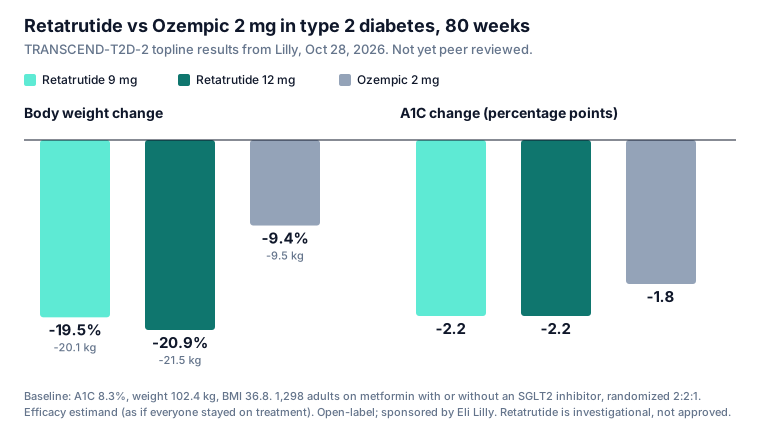
- Weight: −19.5% (−20.1 kg, −44.3 lb) on 9 mg and −20.9% (−21.5 kg, −47.4 lb) on 12 mg, vs −9.4% (−9.5 kg, −20.9 lb) on Ozempic.[1] That is 10.1 to 11.5 percentage points more, or about 10.6 to 12.0 kg (Jabbit arithmetic from the rounded figures).
- A1C: −2.2 points on both doses vs −1.8 on Ozempic, from 8.3%. On average, that would take A1C to about 6.1% vs 6.5% (Jabbit arithmetic).[1]
- Statistics. Lilly says all comparisons were controlled for multiple testing except the 9 mg dose’s A1C superiority over Ozempic and a systolic blood pressure comparison, which showed only “nominal statistical significance,” meaning they were not protected by that control.[1]
- Heart risk factors. Lilly says retatrutide improved non-HDL cholesterol, triglycerides and systolic blood pressure more than Ozempic, but gave no numbers.[1]
Side effects
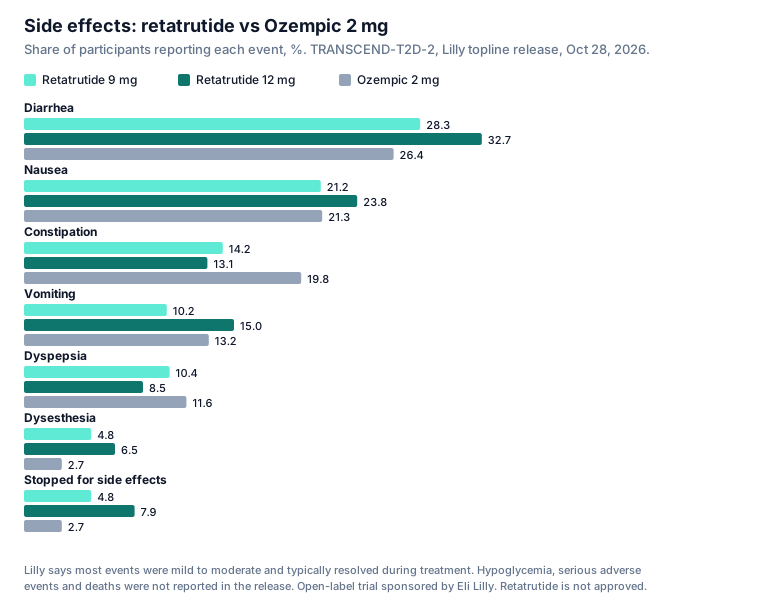
- Stomach side effects were broadly similar. Diarrhea was a little more common on retatrutide (28.3% and 32.7% vs 26.4%) and constipation more common on Ozempic (19.8% vs 14.2% and 13.1%). Lilly says most were mild to moderate and typically resolved during treatment.[1]
- Dysesthesia, an abnormal or burning skin sensation, was reported by 4.8% and 6.5% on retatrutide vs 2.7% on Ozempic.[1][14] The same signal appeared against placebo in TRIUMPH-2 and the sleep apnea trials.[8][13]
- Stopping because of side effects: 4.8% and 7.9% on retatrutide vs 2.7% on Ozempic, so the 12 mg rate was nearly three times higher (Jabbit arithmetic).[1]
- Not in the release: hypoglycemia, serious adverse events, deaths, heart rate, pancreatitis and gallbladder events, and eye findings. Earlier retatrutide trials reported a heart-rate rise of 5 to 7 beats per minute.[1][13]
How it compares with earlier head-to-heads
In SURPASS-2, Lilly’s tirzepatide 15 mg beat semaglutide 1 mg by 0.45 A1C points and 5.5 kg over 40 weeks.[5] In TRANSCEND-T2D-2, retatrutide beat semaglutide 2 mg by about 0.4 points and about 11 to 12 kg over 80 weeks.[1] Jabbit’s analysis: on blood sugar, the margin over semaglutide looks similar to tirzepatide’s; on weight, it looks roughly twice as large. But the trials differ in length, comparator dose and statistical method, so this does not rank retatrutide against tirzepatide. TRIUMPH-5, a double-blind trial testing those two drugs directly, is due for primary completion around November 2026, per its registry record.[10]
Ozempic itself did about what its earlier trials predict. In SUSTAIN FORTE, the 2 mg dose lowered A1C by 2.1 to 2.2 points from 8.9% over 40 weeks, with 6.4 to 6.9 kg of weight loss.[4][3] Here it lowered A1C 1.8 points from a lower start of 8.3% and weight by 9.5 kg over 80 weeks.[1] Our read: people who start with a lower A1C generally have less room to fall, so the comparator does not look handicapped, though the analysis methods differ.
What a careful reader should notice
- It’s a press release. Lilly says detailed results will come at a medical meeting and in a peer-reviewed journal.[1] Until then, nobody outside the company can check the analysis.
- The flattering estimand only. Every number is the “efficacy estimand,” which estimates results “had all randomized participants remained on study intervention.”[1] Lilly’s published retatrutide papers lead with the treatment-regimen estimand, which counts everyone who was randomized, including those who stopped.[7][8] In TRIUMPH-2, Lilly’s release figure for the 12 mg dose was 20.8%; the Lancet paper’s treatment-regimen figure was 18.8%.[1][8] More people stopped retatrutide for side effects here, so the treatment-regimen gap could be somewhat smaller than these numbers suggest.
- Open label. A1C and weight are measured objectively, but knowing your drug can affect how side effects are reported and who drops out.[2]
- Registered outcomes not yet reported. The trial registry lists the share of people reaching an A1C of 6.5% or less, and below 5.7% (the non-diabetic range), plus weight-loss thresholds. None appear in the release.[2][1]
- Lilly ran it. The trial is sponsored by Lilly, which also makes the competing drug Mounjaro.[2][1] Lilly also funded SURPASS-2, and Novo Nordisk, Ozempic’s maker, funded SUSTAIN FORTE.[5][4] Industry funding is normal for drug trials and does not make results wrong, but independent replication adds weight.
The longevity question
For healthy aging, A1C and weight are stand-ins; what matters is heart attacks, strokes, kidney failure and death. Here the drugs are not on equal footing. Ozempic’s label already includes reducing major cardiovascular events in people with type 2 diabetes and heart disease, and reducing kidney decline and cardiovascular death in people with type 2 diabetes and chronic kidney disease.[3] Retatrutide has no outcomes data yet. Its heart and kidney outcomes trial, about 10,000 people, is not due to finish until 2029, per its registry record.[12] Our read: bigger weight loss and better risk factors make a benefit plausible, but it is unproven. One more thing to watch: the Ozempic label warns that rapid improvement in blood sugar “has been associated with a temporary worsening of diabetic retinopathy,” and the release gives no eye data for either drug.[3][1]
Can you switch from Ozempic to retatrutide?
Not legally outside a clinical trial. Lilly says retatrutide “has not been approved by FDA or any regulatory organization anywhere in the world” and that “anyone purporting to sell retatrutide to consumers is breaking the law.”[1] If Ozempic is not doing enough, approved options and dose changes are a conversation for your prescriber, and ClinicalTrials.gov lists retatrutide trials.[2]
FAQ
- Is retatrutide better than Ozempic?
- In Lilly’s TRANSCEND-T2D-2 trial, announced October 28, 2026, retatrutide produced about twice the weight loss of Ozempic 2 mg over 80 weeks and slightly more A1C lowering in adults with type 2 diabetes. These are company topline results, not yet peer reviewed, and there are no heart or kidney outcomes data for retatrutide yet.
- How much weight did people lose on retatrutide vs Ozempic?
- On average, 19.5% (about 44 lb) on retatrutide 9 mg and 20.9% (about 47 lb) on 12 mg, vs 9.4% (about 21 lb) on Ozempic 2 mg, from a starting weight of about 226 lb. Lilly’s figures assume everyone stayed on treatment.
- Does retatrutide have more side effects than Ozempic?
- Stomach side effects were broadly similar, with a little more diarrhea on retatrutide and more constipation on Ozempic. Abnormal skin sensations (dysesthesia) were more common on retatrutide, and more people stopped retatrutide because of side effects: 4.8% and 7.9% vs 2.7%.
- Has TRANSCEND-T2D-2 been published?
- Not yet. As of October 28, 2026, the results are in a Lilly press release. Lilly says full results will be presented at a medical meeting and published in a peer-reviewed journal.
- Can I switch from Ozempic to retatrutide?
- Not legally outside a clinical trial. Retatrutide is not approved anywhere, and Lilly says anyone selling it to consumers is breaking the law. Talk to your prescriber about approved options.
- When could retatrutide be approved?
- Lilly has said it plans to submit retatrutide to FDA in the first quarter of 2027. Any approval would depend on FDA’s review, and no approval date has been announced.
Bottom line
On Lilly’s topline numbers, retatrutide beat Ozempic’s highest dose clearly on weight and modestly on A1C in type 2 diabetes, with more people stopping for side effects and a skin-sensation signal seen across the program.[1][8][13] The full paper, the treatment-regimen numbers, hypoglycemia and serious-event data, and eventually heart and kidney outcomes will decide how much that matters. Ozempic remains the drug with proven outcome benefits; retatrutide remains investigational.[3][12]
References
- Eli Lilly and Company. “Lilly’s retatrutide delivered greater A1C reduction and more than double the weight loss of Ozempic’s highest approved dose in head-to-head trial.” PR Newswire, October 28, 2026, 6:45 a.m. ET. Topline results, efficacy estimand, not peer reviewed. Company statements: TRANSCEND-T2D-2 is “a Phase 3, randomized, open-label trial comparing once-weekly retatrutide (9 mg and 12 mg) with once-weekly Ozempic 2 mg in 1,298 adults with type 2 diabetes inadequately controlled with metformin, with or without an SGLT2 inhibitor,” randomized 2:2:1; “The primary objective was to demonstrate that retatrutide 12 mg is noninferior to Ozempic 2 mg in A1C reduction at 80 weeks.” Results table: A1C “from avg. baseline of 8.3%” −2.2%, −2.2% vs −1.8%; weight “from avg. baseline of 102.4 kg” −19.5% (−20.1 kg), −20.9% (−21.5 kg) vs −9.4% (−9.5 kg). Adverse events (9 mg, 12 mg vs Ozempic): “diarrhea (28.3%, 32.7% vs. 26.4%), nausea (21.2%, 23.8% vs. 21.3%), constipation (14.2%, 13.1% vs. 19.8%), vomiting (10.2%, 15.0% vs. 13.2%) and dyspepsia (10.4%, 8.5% vs. 11.6%)”; dysesthesia “4.8%, 6.5% vs. 2.7%”; “Treatment discontinuation rates due to adverse events were 4.8%, 7.9% vs. 2.7%.” Statistics: comparisons were controlled for family-wise error “except superiority of retatrutide 9 mg vs. Ozempic 2 mg in change in A1C and in systolic blood pressure, which were prespecified secondary endpoints and showed nominal statistical significance.” “All data included in this press release are for the efficacy estimand. The efficacy estimand represents efficacy had all randomized participants remained on study intervention (with possible dose interruptions and modifications) for 80 weeks without initiating additional antihyperglycemic medication (>14 days of use).” “Detailed results from TRANSCEND-T2D-2 will be presented at a future medical meeting and published in a peer-reviewed journal.” Also: Ozempic 2 mg was chosen “because it is the highest approved dose”; TRIUMPH-5 vs tirzepatide is “ongoing”; “In TRIUMPH-2, people with type 2 diabetes and obesity taking the highest dose lost an average of 49.6 lbs (20.8%)”; “Anyone purporting to sell retatrutide to consumers is breaking the law.” Kenneth Custer, Ph.D., Lilly: “we believe retatrutide, if approved, could shift the treatment paradigm for people living with type 2 diabetes, obesity and related cardiometabolic conditions.” https://www.prnewswire.com/news-releases/lillys-retatrutide-delivered-greater-a1c-reduction-and-more-than-double-the-weight-loss-of-ozempics-highest-approved-dose-in-head-to-head-trial-302921328.html. Checked October 28, 2026.
- ClinicalTrials.gov record NCT06260722 (TRANSCEND-T2D-2), API v2, read October 28, 2026: “Effect of Retatrutide Compared With Semaglutide in Adult Participants With Type 2 Diabetes and Inadequate Glycemic Control With Metformin With or Without SGLT2 Inhibitor”; sponsor Eli Lilly and Company; masking: none (open label); status Active, not recruiting; primary completion August 27, 2026 (actual); study completion February 2027 (estimated); primary outcome change in HbA1c; registered secondary outcomes include the share reaching “HbA1c ≤ 6.5%” and “HbA1c < 5.7%,” weight-loss thresholds, triglycerides, non-HDL cholesterol and systolic blood pressure. https://clinicaltrials.gov/study/NCT06260722. Checked October 28, 2026.
- Ozempic (semaglutide) injection US prescribing information, Novo Nordisk, DailyMed set adec4fd2-6858-4c99-91d4-531f5f2a2d79, version effective June 1, 2026 (read via openFDA). Indications include reducing “the risk of major adverse cardiovascular events (cardiovascular death, non-fatal myocardial infarction or non-fatal stroke) in adults with type 2 diabetes mellitus and established cardiovascular disease” and “the risk of sustained eGFR decline, end-stage kidney disease, and cardiovascular death in adults with type 2 diabetes mellitus and chronic kidney disease.” 2 mg is the highest labeled strength. SUSTAIN FORTE results in the label (Ozempic 1 mg vs 2 mg, 40 weeks): HbA1c “Change at week 40” −1.9 vs −2.1; “The mean changes from baseline to week 40 were -5.6 kg and -6.4 kg in the OZEMPIC 1 mg and OZEMPIC 2 mg” groups. Section 5.3: “more events of diabetic retinopathy complications occurred in patients treated with OZEMPIC (3.0%) compared to placebo (1.8%)”; “Rapid improvement in glucose control has been associated with a temporary worsening of diabetic retinopathy.” https://dailymed.nlm.nih.gov/dailymed/drugInfo.cfm?setid=adec4fd2-6858-4c99-91d4-531f5f2a2d79. Checked October 28, 2026.
- Frías JP, Auerbach P, Bajaj HS, et al. Efficacy and safety of once-weekly semaglutide 2·0 mg versus 1·0 mg in patients with type 2 diabetes (SUSTAIN FORTE): a double-blind, randomised, phase 3B trial. Lancet Diabetes Endocrinol. 2021;9(9):563-574. PMID 34293304. SUSTAIN FORTE, double-blind, 961 adults, 40 weeks. Abstract: “Mean baseline HbA1c was 8·9%”; HbA1c “-2·2 percentage points with semaglutide 2·0 mg and -1·9 percentage points with semaglutide 1·0 mg” (trial product estimand) and “-2·1 … and -1·9” (treatment policy estimand); bodyweight “-6·9 kg with semaglutide 2·0 mg” (trial product) and “-6·4 kg” (treatment policy). Funding: “Novo Nordisk.” Abstract read. https://pubmed.ncbi.nlm.nih.gov/34293304/. Checked October 28, 2026.
- Frías JP, Davies MJ, Rosenstock J, et al. Tirzepatide versus Semaglutide Once Weekly in Patients with Type 2 Diabetes. N Engl J Med. 2021;385(6):503-515. PMID 34170647. SURPASS-2, tirzepatide vs semaglutide 1 mg. Abstract: “In an open-label, 40-week, phase 3 trial, we randomly assigned 1879 patients”; baseline HbA1c 8.28%; A1C difference for 15 mg vs semaglutide “-0.45 percentage points (95% CI, -0.57 to -0.32; P<0.001)”; weight differences “-1.9 kg, -3.6 kg, and -5.5 kg.” “(Funded by Eli Lilly; SURPASS-2 ClinicalTrials.gov number, NCT03987919.)” Abstract read. https://pubmed.ncbi.nlm.nih.gov/34170647/. Checked October 28, 2026.
- Rosenstock J, Frias J, Jastreboff AM, et al. Retatrutide, a GIP, GLP-1 and glucagon receptor agonist, for people with type 2 diabetes: a randomised, double-blind, placebo and active-controlled, parallel-group, phase 2 trial conducted in the USA. Lancet. 2023;402(10401):529-544. PMID 37385280. Retatrutide phase 2 in type 2 diabetes, double-blind, 281 adults, with dulaglutide 1.5 mg as active comparator. Abstract: HbA1c at 24 weeks “-2·02% … for the 12 mg escalation group” vs “-1·41% … for the 1·5 mg dulaglutide group”; weight at 36 weeks “16·94% … for the 12 mg escalation group, versus 3·00% … with placebo and 2·02% … with 1·5 mg dulaglutide.” Funded by Eli Lilly. Abstract read. https://pubmed.ncbi.nlm.nih.gov/37385280/. Checked October 28, 2026.
- Bajaj HS, Welch M, Shah P, et al. Efficacy and safety of retatrutide, a GIP, GLP-1, and glucagon receptor agonist, in people with type 2 diabetes and inadequate glycaemic control with diet and exercise (TRANSCEND-T2D-1): a double-blind, randomised, phase 3 trial. Lancet. 2026;407(10546):2402-2413. PMID 42250575. TRANSCEND-T2D-1, retatrutide vs placebo as monotherapy, 537 adults, 40 weeks. Abstract (treatment regimen estimand): HbA1c “-1·69% … with retatrutide 4 mg, -1·86% … with 9 mg, and -1·94% … with 12 mg, versus -0·81% … with placebo”; weight “-15·3% … with 12 mg, versus -2·6% … with placebo”; “No severe hypoglycaemia was reported.” Funding: “Eli Lilly and Company.” Abstract read. https://pubmed.ncbi.nlm.nih.gov/42250575/. Checked October 28, 2026.
- Bellido V, le Roux CW, Ekinci EI, et al. Retatrutide in adults with obesity and type 2 diabetes (TRIUMPH-2): a double-blind, parallel-group, randomised, placebo-controlled, phase 3 trial. Lancet. 2026;408(10563):1455-1472. PMID 42810372. TRIUMPH-2, retatrutide vs placebo in obesity with type 2 diabetes, 1,152 adults, 80 weeks. Abstract: “For the treatment regimen estimand, the mean percentage change from baseline in bodyweight at week 80 was -11·9% … with retatrutide 4 mg, -16·8% … with retatrutide 9 mg, -18·8% … with retatrutide 12 mg, and -5·1% … with placebo”; dysesthesia “13 [4%], 16 [6%], and 21 [7%] vs two [1%]”; “Permanent treatment discontinuation due to adverse events or death was more frequent in participants treated with retatrutide 9 mg (33 [12%]) and 12 mg (22 [8%]).” Funding: Eli Lilly and Company. Abstract read. https://pubmed.ncbi.nlm.nih.gov/42810372/. Checked October 28, 2026.
- Eli Lilly and Company. “Lilly’s triple agonist, retatrutide, successful in two additional Phase 3 obesity trials,” July 23, 2026. Lilly “plans to submit a Biologics License Application (BLA) for retatrutide to FDA in Q1 2027.” https://investor.lilly.com/news-releases/news-release-details/lillys-triple-agonist-retatrutide-successful-two-additional. Quote rechecked October 26, 2026.
- ClinicalTrials.gov record NCT06662383 (TRIUMPH-5), API v2, read October 28, 2026: “A Study of Retatrutide (LY3437943) Compared to Tirzepatide (LY3298176) in Adults Who Have Obesity”; double-blind; status Active, not recruiting; estimated enrollment 800; estimated primary completion November 2026. https://clinicaltrials.gov/study/NCT06662383. Checked October 28, 2026.
- ClinicalTrials.gov record NCT06297603 (TRANSCEND-T2D-3), API v2, read October 28, 2026: retatrutide vs placebo “in Participants With Type 2 Diabetes and Moderate or Severe Renal Impairment”; status Active, not recruiting; estimated enrollment 320; estimated primary completion October 2026. https://clinicaltrials.gov/study/NCT06297603. Checked October 28, 2026.
- ClinicalTrials.gov record NCT06383390 (TRIUMPH-Outcomes), API v2, read October 28, 2026: “The Effect of Retatrutide Once Weekly on Cardiovascular Outcomes and Kidney Outcomes in Adults Living With Obesity”; status Active, not recruiting; estimated enrollment 10,000; estimated primary completion February 2029. https://clinicaltrials.gov/study/NCT06383390. Checked October 28, 2026.
- Grunstein RR, Somers VK, Azarbarzin A, et al. Retatrutide Once Weekly for Treatment of Obstructive Sleep Apnea. N Engl J Med. 2026. PMID 42904878. TRIUMPH-OSA trials, NEJM, published online October 21, 2026; funded by Eli Lilly. Reports more dysesthesia on retatrutide than placebo and a peak heart-rate rise of 5 to 7 beats per minute (full text read for Jabbit’s October 27 teardown). https://pubmed.ncbi.nlm.nih.gov/42904878/. Checked October 28, 2026.
- Brueck H. “Bye bye Ozempic: Eli Lilly says its new drug retatrutide more than doubles weight loss.” Business Insider, October 28, 2026 (6:45 a.m. ET). Reports: “The clinical trial results have not yet been peer-reviewed or published in a medical journal, but were released as the company prepares to announce its quarterly earnings on Thursday,” and describes dysesthesia as “tingling, skin-on-fire type sensations.” https://www.businessinsider.com/retatrutide-ozempic-weight-loss-comparison-side-effects-eli-lilly-results-2026-10. Checked October 28, 2026.
- Jabbit source extract for this page: release, label, registry and abstract quotes and chart values, checked against cached copies on October 28, 2026. https://jabbitapp.com/research/sources/retatrutide-transcend-t2d-2-2026-10-28.json. Checked October 28, 2026.
This page analyzes a company press release, an FDA-approved label, trial registries, published trials and news coverage. It is not medical advice and does not recommend any product or dose. Retatrutide is investigational. Cross-trial comparisons and arithmetic are Jabbit’s analysis. Charts were rebuilt by Jabbit from the sources cited in each caption.