Study teardown · Sermorelin (sermorelin acetate, GHRH 1-29, former brand Geref) · FDA approval and withdrawal records, the aging trials, FDA recall and adverse event data, registry and compounding status · Sources checked October 24, 2026
Published · Updated
Sermorelin (Geref, the “growth hormone peptide” sold by anti-aging clinics): does it work, and is it safe? It was sold as an FDA-approved drug until 2008, and in healthy older adults it raised growth hormone, but strength and sleep did not improve, and 32 FDA recalls since 2012 have included compounded versions.
Sermorelin is the first 29 building blocks of the body’s own growth hormone-releasing hormone (GHRH), the signal that tells the pituitary gland to release growth hormone.[4] Unlike most peptides sold online, it was once an FDA-approved drug: Geref, approved in 1990 as a pituitary test and in 1997 to treat children with growth hormone deficiency.[1] Its maker stopped selling it in 2008 because the active ingredient was no longer being manufactured, and FDA later found the withdrawal was not for safety or effectiveness reasons.[2][1] What clinics sell today is compounded sermorelin, not Geref. In healthy older adults, sermorelin raised growth hormone and IGF-1, but the one six-month placebo-controlled trial found no gain in strength or fitness and no better deep sleep.[6][11]
Why this matters now
Hims & Hers told investors in August 2026 that it plans to offer “already allowed peptides” before the end of the year, including sermorelin.[21] In the meantime, FDA’s October 14, 2026 enforcement report listed a new recall of compounded sermorelin syringes for “lack of assurance of sterility,” bringing the number of recall events that included a sermorelin product since 2012 to 32.[15] FDA’s separate interim peptide compounding policy has been under White House review since October 14, 2026, with no public list.[22] We covered that policy in our FDA peptide compounding explainer. This page sets out what the record shows about sermorelin itself.
Timeline
| Date | Event |
|---|---|
| Dec 1990 | FDA approves Geref (sermorelin acetate) as a diagnostic test of the pituitary’s ability to release growth hormone.[1][3] |
| 1992–1997 | Small U.S. studies, including one at the National Institute on Aging, test sermorelin or a close analog in older adults.[6][7][8] |
| 1996 | Open-label study of 110 children with growth hormone deficiency reports faster growth over 12 months.[5] |
| Sep 1997 | FDA approves Geref to treat idiopathic growth hormone deficiency in children with growth failure.[1] |
| Late 1990s–2006 | University of Washington runs a six-month placebo-controlled trial in healthy older adults.[10][9][11] |
| 2008 | EMD Serono discontinues both Geref products; the diagnostic, it says, because the active ingredient “is no longer being manufactured.”[2][1] |
| Jun 2009 | FDA withdraws approval of both Geref applications at the company’s request.[1] |
| Mar 2013 | FDA determines Geref was not withdrawn for reasons of safety or effectiveness.[1] |
| 2012–2026 | 32 FDA recall events include compounded sermorelin products.[15] |
| Aug 2026 | Hims & Hers says it plans to offer sermorelin before year end.[21] |
| Oct 14, 2026 | Newest sermorelin sterility recall appears in FDA’s enforcement report; FDA’s interim peptide policy reaches White House review the same day.[15][22] |
What sermorelin was approved for
Geref had two approved uses: a one-time test of whether the pituitary can release growth hormone, and nightly treatment of children whose growth failure came from too little growth hormone.[1] In the main pediatric study, 110 children were treated with no placebo group; average growth rose from 4.1 to 7.2 cm a year after 12 months.[5] A 1999 review concluded that sermorelin helped “some prepubertal children” and noted that growth gains with some sermorelin regimens were smaller than with daily growth hormone itself, though the recommended regimen had not been compared head to head.[4] Geref was never approved for adults, for aging, or for body composition.[1]
“FDA-approved” is often used loosely when sermorelin is marketed. The accurate version: a sermorelin product was approved for those two uses until 2009, FDA says the withdrawal was not for safety or effectiveness reasons, and no generic version has been approved since FDA said one could be.[1][3]
The aging evidence
The idea is simple. Growth hormone falls with age, and a drug that nudges the pituitary to release more of its own hormone might avoid some of the side effects of injecting growth hormone directly.[11] Researchers tested that idea in the 1990s and 2000s.
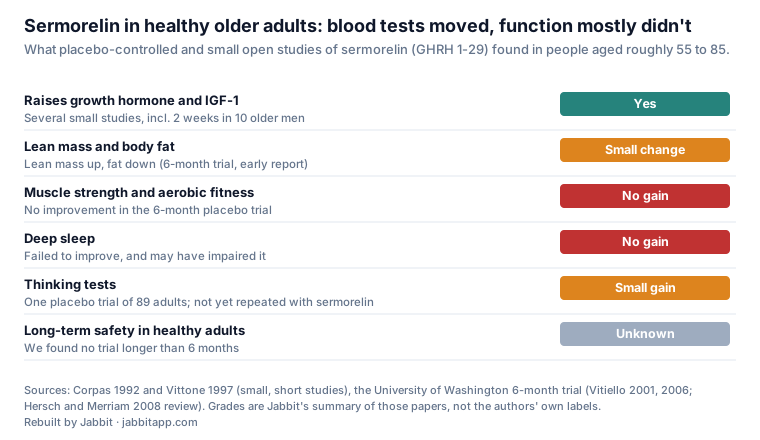
- Hormone levels: in 10 older men, two weeks of twice-daily sermorelin brought growth hormone and IGF-1 up to the levels of young men, with no change in fasting glucose or blood pressure.[6] A once-nightly schedule in 11 older men raised nighttime growth hormone but not IGF-1.[7]
- Body composition: the six-month University of Washington trial reported more lean mass and less body fat, especially belly fat, in preliminary results.[10][11] A 16-week study of a close analog found more lean mass in men only.[8]
- Strength and fitness: the six-month trial found “no improvement in strength or aerobic fitness.”[11] The six-week study without a placebo group reported gains on 2 of 6 strength tests and no change in muscle or fat on scans.[7]
- Sleep: despite the sleep-and-recovery marketing, the review by the trial’s investigators said sermorelin “failed to improve and may even have impaired deep sleep.”[11]
- Thinking: the same trial, with 89 older adults, reported better scores on several timed reasoning tests.[9] A later trial in 152 adults found a similar benefit, but it used tesamorelin, a different, approved GHRH drug, not sermorelin.[12]
The trial’s own investigators called a physical-function result “tantalizing” but said it “needs confirmation,” and wrote that this drug class “has not been approved by regulatory authorities in any jurisdiction” for normal aging.[11] PubMed lists no randomized trial tagged with sermorelin in its title or abstract, and we found no registered trial of sermorelin treatment in healthy adults.[26][17] Much of the positive coverage of sermorelin for adults rests on opinion pieces rather than new trials, such as a two-page 2006 commentary.[14]
Recalls of compounded sermorelin
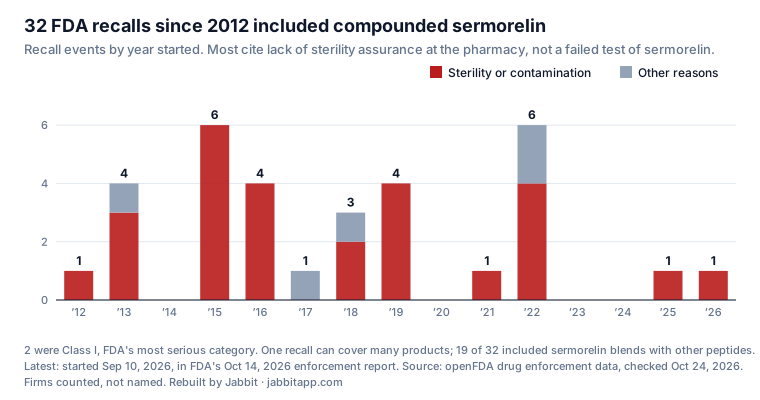
FDA’s enforcement data list 93 sermorelin product entries across 32 recall events by 28 firms since 2012.[15] Most were broad recalls after inspections found a firm could not assure the sterility of its injectable products; they are not test results showing that a given vial of sermorelin was contaminated. Two were Class I, FDA’s most serious category, including one that named a bacterial contaminant.[15] Others cited a potency problem, expiry dates the stability data did not support, and lapses in environmental monitoring. 19 of the events included blends of sermorelin with other peptides such as GHRP-2, GHRP-6 or ipamorelin, which have never been FDA-approved.[15] The most recent, started September 10, 2026, cited sterility concerns related to the formulation and processing equipment.[15]
Safety: what is and isn’t known
- In the approved-era studies: sermorelin was generally well tolerated; the most common side effects were brief facial flushing and injection-site pain.[4][5] The aging studies were small and lasted weeks to months.[6][7][8][9]
- Adverse event reports: FAERS lists 59 reports naming sermorelin, 30 of them as a suspect drug. Common terms include itching, nausea, hypersensitivity and injection-site reactions; 3 mention an anaphylactic reaction, and several describe dispensing or wrong-product errors.[16] These reports are unverified and do not prove cause.
- What the growth hormone axis can do (context, not sermorelin data): in trials of growth hormone itself in healthy older adults, users had more fluid retention, joint pain, carpal tunnel syndrome and breast tissue growth in men, and somewhat more new diabetes.[13] Sermorelin raises growth hormone less directly, and whether it shares those risks over the long term has not been studied. A 2026 review lists blood sugar changes, fluid retention and hormone shifts among effects reported across this drug class.[24]
- Product quality: compounded sermorelin is not FDA-reviewed for quality, and the recall record above shows repeated sterility problems.[15] FDA’s drug listings show 17 registered bulk sermorelin listings from 16 labelers, which tells you supply exists, not that any is good.[18]
Legal status
No sermorelin product is currently FDA-approved; both Geref approvals were withdrawn in 2009.[1][3] Under federal compounding law, a pharmacy may use a bulk substance that is a component of an FDA-approved drug, has a USP monograph, or is on FDA’s 503A bulks list.[19] Compounders and telehealth companies generally treat sermorelin as permitted because it was in an approved product, and Hims & Hers described it as “already allowed.”[21] We did not find an FDA statement that addresses sermorelin by name, and it does not appear on FDA’s list of compounding substances that may pose significant safety risks.[20] Whether FDA’s pending interim peptide policy touches sermorelin is not public.[22] Sermorelin is banned at all times in sport under the WADA list.[23]
What a careful reader should notice
These points are our analysis of the cited sources.
- Sermorelin’s FDA history is real but narrow: a pituitary test and a pediatric growth treatment, never an adult or anti-aging use.[1]
- The best-designed aging trial found that hormone levels rose while strength, fitness and deep sleep did not improve.[11]
- The most interesting adult result, better scores on thinking tests, comes from one trial, and the follow-up used a different drug.[9][12]
- The product sold today is compounded, not Geref, and compounded sermorelin has appeared in 32 recall events, mostly over sterility.[15]
- “Already allowed” describes a compounding pathway, not evidence that sermorelin works for aging.[21][19][11]
Frequently asked questions
- Is sermorelin FDA approved?
- Not anymore. Sermorelin was approved as Geref in 1990 (a pituitary test) and 1997 (children with growth hormone deficiency). Both were discontinued in 2008, and FDA found that was not for safety or effectiveness reasons. Today’s sermorelin is compounded.[1][2]
- Does sermorelin work for anti-aging?
- It raises growth hormone and IGF-1 in older adults, but in the main six-month placebo-controlled trial strength and aerobic fitness did not improve. Body fat fell a little in early results.[6][11]
- Does sermorelin improve sleep?
- The trial evidence says no. Investigators reported it “failed to improve and may even have impaired deep sleep” in healthy older adults.[11]
- Is sermorelin safe?
- In older studies it was generally well tolerated, mostly flushing and injection-site pain. Long-term safety in healthy adults has not been studied, and compounded products have faced repeated sterility recalls.[4][15]
- Why was Geref discontinued?
- EMD Serono said the active ingredient used to make it was no longer being manufactured, and FDA later found the withdrawal was not for safety or effectiveness reasons.[2][1]
- What is the difference between sermorelin and tesamorelin?
- Both mimic GHRH. Tesamorelin is a stabilized analog that FDA approved in 2010 as Egrifta, for excess belly fat in some people with HIV (see our tesamorelin page). Sermorelin has no current approval.[12][25][3]
- Is sermorelin banned in sports?
- Yes. WADA lists sermorelin by name among growth hormone releasing factors prohibited at all times.[23]
Bottom line
Sermorelin is a once-approved drug with a clean exit from the market and a modest record in older adults: hormone levels rise, but the trial evidence does not show stronger muscles or better sleep, and the one cognitive signal needs repeating.[1][11][9] What is sold now is compounded, with a recurring sterility recall record.[15] Anyone weighing it would be relying on small, decades-old studies.
References
- U.S. Food and Drug Administration. “Determination That GEREF (Sermorelin Acetate) Injection, 0.5 Milligrams Base/Vial and 1.0 Milligrams Base/Vial, and GEREF (Sermorelin Acetate) Injection, 0.05 Milligrams Base/Amp, Were Not Withdrawn From Sale for Reasons of Safety or Effectiveness.” Federal Register 78:14095-14096, March 4, 2013 (Docket FDA-2012-P-1071). Geref vials (NDA 20-443) were “initially approved on September 26, 1997” and “indicated for the treatment of idiopathic growth hormone deficiency (GHD) in children with growth failure”; the Geref ampule (NDA 19-863) was “initially approved on December 28, 1990” and “indicated for evaluating the ability of the somatotroph of the pituitary gland to secrete growth hormone.” EMD Serono notified FDA of discontinuation in letters dated July 11 and December 2, 2008; FDA withdrew approval of both NDAs effective June 18, 2009 (74 FR 23407). FDA “determined that both GEREF products were not withdrawn from sale for reasons of safety or effectiveness,” so abbreviated (generic) applications referring to them “may be approved” if they meet all other requirements. https://www.federalregister.gov/documents/2013/03/04/2013-04827/determination-that-geref-sermorelin-acetate-injection-05-milligrams-basevial-and-10-milligrams. Checked October 24, 2026.
- EMD Serono, Inc. “EMD Serono, Inc. to Discontinue Geref Diagnostic,” August 5, 2008 (BioSpace): the company “has made a business decision to discontinue Geref Diagnostic effective October 2008. The drug will be discontinued because the active ingredient used to produce [it] is no longer being manufactured.” https://www.biospace.com/emd-serono-inc-to-discontinue-geref-diagnostic. Checked October 24, 2026.
- U.S. Food and Drug Administration. Drugs@FDA via the openFDA drugsfda endpoint, active ingredient sermorelin acetate: NDA 019863 (GEREF, EMD Serono; original approval December 28, 1990) and NDA 020443 (GEREF, EMD Serono; original approval September 26, 1997), both listed as Discontinued; no other application found. A search on the openfda generic-name field returns no match because that field is not populated for these old applications. https://api.fda.gov/drug/drugsfda.json?search=products.active_ingredients.name:%22SERMORELIN%20ACETATE%22. Checked October 24, 2026.
- Prakash A, Goa KL. Sermorelin: a review of its use in the diagnosis and treatment of children with idiopathic growth hormone deficiency. BioDrugs. 1999;12(2):139-157. PMID 18031173. Describes sermorelin as “a 29 amino acid analogue of human growth hormone-releasing hormone (GHRH)” and “the shortest synthetic peptide with full biological activity of GHRH”; reports it was well tolerated, with “transient facial flushing and pain at injection site” the most common adverse events, and that growth gains with some sermorelin regimens were smaller than with once-daily somatropin, while the recommended sermorelin regimen “has not been directly compared” with somatropin. Published by Adis International. Abstract read. https://pubmed.ncbi.nlm.nih.gov/18031173/. Checked October 24, 2026.
- Thorner M, Rochiccioli P, Colle M, et al.; Geref International Study Group. Once daily subcutaneous growth hormone-releasing hormone therapy accelerates growth in growth hormone-deficient children during the first year of therapy. J Clin Endocrinol Metab. 1996;81(3):1189-1196. PMID 8772599. Open-label, multicenter, no placebo group; 110 children treated, 86 analyzed; mean height velocity rose from 4.1 to 7.2 cm/yr at 12 months; “overall GHRH was well tolerated.” Abstract read. https://pubmed.ncbi.nlm.nih.gov/8772599/. Checked October 24, 2026.
- Corpas E, Harman SM, Piñeyro MA, Roberson R, Blackman MR. Growth hormone (GH)-releasing hormone-(1-29) twice daily reverses the decreased GH and insulin-like growth factor-I levels in old men. J Clin Endocrinol Metab. 1992;75(2):530-535. PMID 1379256. National Institute on Aging. 10 older and 9 young men; 14 days per dose level; at the higher dose GH and IGF-I in older men no longer differed from young men; no effect on fasting glucose, blood pressure, or chemistry and hematology profiles; hormone levels only, no clinical outcomes. Abstract read. https://pubmed.ncbi.nlm.nih.gov/1379256/. Checked October 24, 2026.
- Vittone J, Blackman MR, Busby-Whitehead J, et al. Effects of single nightly injections of growth hormone-releasing hormone (GHRH 1-29) in healthy elderly men. Metabolism. 1997;46(1):89-96. PMID 9005976. 11 men aged 64 to 76, 6 weeks, no placebo group. Nighttime GH rose but IGF-I did not; 2 of 6 strength measures and one endurance test improved; no change in DEXA muscle or fat, weight, glucose or lipids; “no significant adverse effects were observed.” Abstract read. https://pubmed.ncbi.nlm.nih.gov/9005976/. Checked October 24, 2026.
- Khorram O, Laughlin GA, Yen SS. Endocrine and metabolic effects of long-term administration of [Nle27]growth hormone-releasing hormone-(1-29)-NH2 in age-advanced men and women. J Clin Endocrinol Metab. 1997;82(5):1472-1479. PMID 9141536. A close analog of sermorelin, not sermorelin itself. Single-blind; 19 adults aged 55 to 71; 4 weeks of placebo then 16 weeks of the analog. IGF-I rose, then drifted back toward baseline by week 16; lean body mass rose in men only; skin thickness rose in both sexes; “the only adverse side-effect was transient hyperlipidemia.” Abstract read. https://pubmed.ncbi.nlm.nih.gov/9141536/. Checked October 24, 2026.
- Vitiello MV, Moe KE, Merriam GR, Mazzoni G, Buchner DH, Schwartz RS. Growth hormone releasing hormone improves the cognition of healthy older adults. Neurobiol Aging. 2006;27(2):318-323. PMID 16399214. University of Washington; 89 healthy adults (mean age 68), 6 months of daily GHRH or placebo; improvements on several fluid-intelligence tests such as WAIS-R performance IQ. Abstract read. https://pubmed.ncbi.nlm.nih.gov/16399214/. Checked October 24, 2026.
- Vitiello MV, Schwartz RS, Moe KE, Mazzoni G, Merriam GR. Treating age-related changes in somatotrophic hormones, sleep, and cognition. Dialogues Clin Neurosci. 2001;3(3):229-236. PMID 22034239. Review by the trial team reporting “preliminary findings” from the University of Washington GHRH studies in healthy older adults. Abstract read. https://pubmed.ncbi.nlm.nih.gov/22034239/. Checked October 24, 2026.
- Hersch EC, Merriam GR. Growth hormone (GH)-releasing hormone and GH secretagogues in normal aging: Fountain of Youth or Pool of Tantalus? Clin Interv Aging. 2008;3(1):121-129. PMID 18488883; PMC2544358. On the University of Washington study of “6 months treatment with daily bedtime subcutaneous injections of GHRH(1–29)NH2”: “IGF-I levels rose approximately 35%”; subjects showed “an increase in lean body mass and decrease in body fat (particularly abdominal visceral fat). However, there was no improvement in strength or aerobic fitness”; “GHRH failed to improve and may even have impaired deep sleep”; physical-function scores held steady while the placebo group declined, a “tantalizing finding” that “needs confirmation.” Also: “the use of GHS in normal aging has not been approved by regulatory authorities in any jurisdiction.” https://pmc.ncbi.nlm.nih.gov/articles/PMC2544358/. Checked October 24, 2026.
- Baker LD, Barsness SM, Borson S, et al. Effects of growth hormone–releasing hormone on cognitive function in adults with mild cognitive impairment and healthy older adults: results of a controlled trial. Arch Neurol. 2012;69(11):1420-1429. PMID 22869065. 152 adults aged 55 to 87, 20 weeks; used tesamorelin, a stabilized GHRH analog, not sermorelin; favorable effect on executive function; adverse events, described as mild, in 68% on drug vs 36% on placebo. Abstract read. https://pubmed.ncbi.nlm.nih.gov/22869065/. Checked October 24, 2026.
- Liu H, Bravata DM, Olkin I, et al. Systematic review: the safety and efficacy of growth hormone in the healthy elderly. Ann Intern Med. 2007;146(2):104-115. PMID 17227934. 18 randomized study populations of growth hormone itself (not sermorelin): fat mass −2.1 kg and lean mass +2.1 kg, with more soft tissue edema, joint pain, carpal tunnel syndrome and gynecomastia, and somewhat more new diabetes and impaired fasting glucose; “GH cannot be recommended as an antiaging therapy.” Abstract read. https://pubmed.ncbi.nlm.nih.gov/17227934/. Checked October 24, 2026.
- Walker RF. Sermorelin: a better approach to management of adult-onset growth hormone insufficiency? Clin Interv Aging. 2006;1(4):307-308. PMID 18046908. Two-page opinion piece, not a study. Title and record read. https://pubmed.ncbi.nlm.nih.gov/18046908/. Checked October 24, 2026.
- U.S. Food and Drug Administration enforcement reports via the openFDA drug enforcement endpoint, search product_description “sermorelin,” October 24, 2026: 93 product entries in 32 recall events by 28 firms, initiated 2012 to 2026; 2 Class I and 30 Class II. Reasons: 27 lack of sterility assurance or contamination, 3 labeling, stability or manufacturing-control problems, 1 potency, and 1 firm-wide recall after reports of skin abscesses tied to a different product. 19 events included products combining sermorelin with other peptides. The most recent began September 10, 2026 and appeared in FDA’s October 14, 2026 report: Class II, “Lack of Assurance of Sterility: Related to formulation using bacteriostic water; Related to processing equipment used in compounded product.” Firms are counted, not named; full table: https://jabbitapp.com/research/sources/sermorelin-2026-10-24.json. Query: https://api.fda.gov/drug/enforcement.json?search=product_description:%22sermorelin%22&limit=100. Checked October 24, 2026.
- FDA Adverse Event Reporting System via openFDA, reports naming sermorelin, sermorelin acetate or Geref, October 24, 2026: 59 reports, 30 listing it as a suspect drug (23 coded serious; none coded as a death). Most common reaction terms in those reports: itching, nausea, hypersensitivity, injection-site hives and itching, redness, anaphylactic reaction (3 reports) and dispensing or wrong-product errors. FAERS reports are unverified and do not show that a drug caused an event. https://api.fda.gov/drug/event.json?search=patient.drug.medicinalproduct:%22sermorelin%22+patient.drug.medicinalproduct:%22sermorelin%20acetate%22+patient.drug.medicinalproduct:%22geref%22&limit=100. Checked October 24, 2026.
- ClinicalTrials.gov API v2, search “sermorelin,” October 24, 2026: 42 studies returned, because the registry expands the term to GHRH and related drugs; most use tesamorelin, other analogs or unspecified GHRH. Only 3 name sermorelin or Geref (https://clinicaltrials.gov/study/NCT00324064, https://clinicaltrials.gov/study/NCT03018886, https://clinicaltrials.gov/study/NCT00448747), all as part of a diagnostic growth hormone stimulation test; one notes the “unavailability of GHRH (Geref) in the United States.” Two GHRH treatment trials in older adults were terminated early with 5 and 13 participants (https://clinicaltrials.gov/study/NCT00807365, https://clinicaltrials.gov/study/NCT01410799). Census: https://jabbitapp.com/research/sources/sermorelin-2026-10-24.json. Checked October 24, 2026.
- U.S. Food and Drug Administration. National Drug Code directory, unfinished-drug listings file (downloaded October 16, 2026): 17 listings for sermorelin acetate from 16 labelers, 13 of them categorized as “bulk ingredient for human prescription compounding.” A listing is a registration, not an FDA approval or quality finding. Labelers counted, not named. https://www.fda.gov/drugs/drug-approvals-and-databases/national-drug-code-directory. Checked October 24, 2026.
- U.S. Food and Drug Administration. “Bulk Drug Substances Used in Compounding Under Section 503A of the FD&C Act” (content current as of 05/14/2026). Under section 503A a pharmacy may compound with a bulk substance that complies with a USP or NF monograph, if one exists; is a component of an FDA-approved drug product, if no monograph exists; or appears on FDA’s 503A bulks list. https://www.fda.gov/drugs/human-drug-compounding/bulk-drug-substances-used-compounding-under-section-503a-fdc-act. Checked October 24, 2026.
- U.S. Food and Drug Administration. “Certain Bulk Drug Substances for Use in Compounding that May Present Significant Safety Risks” (content current as of 04/22/2026). Sermorelin does not appear on the page. https://www.fda.gov/drugs/human-drug-compounding/certain-bulk-drug-substances-use-compounding-may-present-significant-safety-risks. Checked October 24, 2026.
- Hims & Hers Health, Inc. Second-quarter 2026 earnings call (results released August 10, 2026), prepared remarks by CEO Andrew Dudum: “In the meantime, we plan to offer access to already allowed peptides with safe and well-established supply chains before the end of the year. This will include solutions like sermorelin, glutathione and NAD+.” Transcript published by The Motley Fool: https://www.fool.com/earnings/call-transcripts/2026/08/17/hims-hims-q2-2026-earnings-call-transcript/. Checked October 23, 2026.
- Office of Information and Regulatory Affairs (OMB). Pending EO 12866 Regulatory Review: Interim Access Policy for Compounding Using Certain Peptides, RIN 0910-ZD94, received 10/14/2026. The text and the list of peptides are not public. https://www.reginfo.gov/public/do/eoDetails?rrid=1568964. Checked October 24, 2026.
- World Anti-Doping Agency. The 2026 Prohibited List (in force January 1, 2026). Prohibited at all times: “S2.2.4 Growth hormone releasing factors, including, but not limited to: growth hormone-releasing hormone (GHRH) and its analogues (e.g. CJC-1293, CJC-1295, sermorelin and tesamorelin).” https://www.wada-ama.org/sites/default/files/2025-09/2026list_en_final_clean_september_2025.pdf. Checked October 24, 2026.
- Dominikowski A, Rękoś Z, Olejarz M, et al. The emerging landscape of performance-enhancing peptides modulating GH-IGF1 axis: bridging the gap between clinical evidence and patient self-administration. Front Endocrinol (Lausanne). 2026;17:1822475. PMID 42395176. Narrative review listing sermorelin among GHRH analogues used in online self-administration; reported adverse effects of the drug class include “prolactin and cortisol elevations, appetite changes, and dysglycaemia,” fluid retention, muscle and joint pain and injection-site reactions, with “uncertainty surrounding product composition” in unregulated supply. Abstract read. https://pubmed.ncbi.nlm.nih.gov/42395176/. Checked October 24, 2026.
- U.S. Food and Drug Administration. Drugs@FDA via openFDA: BLA 022505, EGRIFTA (tesamorelin), Theratechnologies; original approval November 10, 2010; marketing status Prescription. https://api.fda.gov/drug/drugsfda.json?search=openfda.generic_name:%22TESAMORELIN%22. Checked October 24, 2026.
- PubMed, October 24, 2026: “sermorelin” [All Fields] 334 records; sermorelin [MeSH] 316; sermorelin in title or abstract with publication type randomized controlled trial: 0. Many records use the name for a diagnostic test rather than treatment. https://pubmed.ncbi.nlm.nih.gov/?term=sermorelin. Checked October 24, 2026.
This page analyzes regulator documents, published studies, registry and adverse event records, and company statements. It is not medical or legal advice and does not recommend any product or dose. No sermorelin product is currently FDA-approved. Charts were rebuilt by Jabbit from the sources cited in each caption.