Study teardown · MK-677 (ibutamoren, MK-0677, LUM-201; sold online as an oral “growth hormone peptide”) · 30 years of records from Merck’s 1990s program to 2026: the short hormone studies, six longer placebo-controlled trials, the heart-failure signal, today’s pediatric and obesity trials, FDA’s safety-risk listing, product-testing studies, WADA, registry, FAERS and PubMed counts · Sources checked October 25, 2026
Published · Updated
MK-677 (ibutamoren): does the oral “growth hormone peptide” work, and is it safe? It is not a peptide, it reliably raises growth hormone and IGF-1, and in Merck’s trials it added about a kilogram of lean mass, but it did not improve strength, function, Alzheimer’s disease or most bone sites, it raised blood sugar, one trial was stopped early for a heart-failure signal, and FDA lists it as a compounding safety risk.
MK-677, also called ibutamoren, is a small synthetic molecule taken by mouth that makes the pituitary gland release more growth hormone.[1][11] It is often sold alongside injectable peptides, but it is not a peptide: it copies the action of ghrelin, the body’s hunger hormone, at the same receptor.[2] Merck’s researchers described it in 1995, and in trials over the next 15 years it reliably raised growth hormone and IGF-1.[1][3][13][14] The outcomes people buy it for mostly did not follow: in healthy older adults it added about a kilogram of lean mass over a year without improving strength or function, it did not reduce body fat, it did not slow Alzheimer’s disease, and it raised blood sugar.[13][8][14] A trial in hip-fracture patients was stopped early for a heart-failure signal, and FDA now lists it among compounding ingredients that may present significant safety risks.[15][32] One company is still testing it as a prescription drug candidate, under the name LUM-201, for children with growth hormone deficiency.[18][20]
Why this matters now
MK-677 turns up often in the illegal performance-product market: in a five-year study by European official medicines control laboratories of 324 suspected illegal performance products, ibutamoren was listed first among the five most frequently reported molecules, and 24% of the samples were presented as dietary supplements.[25] A 2026 sports-medicine review of popular “peptides” singled out MK-677 as associated with significant risks including congestive heart failure.[31] Four of the five bulk-powder listings for ibutamoren in FDA’s drug directory have 2026 marketing start dates, which shows raw material is being registered, not that any product is approved.[37] Meanwhile, a phase 3 trial in children began recruiting in May 2026, and in August 2026 a phase 2 trial pairing it with oral semaglutide in older adults with obesity was registered.[20][21] FDA’s interim peptide compounding policy has been under White House review since October 14, 2026, with its list not public.[35] For where every peptide stands, see our FDA peptide compounding status tracker.
Timeline
| Date | Event |
|---|---|
| 1995 | Merck Research Laboratories describe L-163,191 (MK-0677) as an orally active growth hormone secretagogue and select it for clinical studies.[1] |
| 1996-1999 | Short studies in young men, older adults, obese men, calorie-restricted volunteers and growth hormone-deficient adults and children show rises in growth hormone and IGF-1.[4][3][6][8][7][9][11] |
| 2001 | An 18-month osteoporosis trial in 292 women finds extra bone-density gain at only one of four sites.[10] |
| 2004 | A 6-month trial in 161 hip-fracture patients finds no significant functional benefit.[12] |
| 2008 | A 2-year trial in healthy older adults reports more lean mass but no change in strength or function; a 12-month Alzheimer’s trial in 563 patients finds no effect.[13][14] |
| 2011 | A phase 2b hip-fracture trial is reported as terminated early for a heart-failure safety signal.[15] |
| 2017-2025 | Testing studies find ibutamoren in products sold online as SARMs or supplements, sometimes not on the label.[24][26][25] |
| 2021-2022 | Lumos Pharma publishes analyses of LUM-201 (ibutamoren) in children with growth hormone deficiency.[17][18] |
| 2022-2023 | FDA adds ibutamoren to its compounding safety-risk list, for outsourcing facilities (December 2022) and pharmacies (September 2023).[32] |
| May 2026 | A placebo-controlled phase 3 pediatric trial of LUM-201 starts recruiting; FDA’s May list keeps ibutamoren in 503A category 2.[20][33] |
| August 2026 | A phase 2 trial of LUM-201 plus oral semaglutide in older adults with obesity is registered, not yet recruiting.[21] |
| October 14, 2026 | FDA’s interim peptide compounding policy goes to White House review; its contents are not public.[35] |
What MK-677 is
Ibutamoren is a “nonpeptide” growth hormone secretagogue: a drug-like molecule, not a chain of amino acids, designed to be taken by mouth once a day.[11][2] It acts on the growth hormone secretagogue receptor, the same receptor that ghrelin uses, which is why researchers call it a ghrelin mimetic; mice lacking that receptor confirmed this.[2][13] That is a different route from sermorelin or CJC-1295, which act on the receptor for growth hormone-releasing hormone, but its action was described as indistinguishable from that of the peptide GHRP-6.[1] Because it works through the pituitary, it raises the body’s own growth hormone pulses rather than replacing the hormone: in young men, the total amount of growth hormone was similar to placebo but pulses were more frequent, while IGF-1 rose.[4] It also acts like ghrelin on appetite: increased appetite was the most common side effect in the 2-year trial.[13]
The evidence, rung by rung
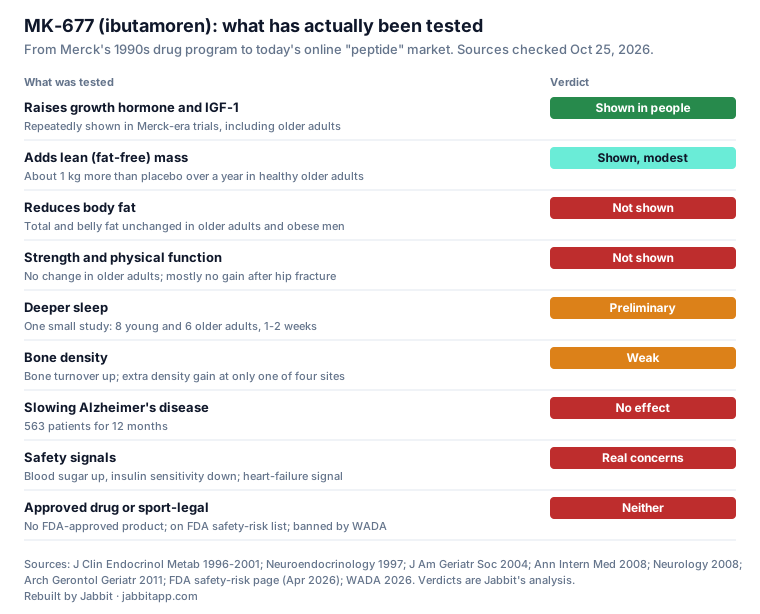
- Hormone levels. In 32 healthy adults aged 64 to 81, four weeks of treatment raised IGF-1 into the range of young adults.[3] IGF-1 rose in every longer trial too: by 84% in hip-fracture patients and by 72.9% in Alzheimer’s patients.[12][14]
- Lean mass and fat. In 65 healthy adults aged 60 to 81 followed for up to 2 years, fat-free mass rose 1.1 kg on MK-677 and fell 0.5 kg on placebo, with no difference in belly or total fat; limb fat and body weight rose more on the drug.[13] In 24 obese men over 8 weeks, fat-free mass rose but total and visceral fat did not change.[8] In calorie-restricted volunteers, a week of treatment reversed protein (nitrogen) loss.[7]
- Strength and function. In the 2-year trial, “Increased fat-free mass did not result in changes in strength or function,” though the authors note the study was too small to judge function.[13] After hip fracture, a 161-patient trial found no significant functional differences; a later trial saw better gait speed but not stair-climbing power, and it was stopped early.[12][15]
- Sleep. One small study reported about 50% more deep (stage IV) sleep and over 20% more REM sleep in 8 young adults after a week, and nearly 50% more REM sleep in 6 older adults.[5] We found no larger trial with sleep as its main outcome.[38][23]
- Bone. It raised markers of bone turnover in 187 older adults.[9] In 292 women with osteoporosis, adding it to alendronate raised femoral-neck density more than alendronate alone (4.2% vs. 2.5%) but not spine, total hip or whole-body density, which the authors called “a concern when weighed against the potential side effects.”[10]
- Brain. In 563 people with Alzheimer’s disease, 12 months of treatment “was ineffective at slowing the rate of progression.”[14] In Alzheimer’s-model mice it did not prevent plaques or memory loss and raised mortality at one dose.[16]
- Liver fat. A 12-person open-label pilot at Massachusetts General Hospital found no significant change in liver fat after 6 months.[22]
The longer trials, in one chart
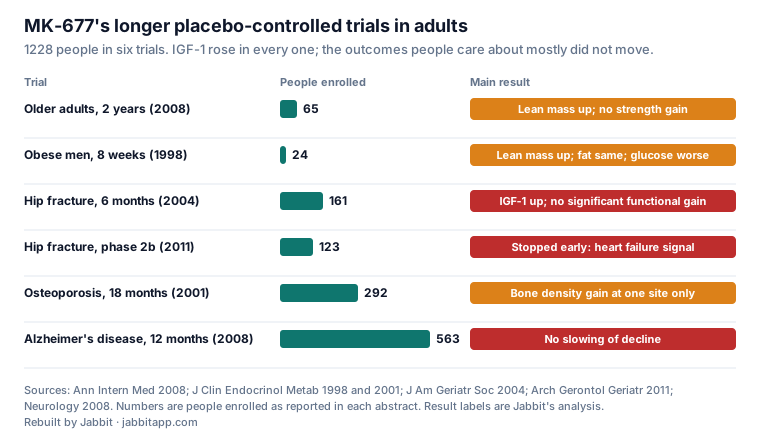
Our analysis: across 1,228 people in these six trials, the drug did what it was designed to do to hormone levels every time, but the clinical outcomes it was tested for did not clearly improve, apart from modest lean-mass and single-site bone gains.[13][8][12][15][10][14] Registry enrollment figures differ from some published ones, so we use the numbers in the papers.[23]
Where development stands: LUM-201
Lumos Pharma is developing ibutamoren as LUM-201 for children whose pituitary still works partly.[18][17] Its analysis of an earlier completed trial in 68 children proposed two screening tests to pick likely responders.[17] In its phase 2 trial of 104 children selected that way, average height growth over the first 6 months, expressed per year, was 6.8 to 8.2 cm across the LUM-201 groups versus 10.6 cm with daily growth hormone injections, according to the results posted on ClinicalTrials.gov.[19] A placebo-controlled phase 3 trial of about 150 children began recruiting in May 2026.[20] Separately, a phase 2 trial registered in August 2026 plans to test LUM-201 plus oral semaglutide against semaglutide alone in 202 adults aged 60 to 84 with obesity, measuring physical function.[21] Our analysis: these are company-sponsored trials still in progress, with no results for adults yet, so they do not show that MK-677 bought online works or is safe for anyone.[20][21]
Safety
- Heart failure signal. The phase 2b hip-fracture trial “was terminated early due to a safety signal of congestive heart failure in a limited number of patients,” and its authors concluded the drug “has an unfavorable safety profile in this patient population.”[15] FDA cites that trial in listing ibutamoren as a significant safety risk.[32]
- Blood sugar. Fasting glucose rose from 5.4 to 6.8 mmol/L after 4 weeks in older adults; glucose tolerance worsened in obese men; and over 2 years, fasting glucose rose and insulin sensitivity fell.[3][8][13]
- Other effects in trials. More appetite that faded after a few months, short-lived mild leg swelling, and muscle pain were the most frequent in the 2-year trial, which also saw weight gain, a rise in cortisol and a small drop in LDL cholesterol.[13]
- Case reports. Single case reports describe liver inflammation after 2 months of use that resolved after stopping, gynecomastia in a man whose supplements also contained other drugs and hormones, and a ruptured spleen in a man also using a SARM, where the authors call any role of the compounds “potential and speculative.”[28][29][30] Case reports cannot show cause.
- What is in the bottle. Testing studies have found ibutamoren in products sold as other drugs or as supplements, sometimes not on the label, and mislabeling was common; doping researchers describe it as “not available therapeutically” yet widely sold online as “supplement” products.[24][26][25][27]
- Reports. FAERS holds 14 reports naming ibutamoren or MK-677; such reports are unverified and do not show cause.[36]
Legal status
No ibutamoren drug is approved by FDA.[36] It is on FDA’s list of bulk substances that may present significant safety risks in compounding, for outsourcing facilities since December 29, 2022 and for pharmacies since September 29, 2023, and FDA’s May 2026 list places it in category 2, substances that raise significant safety risks.[32][33] FDA’s pending interim peptide policy could change how some peptides are handled, but its list is not public, and ibutamoren is not a peptide.[35][2] Five bulk-powder listings exist in FDA’s NDC directory, and a listing is not approval.[37] In sport, WADA’s 2026 list names “ibutamoren (MK-677)” among growth hormone secretagogues prohibited at all times.[34]
What a careful reader should notice
These points are our analysis of the sources cited.
- Raising IGF-1 is not the same as a benefit. MK-677 raised it in every trial, yet the strength, function, bone and brain outcomes mostly did not follow.[13][12][10][14]
- The lean-mass gain was about a kilogram over a year in older adults, and fat did not fall. “Recomp” claims are not what the trials showed.[13][8]
- The best data come from older or sick people. Young, healthy gym users, the main online market, were barely studied beyond a week or two.[4][5][13]
- The heart-failure signal came in frail patients, and its size is not reported in the abstract, but FDA treats it as serious enough to list the drug as a safety risk.[15][32]
- “Peptide” is a marketing label here. Ibutamoren is a small molecule, which also means peptide-specific policies may not apply to it.[11][35]
Frequently asked questions
- Does MK-677 work?
- It reliably raises growth hormone and IGF-1. In trials it added about a kilogram of lean mass over a year in healthy older adults, but it did not improve strength or physical function, did not reduce body fat, did not slow Alzheimer’s disease, and improved bone density at only one of four sites.[3][13][8][14][10]
- Is MK-677 safe?
- Trials found higher blood sugar and lower insulin sensitivity, plus appetite, swelling and muscle pain, and one trial in hip-fracture patients was stopped early for a heart-failure signal. FDA lists it as a significant safety risk for compounding, and products sold online have often been mislabeled.[3][13][15][32][24]
- Is MK-677 a peptide?
- No. It is a small, nonpeptide molecule taken by mouth that mimics ghrelin at the growth hormone secretagogue receptor.[11][2]
- Is MK-677 FDA approved?
- No. There is no approved ibutamoren product, and FDA places it in category 2 for compounding because of safety risks. A company is testing it as LUM-201 in children with growth hormone deficiency.[36][33][20]
- Does MK-677 improve sleep?
- One small 1997 study in 14 people reported more deep and REM sleep over 1 to 2 weeks. That has not been confirmed in larger trials that we found.[5][38]
- Does MK-677 raise blood sugar?
- Yes, in several trials: fasting glucose rose in older adults, glucose tolerance worsened in obese men, and insulin sensitivity fell over 2 years.[3][8][13]
- Is MK-677 banned in sport?
- Yes. WADA’s 2026 Prohibited List names ibutamoren (MK-677) among growth hormone secretagogues, prohibited at all times.[34]
Bottom line
MK-677 had a long, well-funded drug program behind it, and the record is clear on one thing: it raises growth hormone and IGF-1.[1][13][14] What the trials did not show is that this translates into more strength, less fat, better recovery after a fracture, or protection against Alzheimer’s disease, while blood sugar rose and one trial was stopped for a heart-failure signal.[13][8][12][14][15] It is not approved, FDA lists it as a compounding safety risk, and it is banned in sport.[36][32][34] People concerned about low growth hormone, muscle loss or sleep can ask a doctor about tested, approved options; see our sermorelin and CJC-1295 and ipamorelin teardowns for the related growth-hormone peptides.
References
- Patchett AA, Nargund RP, Tata JR, et al. Design and biological activities of L-163,191 (MK-0677): a potent, orally active growth hormone secretagogue. Proc Natl Acad Sci U S A. 1995;92(15):7001-7005. PMID 7624358. Merck Research Laboratories paper describing the compound: it releases GH by a mechanism “indistinguishable from the GH-releasing peptide GHRP-6” and distinct from GHRH; in dogs it was specific for GH with “only modest increases in cortisol”; “Based on these properties, L-163,191 has been selected for clinical studies.” Abstract read. https://pubmed.ncbi.nlm.nih.gov/7624358/. Checked October 25, 2026.
- Smith RG. Development of growth hormone secretagogues. Endocr Rev. 2005;26(3):346-360. PMID 15814848. History of the program: small molecules designed for once-daily oral use; the receptor (GHS-R) was later cloned and its natural activator identified as ghrelin; “ghsr-knockout mice studies confirmed that GHS are ghrelin mimetics.” Abstract read. https://pubmed.ncbi.nlm.nih.gov/15814848/. Checked October 25, 2026.
- Chapman IM, Bach MA, Van Cauter E, et al. Stimulation of the growth hormone (GH)-insulin-like growth factor I axis by daily oral administration of a GH secretogogue (MK-677) in healthy elderly subjects. J Clin Endocrinol Metab. 1996;81(12):4249-4257. PMID 8954023. 32 healthy adults aged 64-81, randomized and placebo-controlled, up to 4 weeks: IGF-1 rose into the young-adult range; “MK-677 produced significant increases in fasting glucose (5.4 +/- 0.3 to 6.8 +/- 0.4 mmol/L at 4 weeks; P < 0.01 vs. baseline)”; cortisol unchanged; prolactin up 23% within the normal range. Abstract read. https://pubmed.ncbi.nlm.nih.gov/8954023/. Checked October 25, 2026.
- Copinschi G, Van Onderbergen A, L’Hermite-Balériaux M, et al. Effects of a 7-day treatment with a novel, orally active, growth hormone (GH) secretagogue, MK-677, on 24-hour GH profiles, insulin-like growth factor I, and adrenocortical function in normal young men. J Clin Endocrinol Metab. 1996;81(8):2776-2782. PMID 8768828. 9 young men, 7 days, crossover: “The amounts of GH secreted were similar in all three conditions, but GH pulse frequency was increased”; IGF-1 rose. Abstract read. https://pubmed.ncbi.nlm.nih.gov/8768828/. Checked October 25, 2026.
- Copinschi G, Leproult R, Van Onderbergen A, et al. Prolonged oral treatment with MK-677, a novel growth hormone secretagogue, improves sleep quality in man. Neuroendocrinology. 1997;66(4):278-286. PMID 9349662. 8 young adults (7-day periods, crossover) and 6 older adults (14-day periods): in the young, “an approximately 50% increase in the duration of stage IV and … a more than 20% increase in REM sleep as compared to placebo”; in older adults, “a nearly 50% increase in REM sleep.” Abstract read. https://pubmed.ncbi.nlm.nih.gov/9349662/. Checked October 25, 2026.
- Chapman IM, Pescovitz OH, Murphy G, et al. Oral administration of growth hormone (GH) releasing peptide-mimetic MK-677 stimulates the GH/insulin-like growth factor-I axis in selected GH-deficient adults. J Clin Endocrinol Metab. 1997;82(10):3455-3463. PMID 9329386. “we studied nine severely GH-deficient men”: IGF-1 and 24-hour GH rose over 4 days. Abstract read. https://pubmed.ncbi.nlm.nih.gov/9329386/. Checked October 25, 2026.
- Murphy MG, Plunkett LM, Gertz BJ, et al. MK-677, an orally active growth hormone secretagogue, reverses diet-induced catabolism. J Clin Endocrinol Metab. 1998;83(2):320-325. PMID 9467534. 8 healthy volunteers on a calorie-restricted diet, 7 days of treatment, crossover: “MK-677 reverses diet-induced nitrogen wasting.” Abstract read. https://pubmed.ncbi.nlm.nih.gov/9467534/. Checked October 25, 2026.
- Svensson J, Lönn L, Jansson JO, et al. Two-month treatment of obese subjects with the oral growth hormone (GH) secretagogue MK-677 increases GH secretion, fat-free mass, and energy expenditure. J Clin Endocrinol Metab. 1998;83(2):362-369. PMID 9467542. 24 obese men, 8 weeks, randomized and placebo-controlled: GH and IGF-1 up, fat-free mass up; “Total and visceral fat were not significantly changed with active therapy”; an oral glucose tolerance test “showed impairment of glucose homeostasis at 2 and 8 weeks.” Abstract read. https://pubmed.ncbi.nlm.nih.gov/9467542/. Checked October 25, 2026.
- Murphy MG, Bach MA, Plotkin D, et al. Oral administration of the growth hormone secretagogue MK-677 increases markers of bone turnover in healthy and functionally impaired elderly adults. J Bone Miner Res. 1999;14(7):1182-1188. PMID 10404019. 187 adults aged 65 or older in three placebo-controlled studies of 2-9 weeks: the drug “stimulates bone turnover in elderly subjects based on elevations in biochemical markers.” Abstract read. https://pubmed.ncbi.nlm.nih.gov/10404019/. Checked October 25, 2026.
- Murphy MG, Weiss S, McClung M, et al. Effect of alendronate and MK-677 (a growth hormone secretagogue), individually and in combination, on markers of bone turnover and bone mineral density in postmenopausal osteoporotic women. J Clin Endocrinol Metab. 2001;86(3):1116-1125. PMID 11238495. 292 women aged 64-85, 18 months: adding MK-677 to alendronate raised femoral-neck bone density more (4.2% vs. 2.5%) but not lumbar spine, total hip or total body; the authors called this “a concern when weighed against the potential side effects of enhanced GH secretion.” Abstract read. https://pubmed.ncbi.nlm.nih.gov/11238495/. Checked October 25, 2026.
- Codner E, Cassorla F, Tiulpakov AN, et al. Effects of oral administration of ibutamoren mesylate, a nonpeptide growth hormone secretagogue, on the growth hormone-insulin-like growth factor I axis in growth hormone-deficient children. Clin Pharmacol Ther. 2001;70(1):91-98. PMID 11452249. “18 prepubertal children (15 male, 3 female) with idiopathic GH deficiency,” 7-8 days: GH and IGF-1 rose. Abstract read. https://pubmed.ncbi.nlm.nih.gov/11452249/. Checked October 25, 2026.
- Bach MA, Rockwood K, Zetterberg C, et al. The effects of MK-0677, an oral growth hormone secretagogue, in patients with hip fracture. J Am Geriatr Soc. 2004;52(4):516-523. PMID 15066065. 161 hip-fracture patients aged 65 or older at 13 centers, 6 months: IGF-1 up 84% vs. 17% on placebo; “There were no significant differences between MK-0677 and placebo in improvement in functional performance measures.” Abstract read. https://pubmed.ncbi.nlm.nih.gov/15066065/. Checked October 25, 2026.
- Nass R, Pezzoli SS, Oliveri MC, et al. Effects of an oral ghrelin mimetic on body composition and clinical outcomes in healthy older adults: a randomized trial. Ann Intern Med. 2008;149(9):601-611. PMID 18981485. 65 healthy adults aged 60-81, 2-year randomized placebo-controlled trial: fat-free mass −0.5 kg on placebo vs. +1.1 kg on MK-677; no difference in visceral or total fat, limb fat up more; weight +0.8 vs. +2.7 kg; fasting glucose up 0.3 mmol/L and insulin sensitivity down; most frequent side effects “an increase in appetite that subsided in a few months and transient, mild lower-extremity edema and muscle pain”; cortisol up 47 nmol/L; LDL cholesterol down slightly; “Increased fat-free mass did not result in changes in strength or function,” though study power was “insufficient to evaluate functional end points.” Abstract read. https://pubmed.ncbi.nlm.nih.gov/18981485/. Checked October 25, 2026.
- Sevigny JJ, Ryan JM, van Dyck CH, et al. Growth hormone secretagogue MK-677: no clinical effect on AD progression in a randomized trial. Neurology. 2008;71(21):1702-1708. PMID 19015485. 563 patients with mild to moderate Alzheimer’s disease, 12 months: IGF-1 up 72.9% at 12 months, yet the drug “was ineffective at slowing the rate of progression of Alzheimer disease.” Abstract read. https://pubmed.ncbi.nlm.nih.gov/19015485/. Checked October 25, 2026.
- Adunsky A, Chandler J, Heyden N, et al. MK-0677 (ibutamoren mesylate) for the treatment of patients recovering from hip fracture: a multicenter, randomized, placebo-controlled phase IIb study. Arch Gerontol Geriatr. 2011;53(2):183-189. PMID 21067829. 123 hip-fracture patients: gait speed improved, stair-climbing power did not significantly (p = 0.292), several other measures did not improve; IGF-1 up 51.4 ng/mL vs. placebo; “Trial was terminated early due to a safety signal of congestive heart failure in a limited number of patients”; “MK-0677 has an unfavorable safety profile in this patient population.” Abstract read. https://pubmed.ncbi.nlm.nih.gov/21067829/. Checked October 25, 2026.
- Tian J, Wang T, Wang Q, et al. MK0677, a ghrelin mimetic, improves neurogenesis but fails to prevent hippocampal lesions in a mouse model of Alzheimer’s disease pathology. J Alzheimers Dis. 2019;72(2):467-478. PMID 31594237. In Alzheimer’s-model mice it increased new nerve cells but did not prevent amyloid, synapse loss or memory decline, and at one of the doses tested it “significantly increased 5xFAD mouse mortality.” Abstract read. https://pubmed.ncbi.nlm.nih.gov/31594237/. Checked October 25, 2026.
- Bright GM, Do MT, McKew JC, et al. Development of a predictive enrichment marker for the oral GH secretagogue LUM-201 in pediatric growth hormone deficiency. J Endocr Soc. 2021;5(6):bvab030. PMID 33982679. Reanalysis of a completed placebo-controlled trial in 68 children with GH deficiency: baseline IGF-1 and the GH response to a single dose identify children likely to respond; “PEM-negative status enriches a population for better growth responses to rhGH.” Abstract read. https://pubmed.ncbi.nlm.nih.gov/33982679/. Checked October 25, 2026.
- Bright GM, Thorner MO. A GH secretagogue receptor agonist (LUM-201) elicits greater GH responses than standard GH secretagogues in subjects of a pediatric GH deficiency trial. Horm Res Paediatr. 2022;95(1):76-81. PMID 35354138. “LUM-201 (ibutamoren, formerly MK-0677) is an orally administered GH secretagogue receptor agonist under development for treatment of pediatric growth hormone deficiency.” Abstract read. https://pubmed.ncbi.nlm.nih.gov/35354138/. Checked October 25, 2026.
- ClinicalTrials.gov NCT04614337, “Phase 2 Study of LUM-201 in Children With Growth Hormone Deficiency (OraGrowtH210 Trial),” sponsor Lumos Pharma, 104 enrolled, completed, results posted. Mean annualized height velocity at 6 months: 6.8 to 8.2 cm/year across the three LUM-201 arms vs. 10.6 cm/year with daily growth hormone injections (rhGH). Children were selected with the company’s predictive enrichment markers. https://clinicaltrials.gov/study/NCT04614337. Checked October 25, 2026.
- ClinicalTrials.gov NCT06948214, “Phase 3 Study of LUM-201 in Children With Growth Hormone Deficiency,” sponsor Lumos Pharma: recruiting, start date May 20, 2026, estimated 150 prepubertal children aged 3-11, 12 months, placebo-controlled; primary outcome “AHV after 12 months on LUM-201 compared to placebo.” A long-term extension (NCT07129759) is not yet recruiting. Lumos Pharma’s trials page lists the phase 3 trial with “Status: Recruiting.” https://clinicaltrials.gov/study/NCT06948214; https://lumos-pharma.com/clinicaltrials/. Checked October 25, 2026.
- ClinicalTrials.gov NCT07754045, “Evaluating the Efficacy and Safety of LUM-201 Plus Semaglutide Versus Semaglutide Plus Placebo in Older Obese Adults,” sponsor Lumos Pharma, first posted August 10, 2026: phase 2, not yet recruiting, estimated 202 adults aged 60-84 with obesity and mild functional impairment; primary outcome the proportion with a Short Physical Performance Battery score of 7 or less at week 26. https://clinicaltrials.gov/study/NCT07754045. Checked October 25, 2026.
- ClinicalTrials.gov NCT05364684, “The Impact of Ibutamoren on Nonalcoholic Fatty Liver Disease,” Massachusetts General Hospital, open-label pilot, 12 adults, completed, results posted: mean change in liver fat at 6 months +3.9 percentage points (SD 6.7), p = 0.4. https://clinicaltrials.gov/study/NCT05364684. Checked October 25, 2026.
- ClinicalTrials.gov API v2, query “ibutamoren OR MK-677 OR MK-0677 OR LUM-201,” pulled October 25, 2026: 14 records, including Merck-sponsored trials in Alzheimer’s disease (NCT00074529, completed) and hip fracture (NCT00128115, terminated), seven Lumos Pharma trials, and a kidney-disease study withdrawn because the investigators “Could not obtain drug supply from manufacturer” (NCT01343641). https://clinicaltrials.gov/search?term=ibutamoren; pull: https://jabbitapp.com/research/sources/mk-677-ibutamoren-2026-10-25.json. Checked October 25, 2026.
- Van Wagoner RM, Eichner A, Bhasin S, et al. Chemical composition and labeling of substances marketed as selective androgen receptor modulators and sold via the internet. JAMA. 2017;318(20):2004-2010. PMID 29183075. Of 44 products bought online as SARMs, 17 contained another unapproved drug, “including the growth hormone secretagogue ibutamoren”; 11 contained substances not on the label. Abstract read. https://pubmed.ncbi.nlm.nih.gov/29183075/. Checked October 25, 2026.
- Barrios MM, Deconinck E, Vanhee C, et al. SARMs, metabolic modulators and growth hormone secretagogues in suspected illegal medicines, bought as sport performance enhancers: a retro- and prospective study within the GEON. Drug Test Anal. 2025;17(10):2078-2085. PMID 40551438. European official medicines control laboratories, 324 samples from 13 countries over 5 years; 24% were presented as dietary supplements; of 18 molecules reported, the abstract lists as “top 5: ibutamoren, ligandrol, ostarine, cardarine and andarine.” Abstract read. https://pubmed.ncbi.nlm.nih.gov/40551438/. Checked October 25, 2026.
- Lee JH, Han JH, Jung EJ, et al. Development and validation of liquid chromatography-tandem mass spectrometry method for screening six selective androgen receptor modulators in dietary supplements. Food Addit Contam Part A. 2021;38(7):1075-1086. PMID 33934684. In 60 supplements bought in 2020, “MK-677 and YK-11, not disclosed on the label, were detected in some products.” Abstract read. https://pubmed.ncbi.nlm.nih.gov/33934684/. Checked October 25, 2026.
- Cutler C, Viljanto M, Taylor P, et al. Equine metabolism of the growth hormone secretagogue MK-0677 in vitro and in urine and plasma following oral administration. Drug Test Anal. 2022;14(7):1273-1290. PMID 35302297. Ibutamoren “is not available therapeutically. Nonetheless, MK-0677 is widely available to purchase online, sold as ‘supplement’ products.” Abstract read. https://pubmed.ncbi.nlm.nih.gov/35302297/. Checked October 25, 2026.
- Cobani E, Amin MS, Hasso M, et al. Hepatotoxicity induced by MK-677. BMJ Case Rep. 2025;18(7):e265728. PMID 40675653. Single case: a man in his early 30s “developed transaminitis after consuming MK-677 for 2 months”; liver tests normalized after stopping. Abstract read. https://pubmed.ncbi.nlm.nih.gov/40675653/. Checked October 25, 2026.
- Chong S, Woolnough CA, Koyyalamudi SR, et al. Reversible gynecomastia and hypogonadism due to usage of commercial performance-enhancing supplement use. JCEM Case Rep. 2024;2(8):luae148. PMID 39145153. Single case; the supplements were “found to contain amounts of RAD-140 … MK-677 … and cardarine” plus undisclosed hormones, so the cause cannot be pinned on one substance. Abstract read. https://pubmed.ncbi.nlm.nih.gov/39145153/. Checked October 25, 2026.
- Jaffry K, Shah J, Naqash N. Spontaneous splenic rupture in a patient with recent use of performance-enhancing compounds: a case report and literature review. Cureus. 2026;18(3):e106106. PMID 42064485. Single case in a man using MK-677 and a SARM; the authors describe the compounds’ role as “potential and speculative.” Abstract read. https://pubmed.ncbi.nlm.nih.gov/42064485/. Checked October 25, 2026.
- Tewari K, Liu TP, Im C, et al. Peptide supplements and their therapeutic applications in sports medicine. Am J Sports Med. 2026. PMID 42578445. Scoping review of six popular compounds: “Some peptides such as MK-677 were associated with significant risks including congestive heart failure,” and claimed benefits “remain unsubstantiated by current human trials.” Abstract read. https://pubmed.ncbi.nlm.nih.gov/42578445/. Checked October 25, 2026.
- U.S. Food and Drug Administration. “Certain Bulk Drug Substances for Use in Compounding that May Present Significant Safety Risks” (content current as of 04/22/2026). Ibutamoren mesylate, 503A (since September 29, 2023) and 503B (since December 29, 2022): “Ibutamoren mesylate poses significant safety risks due to the potential for congestive heart failure in certain patients. The agency is aware of a randomized, placebo-controlled trial assessing ibutamoren mesylate for the treatment of patients recovering from hip fracture that ‘was terminated early due to a potential safety signal of congestive heart failure.’” https://www.fda.gov/drugs/human-drug-compounding/certain-bulk-drug-substances-use-compounding-may-present-significant-safety-risks. Checked October 25, 2026.
- U.S. Food and Drug Administration. “Bulk Drug Substances Nominated for Use in Compounding Under Section 503A,” updated May 14, 2026: “Ibutamoren Mesylate” is listed under “503A Category 2: Bulk Drug Substances that Raise Significant Safety Risks.” https://www.fda.gov/media/94155/download. Checked October 25, 2026.
- World Anti-Doping Agency. 2026 Prohibited List, in force January 1, 2026. Section S2.2.4, growth hormone releasing factors, names “growth hormone secretagogues (GHS) and their mimetics [e.g. anamorelin, capromorelin, ibutamoren (MK-677), …]”; class S2 is prohibited at all times. https://www.wada-ama.org/sites/default/files/2025-09/2026list_en_final_clean_september_2025.pdf. Checked October 25, 2026.
- Office of Information and Regulatory Affairs. RIN 0910-ZD94, “Interim Access Policy for Compounding Using Certain Peptides” (FDA), received October 14, 2026; status “Pending EO 12866 Regulatory Review.” The text and any peptide list are not public. https://www.reginfo.gov/public/do/eoDetails?rrid=1568964. Checked October 25, 2026.
- openFDA, October 25, 2026. Drugs@FDA: no ibutamoren product. FDA Adverse Event Reporting System (data through July 30, 2026): 14 reports naming ibutamoren or MK-677 as a drug. Such reports are unverified and do not show that a substance caused an event. https://open.fda.gov/apis/drug/event/; counts: https://jabbitapp.com/research/sources/mk-677-ibutamoren-2026-10-25.json. Checked October 25, 2026.
- openFDA NDC directory, October 25, 2026: five bulk-ingredient (powder) listings for ibutamoren, with marketing start dates from October 2019 to August 2026, four of them in 2026. A listing is a registration, not FDA approval. Labelers not named here. https://api.fda.gov/drug/ndc.json?search=generic_name:IBUTAMOREN*. Checked October 25, 2026.
- PubMed search “ibutamoren OR MK-677 OR MK-0677 OR MK0677 OR L-163,191,” October 25, 2026: 169 records. Query and IDs: https://jabbitapp.com/research/sources/mk-677-ibutamoren-2026-10-25.json. Checked October 25, 2026.
This page analyzes published studies, regulator documents, company records and registry data. It is not medical or legal advice and does not recommend any product or dose. Ibutamoren (MK-677) is not approved by FDA. Charts were rebuilt by Jabbit from the sources cited in each caption.