Evidence review · testosterone enanthate and cypionate, anabolic-androgenic steroids · WHO contraception trials, Bhasin dose-response trials, former-user studies, ClinicalTrials.gov check · Sources checked October 20, 2026
Published · Updated
Injecting testosterone in your 20s or 30s without low T: will your sperm and your own testosterone come back? After short, supervised use, almost always. After self-directed steroid use, not always, and the one placebo-controlled recovery trial we found stopped after enrolling 8.
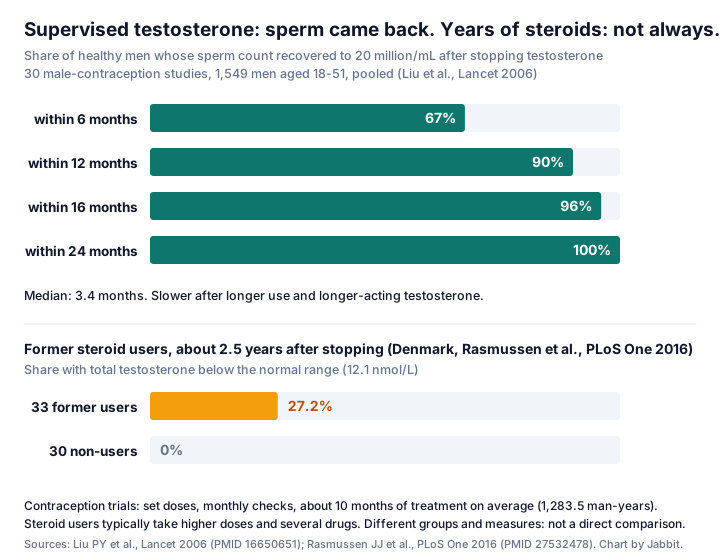
A New York Post story on Tuesday about young men injecting testosterone without a diagnosis, a trend it calls “testmaxxing,” drew more than 960,000 views on X by evening and became an X trending story.[1][2][3] The question it leaves open is the one that matters to anyone considering it: what happens when you stop? The best data come from an unexpected place, the male-contraception trials of the 1990s and 2000s, where healthy men took weekly testosterone shots on purpose to stop making sperm. After those supervised courses, sperm came back in 90% of men within a year and in all of them within two.[9][12] Men who had used steroids on their own did worse: in one study, 27% still had below-normal testosterone about 2.5 years after stopping.[13] And the one randomized trial we found of a drug to help men recover stopped after enrolling 8.[20][21]
Why this matters now
The Post profiled two men in their 30s. One had done “three hormone cycles over two years” and said he hadn’t seen a doctor because he “didn’t want to be talked out of it.” The other bought “a product labeled Pharma Test 250, which lists testosterone enanthate 250 mg/mL as its active ingredient” from what the paper calls a backdoor supplier.[1] The paper’s X post had 967,032 views by about 8 PM ET.[2] Posts on X about testosterone with fertility, sperm, prescriptions or young men rose to 140 on October 20, from 55–104 a day earlier in the week, though overall testosterone talk held at its usual 2,600 to 3,200 posts a day.[4] We covered testosterone therapy for older men with confirmed low levels here. This page covers a different group: young men with normal levels.
The short answer
- It works for muscle. In controlled trials, healthy young men gained lean mass in proportion to the dose, up to 7.9 kg in 20 weeks at 600 mg a week.[6]
- It switches off sperm production. At 200 mg a week, 65% of men had no sperm within six months.[9]
- After supervised courses, sperm came back. Recovery reached 90% of men by 12 months and 100% by 24 in pooled data from 1,549 men.[12]
- After years of self-directed cycles, recovery is less certain. Studies of former users find lasting low testosterone in a minority, and no sperm at a year in some.[13][14][15]
- There is no proven recovery treatment. The one placebo-controlled trial we found stopped for lack of recruitment.[20]
The contraception trials: an accidental test of “testmaxxing”
The World Health Organization tested weekly testosterone as a male birth-control shot. In a trial published in 1990, 271 fertile men at ten centers in seven countries took 200 mg of testosterone enanthate every week. Within six months, 65% had no sperm at all; on average it took 120 days.[9] A second trial of 399 men in nine countries showed it worked as contraception, with 1.4 pregnancies per 100 person-years once counts fell to 3 million per mL or below.[10]
When the men stopped, sperm returned. In the first trial it took a median of 3.7 months to reach 20 million per mL, a common marker of fertility, and 6.7 months to get back to each man’s own starting level.[9] In the second, 33 couples went on to conceive.[10] A 2006 Lancet analysis pooled individual data from 30 such studies of testosterone-based contraception (some combined testosterone with a progestin), about 90% of published data: 1,549 healthy men aged 18 to 51. Recovery to 20 million per mL took a median of 3.4 months. It reached 67% of men within 6 months, 90% within 12, 96% within 16 and 100% within 24. Recovery was slower after longer treatment and with longer-acting testosterone.[12]
The same trials logged side effects. At 200 mg a week, testicles shrank 26% by a year and hemoglobin rose 7.6%. HDL cholesterol fell 14% to 18% in non-Chinese men. 24 of 271 men developed breast tissue, and acne was the most common complaint. These changes reversed within six months of stopping.[11]
What this doesn’t tell you (our analysis): these men used one drug, at a fixed dose, for about 10 months on average, with monthly sperm counts and doctors watching.[12] One of the Post’s subjects describes three cycles over two years and admits to not getting “proper blood work.”[1] FDA says abuse usually involves “doses higher than those typically prescribed and usually in conjunction with other AAS.”[17]
Does it build muscle? Yes, and more with more
Until 1996, the evidence that steroids build strength was, in one trial team’s words, “unsubstantiated.” That year, endocrinologist Shalender Bhasin’s group randomized 43 healthy men to 600 mg of testosterone enanthate or placebo weekly for 10 weeks, with or without lifting. Testosterone plus lifting added 6.1 kg of lean mass. Even without lifting, bench press rose 9 kg on testosterone vs a 1 kg drop on placebo.[5]
A 2001 follow-up mapped the dose. 61 men aged 18 to 35 had their own testosterone switched off, then got 25 to 600 mg a week for 20 weeks. Lean mass rose 3.4, 5.2 and 7.9 kg at 125, 300 and 600 mg. HDL cholesterol fell and hemoglobin rose as levels climbed.[6][7] At 300 and 600 mg, the lowest blood levels between shots averaged 1,345 and 2,370 ng/dL, far above the 350–750 ng/dL that the largest testosterone treatment trial, TRAVERSE, aimed for.[6][18]
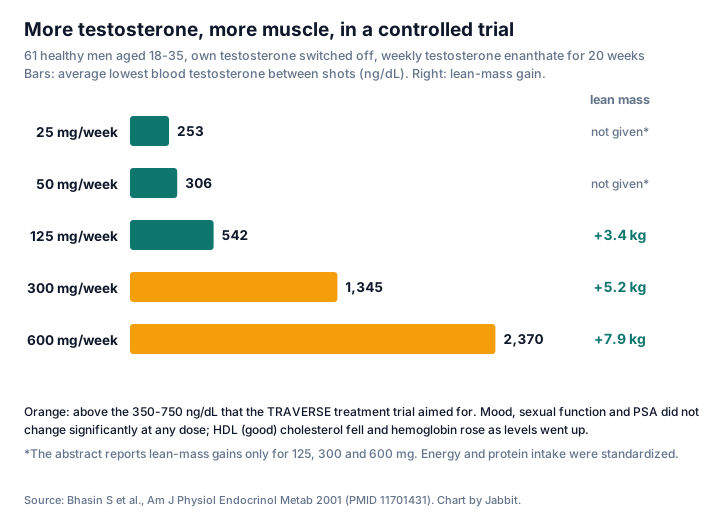
Mood and sex drive barely moved on average in these trials, even at 600 mg.[5][6] In a double-blind trial of 100, 250 and 500 mg a week, one man on 500 mg who did not complete the study had a brief episode resembling “agitated and irritable mania.” The authors warned their study “may significantly underestimate” psychological effects in the community, where people take larger doses of several drugs.[8]
| Effect in healthy young men | What the studies found | Study |
|---|---|---|
| Muscle and strength | Rose with dose: +3.4 kg lean mass at 125 mg/week, +7.9 kg at 600 mg over 20 weeks | Bhasin 2001 (61 men 18–35)[6][5] |
| Sperm production | Stopped in 65% within 6 months at 200 mg/week | WHO contraception trial (271 men)[9] |
| Sperm after stopping (supervised, single drug) | Back to 20 million/mL in 67% by 6 months, 90% by 12, 100% by 24 | Pooled 30 studies (1,549 men)[12] |
| Own testosterone years after steroid cycles | 27% of former users still below normal about 2.5 years later; 0% of non-users | Danish case-control (100 men)[13] |
| Testicle size | Shrank 26% at a year on 200 mg/week; reversible within 6 months | WHO trial side-effect report[11] |
| Red blood cells (hemoglobin, hematocrit) | Rose with dose | Bhasin dose trials[7][6] |
| HDL (good) cholesterol | Fell with dose; −14% to −18% at 200 mg/week in non-Chinese men | Bhasin 2001; WHO trial[6][11] |
| Mood and sex drive | Little change on average up to 500–600 mg/week; one man on 500 mg had a manic-like episode | Bhasin 1996, 2001; Yates 1999[8][6] |
| Breast tissue (gynecomastia) | 24 of 271 men at 200 mg/week | WHO trial side-effect report[11] |
When it doesn’t come back cleanly
The contraception trials stopped at a year or two. The evidence on long-term, self-directed use comes from observational studies of former users, which can’t prove cause and effect and can’t fully account for what else those men took. Here is what they report.
Denmark, 2016. Researchers compared 33 former steroid users, about 2.5 years after stopping, with 30 strength-training men who did not use them. Former users’ median testosterone was 14.4 vs 18.8 nmol/L. 27.2% were below the normal range; none of the comparison men were. Former users also reported more erectile dysfunction (27.3%) and low libido (40.1%).[13]
Massachusetts, 2015. Among 19 untreated former long-term users, 5 had testosterone under 200 ng/dL 3 to 26 months after stopping. The Harvard-led team called withdrawal low testosterone “common, frequently prolonged and associated with substantial morbidity.”[14]
Abu Dhabi, 2022. A single urology clinic followed 520 men who had used steroids within the past year. 94 were infertile at the start. All 33 who had no sperm were still infertile at 12 months despite treatment. The paper calls itself randomized, but 89% of the men ended up on treatment, so its treated-vs-untreated comparison is weak.[15]
In October 2016, FDA approved a class-wide warning for all prescription testosterone labels. It says abuse has been linked to heart attack, heart failure, stroke, depression, aggression, liver toxicity and infertility, and that people coming off high doses report depression, fatigue, irritability, low libido and insomnia. Testosterone is a Schedule III controlled substance.[17]
Our registry check: the recovery trial that never happened
In 2014, an Endocrine Society scientific statement said most performance-drug users are “nonathlete weightlifters” and called for randomized trials of treatments for steroid withdrawal.[16] Twelve years later, we searched ClinicalTrials.gov for studies of steroid users, misuse, withdrawal or steroid-induced low testosterone and read all 24 records.[21]
- 1 randomized, placebo-controlled drug trial to treat low testosterone after steroid use: Copenhagen’s LUCAS trial of letrozole plus hCG. It planned 60 men, started in November 2021, enrolled 8 and was stopped for “Lack of recruitment.” No results are posted.[20]
- 1 randomized harm-reduction trial (a behavioral intervention, not a drug) in São Paulo, not yet recruiting.[21]
- 7 observational studies or cohorts, 3 anti-doping test studies and 12 records that weren’t about steroid users.[21]
Our PubMed search for randomized trials on steroid withdrawal found 8 records, and only the Abu Dhabi study tested a treatment.[21][15] So no plan for recovering after steroids, including “post-cycle therapy,” has randomized-trial support that we could find (our reading of the two databases; a trial outside them could exist).
Strengths and limits
Strengths. The contraception and dose trials were prospective, used measured doses, and followed sperm and hormones closely. The recovery analysis pooled individual data from about 90% of published studies.[12][6][9] The trials show that testosterone does build muscle, which is part of why people take it.[5]
Limits. The trials lasted months, not years, and used one drug. The former-user studies are small and observational, and they rely on what men say they took.[13][14] We read abstracts and registry records, not every full paper. Our registry count depends on search terms and could miss trials registered elsewhere.[21]
Bottom line
Does fertility come back after testosterone? After a supervised course of one drug, the trial record says yes. Sperm returned in 90% of men within a year and in all men within two years, though slower after longer use.[12] After years of self-directed cycles, the record is thinner and less reassuring. A minority of former users still have low testosterone years later, some men with no sperm stay that way, and the one placebo-controlled recovery trial never got going.[13][14][15][20] Testosterone does build muscle, more at higher doses, and the side effects rise with it.[6][7] Guidelines say not to start without confirmed low levels, and not if you want children soon.[19]
If you do keep a record, doses, dates and bloodwork are what a doctor will ask about. Jabbit keeps a private dated log of each injection and site on your iPhone.
Frequently asked questions
- Does testosterone make you infertile?
- It usually stops sperm production while you take it. In a World Health Organization trial, 200 mg of testosterone enanthate a week made 65% of healthy men sperm-free within six months, which is why it was tested as a male contraceptive. In pooled data from 30 such studies (1,549 men), sperm counts came back to 20 million per mL in 67% within 6 months of stopping, 90% within 12 months and all men within 24 months. Recovery was slower after longer use and longer-acting testosterone.
- Will my natural testosterone come back after a cycle?
- After short, supervised use it usually did in the contraception trials. Studies of men who used steroids on their own for years are less reassuring. In a Danish study, 27% of former users still had testosterone below the normal range about 2.5 years after stopping, compared with none of 30 men who never used. In a Massachusetts study, 5 of 19 untreated former long-term users had levels under 200 ng/dL 3 to 26 months after stopping.
- How much muscle does testosterone add?
- In healthy young men it added muscle in proportion to the dose. With their own testosterone switched off, men given 125, 300 or 600 mg of testosterone enanthate a week for 20 weeks gained 3.4, 5.2 and 7.9 kg of lean mass. In a 1996 trial, 600 mg a week plus weight training added 6.1 kg in 10 weeks. The 300 and 600 mg doses produced blood levels far above the 350 to 750 ng/dL range used in the largest treatment trial.
- What are the side effects of testosterone in young men?
- In controlled trials: shrinking testicles (about 26% smaller after a year at 200 mg a week), stopped sperm production, acne, breast tissue growth in some men, lower HDL cholesterol and higher hemoglobin and hematocrit, all rising with dose. Most effects reversed within six months in the WHO trial. FDA’s 2016 label warning adds that abuse, usually at higher doses and with other steroids, has been linked to heart attack, heart failure, stroke, depression, aggression, liver toxicity and infertility.
- Is there a proven way to recover faster after stopping?
- Not from randomized trials. The one placebo-controlled trial we found of a drug treatment for low testosterone after steroid use, Copenhagen’s LUCAS trial of letrozole plus hCG, planned 60 men, enrolled 8 and stopped in 2023 for lack of recruitment, with no results posted. A single-clinic study from Abu Dhabi reported faster recovery in treated men, but nearly all of its men ended up on treatment, and the 33 men with no sperm were all still infertile at 12 months.
- Should I get my testosterone tested before starting?
- The Endocrine Society guideline diagnoses low testosterone only with symptoms plus consistently low fasting morning levels, repeated to confirm, and advises against starting testosterone in men planning to have children soon. Neither man in the New York Post story had a diagnosed deficiency.
References
- Berckelman H. Young men are injecting testosterone to be more ‘masculine’ — without getting doctors involved. New York Post, October 20, 2026, 6:59 AM ET (quotes: young men without diagnosed deficiencies “are increasingly taking testosterone to accelerate their gains, a trend known as ‘testmaxxing’”; one man reports “three hormone cycles over two years”; another uses “a product labeled Pharma Test 250, which lists testosterone enanthate 250 mg/mL as its active ingredient”; Dr. Tim Moss: “You also turn off sperm production” and testosterone and sperm production “can take months or even years to return to normal after stopping”). https://nypost.com/2026/10/20/health/young-men-are-injecting-testosterone-to-be-more-masculine/. Checked October 20, 2026.
- @nypost on X, October 20, 2026, 7:01 AM ET, linking the story (967,032 views, 425 replies, 239 quotes when checked about 8:05 PM ET Oct 20). https://x.com/nypost/status/2112499375071010831. Checked October 20, 2026.
- X trending story, “Young Men Self-Inject Testosterone for Masculinity and Muscle Gains,” updated October 20, 2026 (a summary of posts on X). https://x.com/i/trending/2112681488273850697. Checked October 20, 2026.
- Jabbit count of English original posts on X (no reposts) via the X API recent-counts endpoint, UTC days: posts on testmaxxing or testosterone with fertility, sperm, shutdown, prescriptions or young men, 55–104 a day October 15–19 and 140 on October 20; all posts mentioning testosterone 2,661–3,190 a day October 15–20. Data: testosterone-young-men-fertility-recovery-2026-10-20.json.
- Bhasin S, Storer TW, Berman N, et al. The effects of supraphysiologic doses of testosterone on muscle size and strength in normal men. N Engl J Med. 1996;335(1):1-7. doi:10.1056/NEJM199607043350101. PMID 8637535 (43 men; 600 mg testosterone enanthate or placebo weekly for 10 weeks, with or without lifting; testosterone plus lifting gained 6.1 kg fat-free mass; without lifting, bench press +9 vs −1 kg on placebo; “Neither mood nor behavior was altered in any group”). https://pubmed.ncbi.nlm.nih.gov/8637535/. Checked October 20, 2026.
- Bhasin S, Woodhouse L, Casaburi R, et al. Testosterone dose-response relationships in healthy young men. Am J Physiol Endocrinol Metab. 2001;281(6):E1172-E1181. doi:10.1152/ajpendo.2001.281.6.E1172. PMID 11701431 (61 men aged 18–35; own testosterone suppressed with a GnRH agonist, then 25, 50, 125, 300 or 600 mg testosterone enanthate weekly for 20 weeks; mean nadir testosterone 253, 306, 542, 1,345 and 2,370 ng/dL; fat-free mass +3.4, 5.2 and 7.9 kg at 125, 300 and 600 mg; HDL cholesterol fell and hemoglobin rose with dose; sexual function, mood and PSA did not change significantly at any dose). https://pubmed.ncbi.nlm.nih.gov/11701431/. Checked October 20, 2026.
- Coviello AD, Kaplan B, Lakshman KM, et al. Effects of graded doses of testosterone on erythropoiesis in healthy young and older men. J Clin Endocrinol Metab. 2008;93(3):914-919. doi:10.1210/jc.2007-1692. PMID 18160461 (hemoglobin and hematocrit rose “in a linear, dose-dependent fashion in both young and older men”, more in older men). https://pubmed.ncbi.nlm.nih.gov/18160461/. Checked October 20, 2026.
- Yates WR, Perry PJ, MacIndoe J, et al. Psychosexual effects of three doses of testosterone cycling in normal men. Biol Psychiatry. 1999;45(3):254-260. doi:10.1016/s0006-3223(98)00028-6. PMID 10023498 (healthy men aged 21–40; 100, 250 or 500 mg testosterone cypionate weekly for 14 weeks, double-blind; minimal mood effects in completers; “One noncompleter on 500 mg of testosterone developed a brief syndrome with symptoms similar to an agitated and irritable mania”; the authors say their study “may significantly underestimate the psychological effect of steroid use in the community”). https://pubmed.ncbi.nlm.nih.gov/10023498/. Checked October 20, 2026.
- World Health Organization Task Force on Methods for the Regulation of Male Fertility. Contraceptive efficacy of testosterone-induced azoospermia in normal men. Lancet. 1990;336(8721):955-959. PMID 1977002 (271 fertile men, 200 mg testosterone enanthate weekly; 65% sperm-free by 6 months, mean 120 days; after stopping, median 3.7 months to 20 million/mL and 6.7 months to the man’s own baseline). https://pubmed.ncbi.nlm.nih.gov/1977002/. Checked October 20, 2026.
- World Health Organization Task Force on Methods for the Regulation of Male Fertility. Contraceptive efficacy of testosterone-induced azoospermia and oligozoospermia in normal men. Fertil Steril. 1996;65(4):821-829. PMID 8654646 (399 fertile men, 15 centers in nine countries; 1.4 pregnancies per 100 person-years once counts fell to 3 million/mL or less; after stopping, sperm output recovered and “fertility was demonstrated in 33 couples”). https://pubmed.ncbi.nlm.nih.gov/8654646/. Checked October 20, 2026.
- Wu FC, Farley TM, Peregoudov A, Waites GM; WHO Task Force. Effects of testosterone enanthate in normal men: experience from a multicenter contraceptive efficacy study. Fertil Steril. 1996;65(3):626-636. PMID 8774299 (271 men aged 21–45 on 200 mg weekly; most common side effects painful injections, acne, fatigue and weight gain; gynecomastia in 24 men and prostate problems in 9; testicular volume −26.2% and hemoglobin +7.6% at 360 days; HDL −14% to −18% in non-Chinese men; effects “reversible within 6 months of stopping injections”). https://pubmed.ncbi.nlm.nih.gov/8774299/. Checked October 20, 2026.
- Liu PY, Swerdloff RS, Christenson PD, Handelsman DJ, Wang C; Hormonal Male Contraception Summit Group. Rate, extent, and modifiers of spermatogenic recovery after hormonal male contraception: an integrated analysis. Lancet. 2006;367(9520):1412-1420. doi:10.1016/S0140-6736(06)68614-5. PMID 16650651 (individual data from 30 studies, 1990–2005; 1,549 healthy men aged 18–51; 1,283.5 man-years of treatment; median 3.4 months to 20 million/mL; recovery 67% within 6 months, 90% within 12, 96% within 16, 100% within 24; faster with older age, Asian origin, shorter treatment and shorter-acting testosterone). https://pubmed.ncbi.nlm.nih.gov/16650651/. Checked October 20, 2026.
- Rasmussen JJ, Selmer C, Østergren PB, et al. Former abusers of anabolic androgenic steroids exhibit decreased testosterone levels and hypogonadal symptoms years after cessation: a case-control study. PLoS One. 2016;11(8):e0161208. doi:10.1371/journal.pone.0161208. PMID 27532478 (Denmark; 37 current users, 33 former users about 2.5 years after stopping, 30 controls, all 18–50 and strength-training; former users’ median total testosterone 14.4 vs 18.8 nmol/L; 27.2% of former users below 12.1 nmol/L vs none of the controls; erectile dysfunction 27.3% and decreased libido 40.1% among former users; two authors report research grants from Anti Doping Denmark). https://pubmed.ncbi.nlm.nih.gov/27532478/. Checked October 20, 2026.
- Kanayama G, Hudson JI, DeLuca J, et al. Prolonged hypogonadism in males following withdrawal from anabolic-androgenic steroids: an under-recognized problem. Addiction. 2015;110(5):823-831. doi:10.1111/add.12850. PMID 25598171 (24 former long-term users vs 36 weightlifters who never used; 5 untreated former users had testosterone below 200 ng/dL after 3–26 months off; withdrawal hypogonadism “appears to be common, frequently prolonged and associated with substantial morbidity”). https://pubmed.ncbi.nlm.nih.gov/25598171/. Checked October 20, 2026.
- Al Hashimi M. The deleterious effects of anabolic androgenic steroid abuse on sexual and reproductive health and comparison of recovery between treated and untreated patients: single-center prospective randomized study. Andrologia. 2022;54(11):e14576. doi:10.1111/and.14576. PMID 36065528 (Abu Dhabi clinic; 520 men who had used steroids within a year; 89% ended up on treatment and 11% on observation; of 94 men with infertility, 33 had no sperm, and “all azoospermic’s patients continued to have infertility” at 12 months). https://pubmed.ncbi.nlm.nih.gov/36065528/. Checked October 20, 2026.
- Pope HG Jr, Wood RI, Rogol A, Nyberg F, Bowers L, Bhasin S. Adverse health consequences of performance-enhancing drugs: an Endocrine Society scientific statement. Endocr Rev. 2014;35(3):341-375. doi:10.1210/er.2013-1058. PMID 24423981 (“the vast majority of PED users are not athletes but rather nonathlete weightlifters”; calls for randomized trials of treatments “such as the anabolic-androgen steroid withdrawal syndrome”). https://pubmed.ncbi.nlm.nih.gov/24423981/. Checked October 20, 2026.
- U.S. Food and Drug Administration. Testosterone and other anabolic androgenic steroids (AAS): FDA statement – risks associated with abuse and dependence. Posted October 25, 2016 (class-wide label warning; abuse “usually at doses higher than those typically prescribed and usually in conjunction with other AAS”; reported outcomes include “heart attack, heart failure, stroke, depression, hostility, aggression, liver toxicity, and male infertility”; withdrawal symptoms “depression, fatigue, irritability, loss of appetite, decreased libido, and insomnia”; testosterone is a Schedule III controlled substance). Archived copy: https://web.archive.org/web/20161027052404/https:/www.fda.gov/Safety/MedWatch/SafetyInformation/SafetyAlertsforHumanMedicalProducts/ucm526151.htm. Checked October 20, 2026.
- Lincoff AM, Bhasin S, Flevaris P, et al. Cardiovascular safety of testosterone-replacement therapy. N Engl J Med. 2023;389(2):107-117. doi:10.1056/NEJMoa2215025. PMID 37326322 (gel dose adjusted to keep testosterone between 350 and 750 ng/dL). https://pubmed.ncbi.nlm.nih.gov/37326322/. Checked October 20, 2026.
- Bhasin S, Brito JP, Cunningham GR, et al. Testosterone therapy in men with hypogonadism: an Endocrine Society clinical practice guideline. J Clin Endocrinol Metab. 2018;103(5):1715-1744. doi:10.1210/jc.2018-00229. PMID 29562364 (diagnose only with symptoms and consistently low fasting morning levels; don’t start in men planning fertility in the near term; monitor hematocrit). https://pubmed.ncbi.nlm.nih.gov/29562364/. Checked October 20, 2026.
- ClinicalTrials.gov NCT05205837, the LUCAS trial (Copenhagen University Hospital, Rigshospitalet): randomized, double-blind, placebo-controlled letrozole plus hCG for low testosterone after illicit steroid use; planned 60 men; started November 24, 2021; terminated, “Lack of recruitment”; actual enrollment 8; no results posted. https://clinicaltrials.gov/study/NCT05205837. Checked October 20, 2026.
- Jabbit search of ClinicalTrials.gov (API v2), October 20, 2026, about 8:10 PM ET, for anabolic steroid users, misuse, withdrawal or induced hypogonadism: 24 records, each read by hand. 1 randomized placebo-controlled drug trial to treat steroid-induced low testosterone (NCT05205837); 1 randomized harm-reduction trial, not yet recruiting (https://clinicaltrials.gov/study/NCT07039539); 4 observational studies of steroid users, 3 other observational cohorts, 3 anti-doping test studies, 12 off-topic. A separate search for “post-cycle therapy” found 1 non-randomized study giving supervised performance-enhancing drugs to athletes (https://clinicaltrials.gov/study/NCT07568574, sponsor Enhanced Emirates Limited). A PubMed search for randomized trials on steroid withdrawal found 8 records; 1 tested treatment after steroid use (Al Hashimi 2022). Data: testosterone-young-men-fertility-recovery-2026-10-20.json.
This page analyzes published trials, observational studies, an FDA statement, a clinical guideline, registry records, a news report and posts on X. It is not medical advice and does not recommend starting, stopping or changing testosterone or any other drug; talk with a doctor. The registry and post counts are Jabbit’s own; their inputs are cited above. The people quoted in the New York Post story are described as the paper reported them.