Evidence review · Ozempic, Wegovy and Rybelsus (semaglutide), Zepbound and Mounjaro (tirzepatide), Saxenda and Victoza (liraglutide) · Randomized trials, an animal study, records data, 9 US drug labels, ClinicalTrials.gov review · Sources checked October 20, 2026
Published · Updated
Does microdosing Ozempic, Wegovy, Zepbound or Mounjaro work? Lower doses do something, but the “microdoses” people buy have never been tested in a randomized trial, and the new “low-dose” heart study used about a full Wegovy dose.
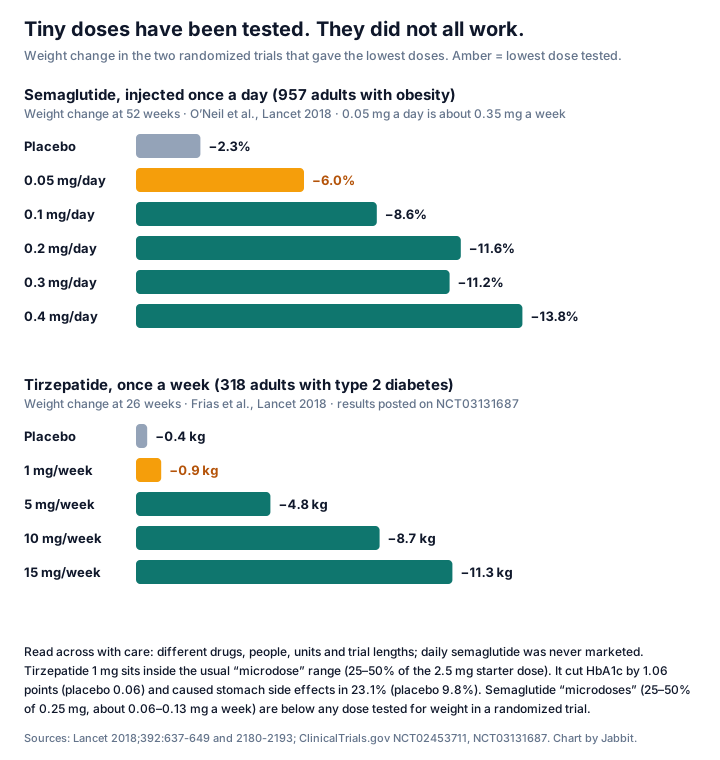
Low doses of GLP-1 drugs aren’t inert. In a Novo Nordisk trial, daily semaglutide as low as 0.05 mg cut weight 6.0% in a year versus 2.3% on placebo, and in a Lilly trial a 1 mg weekly dose of tirzepatide lowered blood sugar almost as much as a standard dose of the diabetes drug dulaglutide.[11][12] The “microdoses” sold online and in clinics are a different matter. That 1 mg of tirzepatide barely moved weight, and the typical semaglutide microdose is below any dose tested for weight loss in a randomized trial.[12][6] This month’s headline, that GLP-1s may protect the heart “at doses too low to produce significant weight loss,” comes from rats and minipigs. In the preprint, the rat dose works out to about 2.4 mg a week in a person, the full Wegovy dose.[1][3][4] We also checked the registry and the labels. Of 15 registered studies that deliberately test lower-than-usual GLP-1 doses, 0 have posted results.[18] Four of the nine labels we read call the starting dose ineffective, titration-only or not approved for maintenance, and four pens’ instructions say not to count clicks.[9]
Why this matters now
On October 13, Cedars-Sinai announced that GLP-1s “may help protect against heart failure even at doses too low to produce significant weight loss.” One of the study’s senior authors said it “opens the door to potentially prescribing GLP-1s at low doses.”[1] The study came out online in the European Heart Journal on October 5.[2] That same day, a pharmacology commentary concluded that “high-quality evidence is essentially absent” for microdosing.[6] Posts about GLP-1 microdosing on X ran at 2 to 10 a day last week.[5] The registry is filling up too. An every-other-week dosing trial was posted on September 21, and a taper trial on October 5.[18] If you’re weighing a smaller dose to save money, cut side effects or chase “longevity,” the useful question is what the evidence shows at the dose you’d actually take.
The short answer
- Some low doses work, but not the ones people call microdoses. Daily semaglutide at 0.05 mg beat placebo. Tirzepatide at 1 mg a week, inside the usual microdose range, barely moved weight.[11][12][6]
- The heart headline doesn’t support microdosing. It’s an animal study, and by the authors’ own scaling the rat dose matches the full Wegovy dose.[3][4][2]
- Stepping down helps more than stopping. Dropping tirzepatide to 5 mg kept off more weight than placebo, but less than staying on full dose.[14]
- The registry has no answers yet. 0 of 15 low-dose studies have posted results, and the only every-other-week trial hasn’t started.[18]
- The pens aren’t built for it. Four pen instructions say don’t count clicks, and Zepbound’s pen holds four fixed doses.[9]
What “microdosing” means
There is no standard definition. An October 2026 commentary in Expert Opinion on Pharmacotherapy describes it as 25% to 50% of the manufacturer’s starting dose, or longer gaps between doses. People get there by counting clicks on multi-dose pens or by spacing injections out.[6] For semaglutide, whose starting dose is 0.25 mg a week, that means roughly 0.06 to 0.13 mg a week. For tirzepatide, starting at 2.5 mg, it means about 0.6 to 1.25 mg.[6][9] A nursing journal report lists the reasons people give: fewer stomach side effects, lower cost and “vanity weight.” It also lists the risks: “pen manipulation, compounded vials, and medication sharing,” and “research-grade” peptides bought online.[7]
PubMed has 13 records that mention microdosing alongside a GLP-1 term. Nine are about the practice: letters, a commentary, a narrative review, a nursing report and one records study. None is a randomized trial.[8]
The lowest doses ever tested in people
- Semaglutide, daily, in obesity (O’Neil 2018). 957 adults took 0.05 to 0.4 mg a day or placebo for a year. Even the lowest dose cut weight 6.0%, versus 2.3% on placebo, and 0.4 mg cut 13.8%. That lowest dose works out to about 0.35 mg a week, a bit above Ozempic’s 0.25 mg starter dose and above typical microdoses. Daily semaglutide injections never reached the market.[11]
- Tirzepatide, weekly, in type 2 diabetes (Frias 2018). 318 adults took 1, 5, 10 or 15 mg, dulaglutide or placebo for 26 weeks. The 1 mg dose lowered HbA1c by 1.06 points, versus 0.06 on placebo, but weight fell just 0.9 kg, versus 0.4 kg on placebo. Only 13.5% lost 5% of their weight. Stomach side effects still hit 23.1% on 1 mg, versus 9.8% on placebo.[12] For scale, 5 mg cut weight 15.0% over 72 weeks in SURMOUNT-1.[13]
- Semaglutide for alcohol use (Hendershot 2025). 48 adults took 0.25 mg, then 0.5 mg, then one week of 1.0 mg. The authors called it “low-dose semaglutide.” It cut alcohol drunk in a lab session and weekly craving, but not drinks per day or drinking days.[15] Those are labeled starter and maintenance doses, not microdoses.
- Heart outcomes. The lowest semaglutide doses shown to cut heart attacks, strokes and cardiovascular deaths are 0.5 and 1.0 mg a week, pooled, in SUSTAIN-6: 6.6% versus 8.9% on placebo in people with type 2 diabetes. Retinopathy complications were higher on the drug.[16]
Records data add a little. Among 490,072 semaglutide users and 322,442 tirzepatide users in one health-records network, about 0.2% and 0.3% met a strict test for staying on the starting dose for six months or more. After a year, they were 2.2% (semaglutide 0.25 mg) and 5.5% (tirzepatide 2.5 mg) lighter on average. The tirzepatide group had more constipation and acute kidney injury than the semaglutide group. The study compared the two low-dose groups with each other, not with placebo, and the authors say the pattern “does not establish” intentional microdosing.[17]
The “low-dose” heart study
The Cedars-Sinai team gave semaglutide to obese rats and minipigs with a stiff-heart form of heart failure (HFpEF). The animals didn’t lose weight, yet their hearts got less stiff and less scarred, and fat around the heart and liver fell.[1][2] The published paper says only that the doses were “empirically determined to be non-weight-loss inducing” and that “future studies are needed to define dose equivalence.”[2]
The preprint version gives the rat dose: 30 nmol/kg twice a week. The authors write that “a common allometric scaling formula suggests this dose would approximate the 2.4 mg/week human dose.” The authors call it low for this model chiefly because these rats, bred to overeat, didn’t lose weight on it; they “continued to gain weight.”[3] We checked that with FDA’s standard body-surface conversion. Divide the rat dose by 6.2 and use FDA’s 60 kg reference adult, and 30 nmol/kg twice a week comes to about 2.4 mg of semaglutide a week, Wegovy’s full dose.[4] Rats aren’t people, and FDA’s conversion is a starting-dose tool, not proof of equal effect. Still, nothing in this study tested a human microdose.[4][2]
What the labels say about low doses
We read the dosing sections and pen instructions of nine current US labels.[9]
| Drug | Starting dose | Lowest maintenance | What the label says |
|---|---|---|---|
| Ozempic | 0.25 mg weekly | 0.5 mg | Start dose is there “to reduce the risk of gastrointestinal adverse reactions.” Pen instructions: don’t set the dose by counting clicks. |
| Wegovy | 0.25 mg weekly | 1.7 mg | Maintenance is “2.4 mg (recommended) or 1.7 mg.” Miss 2 or more doses and you restart the escalation. The 2.4 mg pen: “You can only select 2.4 mg for each dose.” |
| Zepbound | 2.5 mg weekly | 5 mg | “The 2.5 mg dosage is for treatment initiation and is not approved as a maintenance dosage.” If a dose isn’t tolerated, “consider a lower maintenance dosage.” |
| Mounjaro | 2.5 mg weekly | Not specified | Raise in 2.5 mg steps “if additional glycemic control is needed.” No starter-only statement. |
| Rybelsus | 3 mg daily | 7 mg | 3 mg “is not effective for glycemic control.” |
| Victoza | 0.6 mg daily | 1.2 mg | 0.6 mg “is not effective for glycemic control in adults.” Pen: don’t count clicks. |
| Saxenda | 0.6 mg daily | 3 mg | “Lower dosages are for titration only.” Stop if 3 mg isn’t tolerated. Pen: don’t count clicks. |
Four of the nine (Rybelsus, Victoza, Saxenda and Zepbound) say outright that the starting dose is ineffective, for titration only, or not approved for maintenance. Trulicity’s 0.75 mg start is also a maintenance dose, and Foundayo’s 0.8 mg start is part of its escalation.[9] Zepbound and Wegovy both let a prescriber step down, but only to 5 mg and 1.7 mg.[9]
The devices matter too. The instructions for Ozempic, Wegovy, Saxenda and Victoza pens all warn against setting a dose by counting clicks, the microdosing technique the commentary describes.[9][6] Zepbound’s KwikPen holds “4 fixed doses,” with “additional volume to allow for device priming,” and is to be thrown away after four doses “even if there is medicine left in it.”[9] With vials and compounded products, the risk shifts to measuring. In 2024, FDA reported hospitalizations that may be tied to overdoses from compounded semaglutide dosing errors.[10]
What’s being tested now
We searched ClinicalTrials.gov for every study that deliberately gives semaglutide, tirzepatide or liraglutide below its usual dose or schedule, and found 15. They include 3 that use the word “microdosing,” 1 that tests every-other-week dosing, 1 click-based titration, 1 step-down, 4 tapers and 5 fixed “low dose” studies. 0 have posted results.[18]
| Trial | What it tests | Sponsor | People | Status | Main results due | Dose |
|---|---|---|---|---|---|---|
| NCT07092605 | “Microdosed GLP-1” for longevity measures: sublingual or injected compounded semaglutide vs placebo | AgelessRx | 150 | enrolling by invitation | Nov 2025 | not stated |
| NCT07325500 | “Incretin microdosing” after weight loss, people with HIV, vs stopping | UTHealth Houston | 30 | recruiting | May 2028 | 0.5 mg semaglutide weekly |
| NCT07588984 | Noom programs incl. “microdose” compounded semaglutide or tirzepatide (observational) | Noom | 2,310 | not started | May 2029 | not stated |
| NCT07832084 | Stay on full dose vs taper to every other week vs switch to phentermine-topiramate | Jing Luo (investigator) | 60 | not started | Apr 2027 | 0.5 mg semaglutide or 5 mg tirzepatide every 2 weeks |
| NCT07574723 | Click-based, symptom-guided tirzepatide escalation vs per-label | Dasman Diabetes Institute, Kuwait | 68 | recruiting | May 2029 | between labeled steps |
| NCT07294950 | Taper semaglutide 25% every 4 weeks vs abrupt stop | Mount Sinai Hospital, Canada | 98 | recruiting | Sep 2028 | tapering to zero |
| NCT07783854 | Taper semaglutide 1.7 mg by 25% every 8 weeks vs stay on 1.7 mg | Union Hospital, Wuhan | 72 | not started | Dec 2027 | below 1.7 mg |
A few patterns stand out.[18]
- “Microdose” often means a normal dose. The NIH-funded NCT07325500 calls 0.5 mg of semaglutide “microdosing.” That is Ozempic’s lowest maintenance dose. Yale’s alcohol trial (NCT07772960) calls 1.0 mg its “low dose,” and a Bangladesh PCOS trial (NCT06896981) calls 0.5 mg “low-dose.”
- The commercial microdose trials don’t state a dose. AgelessRx’s “microdosed GLP-1” trial (NCT07092605, 150 people) lists compounded semaglutide at 1 mg/mL, sublingual or injected, with no dose. Noom’s 2,310-person study (NCT07588984) is observational, and its “microdose” arms state no dose either.
- The longevity trial measures no aging marker. AgelessRx’s primary outcomes are pain, blood counts “as a measure of immunological health,” basic metabolic labs, mood, heart-rate variability, sleep and activity. It started November 1, 2024, was first posted July 30, 2025, and its estimated primary completion (November 1, 2025) has passed with no results. A second AgelessRx trial, tapering people off semaglutide onto metformin alone or with rapamycin or low-dose naltrexone (NCT07092618), shows the same pattern: started December 2024, posted July 2025, estimated primary completion August 2025, still listed as recruiting.
- Only one trial tests a sub-label schedule for keeping weight off. NCT07832084 will taper 60 people to semaglutide 0.5 mg or tirzepatide 5 mg every other week. Its main outcome is whether people can be recruited and kept in the study, not weight.
- Click dosing is being tested only for escalation. NCT07574723 in Kuwait compares click-based, symptom-guided tirzepatide increases with the label schedule, looking at vomiting.
Every record and the dose each tests are in the source file. These counts are a lower bound. SURMOUNT-MAINTAIN’s record doesn’t use dose-lowering words, so we added it by hand, and others like it may be missed.[18]
Stepping down after weight loss
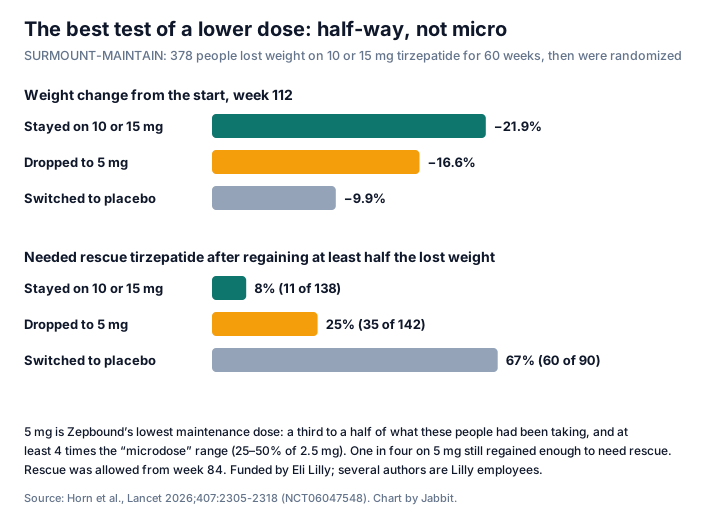
The best evidence on lower doses comes from maintenance. In SURMOUNT-MAINTAIN, 378 people who had lost weight on 10 or 15 mg of tirzepatide for 60 weeks were randomized to stay on that dose, drop to 5 mg, or switch to placebo. At week 112 they were 21.9%, 16.6% and 9.9% below their starting weight. Rescue tirzepatide for regaining at least half the lost weight went to 8%, 25% and 67%.[14] Five mg is a third to a half of what these people had been taking, and at least four times the microdose range.[14][6] For what happens when people stop entirely, see our stopping review.
What the evidence supports
- Labeled lower doses have data. Zepbound 5 mg, Wegovy 1.7 mg and Ozempic 0.5 mg are tested maintenance doses. Ask your prescriber about those before going off-label.[9][14]
- Doses below the starter dose don’t. No randomized trial has tested them for weight, heart or aging outcomes.[18][8][6]
- Don’t count clicks. Four pen instructions say not to, and FDA has linked self-measured compounded doses to hospitalizations.[9][10]
- Side effects don’t vanish at low doses. Stomach side effects were more than twice as common on 1 mg of tirzepatide as on placebo.[12]
- Treat animal “low dose” headlines with care. Check what the dose works out to in people.[3][4]
Strengths and limits
Strengths. The low-dose weight and blood-sugar findings come from randomized, placebo-controlled trials, and SURMOUNT-MAINTAIN randomized people to a lower dose.[11][12][14] The label, registry and PubMed checks are direct reads of primary records.[9][18][8]
Limits. The phase 2 trials are old, short and drug-company funded, and the daily semaglutide regimen was never sold.[11][12] Our dose conversion uses FDA’s generic body-surface formula; drug clearance differs between rats and people.[4][2] The records study has no untreated comparison group.[17] Registry searches miss studies whose records don’t use the words we searched for.[18]
Bottom line
A smaller dose of a GLP-1 drug can still do something, and stepping down to a labeled lower dose after weight loss beat stopping in a large Lilly trial.[11][14] But the microdoses sold for weight, side effects or longevity sit below any dose tested for weight loss in a randomized trial, and nobody has tested them for heart or aging outcomes. The new heart study used a rat dose that scales to about a full Wegovy dose, and the registered microdosing trials have posted nothing.[12][3][4][18]
If you and your prescriber do try a lower dose, the useful data are the same things the trials track: the exact dose, the date of each shot, weight and side effects over time. Jabbit keeps a private, dated log of your doses on your iPhone, so you can see what a change actually did.
Frequently asked questions
- What is GLP-1 microdosing?
- Taking much less of a GLP-1 drug than the label calls for, or taking it less often. An October 2026 pharmacology commentary defines it as 25% to 50% of the manufacturer’s starting dose, or stretching the time between doses. People do it by counting clicks on multi-dose pens, by drawing small amounts from vials, or through compounded products sold as “microdoses.” It is off-label.
- Does microdosing Ozempic or Zepbound work for weight loss?
- Nobody has tested the doses people actually use. The lowest doses ever tested in randomized trials gave mixed results: daily semaglutide at 0.05 mg (about 0.35 mg a week) cut weight 6.0% in a year versus 2.3% on placebo, while tirzepatide at 1 mg a week cut weight just 0.9 kg in 26 weeks versus 0.4 kg on placebo. Typical semaglutide microdoses are lower than any dose tested for weight loss in a randomized trial.
- Does a low dose of semaglutide protect the heart?
- Not shown in people at doses below the label. The Cedars-Sinai study behind this month’s headlines was in rats and minipigs. In the preprint, the rat dose scales to about 2.4 mg a week in a person, the full Wegovy dose, by the authors’ own account and by FDA’s standard conversion. The lowest doses with a proven heart benefit in a big human trial are 0.5 mg and 1.0 mg of semaglutide a week, pooled, in SUSTAIN-6.
- Can I stay on 2.5 mg of Zepbound?
- Zepbound’s label says 2.5 mg is a starting dose and is not approved for maintenance; its lowest maintenance dose is 5 mg. The label does let prescribers consider a lower maintenance dose if a higher one isn’t tolerated. Mounjaro’s diabetes label doesn’t make the same starter-only statement. This is a question for your prescriber.
- Is it safe to count clicks on an Ozempic or Wegovy pen?
- The pen instructions say not to. Ozempic’s says “Do not set the dose by counting the number of clicks you hear,” and Wegovy’s 2.4 mg pen says “You can only select 2.4 mg for each dose.” Zepbound’s KwikPen holds 4 fixed doses plus extra volume for priming. FDA has reported adverse events, some needing hospital care, that may be tied to overdoses when people measured compounded semaglutide doses themselves.
- Can a lower dose help keep weight off after losing it?
- Partly. In SURMOUNT-MAINTAIN, people who stepped down from 10 or 15 mg of tirzepatide to 5 mg kept off more weight than those switched to placebo (16.6% vs 9.9% below their starting weight at 112 weeks), but less than those who stayed on full dose (21.9%). One in four on 5 mg regained enough to need rescue treatment. Several trials testing tapers and every-other-week dosing are just starting.
- Does microdosing GLP-1s slow aging?
- There is no evidence. The only registered trial billed around longevity, run by AgelessRx, measures pain, blood counts, mood, heart-rate variability, sleep and activity, not an aging clock. It was registered about nine months after it started, its planned completion date has passed, and it has posted no results.
References
- Cedars-Sinai Newsroom. Weight loss drugs may protect against heart failure. October 13, 2026 (“Weight loss drugs known as GLP-1s may help protect against heart failure even at doses too low to produce significant weight loss”; Traci Goodchild: “This opens the door to potentially prescribing GLP-1s at low doses to achieve major cardiovascular protection while minimizing common side effects”; NIH-funded; five authors work for Gordian Biotechnology). https://www.cedars-sinai.org/newsroom/weight-loss-drugs-may-protect-against-heart-failure/. Checked October 20, 2026.
- Elbatreek MH, Li Z, Yu X, Gehred ND, et al. Semaglutide, independent of weight loss, attenuates cardiac and hepatic remodelling in experimental heart failure with preserved ejection fraction. Eur Heart J. Published online October 5, 2026. doi:10.1093/eurheartj/ehag732. PMID 42830666 (male ZSF1 obese rats and female minipigs; doses “empirically determined to be non-weight-loss inducing”; the authors write that “future studies are needed to define dose equivalence”). https://pubmed.ncbi.nlm.nih.gov/42830666/. We read the PubMed abstract; the journal page did not load. Checked October 20, 2026.
- Elbatreek MH, et al. Low dose GLP-1 therapy attenuates pathological cardiac and hepatic remodelling in HFpEF independent of weight loss. bioRxiv preprint, September 2025. doi:10.1101/2025.09.26.678829; full text PMC12621885 (rats: “low-dose semaglutide (30 nmol/kg twice weekly)” for 16 weeks; “semaglutide treated rats continued to gain weight”; “While a common allometric scaling formula suggests this dose would approximate the 2.4 mg/week human dose, it is considered a low dose in the ZSF1 obese rat model”). https://pmc.ncbi.nlm.nih.gov/articles/PMC12621885/. Preprint version; the published paper adds minipigs. Checked October 20, 2026.
- US Food and Drug Administration. Guidance for industry: Estimating the maximum safe starting dose in initial clinical trials for therapeutics in adult healthy volunteers. July 2005 (Table 1: to convert a rat dose in mg/kg to a human equivalent dose, divide by 6.2; reference human body weight 60 kg). https://www.fda.gov/media/72309/download. Jabbit arithmetic: 30 nmol/kg × 4,113.58 g/mol (semaglutide’s molecular weight, Ozempic label section 11) = 123.4 µg/kg; ÷ 6.2 = 19.9 µg/kg; × 60 kg = 1.19 mg per dose; twice a week = 2.39 mg a week. Checked October 20, 2026.
- Jabbit count of posts on X (no reposts) pairing microdose, microdosing, “micro dose”, “micro dosing” or microdosed with semaglutide, tirzepatide, Ozempic, Wegovy, Zepbound, Mounjaro, GLP-1 or retatrutide: 10, 5, 5, 9, 2, 7 and 5 a day, October 13 (from 09:00 UTC) through October 19 (UTC days), 43 in all, via the X API recent-counts endpoint. Checked October 20, 2026.
- Beck H, Clements JN. Considerations and challenges in microdosing of GLP-1-based receptor agonists. Expert Opin Pharmacother. Published online October 5, 2026:1-4. doi:10.1080/14656566.2026.2740393. PMID 42788826 (“Microdosing - typically defined as the use of 25-50% of manufacturer-recommended starting doses or extended dosing intervals”; “Techniques include ‘click counting’ with multidose pens or extended-interval dosing”; “high-quality evidence is essentially absent”; concerns about “compounded products, nonstandard dose measurement, and dosing accuracy”). https://pubmed.ncbi.nlm.nih.gov/42788826/. Checked October 20, 2026.
- Trainer N. The “microdosing” dilemma: balancing patient anecdotes with clinical safety amid GLP-1 compounding restrictions. J Am Assoc Nurse Pract. Published online May 26, 2026. doi:10.1097/JXX.0000000000001296. PMID 42201545 (drivers include “gastrointestinal tolerability and ‘vanity weight’”; risks of “pen manipulation, compounded vials, and medication sharing” and “illicit ‘research-grade’ peptides”). https://pubmed.ncbi.nlm.nih.gov/42201545/. Checked October 20, 2026.
- Jabbit PubMed search, October 20, 2026: microdos*[tiab] AND (semaglutide[tiab] OR tirzepatide[tiab] OR GLP-1[tiab] OR GLP-1RA[tiab] OR incretin[tiab] OR liraglutide[tiab]) returned 13 records. 9 are about GLP-1 microdosing as practiced: 5 letters or perspectives (PMIDs 42892786, 42571951, 42244165, 40540673, 39808463), 1 commentary (42788826), 1 narrative review (42668762), 1 nursing report (42201545) and 1 records study (42857675). None is a randomized trial. The other 4 are about anti-doping, phase-0 drug studies, microneedles and psilocybin. List: https://jabbitapp.com/research/sources/glp1-microdose-ctgov-labels-2026-10-20.json. Checked October 20, 2026.
- Jabbit scan of the current DailyMed prescribing information and instructions for use: Ozempic (v20, June 1, 2026; https://dailymed.nlm.nih.gov/dailymed/drugInfo.cfm?setid=adec4fd2-6858-4c99-91d4-531f5f2a2d79), Wegovy (v19, June 18, 2026; https://dailymed.nlm.nih.gov/dailymed/drugInfo.cfm?setid=ee06186f-2aa3-4990-a760-757579d8f77b), Rybelsus (v14, January 30, 2026), Zepbound (v40, August 28, 2026; https://dailymed.nlm.nih.gov/dailymed/drugInfo.cfm?setid=487cd7e7-434c-4925-99fa-aa80b1cc776b), Mounjaro (v40, August 27, 2026; https://dailymed.nlm.nih.gov/dailymed/drugInfo.cfm?setid=d2d7da5d-ad07-4228-955f-cf7e355c8cc0), Saxenda (v22, February 25, 2026), Victoza (v31, October 14, 2025), Trulicity (v62, June 16, 2026) and Foundayo (v10, July 29, 2026). Quotes used: Zepbound “The 2.5 mg dosage is for treatment initiation and is not approved as a maintenance dosage” and “If patients do not tolerate a maintenance dosage, consider a lower maintenance dosage”; Rybelsus 3 mg and Ozempic tablets 1.5 mg “not effective for glycemic control”; Victoza 0.6 mg “is not effective for glycemic control in adults”; Saxenda “lower dosages are for titration only” and “Discontinue SAXENDA if the patient cannot tolerate the 3 mg dosage”; Ozempic 0.25 mg start, escalation “to reduce the risk of gastrointestinal adverse reactions”; Mounjaro “If additional glycemic control is needed, increase the dosage in 2.5 mg increments”; Wegovy maintenance “either 2.4 mg (recommended) or 1.7 mg” and “If 2 or more consecutive doses of WEGOVY injection are missed, reinitiate dosage escalation.” Instructions for use: Ozempic, Wegovy FlexTouch, Saxenda and Victoza pens say not to set the dose by counting clicks (Ozempic: “Do not set the dose by counting the number of clicks you hear”; Wegovy: “You can only select 2.4 mg for each dose”); Zepbound KwikPen: “Each pen contains 4 fixed doses,” “turn the dose knob all the way until it stops,” “contains additional volume to allow for device priming,” and throw it away “after taking 4 weekly doses, even if there is medicine left in it.” Set IDs for all 9: https://jabbitapp.com/research/sources/glp1-microdose-ctgov-labels-2026-10-20.json. Checked October 20, 2026.
- US Food and Drug Administration. FDA alerts health care providers, compounders and patients of dosing errors associated with compounded injectable semaglutide products. July 26, 2024 (“FDA has received reports of adverse events, some requiring hospitalization, that may be related to overdoses due to compounded semaglutide dosing errors. Errors resulted from patients measuring and self-administering incorrect doses and health care providers miscalculating doses.”). https://www.fda.gov/drugs/human-drug-compounding/fda-alerts-health-care-providers-compounders-and-patients-dosing-errors-associated-compounded. Checked October 20, 2026.
- O’Neil PM, Birkenfeld AL, McGowan B, et al. Efficacy and safety of semaglutide compared with liraglutide and placebo for weight loss in patients with obesity: a randomised, double-blind, placebo and active controlled, dose-ranging, phase 2 trial. Lancet. 2018;392(10148):637-649. doi:10.1016/S0140-6736(18)31773-2. PMID 30122305; NCT02453711 (957 adults with obesity, no diabetes; daily semaglutide 0.05, 0.1, 0.2, 0.3 or 0.4 mg; 52-week weight change −6.0%, −8.6%, −11.6%, −11.2%, −13.8% vs −2.3% placebo; all doses significant vs placebo; liraglutide 3.0 mg −7.8%; Novo Nordisk funded). https://pubmed.ncbi.nlm.nih.gov/30122305/. Checked October 20, 2026.
- Frias JP, Nauck MA, Van J, et al. Efficacy and safety of LY3298176, a novel dual GIP and GLP-1 receptor agonist, in patients with type 2 diabetes: a randomised, placebo-controlled and active comparator-controlled phase 2 trial. Lancet. 2018;392(10160):2180-2193. doi:10.1016/S0140-6736(18)32260-8. PMID 30293770. Results posted on NCT03131687 (318 adults with type 2 diabetes; 26-week weight change: tirzepatide 1 mg −0.9 kg, 5 mg −4.8, 10 mg −8.7, 15 mg −11.3, dulaglutide 1.5 mg −2.7, placebo −0.4; HbA1c −1.06 points on 1 mg vs −0.06 on placebo; 13.5% on 1 mg lost at least 5% of body weight; gastrointestinal adverse events 23.1% on 1 mg, 66.0% on 15 mg, 9.8% on placebo; Eli Lilly funded). https://pubmed.ncbi.nlm.nih.gov/30293770/. Checked October 20, 2026.
- Jastreboff AM, Aronne LJ, Ahmad NN, et al. Tirzepatide once weekly for the treatment of obesity. N Engl J Med. 2022;387(3):205-216. doi:10.1056/NEJMoa2206038. PMID 35658024 (72-week weight change −15.0% on 5 mg, −19.5% on 10 mg, −20.9% on 15 mg, −3.1% on placebo). https://pubmed.ncbi.nlm.nih.gov/35658024/. Used here only as a comparison. Checked October 20, 2026.
- Horn DB, Aronne LJ, Wharton S, et al. Tirzepatide for maintenance of bodyweight reduction in people with obesity in the USA (SURMOUNT-MAINTAIN): a multicentre, double-blind, randomised, placebo-controlled trial. Lancet. 2026;407(10545):2305-2318. doi:10.1016/S0140-6736(26)00656-2. PMID 42119587; NCT06047548 (441 enrolled; after 60 weeks on 10 or 15 mg, 378 randomized 3:3:2 to stay on that dose, drop to 5 mg, or switch to placebo; week-112 weight change −21.9%, −16.6% and −9.9%; rescue tirzepatide after regaining at least 50% of lost weight 11 of 138 (8%), 35 of 142 (25%), 60 of 90 (67%); rescue allowed from week 84; Eli Lilly funded, several authors Lilly employees). https://pubmed.ncbi.nlm.nih.gov/42119587/. Checked October 20, 2026.
- Hendershot CS, Bremmer MP, Paladino MB, et al. Once-weekly semaglutide in adults with alcohol use disorder: a randomized clinical trial. JAMA Psychiatry. 2025;82(4):395-405. doi:10.1001/jamapsychiatry.2024.4789. PMID 39937469; NCT05520775 (48 adults; semaglutide 0.25 mg for 4 weeks, 0.5 mg for 4 weeks, 1.0 mg for 1 week, or placebo; “Low-dose semaglutide reduced the amount of alcohol consumed” in a lab drinking session, β −0.48, and weekly craving; no effect on drinks per day or number of drinking days). https://pubmed.ncbi.nlm.nih.gov/39937469/. Checked October 20, 2026.
- Marso SP, Bain SC, Consoli A, et al. Semaglutide and cardiovascular outcomes in patients with type 2 diabetes. N Engl J Med. 2016;375(19):1834-1844. doi:10.1056/NEJMoa1607141. PMID 27633186 (3,297 people; semaglutide 0.5 or 1.0 mg weekly vs placebo; heart attack, stroke or cardiovascular death 6.6% vs 8.9%, HR 0.74, 95% CI 0.58–0.95; retinopathy complications HR 1.76). https://pubmed.ncbi.nlm.nih.gov/27633186/. Checked October 20, 2026.
- Murugadoss K, Venkatakrishnan AJ, Soundararajan V. Comparison of cardiometabolic benefits and tolerability in patients on sustained low doses of semaglutide or tirzepatide. Biol Methods Protoc. 2026;11(1):bpag048. doi:10.1093/biomethods/bpag048. PMID 42857675 (EHR records of 29 million patients; 814 of 490,072 semaglutide users and 1,016 of 322,442 tirzepatide users had at least three 0.25 mg or 2.5 mg prescriptions spanning at least 6 months, a pattern that “may overlap with, but does not establish, intentional microdosing”; mean 12-month weight change −2.2% on low-dose semaglutide vs −5.5% on low-dose tirzepatide; low-dose tirzepatide vs low-dose semaglutide: constipation 32.6% vs 22.4%, acute kidney injury 2.7% vs 0.4%; authors are nference employees). https://pubmed.ncbi.nlm.nih.gov/42857675/. Checked October 20, 2026.
- Jabbit review of ClinicalTrials.gov (API v2), pulled October 20, 2026, about 4:09 AM ET: every study listing semaglutide (788), tirzepatide (303) or liraglutide (515) as an intervention, plus free-text pulls pairing GLP-1 names with microdose, low-dose, taper, interval and maintenance-dose words: 1,708 unique records. 240 used dose-lowering language and were read by hand. 15 deliberately give a GLP-1 drug below its usual dose or schedule: 3 named microdosing, 1 every-other-week, 1 click-based titration, 1 step-down maintenance (SURMOUNT-MAINTAIN, added by hand because its record doesn’t use these words), 4 tapers and 5 fixed “low dose” studies. 0 of 15 have results posted on the registry. Lower bound; every study, the dose it tests and our reasons: https://jabbitapp.com/research/sources/glp1-microdose-ctgov-labels-2026-10-20.json. Checked October 20, 2026.
This page analyzes published trials, an animal study and its preprint, a records study, drug labels, FDA documents and trial-registry records. It is not medical advice and not a dosing guide. It does not recommend any drug, dose, schedule or product. Don’t change your dose without your prescriber. The label, registry and PubMed reviews and the dose conversion are Jabbit’s own; their inputs are cited above.