Evidence teardown · Wegovy · Semaglutide · Rezdiffra · Resmetirom · Fatty liver (MASH) · Healthy aging · Updated October 29, 2026
Published · Updated
Does Wegovy treat fatty liver, and is it better than Rezdiffra? Both Wegovy (semaglutide) and Rezdiffra (resmetirom) are FDA-approved for MASH, the inflamed, scarring form of fatty liver, in adults with moderate to advanced scarring but not cirrhosis. Both approvals rest on biopsy improvements, not yet on fewer liver failures or deaths, and no randomized trial has compared the two directly.
If you have been told you have fatty liver, the question is usually simple: does Wegovy fix it, and is it better than Rezdiffra, the first drug approved for it? Our plain answer: both are approved for the same group, adults with MASH and stage F2 to F3 scarring but no cirrhosis, and both beat placebo on liver biopsies in their main trials.[3][7][4][8] Which one fits depends on your weight, diabetes and heart risk, side effects and what you already take. Neither has yet shown that it prevents cirrhosis, liver cancer, transplant or death.[3][7]
Why this matters now
On October 28, 2026, Novo Nordisk announced 12 abstracts for The Liver Meeting (AASLD), November 5 to 9 in Denver. They include PLATINUM-Truveta, a study of health records from 30 US health systems that “compared the effectiveness of semaglutide 2.4 mg and resmetirom on liver enzymes and cardiometabolic markers.” It is a poster on November 6.[1] That is the first comparison of the two drugs we are aware of, and it is likely to be quoted as “Wegovy vs Rezdiffra” before anyone sees the full poster. Novo’s own release adds the right caveat: “while associations can be demonstrated, causal relationships cannot be definitively established.”[1] Meanwhile the European liver, diabetes and obesity societies (EASL, EASD and EASO) have published joint 2026 guidance on choosing between the two.[11] This page is the background you need to read next week’s headlines.
Wegovy vs Rezdiffra at a glance
| Wegovy (semaglutide) | Rezdiffra (resmetirom) | |
|---|---|---|
| Maker | Novo Nordisk[2] | Madrigal Pharmaceuticals[7] |
| What it is | Weekly GLP-1 injection. FDA says it “promotes weight loss and potentially other mechanisms not fully understood”[2] | Daily pill that partly activates a thyroid hormone receptor in the liver, which FDA says “reduces liver fat accumulation”[6] |
| FDA MASH approval | August 15, 2025, accelerated approval (injection only)[2][3] | March 14, 2024, accelerated approval[6][7] |
| Who it’s for | Adults with noncirrhotic MASH and F2 to F3 fibrosis, with diet and exercise[3] | The same group[7] |
| Pivotal trial | ESSENCE: 800 patients, biopsy at 72 weeks[4] | MAESTRO-NASH: 966 patients, biopsy at 52 weeks[8] |
| Weight change in that trial | −10.5% vs −2.0% on placebo[4] | Weight is not reported in the trial abstract; LDL cholesterol fell 13.6% to 16.3% vs 0.1% on placebo at 24 weeks[8] |
| Other approved uses | Weight management and cutting heart attack and stroke risk in people with heart disease and obesity or overweight[3] | None[7] |
| Main label safety points | Stomach side effects; more fractures and high lipase readings than placebo in the MASH trial[3] | Liver injury warning, gallbladder events, drug interactions[7] |
| Liver outcomes trial | ESSENCE part 2, to 240 weeks; primary completion estimated April 2029[5] | MAESTRO-NASH-OUTCOMES in compensated cirrhosis; estimated December 2026[10] |
Timeline
| Date | Event |
|---|---|
| Feb 2024 | MAESTRO-NASH results published in NEJM.[8] |
| Mar 14, 2024 | FDA approves Rezdiffra, the first MASH drug.[6] |
| 2024 | Lilly’s phase 2 tirzepatide MASH trial (SYNERGY-NASH) published.[12] |
| 2025 | ESSENCE part 1 published in NEJM.[4] |
| Aug 15, 2025 | FDA approves Wegovy injection for MASH.[2] |
| 2026 | EASL-EASD-EASO guidance on choosing between the two.[11] |
| Oct 28, 2026 | Novo previews 12 AASLD abstracts, including the PLATINUM-Truveta comparison.[1] |
| Nov 6 and 8, 2026 | PLATINUM-Truveta poster; ESSENCE BMI under 27 oral presentation.[1] |
| Dec 2026 (est.) | MAESTRO-NASH-OUTCOMES primary completion, per its registry record.[10] |
| Apr 2029 (est.) | ESSENCE primary completion, including liver outcomes.[5] |
What the biopsy trials showed
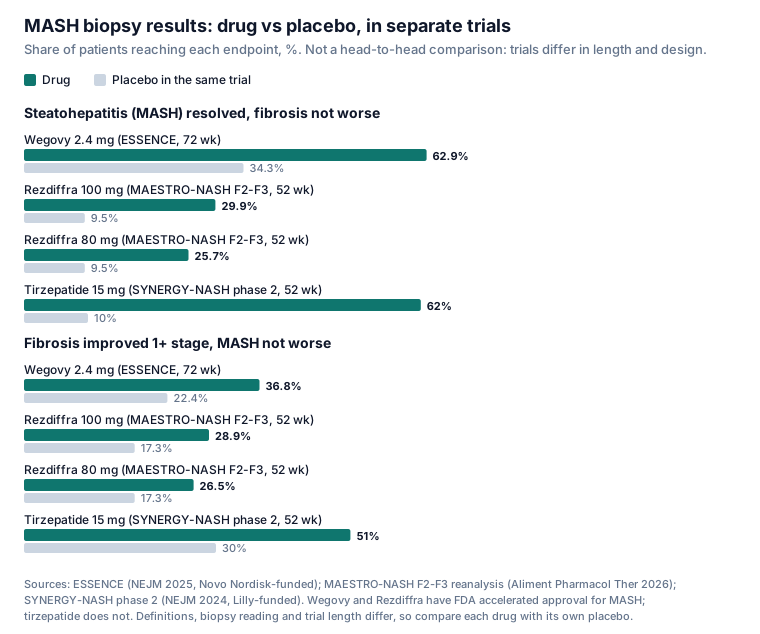
- Wegovy (ESSENCE). At 72 weeks, MASH resolved without worse scarring in 62.9% on semaglutide 2.4 mg vs 34.3% on placebo, a difference of 28.7 points. Scarring improved without worse MASH in 36.8% vs 22.4%, a difference of 14.4 points. Both were statistically significant. Weight fell 10.5% vs 2.0%. The trial was funded by Novo Nordisk.[4]
- Rezdiffra (MAESTRO-NASH). At 52 weeks, MASH resolved in 25.9% (80 mg) and 29.9% (100 mg) vs 9.7% on placebo, and scarring improved in 24.2% and 25.9% vs 14.2%. Serious adverse events were similar across groups (10.9%, 12.7% and 11.5%). The trial was funded by Madrigal.[8] In a later analysis limited to the 917 patients with F2 or F3 scarring, the label population, the figures were 25.7% and 29.9% vs 9.5% for MASH resolution and 26.5% and 28.9% vs 17.3% for scarring.[9]
- How much better than placebo. Our arithmetic from the published percentages: about 29 points (MASH) and 14 points (scarring) for Wegovy, and about 16 to 20 points (MASH) and 9 to 12 points (scarring) for Rezdiffra in the F2 to F3 group.[4][9]
Why you can’t just compare the numbers
Our reading: Wegovy’s bars look taller, but that is not proof it works better. The trials ran different lengths (72 vs 52 weeks), enrolled somewhat different patients, and defined and scored biopsy results differently; MAESTRO-NASH’s main definition of MASH resolution also required a 2-point drop in a disease activity score.[4][8] The placebo groups tell the story: 34% of people on placebo in ESSENCE met the MASH endpoint, compared with about 10% in MAESTRO-NASH.[4][8] When placebo groups differ that much, the trials are not measuring on the same scale. Both drug labels contain the standard warning that rates from different trials “cannot be directly compared.”[3][7] Only a randomized head-to-head trial could settle it, and a ClinicalTrials.gov search on October 29, 2026 found none registered.
Side effects and safety
Wegovy. The label says side effects in the MASH trial were in line with Wegovy’s other uses, which are mostly stomach effects such as nausea, diarrhea, vomiting and constipation.[3][2] Two MASH-specific findings are worth knowing. Fractures occurred in 4.4% on Wegovy vs 3.3% on placebo, and lipase (a pancreas enzyme) rose above three times normal in 4.7% vs 1.3%.[3] The label says there is “limited information in patients with MASH and a BMI <25,” and that the Wegovy pill and the 7.2 mg injection have not been established in MASH.[3] Only 3% of ESSENCE patients had “lean MASH.”[3] Wegovy carries the class warning about thyroid C-cell tumors and should not be used by people with a personal or family history of medullary thyroid cancer or MEN 2.[2][3] For MASH, the label says to use it in pregnancy “only if the potential benefit justifies the potential risk to the fetus.”[3]
Rezdiffra. The most common side effects were diarrhea, nausea, itching, vomiting, constipation, abdominal pain and dizziness, and more people stopped the drug because of side effects than on placebo (about 5 and 8 vs 4 per 100 patient-years).[7] The label warns about liver injury. One patient developed what looked like “drug-induced autoimmune-like hepatitis,” with ALT peaking at 58 times normal; it resolved after stopping. The label tells doctors to monitor liver tests.[7] Gallstones, gallbladder inflammation and gallstone pancreatitis were more common than on placebo.[7] Rezdiffra also interacts with some common drugs: the label caps doses of some statins and advises against combining it with strong CYP2C8 inhibitors such as gemfibrozil. Your pharmacist can check your list.[7]
Which one? What the 2026 guidance says
The joint EASL-EASD-EASO guidance recommends drug treatment for adults with non-cirrhotic MASH and F2 to F3 fibrosis, “alongside structured lifestyle intervention.”[11] On choosing, it says semaglutide “may be preferred in adults with obesity or T2D as well as with established cardiovascular disease or high cardiovascular risk because of its cardiometabolic benefits, whereas resmetirom may be prioritised in individuals without obesity or those already receiving or intolerant to GLP-1RAs.”[11] It also recommends “nutritional and sarcopenia assessment during semaglutide,” a nod to muscle loss during rapid weight loss.[11] The guidance says noninvasive tests such as elastography can replace a biopsy to find people at high risk.[11] Our reading: for the many people with MASH who also have obesity or diabetes, the guidance leans toward Wegovy. Rezdiffra fills the gap for people who don’t need to lose weight or already take a GLP-1 drug.
What about Zepbound, Mounjaro and newer drugs?
Tirzepatide (Zepbound, Mounjaro) is not approved for MASH. In Lilly’s 190-person phase 2 trial, MASH resolved in 62% on the 15 mg dose vs 10% on placebo at 52 weeks. The authors say “larger and longer trials are needed.”[12] Lilly lists a phase 3 MASH program as recruiting, with an estimated primary completion of August 2030.[13] Efruxifermin, an FGF21-based injection that Novo now presents as part of its portfolio, missed its 36-week goal in compensated cirrhosis but showed more fibrosis improvement than placebo at 96 weeks on the higher dose (29% vs 11%) in an Akero-funded phase 2b trial.[14][1] It is investigational, and its phase 3 trial in non-cirrhotic MASH is not expected to finish until 2033, per its registry record.[15]
Cirrhosis is a different question
Neither drug is approved for MASH with cirrhosis. Rezdiffra’s label says to avoid it in decompensated cirrhosis.[7] The 2026 guidance says that in MASH cirrhosis, resmetirom or semaglutide “appear safe but should not be used as MASH-targeted treatment, until further data establish liver-related benefits.”[11] The first big test is Madrigal’s MAESTRO-NASH-OUTCOMES trial in compensated cirrhosis, estimated to reach primary completion in December 2026, per its registry record.[10]
The longevity question
For healthy aging, the point of treating MASH is to prevent cirrhosis, liver cancer, transplant and early death. MASH also travels with heart disease. Both approvals are accelerated, meaning they rest on biopsy changes, and both labels say continued approval may depend on confirmatory trials.[3][7] FDA says ESSENCE will continue to 240 weeks “to determine whether inflammation and scarring improvements seen after 72 weeks translate into decreases in death, liver transplant, and other liver-related events.”[2] Our reading: Wegovy starts with an advantage that has nothing to do with the liver: its label already includes cutting the risk of heart attack, stroke and cardiovascular death in people with heart disease and obesity or overweight.[3] Whether either drug reduces liver deaths is still unproven.
What to watch at AASLD next week
- PLATINUM-Truveta (November 6). 2,873 people starting semaglutide 2.4 mg vs 2,285 starting resmetirom, comparing liver enzymes, weight, A1C and other markers at 3 and 6 months, with statistical weighting to reduce confounding.[1] Liver enzymes are not biopsies, six months is short, and Novo lists the limits itself: possible “unmeasured confounding,” short follow-up and coding errors in health records.[1] The study comes from Novo, which makes one of the two drugs; we will read the poster before drawing conclusions.
- ESSENCE in BMI under 27 (November 8). A post hoc analysis that Novo calls “hypothesis generating.”[1] It matters because the label notes limited data in leaner patients.[3]
- RHODIUM-2. 2,479 people starting semaglutide vs 70,702 who did not, also from health records.[1]
- Efruxifermin. Four abstracts, including new analyses from the SYMMETRY cirrhosis trial.[1]
FAQ
- Does Wegovy treat fatty liver disease?
- Yes, for one group. Since August 15, 2025, Wegovy injection has been FDA-approved for adults with MASH (the inflamed form of fatty liver) and moderate to advanced scarring (stage F2 or F3), not cirrhosis, alongside diet and exercise. It is an accelerated approval based on liver biopsy results; the trial is still running to see whether it prevents liver failure, transplant or death.
- Is Wegovy better than Rezdiffra for MASH?
- Nobody knows yet, because no randomized trial has compared them. In separate trials, each beat its own placebo on liver biopsy results. Wegovy also causes meaningful weight loss and has heart benefits on its label, which is why 2026 European guidance says it may be preferred for people with obesity, type 2 diabetes or heart disease, and that Rezdiffra may be prioritized for people without obesity or who already take, or cannot tolerate, a GLP-1 drug.
- What are the side effects of Rezdiffra vs Wegovy?
- Wegovy’s are mainly stomach side effects such as nausea, diarrhea, vomiting and constipation; in its MASH trial, fractures and high lipase readings were also somewhat more common than on placebo. Rezdiffra’s most common are diarrhea, nausea, itching, vomiting, constipation, abdominal pain and dizziness. Its label warns about liver injury, after one patient developed a drug-induced autoimmune-like hepatitis, and about gallbladder problems. Rezdiffra also interacts with some statins and other drugs.
- Does Zepbound or Mounjaro treat MASH?
- Tirzepatide is not FDA-approved for MASH. In a 190-person phase 2 trial funded by Lilly, more people on tirzepatide had MASH resolve on biopsy at 52 weeks than on placebo. Lilly lists a larger phase 3 program as recruiting, with results not expected until around 2030 per its registry record.
- Can Wegovy or Rezdiffra be used for cirrhosis?
- Neither is approved for MASH cirrhosis, and Rezdiffra’s label says to avoid it in decompensated cirrhosis. The 2026 EASL-EASD-EASO guidance says the two appear safe in compensated cirrhosis but should not be used as MASH-targeted treatment there until data show liver-related benefits. A Rezdiffra outcomes trial in compensated cirrhosis is listed with an estimated primary completion in December 2026.
- What is Novo presenting at AASLD 2026?
- Novo Nordisk says it will present 12 abstracts at The Liver Meeting, November 5 to 9, 2026, in Denver. They include PLATINUM-Truveta, a health-records study comparing semaglutide 2.4 mg with resmetirom on liver enzymes and other markers (poster, November 6), and a post hoc ESSENCE analysis in people with a BMI under 27 (November 8). Novo itself says real-world studies cannot establish cause and effect.
Bottom line
Wegovy and Rezdiffra are both approved options for MASH with F2 to F3 scarring, and each clearly beat placebo on liver biopsies in its own trial.[4][8] The trials can’t tell you which is better. Current guidance points people with obesity, diabetes or heart disease toward semaglutide and others toward resmetirom.[11] Neither has shown yet that it prevents liver failure or death, and neither is a MASH treatment in cirrhosis.[3][7][11] Next week’s AASLD data from Novo are real-world liver-enzyme comparisons from the maker of one of the drugs, not a trial, so treat them as a clue rather than an answer.[1]
References
- Novo Nordisk. “Novo to present new liver data across Wegovy 2.4 mg and investigational efruxifermin at The Liver Meeting AASLD 2026.” PR Newswire, October 28, 2026. 12 abstracts, November 5-9, Denver; PLATINUM-Truveta (semaglutide 2.4 mg n=2,873 vs resmetirom n=2,285, de-identified records from 30 US health systems, June 2021-March 2026, liver enzymes and cardiometabolic markers at 3 and 6 months; poster 2461, November 6), RHODIUM-2, ESSENCE post hoc BMI <27 (oral 0072, November 8), efruxifermin (four abstracts). Company statement: “while associations can be demonstrated, causal relationships cannot be definitively established.” https://www.prnewswire.com/news-releases/novo-to-present-new-liver-data-across-wegovy-2-4-mg-and-investigational-efruxifermin-at-the-liver-meeting-aasld-2026--302922177.html. Checked October 29, 2026.
- US Food and Drug Administration. “FDA Approves Treatment for Serious Liver Disease Known as ‘MASH’.” Content current as of August 15, 2025. Wegovy injection approved for MASH with moderate-to-advanced fibrosis under accelerated approval; ESSENCE interim analysis at week 72; trial continues to 240 weeks. https://www.fda.gov/drugs/news-events-human-drugs/fda-approves-treatment-serious-liver-disease-known-mash. Checked October 29, 2026.
- Wegovy (semaglutide) injection and tablets US prescribing information, Novo Nordisk, revised 06/2026. Indications and usage (MASH, accelerated approval); adverse reactions (MASH trial: fractures 4.4% vs 3.3%; lipase >3x ULN 4.7% vs 1.3%; “limited information in patients with MASH and a BMI <25 kg/m2”; tablets and 7.2 mg injection not established in MASH); pregnancy (8.1); Study 11 baseline characteristics and Table 21. https://www.novo-pi.com/wegovy.pdf. Checked October 29, 2026.
- Sanyal AJ, Newsome PN, Kliers I, et al. Phase 3 Trial of Semaglutide in Metabolic Dysfunction-Associated Steatohepatitis. N Engl J Med. 2025;392(21):2089-2099. PMID 40305708. doi:10.1056/NEJMoa2413258. ESSENCE part 1, week 72, 800 patients (534 semaglutide, 266 placebo); funded by Novo Nordisk. https://pubmed.ncbi.nlm.nih.gov/40305708/. Checked October 29, 2026.
- ClinicalTrials.gov record NCT04822181 (ESSENCE), API v2, read October 29, 2026: sponsor Novo Nordisk A/S; status Active, not recruiting; actual enrollment 1,205; estimated primary completion April 25, 2029. https://clinicaltrials.gov/study/NCT04822181. Checked October 29, 2026.
- US Food and Drug Administration. “FDA Approves First Treatment for Patients with Liver Scarring Due to Fatty Liver Disease.” News release, March 14, 2024 (Rezdiffra). https://www.fda.gov/news-events/press-announcements/fda-approves-first-treatment-patients-liver-scarring-due-fatty-liver-disease. Checked October 29, 2026.
- Rezdiffra (resmetirom) tablets US prescribing information, Madrigal Pharmaceuticals, DailyMed set e67ea09f-a840-439c-86c8-f98585f978b2, version effective July 29, 2026 (read via openFDA). Indications (accelerated approval; avoid in decompensated cirrhosis); warnings 5.1 hepatotoxicity and 5.2 gallbladder-related adverse reactions; adverse reactions 6.1; drug interactions 7; clinical studies 14. https://dailymed.nlm.nih.gov/dailymed/drugInfo.cfm?setid=e67ea09f-a840-439c-86c8-f98585f978b2. Checked October 29, 2026.
- Harrison SA, Bedossa P, Guy CD, et al. A Phase 3, Randomized, Controlled Trial of Resmetirom in NASH with Liver Fibrosis. N Engl J Med. 2024;390(6):497-509. PMID 38324483. doi:10.1056/NEJMoa2309000. MAESTRO-NASH, week 52, 966 patients (F1B-F3); funded by Madrigal Pharmaceuticals. https://pubmed.ncbi.nlm.nih.gov/38324483/. Checked October 29, 2026.
- Mironova M, Padmanabhan K, Schneider D, et al. Phase 3 Trial of Resmetirom Versus Placebo in Metabolic Dysfunction-Associated Steatohepatitis: Reanalysis of Fibrosis Stage 2-3 Subset. Aliment Pharmacol Ther. 2026;64(7):919-929. PMID 42527732. doi:10.1111/apt.70888. Post hoc analysis of 917 MAESTRO-NASH patients with F2 or F3 fibrosis. https://pubmed.ncbi.nlm.nih.gov/42527732/. Checked October 29, 2026.
- ClinicalTrials.gov record NCT05500222 (MAESTRO-NASH-OUTCOMES), API v2, read October 29, 2026: resmetirom vs placebo “on Liver-related Outcomes in Patients With Well-compensated (Child-Pugh A)” NASH cirrhosis; sponsor Madrigal Pharmaceuticals; status Active, not recruiting; estimated enrollment 845; estimated primary completion December 2026. https://clinicaltrials.gov/study/NCT05500222. Checked October 29, 2026.
- European Association for the Study of the Liver (EASL), European Association for the Study of Diabetes (EASD), European Association for the Study of Obesity (EASO). EASL-EASD-EASO guidance on the use of resmetirom and semaglutide as MASH-targeted therapy. J Hepatol. 2026. PMID 42805503. doi:10.1016/j.jhep.2026.08.028. https://pubmed.ncbi.nlm.nih.gov/42805503/. Checked October 29, 2026.
- Loomba R, Hartman ML, Lawitz EJ, et al. Tirzepatide for Metabolic Dysfunction-Associated Steatohepatitis with Liver Fibrosis. N Engl J Med. 2024;391(4):299-310. PMID 38856224. doi:10.1056/NEJMoa2401943. SYNERGY-NASH phase 2, 190 randomized, 52 weeks; funded by Eli Lilly. A correction notice was published (N Engl J Med. 2026;394(12):1248; PMID 41880634); figures here are from the PubMed abstract. https://pubmed.ncbi.nlm.nih.gov/38856224/. Checked October 29, 2026.
- ClinicalTrials.gov record NCT07165028, API v2, read October 29, 2026: “A Master Protocol of Multiple Agents in Adults With Metabolic Dysfunction-Associated Steatotic Liver” disease; sponsor Eli Lilly and Company; phase 3; status Recruiting; estimated primary completion August 2030. https://clinicaltrials.gov/study/NCT07165028. Checked October 29, 2026.
- Noureddin M, Rinella ME, Chalasani NP, et al. Efruxifermin in Compensated Liver Cirrhosis Caused by MASH. N Engl J Med. 2025;392(24):2413-2424. PMID 40341827. doi:10.1056/NEJMoa2502242. SYMMETRY phase 2b, 181 patients; funded by Akero Therapeutics. https://pubmed.ncbi.nlm.nih.gov/40341827/. Checked October 29, 2026.
- ClinicalTrials.gov record NCT06215716, API v2, read October 29, 2026: phase 3 efruxifermin in non-cirrhotic NASH/MASH with fibrosis; lead sponsor listed as Akero Therapeutics, Inc; status Recruiting; estimated enrollment 1,650; estimated primary completion February 2033. https://clinicaltrials.gov/study/NCT06215716. Checked October 29, 2026.
- Jabbit source extract for this page: release, FDA, label, registry and abstract quotes and chart values, checked against cached copies on October 29, 2026. https://jabbitapp.com/research/sources/wegovy-rezdiffra-mash-2026-10-29.json. Checked October 29, 2026.
This page analyzes FDA announcements, FDA-approved labels, trial registries, published trials and a company press release. It is not medical advice and does not recommend any product or dose. Tirzepatide and efruxifermin are not approved for MASH. Cross-trial comparisons and arithmetic are Jabbit’s analysis. The chart was rebuilt by Jabbit from the sources cited in its caption.