Study teardown · amycretin, now named zenagamtide (NNC0487-0111) · Novo Nordisk · phase 1 and 2 trials in The Lancet · 15 phase 3 trials on ClinicalTrials.gov · Sources checked October 24, 2026
Published · Updated
Amycretin (zenagamtide): how much weight do people lose, and when could it be approved? Up to 22% to 24% in one small early trial, and 14.6% in a type 2 diabetes trial. It isn’t approved anywhere, and its first phase 3 results aren’t due until mid-2028.
Amycretin is Novo Nordisk’s experimental weight-loss drug, now called zenagamtide. It is a single molecule that acts on the receptors for two gut and pancreas hormones, GLP-1 and amylin, and it is being tested as a weekly shot and as a daily tablet.[1][2][8] It is not approved anywhere, and Novo names 2029 as its potential launch year.[6][7] The famous 22% to 24% figures come from one small trial at a single clinic.[1] In a larger type 2 diabetes trial, the top dose lost 14.6% at 36 weeks.[5] Stomach side effects were the most common problem, mostly mild to moderate.[1][3][4] None of the 15 phase 3 trials is due to finish its main analysis before June 2028.[17]
Why this matters now
On October 9, 2026, a JAMA news feature reported that products labeled zenagamtide are being sold online by black-market sellers, some marked “for research purposes only.” It also reported that, as of late September, FDA’s website had posted no warning letters to companies selling it.[8] The same feature cited a September systematic review in which amycretin had the largest placebo-subtracted weight loss of any drug analyzed, 23.9%.[8][9] Meanwhile the program keeps growing. On October 6, ClinicalTrials.gov first posted AMBIENCE, an 8,500-person heart-outcomes trial with an estimated start of October 26, 2026.[10] So more people are seeing the name, the numbers and the online listings at the same time, while the evidence behind them is still early.
How much weight people lost
Three kinds of trial have been published. None is phase 3.
| Trial | Who | Length | Zenagamtide | Placebo |
|---|---|---|---|---|
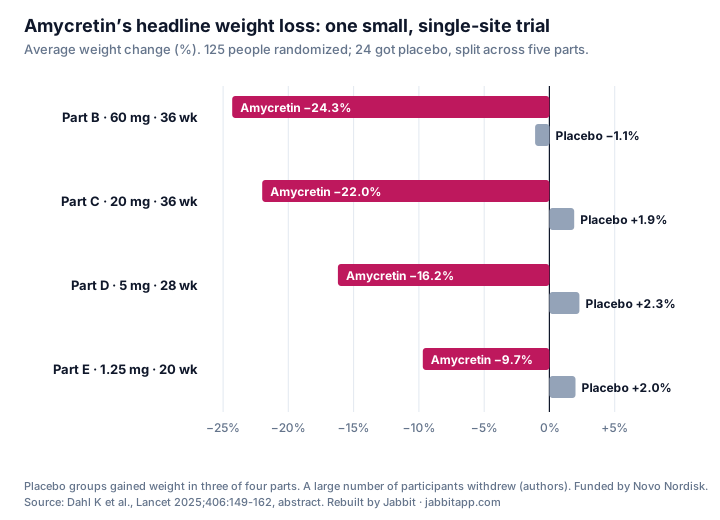
| Phase 1b/2a, weekly shot[1] | 125 people with overweight or obesity, one clinic | 36 weeks | −22.0% (20 mg) · −24.3% (60 mg) | +1.9% · −1.1% |
| Phase 2, weekly shot[3][5] | 262 people with type 2 diabetes, 83 sites | 36 weeks | −4.35% (0.4 mg) to −14.60% (40 mg) | −2.10% |
| Phase 1, daily tablet[2][6] | 144 people with overweight or obesity | 12 weeks | −13.0% (Novo’s slide, top group) | not shown on slide |
Phase 1b/2a figures are the authors’ estimated means. Phase 2 weight figures are from Novo’s release; that trial’s main goal was blood sugar. Novo’s slide notes its figures assume everyone stayed on treatment.[1][5][6]
In the diabetes trial, blood sugar fell too. HbA1c, a three-month average, dropped by 0.9 to 1.7 points from a starting 7.8%.[3] Novo says it saw “no apparent weight loss plateau” by week 36. The 40 mg group had spent only 4 weeks at that dose by then.[5] That could mean more weight loss with longer treatment. It also means the trial can’t yet show where weight loss levels off.
What looks promising
- Big early numbers. Weight loss was larger at higher doses in both the obesity and diabetes trials, and the gaps over placebo are large. In the phase 1b/2a trial, the higher doses were also given for longer.[1][5]
- Two forms. Both the shot and the tablet lowered blood sugar against placebo in separate phase 2 diabetes trials.[3][4]
- A large, varied phase 3 program. The registry lists 15 phase 3 trials planning to enroll 23,074 people in total. They cover obesity, type 2 diabetes, sleep apnea, knee osteoarthritis, two head-to-head trials against semaglutide, heart failure and heart attacks and strokes.[17][14][15][16][10]
Side effects and safety so far
- Stomach effects lead. In every published trial, gastrointestinal events were the most common side effects, and most were mild to moderate.[1][2][3] With the tablet, 26%, 41% and 47% had stomach side effects on 6, 25 and 50 mg, versus 23% on placebo.[4]
- Serious events. In the weekly-shot diabetes trial, 21 of 261 people had a serious adverse event (8%): 18 on zenagamtide and 3 of the 37 on placebo, so rates looked similar in both groups.[3] In the tablet trial, 7 people on zenagamtide had one and nobody on placebo did.[4] No deaths were reported in any of the four trials.[1][2][3][4]
- Dropouts. In the phase 1b/2a trial, the authors write that “a large number of participants withdrew,” and that many of those withdrawals were unrelated to side effects.[1] The abstract doesn’t give the numbers.
- What isn’t known yet. About 717 people took part in the four published trials, by our count.[1][2][3][4] That is too few to judge rarer risks. The heart-safety trial won’t finish until an estimated 2030.[10]
What a careful reader should notice
These points are our analysis of the cited sources.
- The “most weight loss of any drug” ranking rests on one small trial. The review’s amycretin figure, −23.9%, is exactly what you get by subtracting Part C of the phase 1b/2a trial: −22.0% on 20 mg versus +1.9% on placebo.[9][1] The review abstract doesn’t say which arm it used, so this match is our inference. That trial had one clinic, 24 placebo participants across five parts (about 5 per part on average) and many withdrawals.[1]
- The numbers aren’t counted the same way. Novo’s slide figures assume everyone stayed on treatment, and the diabetes trial’s primary analysis used on-treatment data without rescue medication.[6][3] The Wegovy and Zepbound label figures count everyone randomized.[18][19] Results counted the stay-on way usually look better.
- Cross-trial comparisons are rough. With type 2 diabetes, zenagamtide 40 mg showed −14.6% at 36 weeks. In separate, longer trials, Wegovy reached −9.6% at 68 weeks and Zepbound 15 mg −14.7% at 72 weeks.[5][18][19] Without diabetes, the 20 mg and 60 mg groups lost 22% to 24% at 36 weeks, against −14.9% for Wegovy, −20.9% for Zepbound and −25.0% for retatrutide in phase 3 trials of 68 to 80 weeks.[1][18][19][20] Novo’s head-to-head trials against semaglutide, AMAZE 7 and AMAZE 8, are the fair test. They are due in late 2028.[14][15]
- The tablet may lean on the shot’s data. Novo says an application for oral zenagamtide would be “supported by bridging data,” linked to the injectable trials “through exposure-response modelling.”[6] AMAZE 9 is the only oral phase 3 trial we found on the registry.[12][17]
- One company produced all of the evidence. Novo funded each published trial and sponsors all 31 registered studies.[1][2][3][4][17] That’s normal at this stage, but no independent trial exists yet.
When could it be approved?
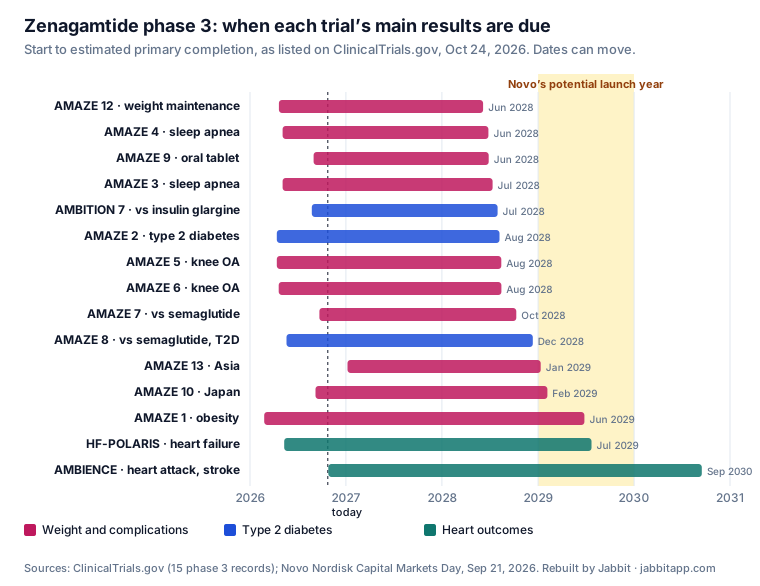
Novo’s September 2026 investor slides list zenagamtide among planned launches in 2029. Novo says the timing is subject to change.[7][6] The registry dates make that a tight path, in our analysis. The earliest phase 3 primary completion is AMAZE 12 on June 6, 2028, and most others land between June and December 2028.[13][17] The flagship obesity trial, AMAZE 1, isn’t due until June 26, 2029.[11] A 2029 launch would likely require a filing built mainly on the 2028 trials, or the timeline will move. Novo hasn’t said which trials an application would use.
Is the zenagamtide sold online the same drug?
You can’t know. The trials used Novo’s product. JAMA reports that products labeled zenagamtide sold online carry disclaimers like “for research purposes only.” No approved version exists anywhere.[7][8] We don’t name sellers. A result from Novo’s trials says nothing about what is in a vial bought online.
Frequently asked questions
- Is amycretin the same as zenagamtide?
- Yes. Zenagamtide is the generic name Novo now uses for the drug first reported as amycretin. JAMA describes it as “formerly called amycretin.” Novo’s 2026 papers use zenagamtide, and the registry also lists it under the code NNC0487-0111.[8][3][17]
- Is amycretin (zenagamtide) FDA approved?
- No. It is investigational and is only available in clinical trials. Novo names 2029 as the potential launch year, and none of its 15 phase 3 trials is due to finish its main analysis before June 2028.[7][17]
- How much weight do people lose on amycretin?
- In one small 36-week trial at a single clinic, the 20 mg and 60 mg groups lost an estimated 22.0% and 24.3%.[1] In a 36-week trial of people with type 2 diabetes, the top 40 mg dose lost 14.6% versus 2.1% on placebo.[5] Phase 3 trials will give firmer numbers.
- What are the side effects of amycretin?
- Mostly stomach side effects, such as nausea, and most were mild to moderate in the published trials. With the daily tablet, 26% to 47% had stomach side effects depending on dose, versus 23% on placebo.[1][3][4] Rarer risks are unknown, because only about 717 people have taken part in the published trials.
- How is amycretin different from CagriSema?
- Both target GLP-1 and amylin. CagriSema pairs two separate drugs, cagrilintide and semaglutide (see our CagriSema teardown). Zenagamtide is a single molecule that acts on both receptors, and it is also being tested as a daily tablet.[1][2][6] Novo lists CagriSema for 2027 and zenagamtide for 2029.[7]
Bottom line
Zenagamtide’s early weight-loss numbers are among the largest reported. But the top figures come from one small, single-clinic trial with many withdrawals, and they assume people stayed on treatment.[1][6] The diabetes result, 14.6% at 36 weeks, comes from a larger trial run in 11 countries, and Novo says weight was still falling at week 36.[3][5] The answers that matter come from AMAZE 7 and AMAZE 8 against semaglutide in late 2028, and from the heart and safety trials after that.[14][15][10] Until then, it is an experimental drug, and there is no way to know whether products sold online under its name match what was tested in those trials.[8]
References
- Dahl K, et al. Once-weekly amycretin, a novel GLP-1 and amylin receptor agonist, administered subcutaneously: results from a phase 1b/2a randomised controlled study. Lancet. 2025;406(10499):149-162. doi:10.1016/S0140-6736(25)01185-7. PMID 40550231. NCT06064006. One clinical research centre in San Antonio, Texas; 125 randomized (101 amycretin, 24 placebo) across five parts; estimated mean weight change Part B 60 mg −24.3% vs −1.1% (week 36), Part C 20 mg −22.0% vs +1.9% (week 36), Part D 5 mg −16.2% vs +2.3% (week 28), Part E 1.25 mg −9.7% vs +2.0% (week 20); “A large number of participants withdrew,” with many discontinuations unrelated to adverse events; gastrointestinal events most common, mostly mild to moderate. Funded by Novo Nordisk. Abstract read. https://pubmed.ncbi.nlm.nih.gov/40550231/. Checked October 24, 2026.
- Gasiorek A, et al. Safety, tolerability, pharmacokinetics, and pharmacodynamics of oral amycretin in people with overweight or obesity: a first-in-human, phase 1 study. Lancet. 2025;406(10499):135-148. doi:10.1016/S0140-6736(25)01176-6. PMID 40550229. NCT05369390. 144 participants; adverse events in 89 (62%), all mild or moderate; gastrointestinal events 180 of 364 events (49%); no deaths. Funded by Novo Nordisk. Abstract read. https://pubmed.ncbi.nlm.nih.gov/40550229/. Checked October 24, 2026.
- Mora P, et al. Once-weekly subcutaneous zenagamtide in people with type 2 diabetes: a randomised, double-blind, placebo-controlled, dose-finding, phase 2 trial. Lancet. 2026;408(10555):621-635. doi:10.1016/S0140-6736(26)01248-1. PMID 42532080. NCT06542874. 262 adults on metformin (with or without an SGLT2 inhibitor) at 83 sites in 11 countries; 36 weeks; HbA1c from a mean 7.8% fell 0.9 points (0.4 mg) to 1.7 points (40 mg; difference from placebo −1.56); primary analysis used the efficacy estimand (on-treatment data without rescue medication); serious adverse events in 21 of 261 (18 on zenagamtide, 3 on placebo); no deaths. Funded by Novo Nordisk. Abstract read. https://pubmed.ncbi.nlm.nih.gov/42532080/. Checked October 24, 2026.
- Mora P, et al. Once-daily oral zenagamtide in people with type 2 diabetes: a randomised, double-blind, placebo-controlled, phase 2 trial. Lancet. 2026;408(10555):607-620. doi:10.1016/S0140-6736(26)01247-X. PMID 42532079. 186 participants; 36 weeks; HbA1c difference from placebo −0.5 (6 mg), −0.99 (25 mg), −1.09 (50 mg) points; gastrointestinal adverse events 26%, 41%, 47% vs 23% on placebo; serious adverse events in 7 people on zenagamtide, none on placebo; no deaths. Funded by Novo Nordisk. Abstract read. https://pubmed.ncbi.nlm.nih.gov/42532079/. Checked October 24, 2026.
- Novo Nordisk. Novo Nordisk’s investigational zenagamtide shows significant A1C reductions with up to 14.6% weight loss in adults with type 2 diabetes, presented at ADA 2026 (press release, June 5, 2026). Mean weight change at week 36: 0.4 mg −4.35%, 1.5 mg −7.62%, 5 mg −8.19%, 10 mg −12.92%, 20 mg −13.13%, 40 mg −14.60% vs −2.10% placebo; 40 mg and 20 mg groups had 4 and 8 weeks at their maintenance dose; “no apparent weight loss plateau”; fixed escalation with permanent discontinuation if a dose was not tolerated; phase 3 in type 2 diabetes planned for the second half of 2026. https://www.prnewswire.com/news-releases/novo-nordisks-investigational-zenagamtide-shows-significant-a1c-reductions-with-up-to-14-6-weight-loss-in-adults-with-type-2-diabetespresented-at-ada-2026--302793124.html. Checked October 24, 2026.
- Novo Nordisk. Capital Markets Day 2026, Obesity presentation (September 21, 2026). Zenagamtide slide: phase 1 oral −13.0% at 12 weeks and phase 1b/2a −24.0% at 36 weeks, with the note “Data shown for weight loss is if all people adhered to treatment, estimated means”; “Biologics License Application for oral zenagamtide submission supported by bridging data,” linked to the subcutaneous AMAZE programme “through exposure-response modelling”; AMAZE 9 tests five oral maintenance doses; oral zenagamtide “Phase 3: Potential launch in 2029.” Timelines described by Novo as subject to change. https://www.novonordisk.com/content/dam/nncorp/global/en/investors/pdfs/capital-markets-day/2026/obesity-presentation-cmd-2026.pdf. Checked October 24, 2026.
- Novo Nordisk. Capital Markets Day 2026, Corporate strategy presentation (September 21, 2026): “new launches every year including CagriSema in 2027, cagrilintide in 2028, zenagamtide in 2029.” https://www.novonordisk.com/content/dam/nncorp/global/en/investors/pdfs/capital-markets-day/2026/corporate-strategy-presentation-cmd-2026.pdf. Checked October 24, 2026.
- Rubin R. Unapproved GLP-1 Drugs Retatrutide and Zenagamtide Sold Online Are No Bargain. JAMA. Published online October 9, 2026. doi:10.1001/jama.2026.20514. PMID 42853576. Medical News feature: zenagamtide, “formerly called amycretin,” is sold online by black-market sellers, some with “for research purposes only” disclaimers; “as of late September, the FDA’s website had not posted any warning letters to companies selling zenagamtide”; FDA had issued 21 warning letters to entities selling retatrutide since December 2024. https://jamanetwork.com/journals/jama/fullarticle/2855339. Checked October 24, 2026.
- Moiz A, Filion KB, Samuels AE, et al. Efficacy and Safety of Glucagon-like Peptide-1 Receptor Agonists and Co-agonists for Weight Loss Among Adults Without Diabetes: An Updated Systematic Review. Ann Intern Med. 2026;179(10):1412-1429 (published online September 1, 2026). doi:10.7326/ANNALS-25-05519. PMID 42673585. 38 trials, 25,816 people; placebo-subtracted weight loss −23.9% (95% CI −29.3% to −18.5%) with amycretin, −22.1% with retatrutide, −19.0% with tirzepatide; no quantitative pooling because of heterogeneity. Abstract read. https://pubmed.ncbi.nlm.nih.gov/42673585/. Checked October 24, 2026.
- ClinicalTrials.gov. NCT07861100, AMBIENCE: zenagamtide vs placebo on cardiovascular events. First posted October 6, 2026; not yet recruiting; estimated start October 26, 2026; 8,500 participants; primary outcome time to first cardiovascular death, non-fatal heart attack, non-fatal stroke, or heart-failure hospitalization or urgent visit; estimated primary completion September 16, 2030. https://clinicaltrials.gov/study/NCT07861100. Checked October 24, 2026.
- ClinicalTrials.gov. NCT07339423, AMAZE 1: subcutaneous zenagamtide vs placebo in obesity, 1,150 participants, 84 weeks; recruiting since February 24, 2026; estimated primary completion June 26, 2029. https://clinicaltrials.gov/study/NCT07339423. Checked October 24, 2026.
- ClinicalTrials.gov. NCT07720271, AMAZE 9: once-daily oral zenagamtide vs placebo, 950 participants, 76 weeks; recruiting since August 31, 2026; estimated primary completion June 27, 2028. https://clinicaltrials.gov/study/NCT07720271. Checked October 24, 2026.
- ClinicalTrials.gov. NCT07503210, AMAZE 12: weight maintenance after a run-in on zenagamtide, 606 participants; active, not recruiting; primary outcome weight change from week 40 to week 92; estimated primary completion June 6, 2028. https://clinicaltrials.gov/study/NCT07503210. Checked October 24, 2026.
- ClinicalTrials.gov. NCT07668414, AMAZE 7: zenagamtide vs semaglutide, 650 participants, 84 weeks; recruiting since September 22, 2026; estimated primary completion October 10, 2028. https://clinicaltrials.gov/study/NCT07668414. Checked October 24, 2026.
- ClinicalTrials.gov. NCT07400107, AMAZE 8: zenagamtide vs semaglutide in people with type 2 diabetes, 1,000 participants; listed as not yet recruiting with an estimated start of May 20, 2026 (record last updated March 12, 2026); estimated primary completion December 12, 2028. https://clinicaltrials.gov/study/NCT07400107. Checked October 24, 2026.
- ClinicalTrials.gov. NCT07567001, HF-POLARIS: zenagamtide vs placebo on heart-failure events, 5,610 participants, up to 165 weeks; estimated primary completion July 23, 2029. https://clinicaltrials.gov/study/NCT07567001. Checked October 24, 2026.
- ClinicalTrials.gov API v2 search for NNC0487-0111, amycretin and zenagamtide (intervention and term fields), run October 24, 2026: 31 unique studies (15 phase 3, 2 phase 2, 14 phase 1), all sponsored by Novo Nordisk, none with posted results; phase 3 planned enrollment 23,074. Jabbit’s extract with every record: https://jabbitapp.com/research/sources/amycretin-zenagamtide-2026-10-24.json. Checked October 24, 2026.
- U.S. Food and Drug Administration. WEGOVY (semaglutide) prescribing information, revised 06/2026. Section 14, Table 8: Study 2 (STEP 1) −14.9% vs −2.4%; Study 3 (STEP 2, type 2 diabetes) −9.6% vs −3.4%; 68 weeks. https://www.accessdata.fda.gov/drugsatfda_docs/label/2026/215256s025lbl.pdf. Checked October 23, 2026.
- U.S. Food and Drug Administration. ZEPBOUND (tirzepatide) prescribing information (217806s042). Section 14, Table 2: Study 1 (SURMOUNT-1) 15 mg −20.9% vs −3.1%; Study 2 (SURMOUNT-2, type 2 diabetes) 15 mg −14.7% vs −3.2%; 72 weeks. https://www.accessdata.fda.gov/drugsatfda_docs/label/2026/217806s042lbl.pdf. Checked October 23, 2026.
- Jastreboff AM, et al. Retatrutide for the treatment of obesity (TRIUMPH-1). N Engl J Med. 2026. PMID 42814954. 80 weeks; 12 mg −25.0% vs −3.9% (treatment-regimen estimand). Funded by Eli Lilly. Abstract read. https://pubmed.ncbi.nlm.nih.gov/42814954/. Checked October 23, 2026.
This page analyzes published trials, company materials, registry records, prescribing information and news reports. It is not medical advice and does not recommend any medication or dose. Zenagamtide (amycretin) is investigational and not approved. Cross-trial comparisons are approximate. Charts were rebuilt by Jabbit from the sources cited in each caption.