Study teardown · survodutide (BI 456906) · SYNCHRONIZE-1 and SYNCHRONIZE-2 in NEJM · heart-safety results due November 9, 2026 · Sources checked October 23, 2026
Published · Updated
Survodutide: how much weight do people lose, and is it better than Zepbound or retatrutide? About 12% to 13% without diabetes and 8% to 10% with type 2 diabetes in Boehringer’s phase 3 trials, below Zepbound and retatrutide in separate trials. Its heart-safety results are due November 9.
Survodutide is Boehringer Ingelheim’s experimental once-weekly shot that switches on two hormone receptors, glucagon and GLP-1. It is not approved anywhere.[2] In two phase 3 trials published in NEJM this year, people on the higher 6.0 mg dose lost 13.0% of their weight over 76 weeks if they didn’t have diabetes and 9.8% if they did. Those figures count everyone who started, including people who stopped the drug.[3][1] In separate trials, Zepbound produced more. With type 2 diabetes, survodutide’s gain over placebo was about the same as Wegovy’s.[13][14] Stomach side effects were common, and about one in five people stopped the drug because of them.[2][5]
Why this matters now
Three things landed close together. On October 1, 2026, NEJM published SYNCHRONIZE-2, the trial in people with obesity and type 2 diabetes, and it was presented the same day at the EASD diabetes meeting in Milan.[1][2] The obesity trial without diabetes, SYNCHRONIZE-1, had appeared in NEJM in June.[3] And the heart-safety trial, SYNCHRONIZE-CVOT, is on the American Heart Association’s late-breaking program for Monday, November 9, 2026, 8:00 to 9:15 a.m. Chicago time (9:00 to 10:15 a.m. ET).[8] ClinicalTrials.gov lists that trial as completed in June 2026.[9] Boehringer and its partner Zealand Pharma have both said the results would come later this year.[2][11] Retatrutide, Lilly’s experimental triple-hormone shot, also has published 2026 phase 3 results, including a type 2 diabetes trial presented at the same meeting, so readers are now comparing the two.[7][15][16]
How much weight people lost
The two trials ran for 76 weeks, were double-blind and compared two doses, 3.6 mg and 6.0 mg, with placebo. Everyone also got lifestyle counseling.[1][3]
| Trial | People | 3.6 mg | 6.0 mg | Placebo | Lost at least 5% (3.6 / 6.0 / placebo) |
|---|---|---|---|---|---|
| SYNCHRONIZE-1: obesity, no diabetes | 725 | −12.2% | −13.0% | −5.4% | 72.6% / 71.9% / 46.3% |
| SYNCHRONIZE-2: obesity and type 2 diabetes | 752 | −8.2% | −9.8% | −3.9% | 57.6% / 64.5% / 35.1% |
Average change in body weight at week 76, everyone randomized counted (the treatment-regimen estimand, each paper’s primary analysis).[3][1]
Boehringer’s press releases lead with bigger numbers: “up to 16.6%” without diabetes and “up to 13.1%” with it.[4][2] Those use the efficacy estimand, which Boehringer defines as the effect “assuming patients remained on treatment for the entire study duration,” and the company notes that its p-values for this estimand are nominal.[2] Both kinds of number are legitimate, but they answer different questions. For someone deciding whether to start, the everyone-counted number is the more realistic guide. It also explains most of the gap: on the stay-on-drug count, the placebo group lost only 3.2% and 3.1%, versus 5.4% and 3.9% with everyone counted.[4][2][3][1]
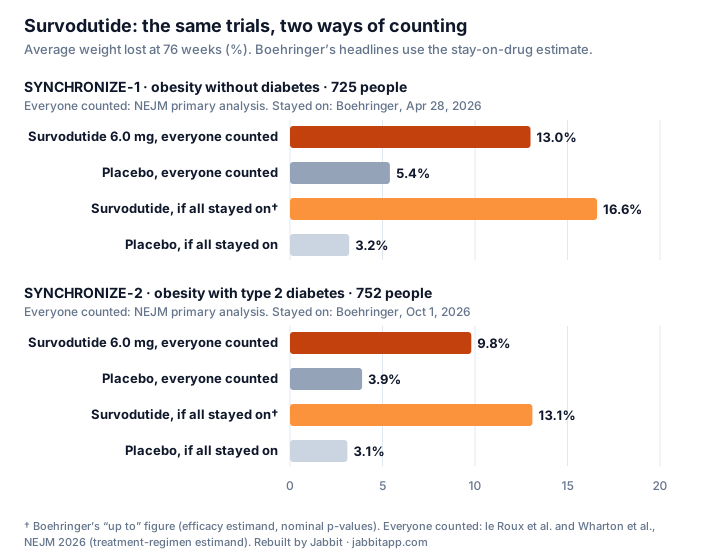
The placebo group in SYNCHRONIZE-1 lost an unusually large 5.4%.[3] AJMC, reporting the trial’s presentation at the American Diabetes Association meeting, said investigators attributed this in part to placebo participants switching to GLP-1 drugs, and that more than 16% of the placebo group reported using a prohibited GLP-1-based medication.[5] If that is the main reason, survodutide’s real effect over placebo is somewhat larger than the 7.6-point gap in the everyone-counted numbers. We can’t say by how much from the published abstract.
Survodutide vs Zepbound, Wegovy and retatrutide
We found no completed trial that tests survodutide directly against any of these drugs, so any comparison relies on separate trials with different people, lengths and placebo results.[6] The fairest rough measure is the extra weight lost beyond placebo, with everyone counted. Using that measure, this is our comparison:
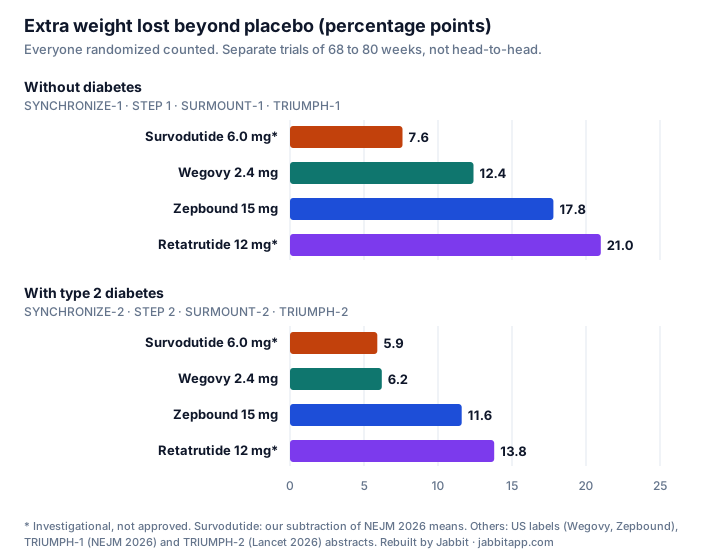
Without diabetes, survodutide comes last of the four by this measure, though the inflated placebo result described above makes its bar look smaller than it may really be. Even Boehringer’s best stay-on-drug figure, 16.6%, is below the 20.9% Zepbound’s label reports with everyone counted.[4][14] With type 2 diabetes the picture changes: survodutide’s 5.9-point gap is close to Wegovy’s 6.2. Zepbound (11.6) and retatrutide (13.8) remain well ahead.[1][13][14][16]
Our read, as analysis: on weight alone, survodutide looks like a Wegovy-class drug rather than a Zepbound or retatrutide competitor. Boehringer is pitching something different. It points to liver fat, visceral fat and blood-sugar measures, and says the glucagon side of the drug “may help improve insulin sensitivity and glucose management through its effects on liver fat reduction.”[2] Whether that matters to patients depends on outcome trials, starting with the heart trial on November 9.
Where survodutide may stand out: liver fat
Boehringer is also developing survodutide for MASH, the inflammatory form of fatty liver disease. FDA gave it Fast Track status for MASH in May 2021 and Breakthrough Therapy designation in September 2024, and the EU medicines agency accepted it into its PRIME scheme in November 2023.[2] In SYNCHRONIZE-MASLD (218 adults with obesity or overweight and fatty liver disease, 48 weeks), AJMC reported that liver fat normalized in 61.0% on 6.0 mg versus 5.7% on placebo.[5] In an MRI substudy of SYNCHRONIZE-1 (25 people per group), AJMC reported that liver fat fell 63.1% on 6.0 mg versus 24.5% on placebo, and visceral fat fell 34.0% versus 11.8%.[5] The large MASH outcome trials, LIVERAGE and LIVERAGE-Cirrhosis, plan to enroll about 1,800 and 1,590 adults.[2]
On muscle, Boehringer said in October that a new muscle-specific analysis of that substudy found muscle “accounted for no more than 10% of total tissue lost.”[2] A related figure has already moved once. Zealand’s half-year report says the lean-loss ratio it had reported for SYNCHRONIZE-1 “has been updated from 10.8% to 11.3% following a recalculation of the dataset.”[11] AJMC reported a 9.8% drop in lean volume in the same substudy.[5] These are small MRI subsets, so we treat them as early.
Side effects and safety
Stomach and bowel side effects are the main issue. In SYNCHRONIZE-1, gastrointestinal adverse events affected 80.9% on 3.6 mg and 89.7% on 6.0 mg, versus 47.9% on placebo. [3] In SYNCHRONIZE-2 the figures were 72.8% and 77.7% versus 38.6%.[1] Boehringer says they were mostly mild to moderate, and lists nausea, vomiting, diarrhea and constipation as the more frequent ones.[2]
The bigger concern is how many people stopped the drug. Boehringer says 18% of people on survodutide in SYNCHRONIZE-2 stopped because of stomach side effects, versus 1.2% on placebo.[2] In SYNCHRONIZE-1, AJMC reported 17.8% and 20.2% versus 2.9%.[5] For context, these are gastrointestinal stops only. On their US labels, 6.8% stopped the Wegovy shot and 6.7% stopped Zepbound 15 mg for any adverse reaction.[13][14] TRIUMPH-2 reported 8% on retatrutide 12 mg stopping for adverse events or death.[16] By our comparison, survodutide’s GI-only quit rate is about two to three times those all-cause rates. Boehringer says the stops “usually occurred during the dose escalation phase, as the study protocol allowed limited flexibility.” It says newer trials allow more flexible dose increases.[2] That is plausible but not yet shown in published data. ACC’s journal scan lists substantial discontinuation among the trial’s limitations.[6]
Other findings, as reported for SYNCHRONIZE-1: resting heart rate rose by 3.2 to 3.5 beats per minute at week 76, according to AJMC.[5] That is at the upper end of the 1 to 4 on Wegovy’s label and above the 1 to 3 on Zepbound’s.[13][14] AJMC also reported no adjudicated major cardiovascular events in the survodutide groups and no acute pancreatitis or pancreatic or thyroid cancer. Raised pancreatic enzymes without symptoms were slightly more common on survodutide.[5] No deaths were reported in SYNCHRONIZE-1.[3] TCTMD reports the SYNCHRONIZE-2 investigators saying the safety profile in people with diabetes is similar to other obesity drugs with GLP-1 activity.[7] The SYNCHRONIZE-2 abstract and Boehringer’s release don’t give per-dose heart rate or discontinuation figures, so we don’t report them.[1][2]
What a careful reader should notice
Boehringer funded SYNCHRONIZE-2 and sponsors the whole program.[1][7][2] The trials compared survodutide with placebo, not with another drug.[6] SYNCHRONIZE-1 excluded people with uncontrolled high blood pressure, according to ACC.[6] TCTMD notes that SYNCHRONIZE-2 excluded people using insulin. Participants started at an average HbA1c of 7.4% and, TCTMD notes, reasonable blood-sugar control, so it is unclear how well the results apply to people with harder-to-control diabetes.[7][2] Boehringer has started a separate trial, SYNCHRONIZE-T2D, that includes people on insulin.[2] Finally, the release says 755 adults took part; the NEJM analysis reports 752.[2][1]
When could survodutide be approved?
We found no announced filing with FDA or the EU as of October 23, 2026. Boehringer’s October release says only that survodutide “has not been approved for use, and its efficacy and safety have not been established.”[2] In May, MedWatch reported that Boehringer said it was waiting for results from the remaining SYNCHRONIZE phase 3 trials, so it was “too early to set a timeline for regulatory submissions.”[12] The heart trial is the large readout still pending. It treated 5,508 people and was designed to show survodutide does not raise the risk of major heart events (a noninferiority design).[10] Our read, as analysis: November 9 is the next milestone to watch. A filing after that is possible, but nothing public commits Boehringer to a date, and any approval would come only after a regulatory review.
Frequently asked questions
- How much weight do people lose on survodutide?
- In the phase 3 trials, about 12% to 13% at 76 weeks without diabetes and 8% to 10% with type 2 diabetes, counting everyone who started. Boehringer’s stay-on-treatment figures are up to 16.6% and 13.1%.[3][1][4][2]
- Is survodutide better than Zepbound (tirzepatide) or retatrutide?
- There is no head-to-head trial. In separate trials, survodutide produced less weight loss beyond placebo than Zepbound or retatrutide. With type 2 diabetes it was about level with Wegovy.[1][3][13][14][15][16]
- What are survodutide’s side effects?
- Mostly nausea, vomiting, diarrhea and constipation. About 18% to 20% stopped the drug because of stomach side effects, versus 1% to 3% on placebo. Heart rate rose by about 3 beats per minute.[2][5]
- When will survodutide be approved?
- We found no announced filing as of October 23, 2026. The heart-safety trial results are scheduled for November 9, 2026.[2][8][12]
- What kind of drug is survodutide?
- A once-weekly injection that activates both the glucagon and GLP-1 receptors. Boehringer licensed it from Zealand Pharma and is developing it for obesity, MASH liver disease and type 2 diabetes.[2]
The bottom line
In two large, double-blind trials run by Boehringer, survodutide beat placebo on weight and blood sugar, and it may have extra liver benefits.[3][1][5] On weight alone, in separate trials, it is closer to Wegovy than to Zepbound or retatrutide. About one in five people stopped it over stomach side effects.[1][2][13][14][16] The November 9 heart-trial results will show whether it is safe for the heart, and whether a filing follows.[8]
References
- Wharton S, le Roux CW, Startseva E, et al.; SYNCHRONIZE-2 Investigators. Survodutide Once Weekly in Adults with Obesity and Type 2 Diabetes. N Engl J Med. Published online October 1, 2026. doi:10.1056/NEJMoa2607219. PMID 42820639. NCT06066528. 752 adults with type 2 diabetes and BMI 27 or higher; survodutide 3.6 mg, 6.0 mg or placebo weekly for 76 weeks; treatment-regimen estimand −8.2%, −9.8% vs −3.9%; at least 5% loss 57.6%, 64.5% vs 35.1%; HbA1c −0.9, −0.8 vs −0.2 points; gastrointestinal adverse events 72.8%, 77.7% vs 38.6%. Funded by Boehringer Ingelheim. Abstract read. https://www.nejm.org/doi/full/10.1056/NEJMoa2607219. Checked October 23, 2026.
- Boehringer Ingelheim. Boehringer Ingelheim’s survodutide achieves up to 13.1% weight loss in new Phase III trial… (press release, October 1, 2026; treatment-regimen and efficacy estimand definitions; efficacy-estimand figures with nominal p-values; discontinuation due to GI adverse events 18% vs 1.2%; SYNCHRONIZE-1 MRI substudy; SYNCHRONIZE-CVOT “later this year”; MASH designations; licensed from Zealand Pharma; NEJM and EASD 2026 Milan presentation, October 1, 2026). https://www.globenewswire.com/news-release/2026/10/01/3372564/0/en/boehringer-ingelheim-s-survodutide-achieves-up-to-13-1-weight-loss-in-new-phase-iii-trial-alongside-significant-improvements-in-glycemic-control-in-people-with-obesity-and-type-2-d.html. Checked October 23, 2026.
- le Roux CW, Wharton S, Startseva E, et al.; SYNCHRONIZE-1 Investigators. Survodutide Once Weekly for the Treatment of Adults with Obesity. N Engl J Med. 2026;395:776-787 (published online June 7, 2026). doi:10.1056/NEJMoa2600751. NCT06066515. 725 adults without diabetes; treatment-regimen estimand −12.2%, −13.0% vs −5.4% at week 76; at least 5% loss 72.6%, 71.9% vs 46.3%; gastrointestinal adverse events 80.9%, 89.7% vs 47.9%; no deaths. Sponsor: Boehringer Ingelheim. Abstract read. https://www.nejm.org/doi/full/10.1056/NEJMoa2600751. Checked October 23, 2026.
- Boehringer Ingelheim. Boehringer Ingelheim’s novel glucagon/GLP-1 dual agonist survodutide achieved significant weight loss of 16.6%… (SYNCHRONIZE-1 topline press release, April 28, 2026; efficacy estimand up to 16.6% vs 3.2%). https://www.globenewswire.com/news-release/2026/04/28/3282218/0/en/boehringer-ingelheim-s-novel-glucagon-glp-1-dual-agonist-survodutide-achieved-significant-weight-loss-of-16-6-delivering-meaningful-metabolic-improvement-in-people-with-obesity-or-.html. Checked October 23, 2026.
- AJMC. Survodutide Phase 3 Data Signal Metabolic Gains Beyond Weight Loss (June 8, 2026; reporting the ADA 2026 SYNCHRONIZE-1 and SYNCHRONIZE-MASLD presentations: efficacy estimand −15.3% and −16.6%; GI discontinuation 17.8%, 20.2% vs 2.9%; heart rate +3.2 to 3.5 bpm; more than 16% of placebo participants reported using a prohibited GLP-1-based drug; MRI substudy of 25 per arm; asymptomatic pancreatic enzyme rises; SYNCHRONIZE-MASLD results; discussant quotes). https://www.ajmc.com/view/survodutide-phase-3-data-signal-metabolic-gains-beyond-weight-loss. Checked October 23, 2026.
- American College of Cardiology. Journal scan: SYNCHRONIZE-1 (June 15, 2026; limitations: no active comparator, substantial discontinuation, uncontrolled hypertension excluded). https://www.acc.org/latest-in-cardiology/journal-scans/2026/06/15/17/15/synchronize-1. Checked October 23, 2026.
- TCTMD. Retatrutide and Survodutide Make Inroads for Weight Loss in Diabetic Patients (October 9, 2026; SYNCHRONIZE-2 excluded insulin users; mean HbA1c 7.4% with reasonable glycemic control at entry; cardiovascular impact unclear pending SYNCHRONIZE-CVOT; investigators say safety similar to other GLP-1-based obesity drugs; SYNCHRONIZE-2 funded by Boehringer Ingelheim). https://www.tctmd.com/news/retatrutide-and-survodutide-make-inroads-weight-loss-diabetic-patients. Checked October 23, 2026.
- American Heart Association. Scientific Sessions 2026, Late-Breaking Science program: LBS.05, Monday, November 9, 2026, 8:00-9:15 a.m. Central time, Chicago, including the SYNCHRONIZE-CVOT survodutide trial; results embargoed until presentation. https://professional.heart.org/en/meetings/scientific-sessions/programming/late-breaking-science. Checked October 23, 2026.
- ClinicalTrials.gov. NCT06077864, A Study to Test the Effect of Survodutide (BI 456906) on Cardiovascular Safety in People With Overweight or Obesity (SYNCHRONIZE-CVOT). Status completed; primary completion June 2026. https://clinicaltrials.gov/study/NCT06077864. Checked October 23, 2026.
- SYNCHRONIZE-CVOT investigators. SYNCHRONIZE-CVOT design and baseline characteristics. JACC Heart Fail. doi:10.1016/j.jchf.2025.102780 (5,508 treated participants; noninferiority design on a five-point MACE outcome). https://doi.org/10.1016/j.jchf.2025.102780. Checked October 23, 2026.
- Zealand Pharma. Company announcement No. 39/2026: Interim report for the first half of 2026 (August 13, 2026). Survodutide section: SYNCHRONIZE-1 lean-loss ratio “updated from 10.8% to 11.3% following a recalculation”; SYNCHRONIZE-2 at EASD and SYNCHRONIZE-CVOT “expected to be reported and presented later in the year.” https://www.zealandpharma.com/media/gfdbqawp/zealand-pharma-h1-2026-interim-report.pdf. Checked October 23, 2026.
- MedWatch, May 1, 2026 (paywalled; summary line read): Boehringer “says it is awaiting results from the remaining phase 3 trials in the Synchronize program, making it too early to set a timeline for regulatory submissions.” https://medwatch.com/News/Pharma___Biotech/article19255482.ece. Checked October 23, 2026.
- U.S. Food and Drug Administration. WEGOVY (semaglutide) prescribing information, revised 06/2026 (NDA 215256 / 218316). Section 5.9 (resting heart rate +1 to 4 bpm on the injection), 6.1 (injection pool 6.8% vs 3.2% stopped for adverse reactions), 14 (Table 8: Study 2 [STEP 1] −14.9% vs −2.4%, difference −12.4; Study 3 [STEP 2, type 2 diabetes] −9.6% vs −3.4%, difference −6.2; 68 weeks). https://www.accessdata.fda.gov/drugsatfda_docs/label/2026/215256s025lbl.pdf. Checked October 23, 2026.
- U.S. Food and Drug Administration. ZEPBOUND (tirzepatide) prescribing information (217806s042). Section 6.1 (6.7% on 15 mg vs 3.4% stopped for adverse reactions; heart rate +1 to 3 bpm), 14 (Table 2: Study 1 [SURMOUNT-1] 15 mg −20.9% vs −3.1%, difference −17.8; Study 2 [SURMOUNT-2, type 2 diabetes] 15 mg −14.7% vs −3.2%, difference −11.6; 72 weeks). https://www.accessdata.fda.gov/drugsatfda_docs/label/2026/217806s042lbl.pdf. Checked October 23, 2026.
- Jastreboff AM, et al. Retatrutide for the treatment of obesity (TRIUMPH-1). N Engl J Med. 2026. PMID 42814954. 80 weeks; 12 mg −25.0% vs −3.9%, difference −21.0 points (treatment-regimen estimand). Funded by Eli Lilly. Abstract read. https://pubmed.ncbi.nlm.nih.gov/42814954/. Checked October 23, 2026.
- Bellido V, le Roux CW, Ekinci EI, et al. Retatrutide in adults with obesity and type 2 diabetes (TRIUMPH-2). Lancet. 2026;408:1455-1472. doi:10.1016/S0140-6736(26)01861-1. PMID 42810372. 80 weeks; 12 mg −18.8% vs −5.1%, difference −13.8 points (treatment-regimen estimand); stopped for adverse events or death 8% (12 mg) and 12% (9 mg) vs 5%. Funded by Eli Lilly. Abstract read. https://pubmed.ncbi.nlm.nih.gov/42810372/. Checked October 23, 2026.
This page analyzes published trials, company announcements, prescribing information and news reports. It is not medical advice and does not recommend any medication or dose. Survodutide is investigational and not approved. Cross-trial comparisons are approximate. Charts were rebuilt by Jabbit from the sources cited in each caption.