Home / Research / Cardio on GLP-1s
Evidence teardown · randomized exercise and GLP-1 trials, the Zepbound label, ClinicalTrials.gov review · Sources checked October 19, 2026
Is cardio a waste of time unless you’re on Zepbound or Wegovy? Exercise still works without the drug, and on one it added fat loss. Nobody has tested cardio with tirzepatide.
A fitness influencer’s post says cardio is “an utter waste of time unless you are on Tirzepatide,” because extra hunger cancels the calories you burn.[1] The trials say that’s half right. People do eat back part of what they burn, but only part. Exercise alone still took off weight in a 10-month trial, and in a year-long trial it kept 4.1 kg off after a diet without making people hungrier.[7][8][3][4] When that same trial added exercise to a GLP-1 drug, body fat fell about twice as much as with either one alone, and a year after everyone stopped, the exercise benefit had held up better than the drug’s.[3][5] But the drug was liraglutide (Saxenda), not tirzepatide (Zepbound). Of 11 registered trials that give semaglutide or tirzepatide with and without an exercise program, 0 have results, and the only tirzepatide one that includes cardio hasn’t started.[12]
Why this matters this week
On Sunday afternoon, October 18, the fitness creator Greg O’Gallagher posted that “cardio for fat loss is an utter waste of time unless you are on Tirzepatide,” since “any calories you burn through effort will be off set by the proportionate increase in hunger,” while “on tirzepatide appetite stays dialled.” By midnight it had about 31,000 views.[1] The bodybuilder Marc Lobliner answered that “Cardio + Diet has helped many folks lose weight at all levels long before GLP-1,” and X ran a trending story on the argument.[2] It’s a question a lot of people on these drugs actually face: is the treadmill worth it? It also has a testable core, so we checked it.
The short answer
Exercise without the drug isn’t a waste. It loses less weight than the calorie math predicts, because people eat a bit more, but it still loses weight and helps keep it off.[7][8][3] With a GLP-1 drug, adding exercise did add fat loss in the one solid trial of the combination.[3] So the second half of the claim has some support, for an older drug. For tirzepatide specifically, it has never been tested.[12] And the Zepbound label already says to use the drug with “increased physical activity.”[9]
Claim 1: “Calories you burn will be offset by the increase in hunger”
This is a real effect, called compensation, and it’s been measured carefully. In the E-MECHANIC trial, 198 adults with overweight or obesity did supervised exercise for 24 weeks at one of two doses. Using a gold-standard method (doubly labeled water), researchers found people ate about 91 to 124 more calories a day. They ended up 1.5 to 2.7 kg short of the weight loss their workouts should have produced.[8] Their metabolism and everyday movement didn’t change. The extra eating explained it.[8]
But compensation is partial, not “proportionate.” In Midwest Exercise Trial 2, 141 sedentary young adults with overweight or obesity did supervised cardio five days a week for 10 months, burning 400 or 600 calories a session, with no diet. Those who completed at least 90% of sessions lost 3.9 kg (4.3%) and 5.2 kg (5.7%). The control group gained 0.5 kg.[7] That’s modest next to tirzepatide’s 15–21% in SURMOUNT-1, but it isn’t zero.[10]
And in the trial that tested exercise right after weight loss, when hunger usually climbs, exercise didn’t raise appetite compared with placebo, even though people were burning more.[4] One year of exercise also raised the body’s own late after-meal GLP-1 response by 37% within that group, a 25% bigger rise than in people with usual activity. The drug groups saw no such change.[6]
Claim 2: “On tirzepatide, burning more calories results in greater fat loss”
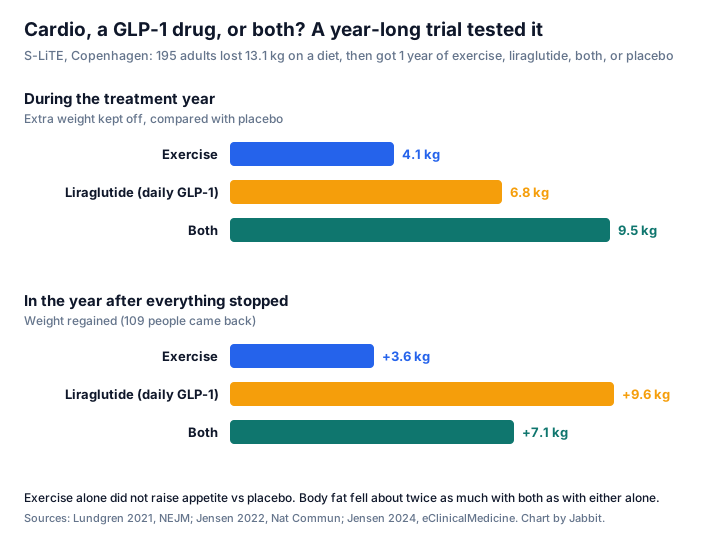
The best test of this idea is S-LiTE, a Danish trial published in NEJM in 2021. 195 adults with obesity first lost an average of 13.1 kg on an 8-week low-calorie diet. Then they were randomly assigned for a year to a vigorous exercise program (indoor cycling and circuit training twice a week, supervised, plus two sessions on their own), the GLP-1 drug liraglutide 3.0 mg a day, both, or placebo.[3][5]
Compared with placebo, exercise kept off 4.1 kg more, liraglutide 6.8 kg more, and the combination 9.5 kg more. Body-fat percentage fell 3.9 points with the combination, about twice as much as with exercise (1.7) or liraglutide (1.9) alone.[3] Only the combination improved blood sugar (HbA1c), insulin sensitivity and fitness.[3] So on a GLP-1, exercise did add fat loss. One detail cuts the other way: on body weight, the combination beat liraglutide alone by 2.7 kg, a gap small enough that it could have been chance (P = 0.13).[3]
The part missing from the X argument is what happened after. A year after all treatment ended, 109 of the participants came back. People who had been on liraglutide alone had regained 9.6 kg. The exercise group had regained 3.6 kg, and the combination group 7.1 kg.[5] The exercisers were also still moving: a median of 240 minutes a week, against 30 minutes for people who’d had liraglutide alone.[5] Only two-thirds of finishers came back, and these follow-up differences didn’t pass the study’s own strict test for multiple comparisons, so treat them as a strong hint rather than proof.[5]
What’s missing: tirzepatide
Liraglutide is an older, daily GLP-1 drug. In a head-to-head trial, people lost 6.4% of their weight on it against 15.8% on semaglutide (Wegovy).[13] The claim is about tirzepatide, so we looked for trials that test it, or semaglutide, with and without exercise.[12]
We pulled all 1,006 semaglutide and tirzepatide studies on ClinicalTrials.gov and read every one whose interventions mention exercise. 11 are randomized trials that give the drug with a structured exercise program in one group and without it in another. 5 of them test only weight training, mostly to see whether it protects muscle. 4 include cardio, and 2 don’t say what kind of exercise. None has posted results.[12]
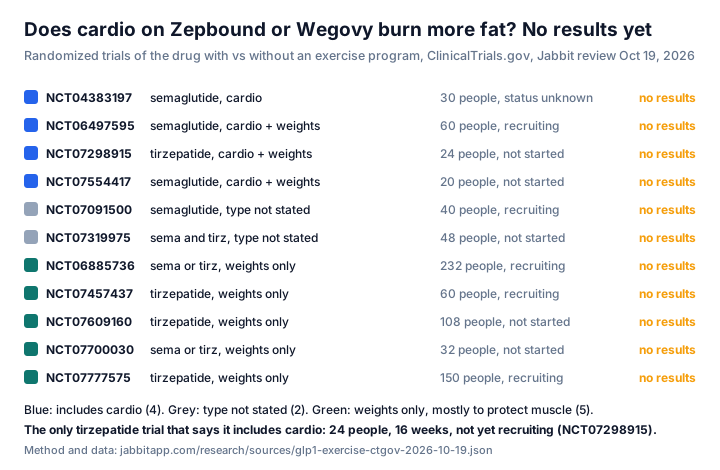
The only tirzepatide trial that says it includes cardio is a University of Virginia study of 24 people over 16 weeks, with weight as its main outcome. It hasn’t started recruiting.[12] The oldest trial on the list, a 30-person Copenhagen study of semaglutide with or without cycling that began in 2019, has an unknown status and no posted results.[12]
What the big drug trials already assumed
Every headline number for these drugs came with exercise advice. In SURMOUNT-1 (tirzepatide) and STEP 1 (semaglutide), everyone, placebo included, got regular counseling to cut 500 calories a day and get at least 150 minutes of activity a week.[10][11] Zepbound’s label says it’s for use “in combination with a reduced-calorie diet and increased physical activity.”[9] The trials didn’t measure how much people actually exercised, so they can’t say how much of the result the activity advice explains.[10][11]
Safety
Two label warnings matter for anyone adding hard cardio on Zepbound. First, the drug can cause acute kidney injury from dehydration, usually in people with nausea, vomiting or diarrhea, and the label tells patients “to take precautions to avoid fluid depletion.” The label says to watch for this especially while the dose is being started or raised, so that’s a time to be careful about fluids on long, sweaty sessions.[9] Second, low blood sugar: in a type 2 diabetes trial, 10.3% of people taking Zepbound with a sulfonylurea had hypoglycemia, against 2.1% without one, and it has also been reported in people without diabetes. The label says to consider lowering insulin or sulfonylurea doses when starting Zepbound, so anyone on those drugs should ask their prescriber before adding hard exercise too.[9] In S-LiTE, raised heart rate and gallstones were more common on liraglutide alone than on liraglutide plus exercise.[3]
What holds up
S-LiTE is a randomized, placebo-controlled, double-blind trial (for the drug), with supervised exercise checked by heart-rate monitors and DEXA scans for body fat.[3][5] E-MECHANIC and Midwest Exercise Trial 2 used supervised, measured exercise, not self-report.[7][8] The limits: S-LiTE used liraglutide, tested weight maintenance after a diet rather than initial loss, and was funded partly by the Novo Nordisk Foundation, with several authors reporting Novo Nordisk ties.[3][5] Midwest Exercise Trial 2 counted only people who did at least 90% of sessions, and its participants averaged 22 years old.[7]
Bottom line
Is cardio pointless unless you’re on Zepbound? No. Hunger eats back part of what exercise burns, not all of it, and exercise helped people keep weight off after a diet without raising their appetite.[4][7][8] On a GLP-1 drug, exercise roughly doubled the drop in body fat in the one strong trial, and its benefit lasted better than the drug’s once treatment stopped.[3][5] Whether the same holds for tirzepatide is a fair guess that nobody has tested yet: 0 of 11 registered trials have results.[12]
References
- Greg O’Gallagher (@gregogallagher) on X, October 18, 2026, 4:35 PM ET: “Cardio for fat loss is an utter waste of time unless you are on Tirzepatide. As any calories you burn through effort will be off set by the proportionate increase in hunger. But on tirzepatide appetite stays dialled and burning more calories results in greater fat loss.” 31,402 impressions, 148 likes, 37 replies and 10 quotes when pulled at about 11:59 PM ET the same day. https://x.com/gregogallagher/status/2111919001538355514. Checked October 19, 2026.
- Replies on X, October 18, 2026 (ET): Marc Lobliner (@MarcLobliner), 7:36 PM, quoting the post: “Cardio + Diet has helped many folks lose weight at all levels long before GLP-1.” (10,320 impressions when pulled) https://x.com/MarcLobliner/status/2111964575222350033; X trending story “Debate Heats Up Over GLP-1 Drugs and Exercise” (updated October 18, 8:28 PM ET) https://x.com/i/trending/2111976660153036877. Checked October 19, 2026.
- Lundgren JR, Janus C, Jensen SBK, et al. Healthy weight loss maintenance with exercise, liraglutide, or both combined. N Engl J Med. 2021;384(18):1719-1730. doi:10.1056/NEJMoa2028198. PMID 33951361; NCT04122716 (S-LiTE; 195 adults with obesity, BMI 32–43, no diabetes, mean 13.1 kg lost on an 8-week low-calorie diet, then 52 weeks of exercise plus placebo, liraglutide 3.0 mg/day, both, or placebo; weight vs placebo −4.1 kg (95% CI −7.8 to −0.4), −6.8 kg (−10.4 to −3.1), −9.5 kg (−13.1 to −5.9); combination vs liraglutide −2.7 kg, P = 0.13; body-fat percentage −3.9 points with the combination, about twice exercise (−1.7) or liraglutide (−1.9); only the combination improved HbA1c, insulin sensitivity and cardiorespiratory fitness; raised heart rate and gallstones more often with liraglutide alone than the combination; funded by the Novo Nordisk Foundation and others). https://pubmed.ncbi.nlm.nih.gov/33951361/. Checked October 19, 2026.
- Jensen SBK, Janus C, Lundgren JR, et al. Exploratory analysis of eating- and physical activity-related outcomes from a randomized controlled trial for weight loss maintenance with exercise and liraglutide single or combination treatment. Nat Commun. 2022;13:4770. doi:10.1038/s41467-022-32307-y. PMID 35970829; PMC9378667 (130 per-protocol completers; “Exercise after weight loss did not increase appetite or sedentary behavior compared with placebo, despite increased exercise energy expenditure and maintained weight loss”; placebo group’s post-meal appetite suppression fell 14% and sitting rose 31 min/day; liraglutide prevented the appetite change). https://pubmed.ncbi.nlm.nih.gov/35970829/. Checked October 19, 2026.
- Jensen SBK, Blond MB, Sandsdal RM, et al. Healthy weight loss maintenance with exercise, GLP-1 receptor agonist, or both combined followed by one year without treatment: a post-treatment analysis of a randomised placebo-controlled trial. EClinicalMedicine. 2024;69:102475. doi:10.1016/j.eclinm.2024.102475. PMID 38544798; PMC10965408 (109 of 195 attended, 66% of completers; exercise program: from week 7, two supervised sessions a week of vigorous indoor cycling plus circuit training and two self-chosen moderate-to-vigorous sessions, monitored by heart-rate watches; regain in the year off treatment 3.6 kg after exercise, 9.6 kg after liraglutide, 7.1 kg after the combination; regain 6.0 kg (2.1–10.0) larger after liraglutide than after exercise; week 0–104 combination vs liraglutide −5.1 kg, P = 0.040, not significant after the prespecified false-discovery correction; median activity a year later 240 min/week after exercise, 225 after combination, 150 after placebo, 30 after liraglutide; funded by Helsefonden and the Novo Nordisk Foundation; several authors report Novo Nordisk ties). https://pubmed.ncbi.nlm.nih.gov/38544798/. Checked October 19, 2026.
- Holt J, Sandsdal RM, Byberg S, et al. One year of exercise after weight loss increases postprandial GLP-1 secretion in contrast to usual activity or GLP-1 receptor agonist treatment. Obesity (Silver Spring). 2026;34(1):51-57. doi:10.1002/oby.70043. PMID 40998556; PMC12724041 (S-LiTE exploratory analysis; one year of exercise raised the late post-meal GLP-1 response 37% within group (95% CI 20–57%), 25% more than usual activity (3–51%, p = 0.02); unchanged in both liraglutide groups). https://pubmed.ncbi.nlm.nih.gov/40998556/. Checked October 19, 2026.
- Donnelly JE, Honas JJ, Smith BK, et al. Aerobic exercise alone results in clinically significant weight loss for men and women: Midwest Exercise Trial 2. Obesity (Silver Spring). 2013;21(3):E219-E228. doi:10.1002/oby.20145. PMID 23592678; PMC3630467 (141 sedentary adults with overweight or obesity, mean age 22.6; supervised exercise 5 days a week for 10 months at 400 or 600 kcal per session, no diet; weight change −3.9 kg (4.3%) and −5.2 kg (5.7%) vs +0.5 kg in controls; analysis limited to people who completed at least 90% of sessions). https://pubmed.ncbi.nlm.nih.gov/23592678/. Checked October 19, 2026.
- Martin CK, Johnson WD, Myers CA, et al. Effect of different doses of supervised exercise on food intake, metabolism, and non-exercise physical activity: the E-MECHANIC randomized controlled trial. Am J Clin Nutr. 2019;110(3):583-592. doi:10.1093/ajcn/nqz054. PMID 31172175; PMC6735935 (198 adults, 24 weeks, 8 or 20 kcal per kg body weight per week of supervised exercise vs control; “compensation” of 1.5 kg and 2.7 kg below expected weight loss; energy intake up 90.7 and 123.6 kcal/day vs −2.3 in controls by doubly labeled water; resting metabolism and non-exercise activity unchanged; compensation “can be treated with dietary or pharmacological interventions”). https://pubmed.ncbi.nlm.nih.gov/31172175/. Checked October 19, 2026.
- ZEPBOUND (tirzepatide) prescribing information, revised 02/2026: indicated “in combination with a reduced-calorie diet and increased physical activity”; section 5.3, acute kidney injury due to volume depletion, mostly in patients with nausea, vomiting or diarrhea “leading to dehydration”; advise patients “to take precautions to avoid fluid depletion”; section 5.7, hypoglycemia 10.3% with a sulfonylurea vs 2.1% without in a type 2 diabetes trial, also reported in adults without type 2 diabetes. https://www.accessdata.fda.gov/drugsatfda_docs/label/2026/217806s042lbl.pdf. Checked October 19, 2026.
- Jastreboff AM, Aronne LJ, Ahmad NN, et al.; SURMOUNT-1 Investigators. Tirzepatide once weekly for the treatment of obesity. N Engl J Med. 2022;387(3):205-216. doi:10.1056/NEJMoa2206038. PMID 35658024 (all participants, including placebo, received regular lifestyle counseling toward a 500-kcal daily deficit and at least 150 minutes of physical activity a week). https://pubmed.ncbi.nlm.nih.gov/35658024/. Checked October 19, 2026.
- Wilding JPH, Batterham RL, Calanna S, et al.; STEP 1 Study Group. Once-weekly semaglutide in adults with overweight or obesity. N Engl J Med. 2021;384(11):989-1002. doi:10.1056/NEJMoa2032183. PMID 33567185 (individual counseling every 4 weeks toward a 500-kcal daily deficit and 150 minutes of weekly physical activity, in both groups). https://pubmed.ncbi.nlm.nih.gov/33567185/. Checked October 19, 2026.
- Jabbit analysis, October 18–19, 2026 (pulled 11:56 PM ET). ClinicalTrials.gov API v2, interventions matching semaglutide or tirzepatide, deduplicated: 1,006 studies; 56 list a behavioral or other intervention mentioning exercise, training, aerobic, cardio, physical activity, walking, cycling, HIIT or resistance. Each was read by hand. Kept: randomized studies in which people on semaglutide or tirzepatide get a structured exercise program in one arm and the same drug without it in another: 11 (NCT04383197, NCT06497595, NCT07091500, NCT07319975, NCT07554417, NCT07298915, NCT06885736, NCT07457437, NCT07609160, NCT07777575, NCT07700030). 5 test resistance training only, 4 include aerobic exercise, 2 don’t say which. 0 have posted results. The only tirzepatide trial that says it includes aerobic exercise is NCT07298915 (University of Virginia, 24 people, 16 weeks, not yet recruiting). Excluded: drug vs placebo on top of exercise (e.g. NCT05173714), exercise in every arm (NCT07223242, NCT07485062), coaching-only lifestyle programs, single-arm and observational studies. Keyword searches can miss studies that describe exercise only in arm text. Scripts: ops/scripts/glp1_exercise_ctgov.py, ops/scripts/glp1_exercise_review.py. Data: https://jabbitapp.com/research/sources/glp1-exercise-ctgov-2026-10-19.json. Checked October 19, 2026.
- Rubino DM, Greenway FL, Khalid U, et al. Effect of weekly subcutaneous semaglutide vs daily liraglutide on body weight in adults with overweight or obesity without diabetes: the STEP 8 randomized clinical trial. JAMA. 2022;327(2):138-150. doi:10.1001/jama.2021.23619. PMID 35015037 (338 adults, 68 weeks; weight change −15.8% with semaglutide 2.4 mg vs −6.4% with liraglutide 3.0 mg, difference −9.4 points; pooled placebo −1.9%). https://pubmed.ncbi.nlm.nih.gov/35015037/. Checked October 19, 2026.
This page analyzes published trials, a drug label and trial registry records. It is not medical advice. Talk to your prescriber before starting a hard exercise program on a GLP-1 medicine, especially if you take insulin or a sulfonylurea. The trial-registry review is Jabbit’s own; inputs are cited above.