Evidence teardown · Zepbound · Ozempic · Wegovy · Stopping GLP-1s · Updated October 27, 2026
Published · Updated
Can a gut procedure stop weight regain after you quit Zepbound or Ozempic? A little, so far. In Fractyl Health’s REMAIN-1 trial, people who stopped tirzepatide and then had a one-time Revita procedure on the lining of the duodenum regained 5.1% of their body weight at 6 months, vs 8.2% after a sham procedure, the company reported on October 16, 2026. The data are early, company-reported and not peer-reviewed, and Revita is not FDA-authorized.
Most people who stop Zepbound, Mounjaro, Wegovy or Ozempic regain much of the weight, and a medical-device company says a one-time endoscopic procedure can slow that down. The reader’s question: if you stop your GLP-1, is there anything besides staying on the drug that keeps the weight off? Our plain answer: Revita, an investigational procedure that heats and resurfaces the lining of the first part of the small intestine, cut regain by about 3 points of body weight vs a sham procedure over 6 months in Fractyl’s own trial. That is a real but modest difference, it is not peer-reviewed, the one-year result is due in early 2027, and Revita is not available in the US outside trials. Staying on the drug is still the best-proven way to keep weight off.
Why this matters now
On October 16, 2026, Fractyl Health reported that REMAIN-1, a randomized, sham-controlled trial of 308 people, met its first main goal at 6 months (p=0.0023).[1] The company says it plans to file a De Novo marketing application with FDA in late Q4 2026 and names late 2027 as a potential authorization date, though FDA has not decided anything.[1] The question it targets is huge: in Lilly’s SURMOUNT-4 trial, people switched from tirzepatide to placebo regained 14.0% of their body weight within a year.[6]
Timeline
| Date | Event |
|---|---|
| 2016 | First-in-human study of duodenal mucosal resurfacing (DMR) in 39 people with type 2 diabetes.[8] |
| 2019–2022 | REVITA-1 and REVITA-2 diabetes studies; the randomized REVITA-2 did not beat sham on HbA1c overall (p=0.147).[9][11] |
| Sep 2024 | REMAIN-1 starts, testing Revita for weight maintenance after stopping tirzepatide.[4] |
| Jul 15, 2026 | Fractyl reports one-year results from a 45-person Midpoint Cohort, not powered for statistics.[3] |
| Oct 16, 2026 | Fractyl reports 6-month Pivotal Cohort results: 5.1% vs 8.2% regain.[1] |
| Q1 2027 | One-year Pivotal results and the second main goal, per Fractyl.[1][4] |
What Revita is
- A procedure, not a drug. Through an upper endoscope, a catheter lifts the lining of the duodenum and then ablates it with heat, so a new lining grows back.[9] Fractyl describes it as a one-time, minimally invasive procedure meant to restore nutrient sensing and signaling.[1]
- Where the idea came from. Researchers say the duodenum became a target from bariatric surgery, where bypassing or altering food contact with the duodenum changes metabolism.[9]
- Its history is in diabetes. Earlier studies tested it for type 2 diabetes, with modest weight loss of about 2.5 kg in one open-label study; a 2021 meta-analysis pooled four studies.[9][12]
- Status. Fractyl says Revita is investigational in the US, has FDA Breakthrough Device designation for weight maintenance after GLP-1s, and is CE marked in the EU and UK.[1] Breakthrough designation speeds review; it is not an approval.
What REMAIN-1 shows
The setup. Adults with obesity and without diabetes took tirzepatide (Zepbound) until they had lost at least 15% of their weight.[4] On average they lost 18.3% over about 25 weeks; 80% were women.[2] They then stopped the drug and were randomized 2 to 1 to Revita or a sham endoscopy, in a triple-masked design, per the registry.[2][4]
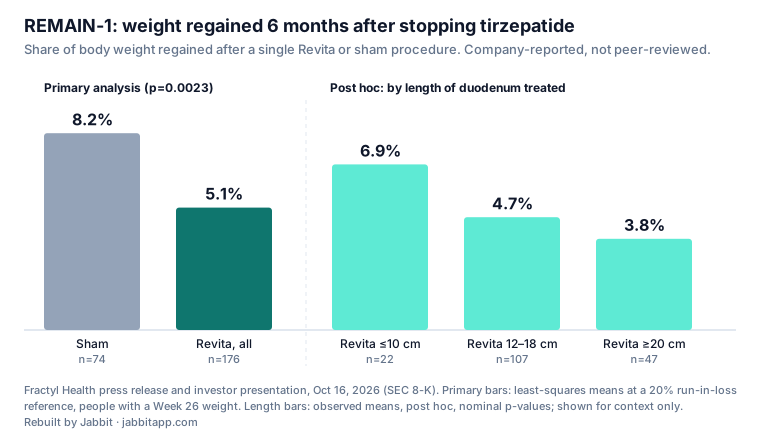
- Main result: 5.1% of body weight regained with Revita vs 8.2% with sham at 6 months, a difference of 3.06 points (95% CI 1.10 to 5.02), p=0.0023. Fractyl says that means about 80% of the drug-induced weight loss was kept vs 67%.[1][2]
- Weight stable or still falling: 32% vs 18%, a post hoc analysis.[1]
- More treatment, less regain? In post hoc splits by how much of the duodenum was treated, regain was 6.9% at 10 cm or less, 4.7% at 12 to 18 cm and 3.8% at 20 cm or more.[1][2]
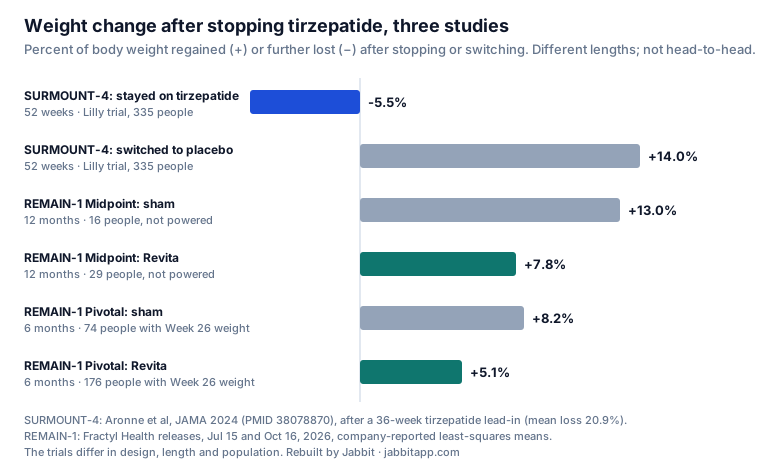
- Earlier one-year signal: in the 45-person Midpoint Cohort, regain at one year was 7.8% vs 13.0%; Fractyl says that cohort was not powered for statistics.[3]
Jabbit’s analysis: 3.06% of the Revita group’s average starting weight of 84.1 kg is about 2.6 kg, or roughly 5.7 lb, less regain over 6 months.[2] Revita slowed regain; it did not stop it on average.
Safety: what is known
- More stomach symptoms early. Through 6 months, 70% of Revita patients vs 55% of sham patients had any adverse event. Events Fractyl judged related to the device or procedure: 42% vs 30%. Nausea 16% vs 3%, abdominal pain 15% vs 6%, vomiting 8% vs 0%, sore throat 19% vs 17%.[2] Fractyl says 94% of related events began within 7 days of the procedure and most were mild.[1]
- Serious events: 2 Revita patients (1%) vs 4 sham patients (4%), with no deaths. In one Revita patient, GI bleeding with anemia (the patient was using two NSAIDs; no duodenal bleeding was seen on endoscopy) and gallbladder inflammation were recorded. Fractyl reports no serious events it judged device- or procedure-related.[2][1]
- From earlier studies: in the first-in-human study, 3 of 39 people developed a narrowing of the duodenum, treated by balloon dilation.[8] In REVITA-1, 52% had at least one procedure-related side effect, 81% of them mild, and no device- or procedure-related serious events were noted between 12 and 24 months.[9][10] The REVITA-2 authors called most adverse events “mild and transient.”[11]
- Long-term effects are unknown. The weight-maintenance data run to 1 year at most, and the larger cohort only to 6 months.[3][1]
The case for Revita
The need is real: in SURMOUNT-4, people who stopped tirzepatide regained 14.0% of body weight in a year, and in the STEP 1 extension people regained about two-thirds of the weight they had lost on semaglutide within a year.[6][7] REMAIN-1 is a randomized, sham-controlled trial, which is the right design to test a procedure.[4] The 6-month result held in Fractyl’s sensitivity analyses, including at the actual 18.3% run-in loss (8.3% vs 5.1%) and in raw observed means (8.1% vs 4.8%).[2] The direction matches the smaller Midpoint Cohort, and the length analysis fits a dose response, though it is post hoc.[3][1] Our read: a single procedure, if it works, could matter for people who stop GLP-1s.
What a careful reader should notice
- Company data, not yet peer-reviewed. All REMAIN-1 numbers come from Fractyl’s releases and investor slides. We found no REMAIN-1 paper in PubMed, and the registry has no results posted.[5][4] The study is ongoing.[2]
- Missing weights differ by arm. 21% of sham patients vs 6% of Revita patients restarted weight-loss drugs, and weights after such events were set to missing; 72% of the sham arm vs 86% of the Revita arm had a Week 26 weight in the main analysis.[2] Our read: restarting may itself signal that sham patients struggled, but the effect of this on the estimate is hard to judge from slides; an analysis counting everyone would help.
- The headline is modeled. The 80% vs 67% figures are estimated at a 20% run-in loss; the actual average was 18.3%. Fractyl’s sensitivity analysis at 18.3% gave a similar result.[2]
- Sham did better than expected. Fractyl’s own slide calls the sham result better than historical data (8.2% vs a modeled 9.2%).[2]
- The dose-response story is post hoc. The ablation-length groups were not randomized, and the shortest group (n=22) did not differ from sham (p=0.46).[2]
- Six months is short. The second main goal, whether most Revita patients keep at least 5% weight loss at one year, is due in Q1 2027.[1][4]
- Narrow population. People without diabetes, mostly women, who had used tirzepatide for about half a year.[2][4] Results may differ for semaglutide users or people on drugs for years.
- Small inconsistency. The release gives the sham Week 26 count as 74; one slide says 76.[1][2]
- Mixed earlier record. In REVITA-2, DMR did not beat sham on HbA1c overall; after results were split by region, the European group showed a benefit (p=0.033).[11]
If you are thinking about stopping a GLP-1
The strongest evidence still says weight tends to return after stopping: in SURMOUNT-4, staying on tirzepatide led to a further 5.5% loss over a year, while switching to placebo led to 14.0% regain.[6] Talk with your prescriber before stopping, and about what plan you will follow afterward. Revita is only available in the US inside trials, and Fractyl does not expect a potential US launch before early 2028.[1] Tracking your weight and doses as you taper or stop can help you and your prescriber spot regain early. Jabbit keeps that log privately on your iPhone.
FAQ
- Can you stop Zepbound or Ozempic without regaining weight?
- Most people regain some or much of it. In SURMOUNT-4, people switched from tirzepatide to placebo regained 14.0% of body weight in a year, and in the STEP 1 extension people regained about two-thirds of their semaglutide weight loss within a year. Some people keep more off than others, and no proven add-on prevents regain yet.
- What is Revita (duodenal mucosal resurfacing)?
- Revita is an investigational endoscopic procedure from Fractyl Health. A catheter passed through the mouth lifts and heat-treats the lining of the duodenum, the first part of the small intestine, so new lining grows back. It was first studied for type 2 diabetes.
- How well did Revita work in the REMAIN-1 trial?
- Fractyl reported that 6 months after stopping tirzepatide, people who had Revita regained 5.1% of body weight vs 8.2% after a sham procedure (p=0.0023). That is about 3 points of body weight. The results are company-reported, from an ongoing trial, and not peer-reviewed.
- Is Revita FDA-approved, and can I get it?
- No. Revita is investigational in the US. Fractyl says it plans to submit a De Novo application to FDA in late 2026 and names late 2027 for a potential authorization and early 2028 for a potential US launch. It is CE marked in the EU and UK.
- What are the side effects of Revita?
- In REMAIN-1, nausea, abdominal pain, vomiting and sore throat were more common after Revita than after sham, mostly in the first week. Fractyl reports no serious events it judged device- or procedure-related. In the first human study, 3 of 39 people developed a narrowed duodenum that was treated with balloon dilation.
- Is staying on a GLP-1 better than Revita for keeping weight off?
- No trial has compared them directly. In SURMOUNT-4, people who stayed on tirzepatide lost a further 5.5% over a year, while REMAIN-1 patients who had Revita still regained 5.1% in 6 months, in a different trial. Any decision belongs with your prescriber.
Bottom line
REMAIN-1 is the first sizable randomized, sham-controlled test of a one-time procedure to slow weight regain after stopping a GLP-1, and it met its 6-month goal. But the effect was about 3 points of body weight, the data are a press release and slides from the company, more sham patients dropped out of the analysis after restarting drugs, and the one-year answer is still pending. For now, it is a promising experiment, not an exit plan from Zepbound or Ozempic.
References
- Fractyl Health press release (GLOBE NEWSWIRE), October 16, 2026, filed with the SEC as Exhibit 99.1 to a Form 8-K. Company statements: “In the modified intention-to-treat (mITT) population (N=308), Revita participants maintained approximately 80% of their GLP-1-induced weight loss after a single treatment at six months, compared with 67% in sham participants (least-squares mean weight regain of 5.1% versus 8.2% of body weight; n=176 versus 74), with high statistical significance (p=0.0023)”; “32% of Revita participants were either weight stable or had further weight loss … versus 18% for sham (post hoc; nominal p=0.020)”; by ablation length, “12 to 18 cm … 43% less regain than sham (observed mean weight regain of 4.7% versus 8.2%; n=107 versus 74)” and “20 cm or more had 53% less regain than sham (mean regain of 3.8%; n=47)”; “no device- or procedure-related serious adverse events, no deaths, and no unanticipated adverse device effects observed as of the September 24, 2026, data cut-off date”; related adverse events “predominantly mild and peri-procedural, with 94% occurring within seven days”; the second co-primary endpoint “will be assessed at 12 months”; FDA Breakthrough Device designation; “Revita is for investigational use only in the United States and is CE marked in the European Union and United Kingdom”; planned milestones: De Novo submission late Q4 2026, one-year data Q1 2027, “Potential FDA marketing authorization” late 2027 and “Potential U.S. commercial launch” early 2028; “the FDA indicated that final pathway determinations will be made following review of the complete safety dataset”. Company-reported, ongoing study, not peer-reviewed. https://www.sec.gov/Archives/edgar/data/1572616/000119312526423377/guts-ex99_1.htm. Checked October 27, 2026.
- Fractyl Health investor presentation on the REMAIN-1 Pivotal Cohort, October 16, 2026, filed with the SEC as Exhibit 99.2 to a Form 8-K. Slides report: 308 randomized (205 Revita, 103 sham), 80% female; mean run-in weight loss on tirzepatide 18.3% over a mean 24.9 weeks; mean weight at randomization 84.1 kg (Revita) and 80.9 kg (sham); primary analysis at a 20% run-in-loss reference “8.2% vs 5.1% -3.06 (-5.02, -1.10) p = 0.0023,” sensitivity at the actual 18.3% mean “8.3% vs 5.1%,” observed means “8.1% vs 4.8%”; intercurrent events before Week 26 in 9% vs 22% (anti-obesity medication 13 vs 22 people); “6% Revita vs 21% sham restarted anti-obesity medication (post hoc, nominal p<0.001)”; “weights after an intercurrent event … set to missing”; Week 26 weight in the analysis for 86% vs 72%; ablation-length analysis labeled “Exploratory” (≤10 cm, n=22: 6.9%, p = 0.46); a modeled historical sham of 9.2% and the phrase “sham outperforming historical data”; any adverse event 70% vs 55%; serious adverse events 2 (1%) vs 4 (4%) patients; device- or procedure-related adverse events 42% vs 30%; nausea 16% vs 3%, abdominal pain 15% vs 6%, vomiting 8% vs 0%, oropharyngeal pain 19% vs 17%; the Revita serious events were “GI hemorrhage and acute blood-loss anaemia in one participant with dual NSAID use and no evidence of duodenal bleeding on endoscopy, acute cholecystitis (Day 79)”; no deaths; “REMAIN-1 is an ongoing study; final data rely on database lock at 12 months.” One slide gives the sham count as “n=176 vs 76” Company-reported. https://www.sec.gov/Archives/edgar/data/1572616/000119312526423377/guts-ex99_2.htm. Checked October 27, 2026.
- Fractyl Health press release (GLOBE NEWSWIRE), July 15, 2026, filed with the SEC as Exhibit 99.1 to a Form 8-K, on the REMAIN-1 Midpoint Cohort. Company statements: in 45 randomized people, regain at one year was “7.8% versus 13.0% of body weight; n=29 versus 16 for Revita versus sham”; “The Midpoint Cohort is not powered for formal statistical significance; results are descriptive”; “Overall TEAE rates were comparable between arms through one year (24% Revita versus 25% sham)”. Company-reported, not peer-reviewed. https://www.sec.gov/Archives/edgar/data/1572616/000119312526303948/guts-ex99_1.htm. Checked October 27, 2026.
- ClinicalTrials.gov record NCT06484114 (REMAIN-1), API v2, read October 27, 2026: sponsor Fractyl Health Inc.; randomized, sham-controlled, triple-masked; adults with obesity who lost at least 15% of body weight on tirzepatide; start September 2024; status active, not recruiting; estimated enrollment 315; estimated primary completion February 15, 2027; primary outcomes are Revita vs sham “percent change in body weight from baseline to week 26” and whether “a majority of Revita DMR participants maintain clinically significant weight loss 52 weeks (1 year) after discontinuing tirzepatide therapy”; last update posted March 3, 2026; no results posted. https://clinicaltrials.gov/study/NCT06484114. Checked October 27, 2026.
- PubMed search for “REMAIN-1” with Revita or duodenal, run October 27, 2026: 0 records. https://pubmed.ncbi.nlm.nih.gov/?term=%22REMAIN-1%22%5Btiab%5D+AND+%28Revita+OR+duodenal%29. Checked October 27, 2026.
- Aronne LJ, Sattar N, Horn DB, et al. Continued Treatment With Tirzepatide for Maintenance of Weight Reduction in Adults With Obesity: The SURMOUNT-4 Randomized Clinical Trial. JAMA. 2024;331(1):38-48. PMID 38078870. SURMOUNT-4 randomized withdrawal trial, funded by Eli Lilly. Abstract: after a 36-week tirzepatide lead-in with “a mean weight reduction of 20.9%,” 670 people were randomized; “The mean percent weight change from week 36 to week 88 was -5.5% with tirzepatide vs 14.0% with placebo”; “withdrawing tirzepatide led to substantial regain of lost weight, whereas continued treatment maintained and augmented initial weight reduction.” Abstract read. https://pubmed.ncbi.nlm.nih.gov/38078870/. Checked October 27, 2026.
- Wilding JPH, Batterham RL, Davies M, et al. Weight regain and cardiometabolic effects after withdrawal of semaglutide: The STEP 1 trial extension. Diabetes Obes Metab. 2022;24(8):1553-1564. PMID 35441470. STEP 1 off-treatment extension, 327 participants, funded by Novo Nordisk. Abstract: “One year after withdrawal of once-weekly subcutaneous semaglutide 2.4 mg and lifestyle intervention, participants regained two-thirds of their prior weight loss”; findings “suggest ongoing treatment is required to maintain improvements in weight and health.” Abstract read. https://pubmed.ncbi.nlm.nih.gov/35441470/. Checked October 27, 2026.
- Rajagopalan H, Cherrington AD, Thompson CC, et al. Endoscopic Duodenal Mucosal Resurfacing for the Treatment of Type 2 Diabetes: 6-Month Interim Analysis From the First-in-Human Proof-of-Concept Study. Diabetes Care. 2016;39(12):2254-2261. PMID 27519448. First-in-human study of duodenal mucosal resurfacing in type 2 diabetes. Abstract: “A total of 39 patients with type 2 diabetes” were treated; “Three patients experienced duodenal stenosis treated successfully by balloon dilation”; “Long-term safety, efficacy, and durability and possible mechanisms of action require further investigation.” Abstract read. https://pubmed.ncbi.nlm.nih.gov/27519448/. Checked October 27, 2026.
- van Baar ACG, Holleman F, Crenier L, et al. Endoscopic duodenal mucosal resurfacing for the treatment of type 2 diabetes mellitus: one year results from the first international, open-label, prospective, multicentre study. Gut. 2020;69(2):295-303. PMID 31331994. REVITA-1 open-label multicentre study in type 2 diabetes. Abstract: DMR involves “catheter-based circumferential mucosal lifting followed by hydrothermal ablation of duodenal mucosa,” an approach based on “bariatric surgery learnings”; “Twenty-four patients had at least one AE (52%) related to DMR. Of these, 81% were mild. One SAE and no unanticipated AEs were reported”; “weight was modestly reduced (-2.5±0.6 kg, p<0.001).” Abstract read. https://pubmed.ncbi.nlm.nih.gov/31331994/. Checked October 27, 2026.
- van Baar ACG, Devière J, Hopkins D, et al. Durable metabolic improvements 2 years after duodenal mucosal resurfacing (DMR) in patients with type 2 diabetes (REVITA-1 Study). Diabetes Res Clin Pract. 2022;184:109194. PMID 35032562. REVITA-1 two-year follow-up. Abstract: “No device- or procedure-related serious adverse events, unanticipated device effects, or hypoglycemic events were noted between 12 and 24 months post-DMR.” Abstract read. https://pubmed.ncbi.nlm.nih.gov/35032562/. Checked October 27, 2026.
- Mingrone G, van Baar AC, Devière J, et al. Safety and efficacy of hydrothermal duodenal mucosal resurfacing in patients with type 2 diabetes: the randomised, double-blind, sham-controlled, multicentre REVITA-2 feasibility trial. Gut. 2022;71(2):254-264. PMID 33597157. REVITA-2 randomized, double-blind, sham-controlled trial in type 2 diabetes. Abstract: overall, HbA1c change “was -10.4 (18.6) mmol/mol in DMR group versus -7.1 (16.4) mmol/mol in sham group (p=0.147)”; results were stratified by region after “heterogeneity between European … and Brazilian … populations,” and in the European group HbA1c change was “-6.6 mmol/mol (17.5 mmol/mol) versus -3.3 mmol/mol (10.9 mmol/mol) post-sham (p=0.033)”; “Most adverse events were mild and transient.” Abstract read. https://pubmed.ncbi.nlm.nih.gov/33597157/. Checked October 27, 2026.
- de Oliveira GHP, de Moura DTH, Funari MP, et al. Metabolic Effects of Endoscopic Duodenal Mucosal Resurfacing: a Systematic Review and Meta-analysis. Obes Surg. 2021;31(3):1304-1312. PMID 33417100. Systematic review and meta-analysis of DMR. Abstract: “Four studies were selected for qualitative and quantitative analysis”; reports glycemic and liver benefits at 3 and 6 months in type 2 diabetes. Abstract read. https://pubmed.ncbi.nlm.nih.gov/33417100/. Checked October 27, 2026.
- Jabbit source extract for this page: press-release, presentation, registry and abstract quotes checked against cached copies on October 27, 2026. https://jabbitapp.com/research/sources/revita-remain1-2026-10-27.json. Checked October 27, 2026.
This page analyzes company press releases and presentations filed with the SEC, a trial registry and published studies. It is not medical advice and does not recommend any product, procedure or dose. Company-reported results are labeled. Charts were rebuilt by Jabbit from the sources cited in each caption.