Study teardown · thymosin alpha-1 (thymalfasin, sold abroad as Zadaxin) · 60 years of papers, FDA’s 2024 review, SEC filings and 60 registered trials · Sources checked October 24, 2026
Published · Updated
Thymosin alpha-1 (TA1): does it actually boost immunity, and is it FDA approved? It isn’t approved in the U.S., FDA’s advisers voted 17 to 4 against letting pharmacies compound it, and its largest trial, in 1,106 people with sepsis, found no survival benefit.
Thymosin alpha-1, often shortened to TA1 or TA-1, is a 28-amino-acid peptide first purified from calf thymus in 1977.[2] A version called thymalfasin is sold as Zadaxin in China and, by the maker’s count, more than 30 countries.[9] It is not approved in the United States.[6] In December 2024, FDA’s pharmacy compounding advisers voted 17 to 4 against adding it to the list of substances pharmacies may compound from.[5] The trials behind its reputation are mostly small, and the largest one, TESTS in sepsis, found no difference in deaths.[15] The main safety concern FDA raised for compounded versions is the immune system reacting to the peptide itself.[6][8]
Why this matters now
TA1 is promoted online as a peptide for staying well through cold and flu season, often alongside the claim that it is approved in dozens of countries. FDA’s 2024 review found compounded TA1 marketed online as injections and nasal sprays, and one website calling a compounded product “FDA-approved,” although FDA has approved no TA1 product.[6] Two new things change the picture. TESTS, the biggest TA1 trial ever run, was published in January 2025, after FDA’s review was written.[15][7] And on October 14, 2026, FDA sent an “interim access policy” for compounding certain peptides to the White House for review. Its text, including which peptides it covers, is not public.[26] We cover that policy here.
Sixty years in one table
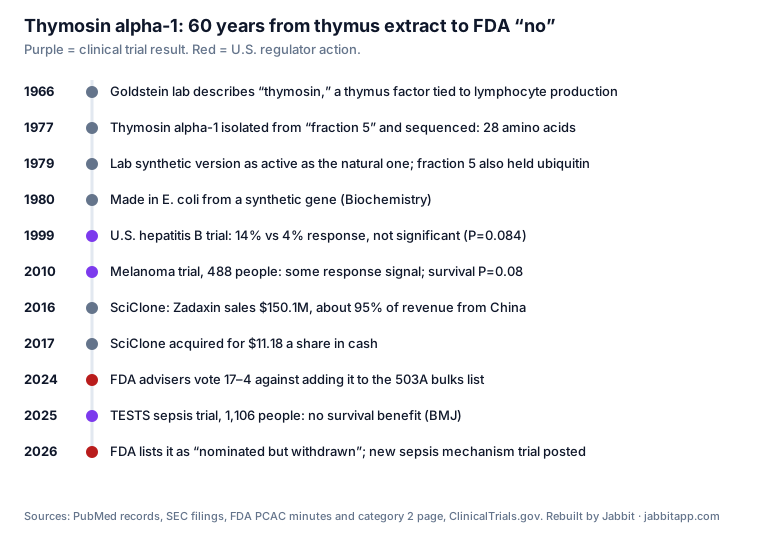
| Year | What happened | Source |
|---|---|---|
| 1966 | Allan Goldstein’s lab describes “thymosin,” a calf-thymus factor tied to lymphocyte production | PNAS[1] |
| 1977 | Thymosin alpha-1 is isolated from the crude “fraction 5” extract and sequenced: 28 amino acids | PNAS[2] |
| 1979 | Reported as 10 to 1,000 times as active as fraction 5 in lab and animal tests; a lab-made version works as well. Another fraction 5 peptide turns out to be ubiquitin | J Biol Chem[3] |
| 1980 | Made in E. coli bacteria from a synthetic gene | Biochemistry[4] |
| 1998–1999 | Hepatitis B trials: positive in Taiwan, not significant in a U.S. placebo-controlled trial | Hepatology, J Viral Hepat[12][11] |
| 2010 | 488-person melanoma trial: more tumor responses; survival gain not statistically significant | J Clin Oncol[13] |
| 2016 | SciClone reports $150.1 million in Zadaxin sales, with about 95% of company revenue from China | SEC 10-K[9] |
| 2017 | SciClone is acquired for $11.18 a share in cash | SEC 8-K[10] |
| Dec 2024 | FDA advisers vote 17 to 4 against adding TA1 to the 503A compounding list | FDA minutes[5] |
| Jan 2025 | TESTS, 1,106 people with sepsis: no difference in 28-day deaths | BMJ[15] |
| 2026 | FDA lists TA1 as “nominated but withdrawn” with an immunogenicity warning; a new sepsis mechanism trial is posted | FDA, ClinicalTrials.gov[8][23] |
“Fraction 5” was a partly purified calf-thymus extract containing many peptides. Thymosin alpha-1 is a different peptide from thymosin beta-4, which was sequenced separately in 1981 and is sold online as TB-500, and it is not the same product as thymalin, a Russian thymus extract.[2][27][8]
What looks promising
- A real immune effect in some patients. In sepsis, TA1 raised a marker of immune-cell readiness (monocyte HLA-DR) more than control in ETASS.[14] In a small COVID-19 trial, CD4 T-cell counts rose faster in one subgroup.[19] These are lab markers, not proof that people do better.
- Some positive trials. A Taiwan hepatitis B trial found more patients clearing the virus 18 months after treatment.[12] The melanoma trial found more tumor responses in two TA1 groups, and the authors called for more trials.[13]
- Long clinical use abroad. Zadaxin is approved in China for hepatitis B and as an immune system enhancer, and it sold about $150 million a year there by 2016, according to SciClone’s filings.[9]
- Tolerability in trials. ETASS recorded no serious drug-related side effects, no safety outcome differed between groups in TESTS, and the melanoma trial found no added toxicity.[14][15][13]
Side effects and safety so far
- Common. Injection-site irritation, redness and discomfort are the most commonly reported side effects, according to FDA’s review.[6]
- Reported in studies. FDA’s review lists liver enzyme (ALT) flares in people with hepatitis B, thyroid (TSH) abnormalities in people with hepatitis C, nipple pain, and fatal immune hemolytic anemia and graft failure in stem cell transplant recipients.[6] FDA also flagged a possible risk of graft-versus-host disease in people deliberately immunosuppressed after transplant.[6]
- Foreign labels. Labels for TA1 products sold abroad carry warnings or contraindications for children, pregnancy and breastfeeding, autoimmune disease and immunosuppressed patients, according to FDA.[6]
- Compounded and “research” products. FDA says TA1 “may pose a significant risk for immunogenicity,” meaning the immune system may react to the peptide, possibly made worse by clumping (aggregation) and impurities. It also judged TA1 not well characterized for compounding.[6][8] Those concerns apply to versions made outside an approved process. A trial result says nothing about what is in a vial bought online.
- Prevention in healthy people. In the only prevention data we found, a retrospective review of 435 hospital staff in Wuhan, “thymosin drugs” had “an insignificant effect,” and side effects increased, especially when combined with interferon.[20]
The sepsis test: the biggest trial found no benefit
Sepsis is where TA1 got its most rigorous test. Both major trials were led by Sun Yat-sen University in China.[14][15]
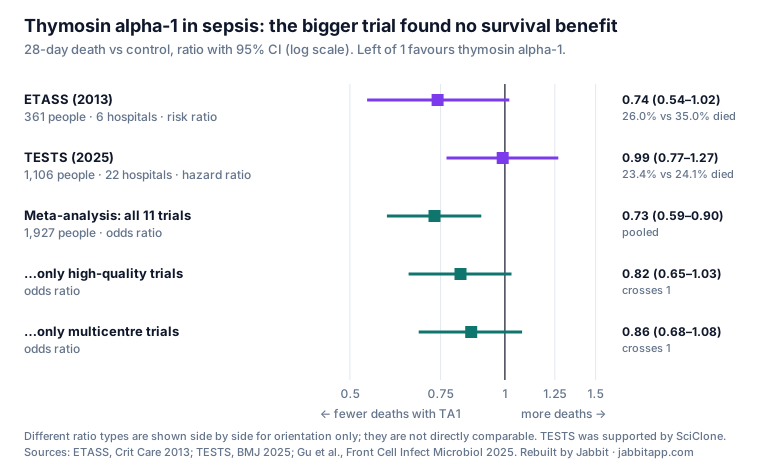
- ETASS (2013) randomized 361 people at six hospitals. Deaths at 28 days were 26.0% with TA1 and 35.0% without it, a result the authors called marginal (P = 0.062).[14]
- TESTS (2025) randomized 1,106 people at 22 centres, with a placebo and double blinding. Deaths were 23.4% with TA1 and 24.1% with placebo (hazard ratio 0.99).[15] The authors concluded there was “no clear evidence” that TA1 lowers 28-day deaths.
- Subgroups point both ways. In TESTS, people under 60 did worse on TA1 (HR 1.67), while people with diabetes did better (HR 0.58).[15] Subgroup findings like these need confirmation before anyone acts on them.
- Pooled data. A 2025 meta-analysis of 11 trials found fewer deaths overall, but not when it kept only the high-quality or multicentre trials. Its own analysis said the total evidence is still too small.[16]
What a careful reader should notice
These points are our analysis of the cited sources.
- The gap shrank as the trials got bigger. ETASS showed a 9-point gap in deaths. TESTS, about three times larger and placebo controlled, showed 0.7 points.[14][15] This pattern, where small early trials look better than large later ones, is common in medicine.
- FDA voted without the best trial. FDA’s briefing and the December 2024 vote came before TESTS was published in January 2025.[5][7][15] TESTS doesn’t help the case for TA1 in sepsis. FDA’s review weighed effectiveness across all the evaluated uses, not sepsis alone.[6]
- The maker was involved in TESTS, and it was still null. SciClone is listed as a collaborator on the TESTS registry record, and the paper reports SciClone support and payments to several authors.[15] A null result from a trial the maker supported is worth noting, because it is the opposite of what a sponsor would hope for.
- “Approved in 30+ countries” comes from the maker. The figure is SciClone’s own statement.[9] FDA said it could not independently verify those approvals in every country, and that TA1 is not approved in the U.S., Japan or Europe except Italy.[6] Foreign approval for hepatitis B or as a hospital immune booster is also not evidence that it prevents colds in healthy people.
- One market carried the drug. About 95% to 97% of SciClone’s revenue came from China in 2014 to 2016.[9] Of the 60 registered TA1 trials we found, 37 have a site in China and 7 have one in the U.S.[25]
- Few results, many trials. Only 2 of those 60 records have results posted on the registry. Of the 15 that are active or planned, 9 are in cancer.[25]
Does it prevent colds, flu or COVID?
We found no randomized trial showing that TA1 prevents colds or flu in healthy adults. In the registry, only 2 of 60 TA1 trials accept healthy volunteers. One, a 2020 Chinese study of nasal interferon drops in medical staff, lists TA1 as an intervention but has an unknown status and no posted results.[24][25] The other, a U.S. phase 1 trial in older adults getting COVID boosters, is mainly measuring side effects and is due to finish in December 2026.[22]
The vaccine idea is older. A 2007 review reported better vaccine responses in older adults given TA1 with flu shots.[21] FDA found the vaccine evidence insufficient, noting the studies were exploratory and didn’t compare against today’s high-dose or adjuvanted flu vaccines for older adults.[6] For COVID-19 treatment in hospital, an early retrospective study from Wuhan reported fewer deaths, but it was not randomized.[17] A 2023 meta-analysis of 8 studies reported fewer deaths (risk ratio 0.59), but the studies disagreed sharply with each other, and its authors said randomized trials are still needed.[18] FDA noted that three of four meta-analyses it reviewed found no drop in deaths, and the one U.S. randomized pilot found no significant difference.[6][19]
Is it legal for a U.S. pharmacy to make it?
TA1 isn’t FDA approved, isn’t on the 503A bulks list, and FDA’s advisers voted against adding it.[5][6] FDA lists it among substances that were “nominated but withdrawn” from its category 2 safety list by the people who nominated it, and it keeps a safety warning on that listing.[8] In our reading, that leaves no clear federal path for a pharmacy to compound it from bulk powder today. This is our analysis, not legal advice. The pending interim access policy could change this if it covers TA1, but its text isn’t public.[26]
Frequently asked questions
- Is thymosin alpha-1 FDA approved?
- No. FDA has approved no drug containing thymosin alpha-1, and FDA notes that a website advertising a compounded version as “FDA-approved” was wrong.[6] It is sold as Zadaxin in China and other countries, and FDA says it is not approved in Japan or Europe, except Italy.[6][9]
- Can pharmacies compound thymosin alpha-1?
- In December 2024, FDA’s compounding advisers voted 17 to 4 against adding it to the 503A bulks list. FDA now lists it as “nominated but withdrawn” from its category 2 list, with a warning about immune reactions.[5][8] A pending FDA policy on compounding certain peptides could change things, but its text isn’t public.[26]
- Does thymosin alpha-1 prevent colds or flu?
- There’s no good evidence it does. We found no randomized trial in healthy adults showing it prevents colds or flu. A retrospective study of 435 hospital staff found that thymosin drugs had “an insignificant effect” against COVID-19, with more side effects.[20][25]
- Is thymosin alpha-1 the same as TB-500 or thymalin?
- No. Thymosin alpha-1 and thymosin beta-4 are different thymus peptides, sequenced in 1977 and 1981. FDA describes TB-500 as a thymosin beta-4 fragment.[2][27][8] Thymalin is a Russian thymus extract. See our TB-500 teardown and thymalin teardown.
- What are the side effects of thymosin alpha-1?
- Injection-site irritation is the most common. FDA’s review also lists liver enzyme flares, thyroid test changes, and rare serious immune problems in stem cell transplant patients. Foreign labels warn about use in pregnancy, autoimmune disease and immunosuppression.[6]
- Does thymosin alpha-1 help in sepsis?
- The largest trial says no. TESTS randomized 1,106 people with sepsis, and deaths at 28 days were 23.4% on TA1 versus 24.1% on placebo.[15]
Bottom line
Thymosin alpha-1 has a real scientific history and decades of use as a prescription drug abroad.[2][9] But its evidence comes mostly from small trials, and the largest, best-designed trial found no survival benefit in sepsis.[15][16] FDA found no good evidence for any of the 13 uses it reviewed, its advisers voted against compounding it, and FDA warns about immune reactions to the peptide.[5][6][8] We found no trial showing it keeps healthy people from getting sick.[25] Claims that it does go further than the evidence.
References
- Goldstein AL, Slater FD, White A. Preparation, assay, and partial purification of a thymic lymphocytopoietic factor (thymosin). Proc Natl Acad Sci U S A. 1966;56(3):1010-1017. doi:10.1073/pnas.56.3.1010. PMID 5230175. https://pubmed.ncbi.nlm.nih.gov/5230175/. Checked October 24, 2026.
- Goldstein AL, Low TL, McAdoo M, et al. Thymosin alpha1: isolation and sequence analysis of an immunologically active thymic polypeptide. Proc Natl Acad Sci U S A. 1977;74(2):725-729. doi:10.1073/pnas.74.2.725. PMID 265536. A heat-stable, highly acidic 28-amino-acid peptide from calf thymus, one of several in “thymosin fraction 5.” Abstract read. https://pubmed.ncbi.nlm.nih.gov/265536/. Checked October 24, 2026.
- Low TL, Thurman GB, McAdoo M, et al. The chemistry and biology of thymosin. I. Isolation, characterization, and biological activities of thymosin alpha1 and polypeptide beta1 from calf thymus. J Biol Chem. 1979;254(3):981-986. PMID 216684. Thymosin alpha-1 “10 to 1,000 times as active as thymosin Fraction 5” in one in vivo and several in vitro assays; polypeptide beta1 inactive. A companion paper (PMID 762108) reports that a chemically synthesized thymosin alpha-1 was as active as the natural molecule in its assays and that polypeptide beta1 is identical to ubiquitin. Abstracts read. https://pubmed.ncbi.nlm.nih.gov/216684/ and https://pubmed.ncbi.nlm.nih.gov/762108/. Checked October 24, 2026.
- Wetzel R, Heyneker HL, Goeddel DV, et al. Production of biologically active N alpha-desacetylthymosin alpha 1 in Escherichia coli through expression of a chemically synthesized gene. Biochemistry. 1980;19(26):6096-6104. doi:10.1021/bi00567a023. PMID 7008828. The E. coli product matched the natural sequence but lacked the N-terminal acetyl group. Abstract read. https://pubmed.ncbi.nlm.nih.gov/7008828/. Checked October 24, 2026.
- U.S. Food and Drug Administration. Pharmacy Compounding Advisory Committee, December 4, 2024: summary minutes. Thymosin alpha-1 (free base) and thymosin alpha-1 acetate, each asked “Should … be placed on the list?” (the 503A bulks list): Yes 4, No 17, Abstain 0 for both. Members voting no “agreed there was no compelling evidence demonstrating clinical effectiveness and safety”; some voting yes said it “should be accessible to patients as an option for use.” Uses evaluated: hepatitis B, hepatitis C, HIV, COVID-19, depressed vaccine response, influenza vaccine adjuvant, melanoma, liver cancer, lung cancer, sepsis, infections after stem cell transplant, COPD and ME/CFS. https://www.fda.gov/media/185642/download. Checked October 24, 2026.
- U.S. Food and Drug Administration. Thymosin alpha-1 (free base) and thymosin alpha-1 acetate: FDA presentation slides, Pharmacy Compounding Advisory Committee, December 4, 2024. Compounded products “marketed online in the United States” as an injectable and nasal spray; “A website advertises a compounded SC injectable product that is ‘FDA-approved’; however, FDA has approved no drug products containing Ta1”; citing SciClone’s 2014 annual report on approvals in Asia-Pacific, Latin America, Eastern Europe and the Middle East, FDA “is unable to independently verify these claims of approval in all the specified countries”; “Ta1 is not approved in the United States, Japan, or Europe (except Italy)”; not well characterized; serum half-life about 2 hours after an injection under the skin in healthy men; 1 FAERS report (confounded by peginterferon); adverse events reported in studies including ALT flares in hepatitis B, TSH abnormalities in hepatitis C, nipple pain, and fatal immune hemolytic anemia and engraftment failure in stem cell transplant recipients; foreign labels warn about use in children, pregnancy and breastfeeding, autoimmune disease and immunosuppression; “Ta1 may pose a significant risk for immunogenicity”; “Three of the four meta-analyses concluded that there was no decrease” in COVID-19 mortality; “None of the clinical practice guidelines for U.S. health professionals recommend Ta1.” https://www.fda.gov/media/183892/download. Checked October 24, 2026.
- U.S. Food and Drug Administration. Briefing document: thymosin alpha-1 (free base) and thymosin alpha-1 acetate, Pharmacy Compounding Advisory Committee, December 4, 2024 (posted November 2024). FDA’s full evaluation of chemistry, historical use, safety and effectiveness. https://www.fda.gov/media/183820/download. Checked October 24, 2026.
- U.S. Food and Drug Administration. Certain bulk drug substances for use in compounding that may present significant safety risks (category 2). Content current as of 04/22/2026. Thymosin-alpha 1 (Ta1) is listed under “Bulk drug substances nominated but withdrawn” (substances “previously in category 2” that “were withdrawn by the nominators”), with the risk statement: compounded drugs containing it “may pose significant risk for immunogenicity for certain routes of administration and may have complexities with regard to peptide-related impurities and API characterization. The safety-related information is inadequate for the agency to sufficiently understand the extent of any safety issues raised by the proposed compounded drug.” https://www.fda.gov/drugs/human-drug-compounding/certain-bulk-drug-substances-use-compounding-may-present-significant-safety-risks. Checked October 24, 2026.
- SciClone Pharmaceuticals, Inc. Form 10-K for fiscal year 2016 (filed with the SEC, 2017). “ZADAXIN is approved in over 30 countries”; approved in China for hepatitis B and as an immune system enhancer; China about 95%, 96% and 97% of net revenues in 2016, 2015 and 2014; ZADAXIN product sales $150.1 million (2016), $146.1 million (2015) and $126.1 million (2014); U.S. orphan drug designations for malignant melanoma, chronic hepatitis B and hepatocellular carcinoma. Company statements. https://www.sec.gov/Archives/edgar/data/880771/000088077117000035/scln-20161231x10k.htm. Checked October 24, 2026.
- SciClone Pharmaceuticals, Inc. Form 8-K, October 13, 2017: merger completed; each share converted into the right to receive $11.18 in cash, and SciClone became a wholly owned subsidiary of the acquiring holding company. https://www.sec.gov/Archives/edgar/data/880771/000119312517309994/d462308d8k.htm. Checked October 24, 2026.
- Mutchnick MG, Lindsay KL, Schiff ER, et al. Thymosin alpha1 treatment of chronic hepatitis B: results of a phase III multicentre, randomized, double-blind and placebo-controlled study. J Viral Hepat. 1999;6(5):397-403. doi:10.1046/j.1365-2893.1999.00181.x. PMID 10607256. 97 patients; complete response 7 of 49 (14%) vs 2 of 48 (4%), P = 0.084; “These results do not confirm observations of treatment efficacy reported in other clinical studies.” Abstract read. https://pubmed.ncbi.nlm.nih.gov/10607256/. Checked October 24, 2026.
- Chien RN, Liaw YF, Chen TC, et al. Efficacy of thymosin alpha1 in patients with chronic hepatitis B: a randomized, controlled trial. Hepatology. 1998;27(5):1383-1387. doi:10.1002/hep.510270527. PMID 9581695. 98 patients in Taiwan; untreated control group; complete virological response at 18 months 40.6% (26 weeks) and 26.5% (52 weeks) vs 9.4% (P = .004 and P = .068); similar rates at the end of therapy. Abstract read. https://pubmed.ncbi.nlm.nih.gov/9581695/. Checked October 24, 2026.
- Maio M, Mackiewicz A, Testori A, et al. Large randomized study of thymosin alpha 1, interferon alfa, or both in combination with dacarbazine in patients with metastatic melanoma. J Clin Oncol. 2010;28(10):1780-1787. doi:10.1200/JCO.2009.25.5208. PMID 20194853. 488 patients, five groups; 10 and 12 tumor responses in two thymosin groups vs 4 in the control group; median overall survival 9.4 vs 6.6 months (HR 0.80, CI 0.63 to 1.02, P = .08); no added toxicity; authors: results “suggest Talpha1 has activity” and provide “rationale for further clinical evaluation.” Abstract read. https://pubmed.ncbi.nlm.nih.gov/20194853/. Checked October 24, 2026.
- Wu J, Zhou L, Liu J, et al. The efficacy of thymosin alpha 1 for severe sepsis (ETASS): a multicenter, single-blind, randomized and controlled trial. Crit Care. 2013;17(1):R8. doi:10.1186/cc11932. PMID 23327199. NCT00711620. Six hospitals in China; 361 patients; 28-day mortality 26.0% vs 35.0% (P = 0.062; log-rank P = 0.049); relative risk 0.74 (0.54 to 1.02); no serious drug-related adverse event recorded. Abstract read. https://pubmed.ncbi.nlm.nih.gov/23327199/. Checked October 24, 2026.
- Wu J, Pei F, Zhou L, et al. The efficacy and safety of thymosin α1 for sepsis (TESTS): multicentre, double blinded, randomised, placebo controlled, phase 3 trial. BMJ. 2025;388:e082583. doi:10.1136/bmj-2024-082583. PMID 39814420. NCT02867267 (lead sponsor Sun Yat-sen University; collaborator SciClone Pharmaceuticals). 22 centres in China; 1,106 randomized, 1,089 analyzed; 28-day mortality 127 of 542 (23.4%) vs 132 of 547 (24.1%), HR 0.99 (0.77 to 1.27), P = 0.93; no secondary or safety outcome differed significantly; prespecified subgroups: age under 60 HR 1.67 (1.04 to 2.67), 60 and over 0.81 (0.61 to 1.09); diabetes 0.58 (0.35 to 0.99). Authors: “no clear evidence to suggest that thymosin α1 decreases 28 day all cause mortality.” The paper’s competing-interest statement reports SciClone support and SciClone grants or fees for several authors. Abstract read. https://pubmed.ncbi.nlm.nih.gov/39814420/. Checked October 24, 2026.
- Gu B, et al. Efficacy of thymosin α1 for sepsis: a systematic review and meta-analysis of randomized controlled trials. Front Cell Infect Microbiol. 2025;15:1673959. doi:10.3389/fcimb.2025.1673959. PMID 40969554. 11 RCTs (967 vs 960 patients); 28-day mortality OR 0.73 (0.59 to 0.90) overall, but high-quality trials OR 0.82 (0.65 to 1.03) and multicentre trials OR 0.86 (0.68 to 1.08); trial sequential analysis “suggests that the current sample size is inadequate.” Abstract read. https://pubmed.ncbi.nlm.nih.gov/40969554/. Checked October 24, 2026.
- Liu Y, Pan Y, Hu Z, et al. Thymosin alpha 1 reduces the mortality of severe coronavirus disease 2019 by restoration of lymphocytopenia and reversion of exhausted T cells. Clin Infect Dis. 2020;71(16):2150-2157. doi:10.1093/cid/ciaa630. PMID 32442287. Retrospective review of 76 severe cases at 2 hospitals in Wuhan; mortality 11.11% treated vs 30.00% untreated (P = .044). Abstract read. https://pubmed.ncbi.nlm.nih.gov/32442287/. Checked October 24, 2026.
- Soeroto AY, et al. The efficacy of thymosin alpha-1 therapy in moderate to critical COVID-19 patients: a systematic review, meta-analysis, and meta-regression. Inflammopharmacology. 2023;31(6):3317-3325. doi:10.1007/s10787-023-01354-2. PMID 37845598. 8 studies; mortality RR 0.59 (0.37 to 0.93), I² = 84%; no difference in mechanical ventilation or length of stay; benefit “significantly affected” by sample size; “Randomized clinical trials (RCTs) are still required.” Abstract read. https://pubmed.ncbi.nlm.nih.gov/37845598/. Checked October 24, 2026.
- Shehadeh F, Benitez G, Mylona EK, et al. A pilot trial of thymalfasin (thymosin-α-1) to treat hospitalized patients with hypoxemia and lymphocytopenia due to coronavirus disease 2019 infection. J Infect Dis. 2023;227(2):226-235. doi:10.1093/infdis/jiac362. PMID 36056913. Open-label randomized pilot, 49 patients analyzed; clinical recovery subdistribution HR 1.48 (0.68 to 3.25) and 1.28 (0.35 to 4.63), “neither difference was significant”; faster CD4+ T-cell rise in one subgroup. Registry NCT04487444: terminated “due to slow enrollment and the transfer of the PI to another institution.” https://pubmed.ncbi.nlm.nih.gov/36056913/ and https://clinicaltrials.gov/study/NCT04487444. Checked October 24, 2026.
- Liu X, Liu Y, Wang L, et al. Analysis of the prophylactic effect of thymosin drugs on COVID-19 for 435 medical staff: a hospital-based retrospective study. J Med Virol. 2021;93(3):1573-1580. doi:10.1002/jmv.26492. PMID 32897543. Wuhan, January 25 to March 25, 2020; “thymosin drugs” (the abstract does not say only thymosin alpha-1) before or after exposure “had an insignificant effect, and the adverse drug reaction (ADR) was increased, especially when thymosin drugs were used together with α-interferon.” Abstract read. https://pubmed.ncbi.nlm.nih.gov/32897543/. Checked October 24, 2026.
- Ershler WB, Gravenstein S, Geloo ZS. Thymosin alpha 1 as an adjunct to influenza vaccination in the elderly: rationale and trial summaries. Ann N Y Acad Sci. 2007;1112:375-384. doi:10.1196/annals.1415.050. PMID 17600281. Review: “In both animal experiments and human trials, there has been demonstrated enhancement of vaccine responses.” Abstract read. https://pubmed.ncbi.nlm.nih.gov/17600281/. Checked October 24, 2026.
- ClinicalTrials.gov. NCT06821100: thymalfasin as an enhancer of vaccine response among older adults receiving booster doses of COVID-19 vaccine. The Methodist Hospital Research Institute; phase 1; recruiting; 75 participants (estimated); started December 2, 2024; primary outcome treatment-emergent adverse events; estimated primary completion December 1, 2026. https://clinicaltrials.gov/study/NCT06821100. Checked October 24, 2026.
- ClinicalTrials.gov. NCT07866118: randomized, controlled mechanism study of thymosin alpha-1 in immunosuppressed sepsis patients. Shanghai Zhongshan Hospital; first posted October 8, 2026; recruiting; 60 participants (estimated); primary outcome change in monocyte HLA-DR at day 7; estimated primary completion May 31, 2028. https://clinicaltrials.gov/study/NCT07866118. Checked October 24, 2026.
- ClinicalTrials.gov. NCT04320238: interferon alpha nasal drops to prevent COVID-19 in medical staff, with thymosin alpha-1 listed as an intervention. Shanghai Jiao Tong University School of Medicine; phase 3; first posted March 24, 2020; status unknown; no results posted. https://clinicaltrials.gov/study/NCT04320238. Checked October 24, 2026.
- ClinicalTrials.gov API v2 search for thymalfasin, thymosin alpha 1, thymosin alpha-1 and Zadaxin (intervention field), run October 24, 2026: 60 studies listing thymosin alpha-1 as an intervention; 37 with a site in China and 7 with a site in the United States; 2 with posted results; 15 recruiting, not yet recruiting, enrolling or active, 9 of them in cancer; 2 accepting healthy volunteers (NCT04320238, NCT06821100). Jabbit’s extract with every record: https://jabbitapp.com/research/sources/thymosin-alpha-1-2026-10-24.json. Checked October 24, 2026.
- Office of Information and Regulatory Affairs (OMB). Pending EO 12866 Regulatory Review: Interim Access Policy for Compounding Using Certain Peptides, RIN 0910-ZD94, received 10/14/2026, stage: Notice. The text and the list of peptides are not public. https://www.reginfo.gov/public/do/eoDetails?rrid=1568964. Checked October 24, 2026.
- Low TL, Hu SK, Goldstein AL. Complete amino acid sequence of bovine thymosin beta 4: a thymic hormone that induces terminal deoxynucleotidyl transferase activity in thymocyte populations. Proc Natl Acad Sci U S A. 1981;78(2):1162-1166. doi:10.1073/pnas.78.2.1162. PMID 6940133. https://pubmed.ncbi.nlm.nih.gov/6940133/. Checked October 24, 2026.
This page analyzes published trials, FDA documents, SEC filings and registry records. It is not medical or legal advice and does not recommend any medication or dose. Thymosin alpha-1 is not approved in the United States. Charts were rebuilt by Jabbit from the sources cited in each caption.