Study teardown · LL-37 (cathelicidin, developed as ropocamptide, discussed online as an “immune” or “antimicrobial” peptide) · FDA documents, the human trials and their sponsor disclosures, registry and FAERS counts, the core patent · Sources checked October 24, 2026
Published · Updated
LL-37 (cathelicidin), the “immune peptide”: does it work, and is it safe? Your body makes it and small wound trials looked promising, but the largest trial missed its goal, nobody has tested injecting it, and FDA flags immune, reproductive and tumor-growth concerns.
LL-37 is a natural human peptide, the only cathelicidin our bodies make, released by skin, gut and airway cells and by white blood cells to kill microbes and signal the immune system.[4][5] As a drug, it has been tested in four small human trials, three of them on wounds and one by injection into melanoma tumors.[27][8][9][12][13] A 34-patient leg ulcer trial looked promising, but the 148-patient follow-up missed its main goal, and its developer later said it could not raise the money to continue.[8][9][11] We found no controlled trial of LL-37 injected under the skin or taken by mouth. FDA says it lacks the safety information to know whether it would harm people, and it cites immune, impurity, male-reproduction and tumor-growth concerns.[27][1]
Why this matters now
FDA says its Pharmacy Compounding Advisory Committee will discuss cathelicidin (LL-37) at a meeting before the end of February 2027, together with GHK-Cu, dihexa acetate, melanotan II and PEG-MGF. All five are being considered for the list of substances pharmacies may compound.[2] No date or briefing materials have been posted. FDA’s separate interim peptide compounding policy has been under White House review since October 14, 2026, and because its list of peptides is not public, it is unknown whether it covers LL-37.[3] Meanwhile, LL-37 is widely discussed online as a peptide for immunity, stubborn infections, biofilms and gut health. This page sets out what the human record shows before that meeting. For the wider policy, see our FDA peptide compounding explainer.
Timeline
| Date | Event |
|---|---|
| 1995 | Swedish researchers describe the human cathelicidin peptide, made mainly in bone marrow and testis.[4] |
| 2003 | Priority date of the wound-healing patent later assigned to Promore Pharma (granted 2015, now expired).[26] |
| 2005–2006 | Studies show vitamin D switches on the cathelicidin gene in immune cells.[6][7] |
| 2007 | LL-37 is linked to inflammation in psoriasis and rosacea.[15][18] |
| 2014 | First-in-human venous leg ulcer trial (34 patients): faster healing at the two lower strengths.[8] |
| 2015–2020 | MD Anderson tests LL-37 injected into melanoma tumors; 3 participants appear in posted results.[13][14] |
| Nov 2020 | HEAL LL-37 phase IIb (148 patients) reports no difference from placebo on wound closure; the sponsor highlights a subgroup analysis that it says was not pre-planned.[9][10] |
| 2023 | Indonesian diabetic foot ulcer trial (25 patients) reports better wound granulation.[12] |
| Jun 2023 | Promore’s board says chances to raise capital for ropocamptide are limited; the company later becomes PMD Device Solutions.[11] |
| Apr 2026 | FDA’s category 2 page lists LL-37 among withdrawn compounding nominations, with safety concerns.[1] |
| By Feb 2027 | FDA compounding advisory committee due to discuss LL-37.[2] |
What LL-37 is
LL-37 is a 37-amino-acid fragment cut from a larger precursor protein, hCAP18. It is the only peptide of the cathelicidin family found in humans.[5] The body makes it in skin, the gut, the airways and other linings, and in white blood cells. In the lab it kills a broad range of bacteria and helps break up biofilms. It also attracts and activates immune cells and helps wound repair.[5][25] Vitamin D directly switches on its gene in immune cells, which is one way researchers think vitamin D supports defense against tuberculosis.[6][7] None of this lab biology shows that taking extra LL-37 helps healthy people. PubMed lists more than 4,700 papers on LL-37 or cathelicidin, mostly laboratory, animal or biomarker studies.[29]
Despite decades of interest, LL-37 has not become an approved antibiotic. A 2021 review lists the obstacles as “high cost, lower activity in physiological environments, susceptibility to proteolytic degradation, and high toxicity to human cells.”[25] The wound patent itself says LL-37’s “cytotoxic effect” may need to be reduced with a lipid in the formula.[26]
The human evidence: four small trials
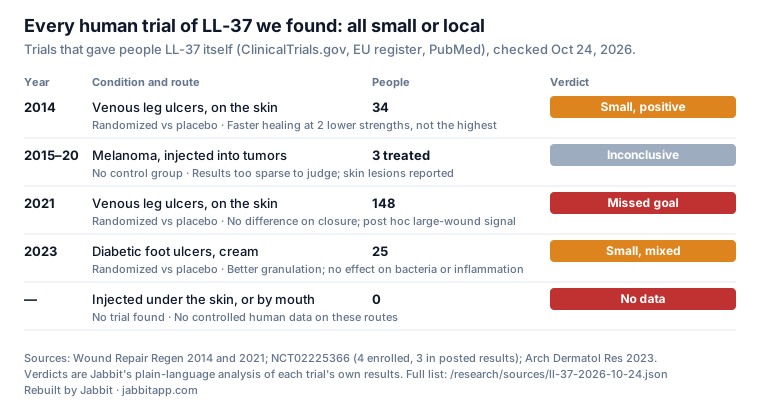
- Leg ulcers, 2014 (34 patients): after a placebo run-in, patients got one of three strengths of LL-37 or placebo on their ulcers twice a week for 4 weeks. The two lower strengths cut mean ulcer area by 68% and 50%, with healing rates about six and three times placebo, though only the first was statistically significant (p=0.003 and p=0.088). The highest strength did no better than placebo, and no safety concerns were reported.[8] The first author worked for Pergamum AB, an industry developer.[8]
- Leg ulcers, 2021 (148 patients, phase IIb): this was the confirmatory test, run at 15 sites in Poland and Sweden for up to 13 weeks. It found no difference: 26.5% and 24.7% of patients on the two strengths had confirmed complete closure, compared with 25.3% on placebo.[9]
- Diabetic foot ulcers, 2023 (25 patients): LL-37 cream improved a measure of healthy new tissue (granulation) at every weekly check over 4 weeks. It did not significantly lower inflammatory markers or bacterial counts, which matters given the peptide’s antimicrobial reputation.[12] Its registry record still lists the status as unknown, with no results posted.[27]
- Melanoma, 2015–2020 (3 treated): this uncontrolled MD Anderson study injected LL-37 into tumors. Posted results cover 3 participants, one of whom stopped for lack of efficacy, which is too few to judge benefit.[13]
The largest trial: a miss, then a subgroup
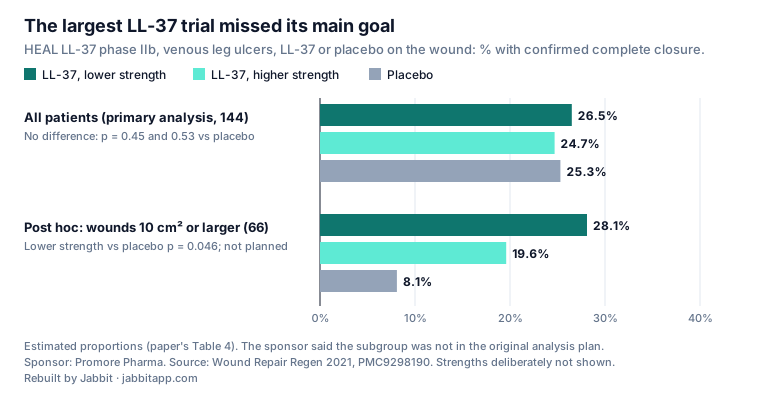
When HEAL LL-37 missed its primary endpoint, its sponsor, Promore Pharma, pointed to patients with large ulcers (at least 10 cm²). In that group, 28.1% on the lower strength healed, compared with 8.1% on placebo (p=0.046).[9] Promore’s own clarification said that “this subgroup analysis regarding efficacy was not part of the original statistical analysis plan,” while noting that randomization had been stratified by wound size.[10] The higher strength did not show the same pattern (19.6%).[9] Our analysis: a single unplanned subgroup result in a trial that otherwise found no effect is a reason for a new trial, not proof of benefit. The paper discloses that Promore funded the study, that three authors were Promore employees and that one was a minority shareholder.[9]
That new trial has not happened. In a notice from Nasdaq Stockholm, Promore’s board is quoted as assessing in 2023 that “the opportunities to raise the capital needed to develop the Company’s program for ropocamptide were limited.” The company then merged into a medical device business under a new name.[11] Its core US wound patent has since expired, according to Google Patents.[26]
Safety: what is and isn’t known
- FDA’s view: FDA says compounded LL-37 “may pose risk for immunogenicity for certain routes of administration” and may have problems with “peptide-related impurities.” It says it “lacks sufficient safety-related information” to know whether LL-37 would harm people, and that animal and lab research suggests “detrimental effects on male reproduction” and that it “can be protumorigenic in some tissues.”[1]
- In the wound trials: LL-37 on the skin was generally well tolerated in studies lasting 4 to 13 weeks. In HEAL, 7.4% of patients had a serious adverse event, none judged related to the drug, and there were no deaths.[9][8][12] In the foot ulcer trial, one patient had mild skin irritation that the authors attributed to wound fluid.[12] These results are for local use on wounds and do not tell us about injected products.
- Injected into tumors: a case report from the melanoma study describes wart-like skin growths with atypical cells, resembling keratoacanthoma, that appeared about 45 days after injections began and cleared within 2 months of stopping.[14] The trial registry lists a squamous cell carcinoma, actinic keratosis and other events in single participants, without saying whether LL-37 caused them.[13]
- Autoimmune and inflammatory disease: LL-37 helps drive inflammation in psoriasis by turning the body’s own DNA into an immune trigger, and about two-thirds of patients with moderate-to-severe psoriasis have T cells that target it.[15][16] Excess cathelicidin promotes skin inflammation in rosacea, and LL-37–DNA complexes activate immune cells in lupus.[18][17][19] These studies concern the body’s own LL-37 in disease. Whether extra LL-37 could worsen these conditions has not been tested (our analysis).
- Cancer, in both directions: LL-37 is overexpressed in some ovarian, breast and lung cancers, and blocking it slowed ovarian tumors in mice.[20][21] In colon and stomach cancer models it appears to suppress tumors instead.[22][23] That split is consistent with FDA’s wording that it can be protumorigenic “in some tissues” (our analysis).[1]
- Male reproduction: in the lab, LL-37 stopped mouse and human sperm from swimming, and treated sperm failed to fertilize in mice. The researchers proposed it as a contraceptive.[24] FDA does not cite specific papers, so linking this study to FDA’s concern is our analysis.[1]
- Adverse event reports: FAERS has no reports coded as LL-37 or cathelicidin and one non-serious report naming ropocamptide among 23 products. That is far too little to judge safety either way.[28]
Legal status
No LL-37 product is approved by FDA.[28] FDA lists cathelicidin LL-37 among bulk substances whose compounding nominations were withdrawn, with the safety summary quoted above, and its advisory committee is due to discuss it by February 2027.[1][2] Whether the pending interim peptide policy covers LL-37 is not public.[3]
What a careful reader should notice
These points are our analysis of the cited sources.
- “Your body makes it” is true, but that does not make extra LL-37 safe. The same peptide fuels inflammation in psoriasis, rosacea and lupus.[5][15][18][17]
- The encouraging leg ulcer result came from 34 patients. When the trial was repeated with 148, the effect disappeared.[8][9]
- In both leg ulcer trials, a stronger preparation did not do better, and in the first trial the highest strength matched placebo. A higher strength being no better is a warning sign, not an invitation to use more.[8][9]
- The antimicrobial reputation rests mainly on lab work. The one trial that measured bacteria in wounds found no significant drop.[25][12]
- All controlled human data are for LL-37 applied to wounds. We found no trial of injecting it under the skin or taking it by mouth.[27]
- FDA’s committee will be weighing a peptide that FDA itself says it lacks the safety information to assess.[1][2]
Frequently asked questions
- Is LL-37 safe?
- No one knows for use outside trials. Applied to wounds in trials lasting up to 13 weeks, it was generally well tolerated. FDA says it lacks the safety information to know whether LL-37 would cause harm in people, and it flags immunogenicity, impurity, male-reproduction and tumor-growth concerns. Injected use has not been tested in a controlled trial.[9][8][1][27]
- Does LL-37 help wounds heal?
- A 34-patient leg ulcer trial and a 25-patient diabetic foot ulcer trial reported benefits, but the largest trial, with 148 patients, found no difference from placebo in wound closure. Its large-wound subgroup signal came from an analysis that was not pre-planned.[8][12][9][10]
- Does LL-37 boost immunity or clear infections and biofilms?
- LL-37 is part of the body’s natural defenses and kills microbes and disrupts biofilms in lab studies. It has not been approved as an antibiotic, and the one wound trial that measured bacteria found no significant reduction. We found no human trial for immunity, Lyme disease or gut infections.[5][25][12][27]
- Is LL-37 FDA approved or legal to compound?
- No LL-37 product is FDA approved. FDA lists it among withdrawn compounding nominations with safety concerns, and its advisory committee is due to discuss it before the end of February 2027.[28][1][2]
- Can LL-37 cause cancer?
- There is no evidence that it causes cancer in people, but research points both ways. It is overexpressed in, and may help drive, some ovarian, breast and lung cancers, while it appears to suppress colon and stomach cancer in lab models. FDA says it can be protumorigenic in some tissues.[20][21][22][23][1]
- Does LL-37 affect fertility?
- In lab and mouse studies, LL-37 stopped sperm from moving and prevented fertilization, and researchers proposed it as a contraceptive. FDA cites nonclinical findings suggesting harm to male reproduction. Human effects are unknown.[24][1]
- What is ropocamptide?
- Ropocamptide is the name Promore Pharma used for LL-37 as a wound-healing drug. Promore’s board said in 2023 that its chances of raising money to develop it were limited, and the company has since become a device business.[9][11]
Bottom line
LL-37 is a genuine part of human immunity, and it showed early promise when applied to chronic wounds.[5][8] But the only large trial found no benefit, the developer stopped, nobody has tested injected use in a controlled trial, and FDA says it cannot judge whether LL-37 is safe while citing immune, reproductive and tumor-growth concerns.[9][11][27][1] Anyone using it outside a trial would be relying on lab and wound data that do not answer those questions.
References
- U.S. Food and Drug Administration. “Certain Bulk Drug Substances for Use in Compounding that May Present Significant Safety Risks” (content current as of 04/22/2026). Cathelicidin LL-37 is listed under bulk drug substances nominated for compounding whose nominations were later withdrawn. FDA’s summary: “Compounded drugs containing cathelicidin LL-37 may pose risk for immunogenicity for certain routes of administration and may have complexities with regard to peptide-related impurities and API characterization. FDA lacks sufficient safety-related information regarding cathelicidin LL-37 to know whether the drug would cause harm when administered to humans. Nonclinical research findings suggest detrimental effects on male reproduction and that this drug can be protumorigenic in some tissues.” https://www.fda.gov/drugs/human-drug-compounding/certain-bulk-drug-substances-use-compounding-may-present-significant-safety-risks. Checked October 24, 2026.
- U.S. Food and Drug Administration. “Meeting of the Pharmacy Compounding Advisory Committee” (content current as of 04/15/2026). “FDA will host an advisory committee meeting before the end of February 2027”; agenda: Cathelicidin (LL-37), GHK-Cu, Dihexa acetate, Melanotan II and PEG-MGF, “being considered for inclusion on the 503A bulks list.” Time, location and materials not yet posted. https://www.fda.gov/advisory-committees/pharmacy-compounding-advisory-committee/meeting-pharmacy-compounding-advisory-committee. Checked October 24, 2026.
- Office of Information and Regulatory Affairs (OMB). Pending EO 12866 Regulatory Review: Interim Access Policy for Compounding Using Certain Peptides, RIN 0910-ZD94, received 10/14/2026, stage: Notice. The text and the list of peptides are not public. https://www.reginfo.gov/public/do/eoDetails?rrid=1568964. Checked October 24, 2026.
- Agerberth B, et al. FALL-39, a putative human peptide antibiotic, is cysteine-free and expressed in bone marrow and testis. Proc Natl Acad Sci U S A. 1995;92(1):195-199. PMID 7529412. Discovery of the human cathelicidin gene product (Karolinska Institutet). https://pubmed.ncbi.nlm.nih.gov/7529412/. Checked October 24, 2026.
- Dürr UH, Sudheendra US, Ramamoorthy A. LL-37, the only human member of the cathelicidin family of antimicrobial peptides. Biochim Biophys Acta. 2006;1758(9):1408-1425. PMID 16716248. Review: a 37-amino-acid helical peptide made in skin, gut, airway and other epithelia and by white blood cells, with antimicrobial, immune-signaling and wound-repair roles. Abstract read. https://pubmed.ncbi.nlm.nih.gov/16716248/. Checked October 24, 2026.
- Gombart AF, Borregaard N, Koeffler HP. Human cathelicidin antimicrobial peptide (CAMP) gene is a direct target of the vitamin D receptor and is strongly up-regulated in myeloid cells by 1,25-dihydroxyvitamin D3. FASEB J. 2005;19(9):1067-1077. PMID 15985530. https://pubmed.ncbi.nlm.nih.gov/15985530/. Checked October 24, 2026.
- Liu PT, et al. Toll-like receptor triggering of a vitamin D-mediated human antimicrobial response. Science. 2006;311(5768):1770-1773. PMID 16497887. Human immune cells; vitamin D-dependent induction of cathelicidin and killing of M. tuberculosis in the lab. https://pubmed.ncbi.nlm.nih.gov/16497887/. Checked October 24, 2026.
- Grönberg A, Mahlapuu M, Ståhle M, Whately-Smith C, Rollman O. Treatment with LL-37 is safe and effective in enhancing healing of hard-to-heal venous leg ulcers: a randomized, placebo-controlled clinical trial. Wound Repair Regen. 2014;22(5):613-621. PMID 25041740. 34 patients in Sweden; 3-week placebo run-in, then 4 weeks of twice-weekly applications of one of three strengths or placebo (EudraCT 2012-002100-41). Healing rate constants for the two lower strengths about sixfold (p=0.003) and threefold (p=0.088) higher than placebo; mean ulcer area reduced 68% and 50%; the highest strength did not differ from placebo; no safety concerns reported. First author affiliated with Pergamum AB, an industry developer. Abstract and HEAL paper background read. https://pubmed.ncbi.nlm.nih.gov/25041740/. Checked October 24, 2026.
- Mahlapuu M, et al. Evaluation of LL-37 in healing of hard-to-heal venous leg ulcers: a multicentric prospective randomized placebo-controlled clinical trial. Wound Repair Regen. 2021;29(6):938-950. doi:10.1111/wrr.12977; PMC9298190; EudraCT 2018-000536-10. PMID 34687253. HEAL LL-37 phase IIb at 15 sites in Poland and Sweden; 148 randomized to LL-37 at two strengths or placebo on the wound, with compression, for up to 13 weeks. Confirmed complete closure (full analysis set): 26.5% lower strength (p=0.4453 vs placebo), 24.7% higher strength (p=0.5274), 25.3% placebo. Post hoc subgroup with wounds of at least 10 cm²: 28.1%, 19.6% and 8.1% (lower strength vs placebo p=0.0458). 122 adverse events in 64 patients (43.2%); 12 non-fatal serious adverse events in 11 patients (7.4%), none assessed as related; no deaths. Funded by Promore Pharma AB; three authors were Promore employees and one a minority shareholder, per the paper’s disclosures. Full text read. https://pubmed.ncbi.nlm.nih.gov/34687253/. Checked October 24, 2026.
- Promore Pharma AB. “Clarification of outcome in the clinical trial HEAL LL-37,” press release, November 20, 2020: “This subgroup analysis regarding efficacy was not part of the original statistical analysis plan,” while noting randomization was stratified by wound size. https://storage.mfn.se/a9041841-95d2-40fa-8919-9cb79e748aef/clarification-of-outcome-in-the-clinical-trial-heal-ll-37.pdf. Checked October 24, 2026.
- Nasdaq Stockholm. “The observation status for Promore Pharma AB under name change to PMD Device Solutions AB,” January 11, 2024. The notice recalls that on June 28, 2023 Promore received observation status after it discontinued its ensereptide program and “the Company’s board of directors had assessed that the opportunities to raise the capital needed to develop the Company’s program for ropocamptide were limited”; Promore then acquired PMD Device Solutions in a reverse takeover. https://www.nasdaq.com/press-release/the-observation-status-for-promore-pharma-ab-under-name-change-to-pmd-device. Checked October 24, 2026.
- Miranda E, et al. Efficacy of LL-37 cream in enhancing healing of diabetic foot ulcer: a randomized double-blind controlled trial. Arch Dermatol Res. 2023;315(9):2623-2633. PMC10514151; NCT04098562. PMID 37480520. 25 patients with mildly infected diabetic foot ulcers in Jakarta, January 2020 to June 2021; cream or placebo twice weekly for 4 weeks. Granulation index higher with LL-37 on days 7, 14, 21 and 28 (p=0.031, 0.009, 0.006, 0.037); no significant differences in IL-1α, TNF-α or bacterial colonization; one mild irritant contact dermatitis, attributed by the authors to wound exudate; recruitment limited by COVID-19. Funded by a Universitas Indonesia grant. Full text read. https://pubmed.ncbi.nlm.nih.gov/37480520/. Checked October 24, 2026.
- ClinicalTrials.gov NCT02225366. Phase 1/2 study of intratumoral LL37 in metastatic melanoma, MD Anderson Cancer Center; start July 2015, completed November 2020, results first posted December 2021. Enrollment listed as 4; posted results cover 3 participants in two cohorts, 1 of whom stopped for lack of efficacy. No serious adverse events posted; other adverse events listed in one participant each include squamous cell carcinoma, actinic keratosis, skin hypopigmentation and hypothyroidism, and anemia in two. The registry does not state whether events were caused by the drug. https://clinicaltrials.gov/study/NCT02225366. Checked October 24, 2026.
- Dolkar T, et al. Dermatologic toxicity from novel therapy using antimicrobial peptide LL-37 in melanoma: a detailed examination of the clinicopathologic features. J Cutan Pathol. 2018;45(7):539-544. PMID 29665030. Case report from the MD Anderson trial: about 45 days after starting weekly injections into melanoma lesions, multiple wart-like skin papules appeared; most biopsies showed inflammation with atypical squamous growth resembling keratoacanthoma; lesions resolved within 2 months of stopping. Abstract read. https://pubmed.ncbi.nlm.nih.gov/29665030/. Checked October 24, 2026.
- Lande R, et al. Plasmacytoid dendritic cells sense self-DNA coupled with antimicrobial peptide. Nature. 2007;449(7162):564-569. PMID 17873860. In psoriasis skin, LL37 binds the body’s own DNA and turns it into a trigger for interferon-producing immune cells. https://pubmed.ncbi.nlm.nih.gov/17873860/. Checked October 24, 2026.
- Lande R, et al. The antimicrobial peptide LL37 is a T-cell autoantigen in psoriasis. Nat Commun. 2014;5:5621. PMID 25470744. LL37-specific T cells in about two-thirds of patients with moderate-to-severe psoriasis, correlating with disease activity. Abstract read. https://pubmed.ncbi.nlm.nih.gov/25470744/. Checked October 24, 2026.
- Lande R, et al. Neutrophils activate plasmacytoid dendritic cells by releasing self-DNA-peptide complexes in systemic lupus erythematosus. Sci Transl Med. 2011;3(73):73ra19. PMID 21389263. https://pubmed.ncbi.nlm.nih.gov/21389263/. Checked October 24, 2026.
- Yamasaki K, et al. Increased serine protease activity and cathelicidin promotes skin inflammation in rosacea. Nat Med. 2007;13(8):975-980. PMID 17676051. Rosacea skin had abnormally high cathelicidin; injecting the rosacea forms of the peptide into mouse skin increased inflammation. Abstract read. https://pubmed.ncbi.nlm.nih.gov/17676051/. Checked October 24, 2026.
- Kahlenberg JM, Kaplan MJ. Little peptide, big effects: the role of LL-37 in inflammation and autoimmune disease. J Immunol. 2013;191(10):4895-4901. PMID 24185823. Review covering psoriasis, lupus, rheumatoid arthritis and atherosclerosis. https://pubmed.ncbi.nlm.nih.gov/24185823/. Checked October 24, 2026.
- Coffelt SB, et al. The pro-inflammatory peptide LL-37 promotes ovarian tumor progression through recruitment of multipotent mesenchymal stromal cells. Proc Natl Acad Sci U S A. 2009;106(10):3806-3811. PMID 19234121. Mouse xenograft study; neutralizing LL-37 reduced tumor growth; notes overexpression in ovarian, breast and lung cancers. Abstract read. https://pubmed.ncbi.nlm.nih.gov/19234121/. Checked October 24, 2026.
- Heilborn JD, et al. Antimicrobial protein hCAP18/LL-37 is highly expressed in breast cancer and is a putative growth factor for epithelial cells. Int J Cancer. 2005;114(5):713-719. PMID 15609314. https://pubmed.ncbi.nlm.nih.gov/15609314/. Checked October 24, 2026.
- Ren SX, et al. Host immune defense peptide LL-37 activates caspase-independent apoptosis and suppresses colon cancer. Cancer Res. 2012;72(24):6512-6523. PMID 23100468. Lab and mouse study in the opposite direction: LL-37 killed colon cancer cells, and mice lacking cathelicidin were more susceptible to colon tumors. Abstract read. https://pubmed.ncbi.nlm.nih.gov/23100468/. Checked October 24, 2026.
- Wu WK, et al. Emerging roles of the host defense peptide LL-37 in human cancer and its potential therapeutic applications. Int J Cancer. 2010;127(8):1741-1747. PMID 20521250. Review: LL-37 appears to promote some cancers (such as ovarian, lung and breast) and suppress others (such as colon and gastric). https://pubmed.ncbi.nlm.nih.gov/20521250/. Checked October 24, 2026.
- Srakaew N, et al. Antimicrobial host defence peptide, LL-37, as a potential vaginal contraceptive. Hum Reprod. 2014;29(4):683-696. PMID 24549217. LL-37 made mouse and human sperm lose motility in the lab, and LL-37-treated sperm failed to fertilize in mice; the authors proposed it as a contraceptive. Abstract read. https://pubmed.ncbi.nlm.nih.gov/24549217/. Checked October 24, 2026.
- Ridyard KE, Overhage J. The potential of human peptide LL-37 as an antimicrobial and anti-biofilm agent. Antibiotics (Basel). 2021;10(6):650. PMID 34072318. Review: LL-37 has broad lab activity against bacteria and biofilms but is not approved as an antibiotic; limits include “high cost, lower activity in physiological environments, susceptibility to proteolytic degradation, and high toxicity to human cells.” Abstract read. https://pubmed.ncbi.nlm.nih.gov/34072318/. Checked October 24, 2026.
- US Patent 9,125,875 B2, “Use of the cathelicidin LL-37 and derivatives thereof for wound healing,” priority January 29, 2003, granted September 8, 2015; original assignee Lipopeptide AB, current assignee Promore Pharma AB; status “Expired - Fee Related,” anticipated expiration January 28, 2024 (Google Patents). The abstract describes stimulating epithelial and stromal cell growth to heal chronic ulcers and notes: “The cytotoxic effect of LL-37 may be reduced by including a bilayer-forming polar lipid.” https://patents.google.com/patent/US9125875B2/en. Checked October 24, 2026.
- ClinicalTrials.gov API v2, pulled October 24, 2026. Searches “LL-37,” “LL37,” “cathelicidin” and “ropocamptide”: 98 unique studies. Only 2 give LL-37 as a drug: https://clinicaltrials.gov/study/NCT02225366 (melanoma, injected into tumors) and https://clinicaltrials.gov/study/NCT04098562 (diabetic foot ulcers, cream; status listed as unknown, no results posted). The rest measure LL-37 levels, often in vitamin D or gum disease studies. Promore’s leg ulcer trials are on the EU Clinical Trials Register. Census: https://jabbitapp.com/research/sources/ll-37-2026-10-24.json. Checked October 24, 2026.
- FDA Adverse Event Reporting System via openFDA, October 24, 2026. Searches of patient.drug.medicinalproduct for “LL-37,” “LL37” and “cathelicidin” return no matches; “ropocamptide” returns 1 report (received January 2026, United States, not serious) that lists it among 23 different products, with muscle twitching, tingling, muscle spasms and “drug ineffective.” A report with that many products cannot show what caused anything. Drugs@FDA searches return no matches, meaning no approved US product. Zero or few reports is not evidence of safety. https://api.fda.gov/drug/event.json?search=patient.drug.medicinalproduct:%22ROPOCAMPTIDE%22. Checked October 24, 2026.
- PubMed search “LL-37”[tiab] OR “LL37”[tiab] OR cathelicidin[tiab], October 24, 2026: 4,707 records. Most are laboratory, animal or biomarker studies; the human treatment trials we found are cited above. https://pubmed.ncbi.nlm.nih.gov/?term=%22LL-37%22%5Btiab%5D+OR+%22LL37%22%5Btiab%5D+OR+cathelicidin%5Btiab%5D. Checked October 24, 2026.
This page analyzes regulator documents, published studies, company statements and registry records. It is not medical or legal advice and does not recommend any product or dose. LL-37 is not approved by FDA. Charts were rebuilt by Jabbit from the sources cited in each caption.