Status tracker · FDA category lists, compounding advisory committee votes, Drugs@FDA and the human evidence for every peptide Jabbit has covered · Sources checked October 24, 2026
Published · Updated
Which peptides is FDA reviewing, and can pharmacies compound them in 2026? A sourced status table for 21 peptides and NAD+, from BPC-157 to sermorelin.
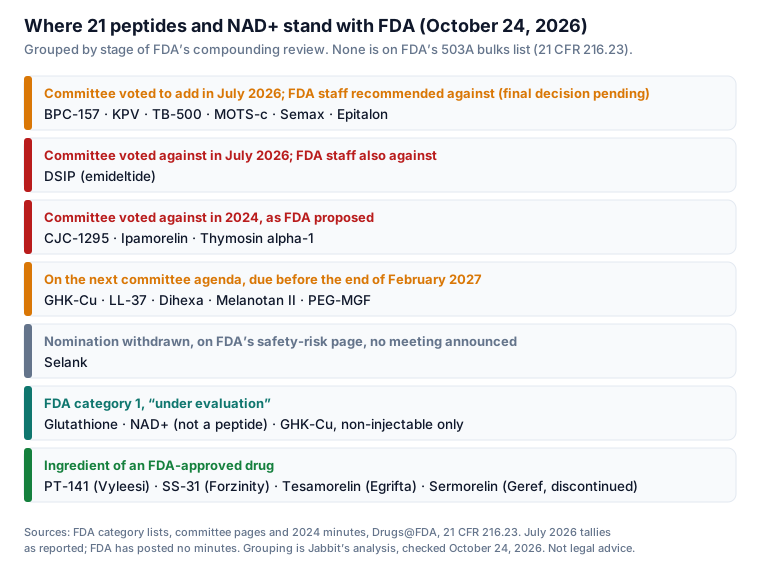
FDA has not added a single peptide to the list of bulk ingredients that pharmacies may compound under section 503A; that list holds six substances, none of them peptides.[6] Of the 21 peptides we have covered, 16 sit on FDA’s page of substances that may present significant safety risks, at least for some routes; 10 have already gone before FDA’s compounding advisory committee, and 5 more are due before the end of February 2027.[1][8][18][19][7] Four are or were ingredients of FDA-approved drugs, which is a different legal path.[21] Meanwhile an interim FDA peptide policy has been under White House review since October 14, 2026, and nobody outside government knows which peptides it covers.[20] The table below shows where each one stands, with every status linked to an FDA source.
How a pharmacy can legally compound a peptide
A traditional compounding pharmacy (section 503A) may make a drug from a bulk ingredient only if the ingredient has a USP or NF monograph, is a component of an FDA-approved drug, or is on FDA’s 503A bulks list.[4][5] FDA builds that list by regulation, after consulting its Pharmacy Compounding Advisory Committee, and so far the list holds six mostly topical substances.[5][6] While the list is incomplete, FDA’s interim policy says it does not intend to take action against compounding with substances in its “category 1,” under evaluation, if other conditions are met.[3] Category 2 holds substances that raise significant safety risks, and FDA also keeps a page of nominations that were withdrawn, with its safety findings attached.[1][2]
Two points are easy to miss. A committee vote is advice, not a decision: FDA can disagree with it and must still go through rulemaking.[5][6] And a withdrawn nomination does not mean a substance was cleared. Our reading, which is not legal advice, is that a peptide that is neither in category 1 nor in an approved drug is not covered by the interim policy’s enforcement discretion; a medical publisher summarizing the July votes lists those peptides as “Not on 503A list, not in Category 1.”[3][16]
The status table
Each row links to our full teardown. The status column cites FDA documents; the evidence column is our one-line summary of each teardown, where every study is cited. Committee tallies from July 2026 are as reported by people who watched the public webcast, because FDA has not posted minutes.[8][16][17]
Voted on in July 2026
FDA staff recommended against listing all seven. The committee voted for six of them and against DSIP. FDA has not announced a decision on any.[9][10][11][12][13][14][15][16]
| Peptide | Where it stands with FDA | Approved US drug? | Human evidence (our summary) |
|---|---|---|---|
| BPC-157 | FDA staff: against listing[9]. Committee: for, reported 8-6-1[8][16][17]. On FDA’s withdrawn-nominations safety page[1]. | None[21] | No published completed randomized trial in people. |
| KPV | FDA staff: against[10]. Committee: for, reported 8-6-1[8][16][17]. FDA has found no human exposure data[1]. | None[21] | No human trial of KPV itself; the one uncontrolled study used a different molecule. |
| TB-500 | FDA staff: against[11]. Committee: for, reported 8-6-1[8][16][17]. FDA has found no human exposure data[1]. | None[21] | No study of TB-500 in people; the trials cited online used full thymosin beta-4. |
| MOTS-c | FDA staff: against[12]. Committee: for, reported 7-5-2[8][16][17]. FDA has found no human exposure data[1]. | None[21] | No published study giving MOTS-c to people. |
| Semax | FDA staff: against[13]. Committee: for, reported 8-5-1[8][16][17]. On FDA’s safety page[1]. | None[21] | Small Russian studies without placebo groups, involving its developers; registered in Russia for stroke. |
| Epitalon | FDA staff: against[14]. Committee: for, reported 7-4-1 or 7-5-1[8][16][17]. On FDA’s safety page[1]. | None[21] | Longevity claims trace to small studies from its developers’ group; FDA found no insomnia studies. |
| DSIP (emideltide) | FDA staff: against[15]. Committee: against, reported 6-7-1[8][16][17]. On FDA’s safety page[1]. | None[21] | Small 1980s IV studies; two independent placebo trials found little benefit. |
Next on the committee’s agenda, due before the end of February 2027
FDA has listed these five for its next 503A bulks discussion but has not set a date.[7]
| Peptide | Where it stands with FDA | Approved US drug? | Human evidence (our summary) |
|---|---|---|---|
| GHK-Cu | Split by route. Injectable: on FDA’s safety page, with an immune-reaction warning[1]. Non-injectable (creams, for example): back in category 1 since May 2026[2]. On the next committee agenda[7]. | None[21] | A 511-patient diabetic foot ulcer trial was no better than placebo; injection untested. |
| LL-37 (cathelicidin) | On FDA’s safety page (reproductive and tumor-growth concerns in lab studies)[1]. Next committee agenda[7]. | None[21] | The largest wound trial (148 patients) missed its main goal; injection untested. |
| Dihexa | FDA has found no human exposure data[1]. Next committee agenda[7]. | None[21] | No human trial. |
| Melanotan II | On FDA’s safety page, citing case reports including melanoma[1]. Next committee agenda[7]. | None[21] | Small 1990s studies; never approved anywhere; serious-harm case reports. |
| PEG-MGF | FDA has found no human exposure data[1]; plain MGF sits in category 3[2]. Next committee agenda[7]. | None[21] | Never tested in people. |
Voted against in 2024
In 2024, FDA proposed not listing these, and the committee voted against placing them on the list by wide margins.[19][18]
| Peptide | Where it stands with FDA | Approved US drug? | Human evidence (our summary) |
|---|---|---|---|
| CJC-1295 | December 2024: the committee backed FDA’s proposal not to list it, 12 or 13 votes to 0 or 1 across five forms[18]. On FDA’s safety page[1]. | None[21] | No published trial of the CJC-1295 and ipamorelin combination in people. |
| Ipamorelin | October 2024: committee backed FDA’s proposal not to list it, 0-12-1[19]. On FDA’s 503A safety page as withdrawn, and in active category 2 for outsourcing facilities (503B)[1]. | None[21] | Studied in people mainly for gut recovery after bowel surgery; FDA cites a published IV study reporting serious adverse events including death. |
| Thymosin alpha-1 | December 2024: committee backed FDA’s proposal not to list it, 4-17-0 for each form[18][31]. On FDA’s safety page[1]. | None in the US[21] | The largest trial (1,106 sepsis patients) found no survival benefit; approved in China as Zadaxin. |
Category 1, or no meeting scheduled
| Peptide | Where it stands with FDA | Approved US drug? | Human evidence (our summary) |
|---|---|---|---|
| Selank | On FDA’s safety page as a withdrawn nomination[1]. No committee meeting announced[7]. | None[21] | Small, unblinded, partly company-funded Russian studies. |
| Glutathione | Category 1, “under evaluation”[2], covered by FDA’s interim policy if its conditions are met[3]. CDC has linked a 2026 cluster of illnesses to injected glutathione that pharmacies compounded from supplement-grade ingredients[30]. | No glutathione drug; its oxidized form is an ingredient in an eye irrigation solution[21] | IV skin-lightening rests on one small, flawed study; a small IV Parkinson’s trial found no significant benefit. |
| NAD+ (not a peptide) | Category 1, “under evaluation”[2][3], though FDA’s 2019 proposed rule proposed leaving it off the list; that proposal was never finalized for NAD[29][6]. | None[21] | No placebo-controlled trial of NAD+ drips or shots for aging. |
Ingredients of FDA-approved drugs
Our reading: a component of an approved drug can be a lawful 503A ingredient, but compounders still may not make what are “essentially copies” of a commercially available drug, and tesamorelin is now regulated as a biologic, which FDA says the compounding sections do not exempt from licensure.[4][5][28]
| Peptide | Where it stands with FDA | Approved US drug? | Human evidence (our summary) |
|---|---|---|---|
| PT-141 (bremelanotide) | Ingredient of an approved drug[21]. FDA sent warning letters in August 2026 to online sellers of “research” PT-141[25]. | Vyleesi, for premenopausal women with low sexual desire disorder[24] | Modest benefit in the trials that led to approval; not approved for men. |
| SS-31 (elamipretide) | Ingredient of an approved drug[21][26]. | Forzinity, accelerated approval for Barth syndrome (2025)[26] | 9 of 13 placebo-controlled trials missed their main goal. |
| Tesamorelin | Regulated as a biological product since 2020[27]; FDA’s guidance says the compounding sections do not exempt biologics from licensure[28]. | Egrifta, for excess belly fat in adults with HIV-associated lipodystrophy[21][27] | Shown to reduce abdominal fat in that HIV population. |
| Sermorelin | Once approved as Geref (discontinued); FDA determined it was not withdrawn for safety or effectiveness reasons[22][21]. | Geref, discontinued[21] | Raised growth hormone in older adults, but strength and fitness did not improve in the main 6-month trial. |
Other peptides on FDA’s lists that we have not covered yet: GHRP-2 and GHRP-6 (category 2 for outsourcing facilities). Ibutamoren, the oral non-peptide often sold as MK-677 (category 2 for pharmacies and outsourcing facilities), now has its own MK-677 evidence teardown. Kisspeptin-10 (503A category 2) now has its own kisspeptin-10 evidence teardown. AOD-9604 (withdrawn nomination; the committee backed FDA’s proposal not to list it in 2024) now has its own AOD-9604 evidence teardown.[1][2][18]
What the table shows
These points are our analysis of the sources cited.
- The evidence and the votes point in different directions. For the six peptides the committee backed in July, FDA’s staff concluded the balance of the criteria weighed against them. Our teardowns found the human evidence thin for all six: no human data for KPV itself, TB-500 or MOTS-c, and small, mostly uncontrolled or developer-run studies for BPC-157, semax and epitalon.[9][10][11][12][13][14][16]
- The 2024 and 2026 committees voted very differently. In 2024 the panel sided with FDA staff on every peptide we track, often unanimously; in July 2026 it overrode staff on six of seven.[19][18][16] Our DSIP teardown looks at how the July votes split.
- “Approved” usually means one narrow use. Each of the four approved peptides is approved for a specific condition, from Barth syndrome to HIV-associated belly fat, not for the anti-aging or recovery uses they are often marketed for.[24][26][27][22]
- Some companies treat a peptide as allowed when it has an approved-drug path. One large telehealth company described sermorelin, glutathione and NAD+ as “already allowed peptides” in August 2026.[23] That matches the paths in the table for sermorelin (former approved drug) and for glutathione and NAD+ (category 1), but FDA’s own 2019 proposed rule would have left NAD off the list.[22][2][29]
- The biggest unknown is the interim policy. Its text is not public, so whether it changes any row above is unknown; we will update the table when it is published.[20]
What to watch next
- The text of FDA’s interim peptide compounding policy, RIN 0910-ZD94, once White House review ends.[20]
- FDA’s decisions on the seven July 2026 peptides, and the meeting minutes, which were not posted as of October 24, 2026.[8]
- A date, briefing documents and docket for the committee meeting on GHK-Cu, LL-37, dihexa, melanotan II and PEG-MGF.[7]
- Any proposed rule adding peptides to 21 CFR 216.23, which would open a public comment period.[5][6]
Frequently asked questions
- Which peptides is FDA reviewing in 2026?
- FDA’s compounding advisory committee voted on BPC-157, KPV, TB-500, MOTS-c, semax, epitalon and DSIP in July 2026, and FDA says it will bring GHK-Cu, LL-37, dihexa, melanotan II and PEG-MGF to the committee before the end of February 2027. FDA has not announced final decisions.[8][16][7]
- Can pharmacies compound BPC-157 in 2026?
- BPC-157 is not on FDA’s 503A bulks list, is not in category 1 and is not in any approved drug. FDA staff recommended against listing it; the committee voted for it, 8-6-1 as reported, but that vote is advisory and FDA has not acted. Our reading, not legal advice, is that nothing has yet changed its status.[6][2][9][16][21]
- What does FDA “category 2” mean for peptides?
- Category 2 holds bulk ingredients FDA says raise significant safety risks. Most peptides sold online appear on FDA’s related page of nominations that were withdrawn, with FDA’s safety findings listed, often that it has little or no human safety data.[2][1]
- Does a committee vote make a peptide legal to compound?
- No. The committee advises FDA; a substance joins the 503A bulks list only through FDA rulemaking, and the list currently contains no peptides.[5][6]
- Is sermorelin legal to compound?
- Sermorelin was the active ingredient in Geref, an approved drug that was discontinued, and FDA determined it was not withdrawn for safety or effectiveness reasons. Compounders generally treat it as permitted on that basis. Whether a specific product is lawful depends on how it is made, and this is not legal advice.[22][21][4][23]
- Which peptides are FDA approved?
- Of those we cover, bremelanotide (Vyleesi), elamipretide (Forzinity) and tesamorelin (Egrifta) are approved, each for one narrow use, and sermorelin was approved as Geref until it was discontinued.[21][24][26][27][22]
- Is GHK-Cu allowed in compounded creams?
- FDA put non-injectable GHK-Cu back in category 1, under evaluation, in May 2026, while injectable GHK-Cu remains on its safety-risk page. GHK-Cu is due before the committee by the end of February 2027.[2][1][7]
Bottom line
As of October 24, 2026, no peptide is on FDA’s 503A bulks list, and most of the peptides marketed for recovery, longevity or the brain sit on FDA’s safety-risk page with little or no human safety data.[6][1] The July committee votes raised hopes, but they are advisory and FDA’s own staff recommended the opposite.[16][9] The only peptides with clear legal paths are those in approved drugs or in category 1, and even those have limits.[4][3][2] We will update this tracker when FDA publishes its interim policy or announces decisions.
References
- U.S. Food and Drug Administration. “Certain Bulk Drug Substances for Use in Compounding that May Present Significant Safety Risks.” The table “Bulk drug substances nominated but withdrawn” lists AOD-9604, BPC-157, cathelicidin LL-37, CJC-1295, dihexa acetate, emideltide (DSIP), epitalon, GHK-Cu (for injectable routes of administration), ipamorelin acetate, KPV, PEG-MGF, melanotan II, MOTs-C, selank acetate, semax, thymosin-alpha 1 and TB-500, each with FDA’s safety summary (for example, BPC-157: “FDA has no, or only limited, safety-related information”; KPV, dihexa, MOTs-C, PEG-MGF and TB-500: FDA has “not identified any human exposure data”; melanotan II: case reports including melanoma and posterior reversible encephalopathy syndrome; CJC-1295: serious adverse events including increased heart rate and a systemic vasodilatory reaction). Active category 2 entries include GHRP-2 and GHRP-6 (503B), ibutamoren mesylate (503A and 503B), kisspeptin-10 (503A) and ipamorelin acetate (503B, since September 29, 2023, noting serious adverse events including death in IV studies for gastric motility). https://www.fda.gov/drugs/human-drug-compounding/certain-bulk-drug-substances-use-compounding-may-present-significant-safety-risks. Checked October 24, 2026.
- U.S. Food and Drug Administration. “Bulk Drug Substances Nominated for Use in Compounding Under Section 503A of the Federal Food, Drug, and Cosmetic Act,” categories 1-3, updated May 14, 2026. Category 1 (“Under Evaluation”) includes glutathione, nicotinamide adenine dinucleotide (NAD) and “GHK-Cu (except for injectable routes of administration)”, which FDA says was removed on April 22, 2026 after nominations were withdrawn and added back after a nominator clarified on May 5, 2026 that it withdrew only the injectable route. Category 2 (503A) lists ibutamoren mesylate and kisspeptin-10; mechano growth factor (MGF) is in category 3 (“Nominated Without Adequate Support”). https://www.fda.gov/media/94155/download. Checked October 24, 2026.
- U.S. Food and Drug Administration. Interim Policy on Compounding Using Bulk Drug Substances Under Section 503A of the Federal Food, Drug, and Cosmetic Act, guidance for industry, January 2025. FDA “does not intend to take regulatory action” for 503A compounding with a bulk substance that has no applicable USP or NF monograph and is not a component of an FDA-approved drug if, “among other conditions,” the substance appears in category 1. https://www.fda.gov/media/174456/download. Checked October 24, 2026.
- U.S. Food and Drug Administration. “Bulk Drug Substances Used in Compounding Under Section 503A of the FD&C Act” (content current as of 05/14/2026). A 503A pharmacy may compound with a bulk substance that complies with a USP or NF monograph, if one exists; is a component of an FDA-approved drug, if no monograph exists; or appears on the 503A bulks list. https://www.fda.gov/drugs/human-drug-compounding/bulk-drug-substances-used-compounding-under-section-503a-fdc-act. Checked October 24, 2026.
- 21 U.S.C. 353a (FD&C Act section 503A), including (b)(1)(A)(i) on bulk drug substances, (b)(1)(D) on not compounding drugs that are “essentially copies of a commercially available drug product,” (b)(1)(C) on drugs withdrawn or removed because they were found unsafe or not effective, and (c) on developing the bulks list by regulation after consulting an advisory committee. Legal Information Institute. https://www.law.cornell.edu/uscode/text/21/353a. Checked October 24, 2026.
- Electronic Code of Federal Regulations. 21 CFR 216.23. Paragraph (a), the 503A bulks list, names six substances: Brilliant Blue G, cantharidin, diphenylcyclopropenone, N-acetyl-D-glucosamine, squaric acid dibutyl ester and thymol iodide. Paragraph (b) names four substances FDA decided not to include. The section was last amended in 2019. https://www.ecfr.gov/current/title-21/chapter-I/subchapter-C/part-216/subpart-C/section-216.23. Checked October 24, 2026.
- U.S. Food and Drug Administration. Meeting of the Pharmacy Compounding Advisory Committee: “FDA will host an advisory committee meeting before the end of February 2027”; the 503A bulks agenda lists cathelicidin (LL-37), GHK-Cu, dihexa acetate, melanotan II and PEG-MGF. No date, Federal Register notice or docket was posted when we checked. https://www.fda.gov/advisory-committees/pharmacy-compounding-advisory-committee/meeting-pharmacy-compounding-advisory-committee. Checked October 24, 2026.
- U.S. Food and Drug Administration. July 23-24, 2026 Meeting of the Pharmacy Compounding Advisory Committee (content current as of 08/06/2026). Lists BPC-157, emideltide, epitalon, KPV, MOTS-c, semax and TB-500; briefing documents and FDA presentations are posted, but no minutes or official vote record were posted when we checked. https://www.fda.gov/advisory-committees/advisory-committee-calendar/july-23-24-2026-meeting-pharmacy-compounding-advisory-committee-07232026. Checked October 24, 2026.
- U.S. Food and Drug Administration. FDA Briefing Document, Pharmacy Compounding Advisory Committee meeting, July 23-24, 2026: BPC-157. The conclusion states that a balancing of the criteria “weighs against” the substance being placed on the 503A bulks list. Conclusion read. https://www.fda.gov/media/193343/download. Checked October 24, 2026.
- U.S. Food and Drug Administration. FDA Briefing Document, Pharmacy Compounding Advisory Committee meeting, July 23-24, 2026: KPV. The conclusion states that a balancing of the criteria “weighs against” the substance being placed on the 503A bulks list. Conclusion read. https://www.fda.gov/media/193346/download. Checked October 24, 2026.
- U.S. Food and Drug Administration. FDA Briefing Document, Pharmacy Compounding Advisory Committee meeting, July 23-24, 2026: TB-500. The conclusion states that a balancing of the criteria “weighs against” the substance being placed on the 503A bulks list. Conclusion read. https://www.fda.gov/media/193349/download. Checked October 24, 2026.
- U.S. Food and Drug Administration. FDA Briefing Document, Pharmacy Compounding Advisory Committee meeting, July 23-24, 2026: MOTS-c. The conclusion states that a balancing of the criteria “weighs against” the substance being placed on the 503A bulks list. Conclusion read. https://www.fda.gov/media/193347/download. Checked October 24, 2026.
- U.S. Food and Drug Administration. FDA Briefing Document, Pharmacy Compounding Advisory Committee meeting, July 23-24, 2026: semax. The conclusion states that a balancing of the criteria “weighs against” the substance being placed on the 503A bulks list. Conclusion read. https://www.fda.gov/media/193348/download. Checked October 24, 2026.
- U.S. Food and Drug Administration. FDA Briefing Document, Pharmacy Compounding Advisory Committee meeting, July 23-24, 2026: epitalon. The conclusion states that a balancing of the criteria “weighs against” the substance being placed on the 503A bulks list. Conclusion read. https://www.fda.gov/media/193345/download. Checked October 24, 2026.
- U.S. Food and Drug Administration. FDA Briefing Document, Pharmacy Compounding Advisory Committee meeting, July 23-24, 2026: emideltide (DSIP). The conclusion states that a balancing of the criteria “weighs against” the substance being placed on the 503A bulks list. Conclusion read. https://www.fda.gov/media/193344/download. Checked October 24, 2026.
- MDside. “The FDA advisory vote on six peptides: what has to happen before a clinic can use them.” October 2026. Reported tallies (yes-no-abstain): BPC-157 8-6-1, KPV 8-6-1, TB-500 8-6-1, MOTS-c 7-5-2, semax 8-5-1, epitalon “7-4-1 or 7-5-1”, emideltide (DSIP) 6-7-1; notes FDA had not posted minutes and that the voted substances are “Not on 503A list, not in Category 1.” https://www.mdside.com/peptide-advisory-vote-what-happens-next/. Checked October 24, 2026.
- Holland & Knight. “Peptides at a Crossroads: What Wellness Providers Need to Know.” October 2026. Law firm client alert summarizing the July 2026 committee votes and the pending interim policy; its views are its own. https://www.hklaw.com/en/insights/publications/2026/10/peptides-at-a-crossroads-what-wellness-providers-need-to-know. Checked October 24, 2026.
- U.S. Food and Drug Administration. Final summary minutes, Pharmacy Compounding Advisory Committee, December 4, 2024. Each question stated that “FDA is proposing that” the substance “NOT be included on the 503A Bulks List” and asked whether it should be placed on the list (yes/no/abstain): CJC-1295 free base 0/13/0, acetate 1/12/0, DAC free base, DAC acetate and DAC trifluoroacetate each 0/13/0; thymosin alpha-1 free base 4/17/0 and acetate 4/17/0; AOD-9604 0/12. https://www.fda.gov/media/185642/download. Checked October 24, 2026.
- U.S. Food and Drug Administration. Final summary minutes, Pharmacy Compounding Advisory Committee, October 29, 2024. FDA proposed that ipamorelin “NOT be included” on the 503A bulks list; asked whether it should be placed on the list, members voted 0 yes, 12 no, 1 abstain for the free base and the same for the acetate. https://www.fda.gov/media/185412/download. Checked October 24, 2026.
- Office of Information and Regulatory Affairs (OMB). Pending EO 12866 Regulatory Review: Interim Access Policy for Compounding Using Certain Peptides, RIN 0910-ZD94, received 10/14/2026, stage: Notice. The text and the list of peptides are not public. https://www.reginfo.gov/public/do/eoDetails?rrid=1568964. Checked October 24, 2026.
- U.S. Food and Drug Administration, openFDA Drugs@FDA API, active-ingredient searches run October 24, 2026. Results: sermorelin, NDA019863 and NDA020443 (Geref, both discontinued); bremelanotide, NDA210557 (Vyleesi, prescription); elamipretide, NDA215244 (Forzinity, prescription); tesamorelin, BLA022505 (Egrifta, prescription); glutathione disulfide only as an ingredient of an eye irrigation solution (BSS Plus); no results for BPC-157, KPV, thymosin beta, MOTS-c, semax, epitalon, emideltide, GHK, cathelicidin, dihexa, melanotan, mechano growth factor, CJC-1295, ipamorelin, thymosin alpha or thymalfasin, selank, or nicotinamide adenine dinucleotide. Query pattern: https://api.fda.gov/drug/drugsfda.json?search=products.active_ingredients.name:%22SERMORELIN%22; raw counts: https://jabbitapp.com/research/sources/peptide-status-tracker-2026-10-24.json. Checked October 24, 2026.
- U.S. Food and Drug Administration. “Determination That GEREF (Sermorelin Acetate) Injection, 0.5 Milligrams Base/Vial and 1.0 Milligrams Base/Vial, and GEREF (Sermorelin Acetate) for Injection, 0.05 Milligrams Base/Vial, Were Not Withdrawn From Sale for Reasons of Safety or Effectiveness.” Federal Register 78 FR 14095, March 4, 2013. https://www.federalregister.gov/documents/2013/03/04/2013-04827/determination-that-geref-sermorelin-acetate-injection-05-milligrams-basevial-and-10-milligrams. Checked October 24, 2026.
- Hims & Hers Health, Inc. Second-quarter 2026 earnings call (results released August 10, 2026), prepared remarks: “we plan to offer access to already allowed peptides with safe and well-established supply chains before the end of the year. This will include solutions like sermorelin, glutathione and NAD+.” The company’s characterization is its own. Transcript published by The Motley Fool: https://www.fool.com/earnings/call-transcripts/2026/08/17/hims-hims-q2-2026-earnings-call-transcript/. Checked October 24, 2026.
- Vyleesi (bremelanotide injection) prescribing information, DailyMed. Indicated for premenopausal women with acquired, generalized hypoactive sexual desire disorder. https://dailymed.nlm.nih.gov/dailymed/drugInfo.cfm?setid=f1d0c1b5-2f39-4bad-a6a4-0066e3ad5dcf. Checked October 24, 2026.
- U.S. Food and Drug Administration. Warning letter 735063, August 24, 2026, one of a set of letters to online sellers of peptides including bremelanotide (PT-141) labeled for research use. https://www.fda.gov/inspections-compliance-enforcement-and-criminal-investigations/warning-letters/peptide-partners-llc-735063-08242026. Checked October 24, 2026.
- Forzinity (elamipretide) prescribing information, 2025. Accelerated approval to improve muscle strength in Barth syndrome. https://www.accessdata.fda.gov/drugsatfda_docs/label/2025/215244s000lbl.pdf. Checked October 24, 2026.
- U.S. Food and Drug Administration. List of approved NDAs for biological products that were deemed to be BLAs on March 23, 2020; includes Egrifta (tesamorelin). https://www.fda.gov/media/119229/download. Checked October 24, 2026.
- U.S. Food and Drug Administration. Mixing, Diluting, or Repackaging Biological Products Outside the Scope of an Approved Biologics License Application, guidance for industry. Section heading: “Sections 503A and 503B of the FD&C Act Do Not Exempt Biological Products from the Premarket Approval Requirements of the PHS Act or from Provisions of the FD&C Act.” https://www.fda.gov/media/90986/download. Checked October 24, 2026.
- U.S. Food and Drug Administration. Proposed rule, “Amendments to the List of Bulk Drug Substances That Can Be Used to Compound Drug Products in Accordance With Section 503A,” 84 FR 46688, September 5, 2019. Proposes that 26 substances, including nicotinamide adenine dinucleotide (NAD), “not be included on the list”; the final list in 21 CFR 216.23(b) does not include NAD. https://www.federalregister.gov/documents/2019/09/05/2019-18951/amendments-to-the-list-of-bulk-drug-substances-that-can-be-used-to-compound-drug-products-in. Checked October 24, 2026.
- U.S. Centers for Disease Control and Prevention. Adverse Events Linked to Injectable Glutathione Compounded with Dietary Supplement Grade Ingredient: Current Situation, updated September 15, 2026: “over 25 people becoming sick in at least four states.” https://www.cdc.gov/healthcare-associated-infections/current-situation/index.html. Checked October 24, 2026.
- U.S. Food and Drug Administration. FDA presentation on thymosin alpha-1, Pharmacy Compounding Advisory Committee, December 4, 2024. https://www.fda.gov/media/183892/download. Checked October 24, 2026.
- Jabbit. Machine-readable status data for this page: category memberships, reported tallies, 2024 minutes counts and Drugs@FDA search results. https://jabbitapp.com/research/sources/peptide-status-tracker-2026-10-24.json. Checked October 24, 2026.
This page summarizes FDA documents, committee records, Drugs@FDA data and our own teardowns. It is not medical or legal advice and does not recommend any product, seller or dose. Statuses can change quickly; check the linked FDA sources. The chart was built by Jabbit from the sources cited in its caption.