Study teardown · Kisspeptin-10 (kisspeptin, metastin, sold online for testosterone, fertility and libido) · 30 years of studies from the 1996 gene discovery to 2026, two drug-company analog programs, FDA and WADA status, registry, FAERS and PubMed counts · Sources checked October 25, 2026
Published · Updated
Kisspeptin-10: does it boost testosterone or restore fertility, and is it safe? A single dose briefly raises the hormones that drive testosterone, but the response fades with repeated or constant exposure, two drug-company trials of an analog for low testosterone were stopped for missing their goals, we found no trials of fertility recovery after TRT, and FDA lists it among compounding ingredients that raise significant safety risks.
Kisspeptin is a natural hormone that sits at the top of the reproductive chain: it tells the brain to release GnRH, which tells the pituitary to release LH and FSH, which tell the testes to make testosterone and sperm.[4][6] In small supervised studies, one dose raised LH and, in young men, testosterone within hours.[7][9][24] But the body tunes out kisspeptin when exposure is frequent or constant, and a potent analog given continuously drove testosterone down into the castration range.[12][20][21] Two drug-company phase 2a trials using an analog to raise low testosterone were terminated after missing their primary goals, and we found no published trial testing kisspeptin to restore fertility after testosterone therapy.[22][27] The honest answer: it is a real hormone with serious research uses, especially in IVF, but there is no good evidence that the injections sold online boost testosterone or fertility over time, and FDA lists kisspeptin-10 among compounding ingredients that raise significant safety risks.[14][29][30]
Why this matters now
Kisspeptin-10 is widely promoted online as an “upstream” way to raise your own testosterone, to restart fertility after TRT or steroids, and as a libido peptide. Three recent developments are relevant. A placebo-controlled study published in August 2026 tested repeated kisspeptin-10 in healthy men and found that the schedule decides whether the response lasts.[26] The first two bulk-ingredient listings for kisspeptin-10 acetate appeared in FDA’s drug directory in January and May 2026, which shows raw powder is being registered for sale, not that any product is approved.[36] And FDA’s interim peptide compounding policy has been under White House review since October 14, 2026, with its peptide list not public; kisspeptin-10 has sat in FDA’s category of substances that raise significant safety risks since September 2023.[31][29] For where every peptide stands, see our FDA peptide compounding status tracker.
Timeline
| Date | Event |
|---|---|
| 1996 | Researchers in Hershey, Pennsylvania, report KiSS-1 as a gene that suppresses melanoma spread; the name nods to Hershey’s chocolate Kisses.[1][5] |
| 2001 | The gene’s 54-amino-acid peptide is isolated from placenta, named metastin, and matched to the receptor GPR54.[2] |
| 2003 | Two teams link broken GPR54 genes to failed puberty in families, and in mice; kisspeptin becomes a “puberty gene” story.[3][4] |
| 2005 | An early human study: an IV infusion raises LH, FSH and testosterone in 6 healthy men.[7] |
| 2009-2010 | Repeated injections in women with hypothalamic amenorrhea show the response fading (tachyphylaxis); twice-weekly dosing fades less.[12][13] |
| 2011 | Kisspeptin-10, the short form now sold online, is shown to raise LH in men but not in women early in the cycle.[9][10] |
| 2013-2014 | Takeda’s analogs TAK-683 and TAK-448, given continuously, push testosterone below castration levels in healthy men.[21][20] |
| 2014-2017 | Phase 2 IVF trials use one or two kisspeptin-54 shots to trigger egg maturation, including in women at high risk of ovarian hyperstimulation.[14][15][16] |
| 2015-2016 | Two Takeda phase 2a trials of TAK-448 to raise testosterone in men are terminated for missing their primary endpoints.[22] |
| 2017-2023 | Brain-scan studies, then two small trials in women and men with low sexual desire, using single IV infusions.[17][18][19] |
| September 29, 2023 | FDA places kisspeptin-10 in 503A category 2, substances that raise significant safety risks.[29] |
| 2024 | WADA adds kisspeptin and its agonist analogs to the Prohibited List; it stays on the 2026 list.[33][32] |
| August 2026 | A 12-day study in 15 men finds daily on-off infusions keep working while continuous infusion does not.[26] |
| October 14, 2026 | FDA’s interim peptide compounding policy goes to White House review; its contents are not public.[31] |
What kisspeptin is
The KISS1 gene makes a precursor protein that is cut into peptides of different lengths. Kisspeptin-54 is the main form in blood, and kisspeptin-10 is its last ten amino acids, the shortest piece with full activity at the receptor.[2][9][6] Both act mainly in the brain, on the neurons that release GnRH, so kisspeptin works one step above GnRH and two steps above LH and testosterone.[6][5] People born without a working receptor do not go through normal puberty, which is why researchers see it as a master switch for the reproductive system.[3][4] It breaks down quickly: a 2024 review puts the half-life in blood at about 28 minutes for kisspeptin-54 and about 3 minutes for kisspeptin-10, one reason drug companies developed longer-lasting analogs.[7][6] In research, a kisspeptin test can show whether a man’s low hormones come from the brain, separating men with congenital hypogonadotropic hypogonadism from healthy men.[28]
The evidence, rung by rung
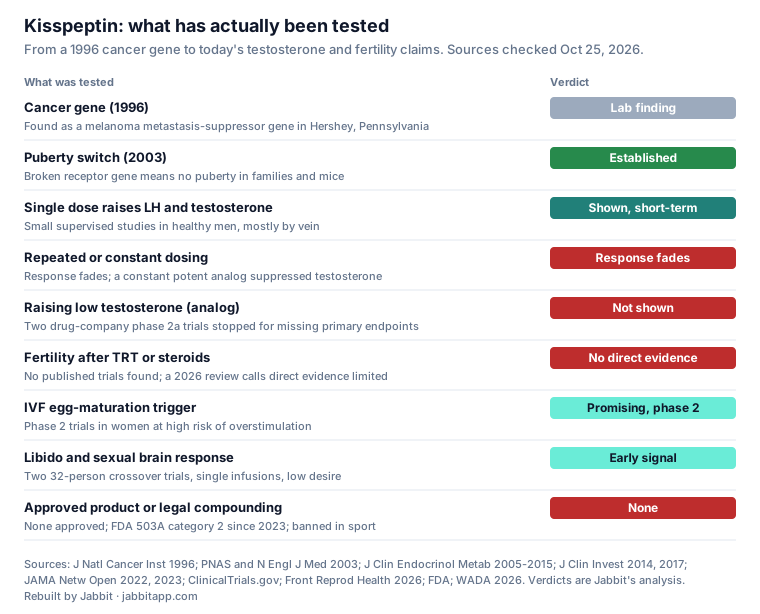
- Short-term hormone rise. In healthy men, a single IV dose or a day-long infusion raised LH and testosterone in studies of 4 to 6 men per group.[7][9] Kisspeptin-10 and kisspeptin-54 behaved similarly, and GnRH itself was more potent than either.[11] More is not always better: the highest single kisspeptin-10 dose tested produced a smaller LH response than a lower one.[9]
- Age. In one study, a kisspeptin-10 shot raised LH in young, middle-aged and older men, but raised testosterone significantly only in the young group.[24] Another found older men’s brains still responded but their testosterone rise was smaller, which the authors attribute to the testes.[25] That matters for men over 40: the authors note that age-related testosterone decline involves the testes, though brain or pituitary changes may coexist.[25]
- Women. Kisspeptin-10 did not change LH or FSH in women early in the menstrual cycle, though it did near ovulation.[10][8]
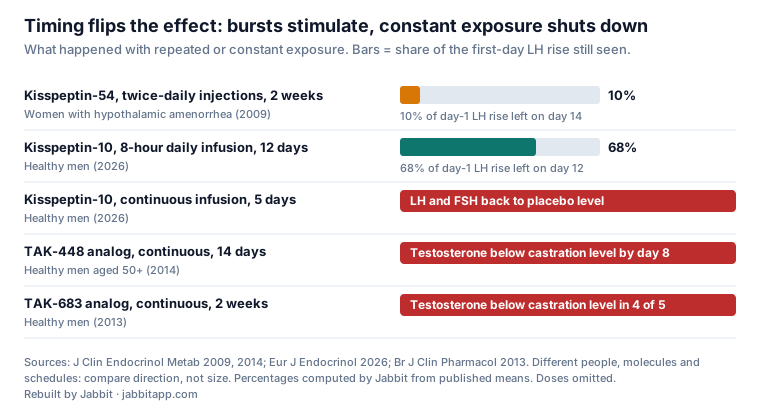
- Repeated or constant use. Twice-daily injections in women with hypothalamic amenorrhea cut the LH response from 24.0 to 2.5 IU/L over two weeks, while twice-weekly injections faded less.[12][13] Continuous exposure to the analogs TAK-448 and TAK-683 drove testosterone below castration levels in healthy men, which is why they were also studied as prostate cancer treatments. TAK-448 was later renamed MVT-602 and studied in women.[20][21][6][23] In the August 2026 study, a continuous 5-day kisspeptin-10 infusion left LH and FSH no different from placebo, although testosterone stayed raised, while daily 8-hour infusions still worked on day 12.[26]
- Raising low testosterone. Takeda tested TAK-448 given intermittently in middle-aged and older men with low testosterone, and in men with obesity-related low hormones; both phase 2a trials were terminated for missing their primary endpoints, and no results were posted.[22] We found no completed placebo-controlled trial showing that kisspeptin raises testosterone in men with low levels over weeks or months.[34][37]
- Fertility after TRT or steroids. This is the most common online claim, and the one with the least direct support. A 2026 review of peptide approaches after TRT concludes that direct evidence for restored sperm production or fertility “remains limited,” and we found no registered trial testing it. Registered trials today mostly study people with diagnosed hormone disorders, such as hypogonadotropic hypogonadism and hypothalamic amenorrhea.[27][34]
- IVF. The strongest clinical results are in women. One or two kisspeptin-54 shots triggered egg maturation in phase 2 trials, including 60 women at high risk of ovarian hyperstimulation syndrome, none of whom developed moderate or severe OHSS.[14][15][16] These trials did not compare kisspeptin head to head with standard triggers.[16]
- Libido. In brain-scan studies, kisspeptin infusions boosted responses to sexual images, and in two crossover trials of 32 women and 32 men with low sexual desire, single 75-minute IV infusions changed brain activity, with secondary signals such as more penile tumescence in men.[17][18][19] Those were one-time hospital infusions of kisspeptin-54, not repeated home injections of kisspeptin-10.[18][19]
Safety: what is and isn’t known
In the short, supervised studies, kisspeptin was generally well tolerated: the 2010 amenorrhea study and the 2022 low-desire trial in women reported no adverse effects, and adverse events with TAK-683 were similar to placebo.[13][18][21] With TAK-448, 26% of healthy men had mild to moderate adverse events.[20] The total human experience is small: mostly single doses or a few weeks, often given by vein, in studies of a few to a few dozen people.[37][34] Many of the European studies come from one London research group, as the overlapping author lists in our references show.[12][14][19][26]
The biggest known risk is the opposite of the marketing. Frequent or constant exposure blunts the response, and continuous exposure to potent analogs shut testosterone down.[12][20][21][6] Whether that happens with products sold online, at whatever schedule users choose, has not been studied. FDA’s safety concern is about the products themselves: compounded kisspeptin-10 “may pose risk for immunogenicity,” may have problems with impurities, and FDA “lacks sufficient information to know whether the drug would cause harm.”[29] FAERS holds one report naming kisspeptin, but unapproved products bought online are rarely reported, so that says little about safety.[35]
Legal status
No kisspeptin product is approved by FDA, and Drugs@FDA lists none.[35] FDA has placed kisspeptin-10 in 503A category 2, bulk drug substances that raise significant safety risks, since September 29, 2023, and it remains there on the list updated May 14, 2026.[29][30] FDA’s pending interim peptide policy could change how some peptides are handled, but its list is not public.[31] Two bulk powders are registered in FDA’s NDC directory, and a listing is not approval.[36] In sport, “kisspeptin and its agonist analogues” are banned at all times for men under WADA’s list, as testosterone-stimulating peptides.[32][33]
What a careful reader should notice
These points are our analysis of the sources cited.
- The claim that kisspeptin raises testosterone comes from single doses in small groups of mostly young, healthy men. Nobody has shown a lasting rise in men with low testosterone.[7][9][24][22]
- A drug-company attempt to turn kisspeptin into a testosterone-raising drug used an analog, and its two phase 2a trials were stopped for missing their goals.[22]
- Timing is everything with this hormone: the same molecule can stimulate or suppress the system depending on how often it is given.[12][26][20]
- The impressive IVF and libido results used kisspeptin-54 in hospitals, often by vein, under research protocols. They do not show what home injections of kisspeptin-10 do.[14][15][19]
- Kisspeptin-10 did not work in women early in the cycle, and testosterone responses were weaker in older men, so results do not transfer neatly between groups.[10][24][25]
- For fertility after TRT, the evidence gap is acknowledged in the research literature itself.[27]
Frequently asked questions
- Does kisspeptin-10 raise testosterone?
- Briefly, in some people. Single doses raised LH and testosterone in small studies of healthy young men, but testosterone rose less or not significantly in older men, and the response fades with repeated or constant use. No trial has shown a lasting rise in men with low testosterone.[7][9][24][12][22]
- Can kisspeptin restore fertility after TRT or steroids?
- That has not been tested in a published trial that we could find. A 2026 review says direct evidence that peptides like kisspeptin restore sperm production or fertility after TRT “remains limited.”[27][34]
- Is kisspeptin-10 safe?
- It looked well tolerated in short, supervised research studies, but long-term safety is unknown. FDA says it lacks the information to know whether compounded kisspeptin-10 would cause harm and flags immune-reaction and impurity risks. Frequent or constant exposure can suppress the reproductive system.[13][18][29][20]
- Is kisspeptin FDA approved?
- No. There is no approved kisspeptin product in the United States, and FDA lists kisspeptin-10 in its compounding category for substances that raise significant safety risks.[35][29][30]
- Does kisspeptin increase libido?
- There is an early signal. In two small crossover trials of people with low sexual desire, single hospital IV infusions of kisspeptin-54 changed brain responses to sexual images, with some secondary improvements. Larger and longer trials have not been reported.[18][19]
- Is kisspeptin used in IVF?
- Only in research so far. Phase 2 trials used kisspeptin-54 to trigger egg maturation, including in women at high risk of ovarian hyperstimulation, with encouraging results, but it is not an approved IVF drug.[14][15][16][35]
- Why is it called kisspeptin?
- The gene was discovered in Hershey, Pennsylvania, in 1996, and the name honors the town’s chocolate Kisses; the “SS” stands for suppressor sequence, because it was first found as a gene that suppressed cancer spread.[1][5]
Bottom line
Kisspeptin went from a cancer gene in 1996 to the recognized master switch of puberty, and it remains a valuable research tool and a promising IVF trigger.[1][4][15] As a testosterone or fertility booster, the record is thin: brief rises in small groups of healthy men, a response that fades with frequent use, suppression with constant exposure, and two terminated drug-company trials.[7][12][20][22] No product is approved, FDA flags compounded kisspeptin-10 as a safety risk, and it is banned in sport.[35][29][32] Men worried about low testosterone or fertility after TRT have approved options to discuss with a doctor; for what the trials show, see our pages on fertility recovery after testosterone and TRT in men over 40.
References
- Lee JH, Miele ME, Hicks DJ, et al. KiSS-1, a novel human malignant melanoma metastasis-suppressor gene. J Natl Cancer Inst. 1996;88(23):1731-1737. PMID 8944003. Penn State College of Medicine, Hershey, Pennsylvania. “KiSS-1 mRNA expression occurred only in nonmetastatic melanoma cells”; putting the gene into metastatic melanoma cells suppressed metastasis in mice. Abstract read. https://pubmed.ncbi.nlm.nih.gov/8944003/. Checked October 25, 2026.
- Ohtaki T, Shintani Y, Honda S, et al. Metastasis suppressor gene KiSS-1 encodes peptide ligand of a G-protein-coupled receptor. Nature. 2001;411(6837):613-617. PMID 11385580. Isolated a 54-amino-acid peptide from human placenta, named “metastin,” as the natural partner of the receptor now called GPR54 (KISS1R). Abstract read. https://pubmed.ncbi.nlm.nih.gov/11385580/. Checked October 25, 2026.
- de Roux N, Genin E, Carel JC, et al. Hypogonadotropic hypogonadism due to loss of function of the KiSS1-derived peptide receptor GPR54. Proc Natl Acad Sci U S A. 2003;100(19):10972-10976. PMID 12944565. In a family with hypogonadotropic hypogonadism (no normal puberty), “all affected siblings” carried the same deletion in GPR54. Abstract read. https://pubmed.ncbi.nlm.nih.gov/12944565/. Checked October 25, 2026.
- Seminara SB, Messager S, Chatzidaki EE, et al. The GPR54 gene as a regulator of puberty. N Engl J Med. 2003;349(17):1614-1627. PMID 14573733. GPR54 mutations in people with failed puberty, and a Gpr54-deficient mouse with the same picture. Abstract read. https://pubmed.ncbi.nlm.nih.gov/14573733/. Checked October 25, 2026.
- Koysombat K, Tsoutsouki J, Patel AH, et al. Kisspeptin and neurokinin B: roles in reproductive health. Physiol Rev. 2025;105(2):707-764. PMID 39813600. Review. On the name: the gene was called KiSS-1 because the authors “paid homage to Hershey, Pennsylvania, where the gene was first discovered,” home of the chocolate “kisses,” with “SS” for suppressor sequence. Full text read (PMC7619119). https://pubmed.ncbi.nlm.nih.gov/39813600/. Checked October 25, 2026.
- Patel B, Koysombat K, Mills EG, et al. The emerging therapeutic potential of kisspeptin and neurokinin B. Endocr Rev. 2024;45(1):30-68. PMID 37467734. Review. “KP-10 has a shorter terminal half-life than KP-54 (t1/2 3 vs 28 minutes)”; “The KP receptor is vulnerable to tachyphylaxis”; “MVT-602 (formerly known as TAK-448).” Full text read (PMC10765167). https://pubmed.ncbi.nlm.nih.gov/37467734/. Checked October 25, 2026.
- Dhillo WS, Chaudhri OB, Patterson M, et al. Kisspeptin-54 stimulates the hypothalamic-pituitary gonadal axis in human males. J Clin Endocrinol Metab. 2005;90(12):6609-6615. PMID 16174713. 6 healthy men, double-blind placebo-controlled crossover, one 90-minute IV infusion: “Kisspeptin-54 infusion significantly increased plasma LH, FSH, and testosterone concentrations compared with saline infusion”; mean 3-hour testosterone 24.9 vs 21.7 nmol/L; plasma half-life 27.6 minutes. Abstract read. https://pubmed.ncbi.nlm.nih.gov/16174713/. Checked October 25, 2026.
- Dhillo WS, Chaudhri OB, Thompson EL, et al. Kisspeptin-54 stimulates gonadotropin release most potently during the preovulatory phase of the menstrual cycle in women. J Clin Endocrinol Metab. 2007;92(10):3958-3966. PMID 17635940. Healthy women; “The effect of kisspeptin was greatest in the preovulatory phase.” Abstract read. https://pubmed.ncbi.nlm.nih.gov/17635940/. Checked October 25, 2026.
- George JT, Veldhuis JD, Roseweir AK, et al. Kisspeptin-10 is a potent stimulator of LH and increases pulse frequency in men. J Clin Endocrinol Metab. 2011;96(8):E1228-E1236. PMID 21632807. Healthy men given IV kisspeptin-10: a rapid rise in LH; the highest single dose tested “elicited a reduced response” compared with a lower one; a 22.5-hour infusion raised LH and testosterone. Abstract read. https://pubmed.ncbi.nlm.nih.gov/21632807/. Checked October 25, 2026.
- Jayasena CN, Nijher GM, Comninos AN, et al. The effects of kisspeptin-10 on reproductive hormone release show sexual dimorphism in humans. J Clin Endocrinol Metab. 2011;96(12):E1963-E1972. PMID 21976724. 4-5 people per group. Kisspeptin-10 raised LH and FSH in men; in women in the follicular phase “no alterations in serum gonadotropins were observed” by any route tested, while it worked in the preovulatory phase. Abstract read. https://pubmed.ncbi.nlm.nih.gov/21976724/. Checked October 25, 2026.
- Jayasena CN, Abbara A, Narayanaswamy S, et al. Direct comparison of the effects of intravenous kisspeptin-10, kisspeptin-54 and GnRH on gonadotrophin secretion in healthy men. Hum Reprod. 2015;30(8):1934-1941. PMID 26089302. Healthy men; the two kisspeptin forms behaved similarly, and “GnRH was more potent when compared with either kisspeptin isoform.” Abstract read. https://pubmed.ncbi.nlm.nih.gov/26089302/. Checked October 25, 2026.
- Jayasena CN, Nijher GM, Chaudhri OB, et al. Subcutaneous injection of kisspeptin-54 acutely stimulates gonadotropin release in women with hypothalamic amenorrhea, but chronic administration causes tachyphylaxis. J Clin Endocrinol Metab. 2009;94(11):4315-4323. PMID 19820030. Randomized double-blind, 5 women per group, twice-daily injections under the skin for 2 weeks. Mean maximal LH rise 24.0 IU/L on day 1 and 2.5 IU/L on day 14; FSH 9.1 and 0.5 IU/L: “These responses were significantly reduced on the 14th injection day.” Abstract read. https://pubmed.ncbi.nlm.nih.gov/19820030/. Checked October 25, 2026.
- Jayasena CN, Nijher GM, Abbara A, et al. Twice-weekly administration of kisspeptin-54 for 8 weeks stimulates release of reproductive hormones in women with hypothalamic amenorrhea. Clin Pharmacol Ther. 2010;88(6):840-847. PMID 20980998. With twice-daily dosing the FSH response was “nearly abolished by day 2”; “Twice-weekly KP-54 administration resulted in only partial desensitization”; “No adverse effects were observed.” Abstract read. https://pubmed.ncbi.nlm.nih.gov/20980998/. Checked October 25, 2026.
- Jayasena CN, Abbara A, Comninos AN, et al. Kisspeptin-54 triggers egg maturation in women undergoing in vitro fertilization. J Clin Invest. 2014;124(8):3667-3677. PMID 25036713. 53 women given one injection to trigger egg maturation in IVF; fertilization and embryo transfer in 92% (49/53); “Biochemical and clinical pregnancy rates were 40% (21/53) and 23% (12/53), respectively.” Registered as NCT01667406. Abstract read. https://pubmed.ncbi.nlm.nih.gov/25036713/. Checked October 25, 2026.
- Abbara A, Jayasena CN, Christopoulos G, et al. Efficacy of kisspeptin-54 to trigger oocyte maturation in women at high risk of ovarian hyperstimulation syndrome (OHSS) during in vitro fertilization (IVF) therapy. J Clin Endocrinol Metab. 2015;100(9):3322-3331. PMID 26192876. Phase 2 randomized trial of 60 women at high risk of OHSS, Hammersmith Hospital IVF unit, London; oocyte maturation in 95%; “No woman developed moderate, severe, or critical OHSS.” Abstract read. https://pubmed.ncbi.nlm.nih.gov/26192876/. Checked October 25, 2026.
- Abbara A, Clarke S, Islam R, et al. A second dose of kisspeptin-54 improves oocyte maturation in women at high risk of ovarian hyperstimulation syndrome: a Phase 2 randomized controlled trial. Hum Reprod. 2017;32(9):1915-1924. PMID 28854728. 62 women randomized to one or two doses; a second dose raised the share reaching the target egg yield from 45% to 71%. The authors write that further studies should compare kisspeptin “to more established triggers.” Abstract read. https://pubmed.ncbi.nlm.nih.gov/28854728/. Checked October 25, 2026.
- Comninos AN, Wall MB, Demetriou L, et al. Kisspeptin modulates sexual and emotional brain processing in humans. J Clin Invest. 2017;127(2):709-719. PMID 28112678. 29 healthy young men, brain scans during kisspeptin or placebo infusion: it “enhanced limbic brain activity specifically in response to sexual and couple-bonding stimuli.” Abstract read. https://pubmed.ncbi.nlm.nih.gov/28112678/. Checked October 25, 2026.
- Thurston L, Hunjan T, Ertl N, et al. Effects of kisspeptin administration in women with hypoactive sexual desire disorder: a randomized clinical trial. JAMA Netw Open. 2022;5(10):e2236131. PMID 36287566. Double-masked placebo-controlled crossover; 32 of 40 randomized premenopausal women with HSDD completed both 75-minute IV infusion visits. Brain-scan endpoints; “Kisspeptin was well-tolerated with no reported adverse effects.” ISRCTN17271094. Abstract read. https://pubmed.ncbi.nlm.nih.gov/36287566/. Checked October 25, 2026.
- Mills EG, Ertl N, Wall MB, et al. Effects of kisspeptin on sexual brain processing and penile tumescence in men with hypoactive sexual desire disorder: a randomized clinical trial. JAMA Netw Open. 2023;6(2):e2254313. PMID 36735255. Double-blind placebo-controlled crossover at one UK academic center; 32 of 37 randomized men completed two 75-minute IV infusion visits. Penile tumescence to sexual stimuli rose “by up to 56% more than placebo” (a secondary analysis); the authors suggest “potential as the first pharmacological treatment for men with low sexual desire.” Abstract read. https://pubmed.ncbi.nlm.nih.gov/36735255/. Checked October 25, 2026.
- MacLean DB, Matsui H, Suri A, et al. Sustained exposure to the investigational kisspeptin analog, TAK-448, down-regulates testosterone into the castration range in healthy males and in patients with prostate cancer: results from two phase 1 studies. J Clin Endocrinol Metab. 2014;99(8):E1445-E1453. PMID 24762108. Healthy men aged 50 or older: testosterone rose about 1.3- to 2-fold by 48 hours after single doses, but during a 14-day infusion it fell below baseline by 60 hours and “reached a subsequently sustained below-castration level by day 8”; grade 1-2 adverse events in 26%. Abstract read. https://pubmed.ncbi.nlm.nih.gov/24762108/. Checked October 25, 2026.
- Scott G, Ahmad I, Howard K, et al. Double-blind, randomized, placebo-controlled study of safety, tolerability, pharmacokinetics and pharmacodynamics of TAK-683, an investigational metastin analogue in healthy men. Br J Clin Pharmacol. 2013;75(2):381-391. PMID 22803642. Continuous dosing of this analog “suppressed testosterone below castration level” in four of five men at the top level by day 7; adverse events similar to placebo. Abstract read. https://pubmed.ncbi.nlm.nih.gov/22803642/. Checked October 25, 2026.
- ClinicalTrials.gov records, pulled October 25, 2026. NCT02381288 (Takeda): phase 2a, TAK-448 “Administered Intermittently in Middle-aged and Older Men With Low Testosterone,” 17 enrolled, September 2015 to April 2016, terminated: “Sponsor decision to terminate the study because the study did not meet the primary endpoint.” https://clinicaltrials.gov/study/NCT02381288. NCT02369796 (Takeda): phase 2a in overweight or obese men with hypogonadotropic hypogonadism, 15 enrolled, 2015, terminated because it “did not achieve the primary efficacy objective.” https://clinicaltrials.gov/study/NCT02369796. No results were posted for either. Checked October 25, 2026.
- Abbara A, Eng PC, Phylactou M, et al. Kisspeptin receptor agonist has therapeutic potential for female reproductive disorders. J Clin Invest. 2020;130(12):6739-6753. PMID 33196464. Compares the analog MVT-602 with kisspeptin-54 in women; its LH rise was larger and “peaked later.” Abstract read. https://pubmed.ncbi.nlm.nih.gov/33196464/. Checked October 25, 2026.
- Ullah H, Nabi G, Zubair H, et al. Age-dependent changes in the reproductive axis responsiveness to kisspeptin-10 administration in healthy men. Andrologia. 2019;51(4):e13219. PMID 30590872. Single IV kisspeptin-10 in healthy young, middle-aged and older men: LH rose in all groups, but testosterone rose significantly “after kisspeptin-10 injection only in the adult men group” (the youngest). Abstract read. https://pubmed.ncbi.nlm.nih.gov/30590872/. Checked October 25, 2026.
- Abbara A, Narayanaswamy S, Izzi-Engbeaya C, et al. Hypothalamic response to kisspeptin-54 and pituitary response to gonadotropin-releasing hormone are preserved in healthy older men. Neuroendocrinology. 2018;106(4):401-410. PMID 29544222. 5 older and 5 young men per group: the LH response “was at least preserved in older men,” but testosterone rises “were reduced in older men,” which the authors read as an impaired testicular response. Abstract read. https://pubmed.ncbi.nlm.nih.gov/29544222/. Checked October 25, 2026.
- Yeung AC, Phylactou M, Koysombat K, et al. Chronic subcutaneous kisspeptin-10 stimulates gonadotropin secretion for 12 days in healthy men. Eur J Endocrinol. 2026;195(2):206-216. PMID 42549827. Published August 2026. 15 healthy men, single-blinded, placebo-controlled. With a continuous 5-day infusion, testosterone stayed raised but “gonadotropin concentrations were similar to vehicle”; with daily 8-hour infusions for 12 days, mean LH rise was +1.68 IU/L on day 1 and +1.14 IU/L on day 12. Abstract read. https://pubmed.ncbi.nlm.nih.gov/42549827/. Checked October 25, 2026.
- Cretu AM, Kamar AAM, Ciobica A, et al. Emerging peptide and neuroendocrine strategies for TRT-induced reproductive suppression and functional male hypogonadism: a narrative review. Front Reprod Health. 2026;8:1914709. PMID 42666625. “direct evidence demonstrating restoration of spermatogenesis or fertility following TRT-induced suppression remains limited,” with open questions on long-term efficacy, safety and protocols. Abstract read. https://pubmed.ncbi.nlm.nih.gov/42666625/. Checked October 25, 2026.
- Abbara A, Eng PC, Phylactou M, et al. Kisspeptin-54 accurately identifies hypothalamic gonadotropin-releasing hormone neuronal dysfunction in men with congenital hypogonadotropic hypogonadism. Neuroendocrinology. 2021;111(12):1176-1186. PMID 33227799. 21 men with congenital hypogonadotropic hypogonadism and 21 healthy men: a one-time kisspeptin test separated the two groups completely. Abstract read. https://pubmed.ncbi.nlm.nih.gov/33227799/. Checked October 25, 2026.
- U.S. Food and Drug Administration. “Certain Bulk Drug Substances for Use in Compounding that May Present Significant Safety Risks” (content current as of 04/22/2026). Entry “Kisspeptin-10, 503A, September 29, 2023”: compounded drugs containing it “may pose risk for immunogenicity for certain routes of administration and may have complexities with regard to peptide-related impurities and API characterization. FDA has no, or only limited, safety-related information for the proposed routes of administration. Therefore, the agency lacks sufficient information to know whether the drug would cause harm when administered to humans.” https://www.fda.gov/drugs/human-drug-compounding/certain-bulk-drug-substances-use-compounding-may-present-significant-safety-risks. Checked October 25, 2026.
- U.S. Food and Drug Administration. “Bulk Drug Substances Nominated for Use in Compounding Under Section 503A,” updated May 14, 2026. Kisspeptin-10 is listed in 503A Category 2, “Bulk Drug Substances that Raise Significant Safety Risks.” https://www.fda.gov/media/94155/download. Checked October 25, 2026.
- Office of Information and Regulatory Affairs. RIN 0910-ZD94, “Interim Access Policy for Compounding Using Certain Peptides” (FDA), received October 14, 2026; status “Pending EO 12866 Regulatory Review.” The text and any peptide list are not public. https://www.reginfo.gov/public/do/eoDetails?rrid=1568964. Checked October 25, 2026.
- World Anti-Doping Agency. 2026 Prohibited List, in force January 1, 2026. Section S2.2.1, “Testosterone-stimulating peptides in males,” includes “kisspeptin and its agonist analogues”; class S2 is prohibited at all times. https://www.wada-ama.org/sites/default/files/2025-09/2026list_en_final_clean_september_2025.pdf. Checked October 25, 2026.
- Krombholz S, Korsmeier L, Thomas A, et al. Analysis and characterization of kisspeptin and its analogues in serum and urine samples by liquid chromatography-high-resolution mass spectrometry for doping control purposes. Drug Test Anal. 2026;18(7):862-876. PMID 42057309. Kisspeptins were “included in the Prohibited List of the World Anti‐Doping Agency (WADA) in 2024.” Full text read (PMC13327143). https://pubmed.ncbi.nlm.nih.gov/42057309/. Checked October 25, 2026.
- ClinicalTrials.gov API v2, query “kisspeptin,” pulled October 25, 2026: 45 records, of which 23 give kisspeptin or an analog (most others only measure it in blood). Many UK studies are registered on ISRCTN instead, so this undercounts. IDs: https://jabbitapp.com/research/sources/kisspeptin-2026-10-25.json. Checked October 25, 2026.
- openFDA, October 25, 2026. FDA Adverse Event Reporting System: 1 report naming kisspeptin (received April 2020; weight increased, oestrone increased). Drugs@FDA: no kisspeptin product. Enforcement reports: none. Few reports is not evidence of safety: unapproved products bought online are rarely reported. https://open.fda.gov/apis/drug/event/; counts: https://jabbitapp.com/research/sources/kisspeptin-2026-10-25.json. Checked October 25, 2026.
- openFDA NDC directory, October 25, 2026. Two bulk-ingredient (powder) listings for kisspeptin-10 acetate, with marketing start dates of January 13 and May 1, 2026. A listing is a registration, not FDA approval. Labelers not named here. https://api.fda.gov/drug/ndc.json?search=generic_name:%22kisspeptin%22. Checked October 25, 2026.
- PubMed searches, October 25, 2026: “kisspeptin[tiab]” returns 3,333 records, about 200 to 270 a year since 2016; 60 are tagged as clinical or randomized trials, many of them small physiology studies. Queries and yearly counts: https://jabbitapp.com/research/sources/kisspeptin-2026-10-25.json. Checked October 25, 2026.
This page analyzes published studies, regulator documents and registry data. It is not medical or legal advice and does not recommend any product or dose. Kisspeptin is not approved by FDA. Charts were rebuilt by Jabbit from the sources cited in each caption.