Study teardown · PT-141 (bremelanotide, sold as Vyleesi) · FDA label and approval, phase 3 trials, 30 years of papers, SEC filings, FDA warning letters, FAERS and 10 registered trials · Sources checked October 24, 2026
Published · Updated
PT-141 (bremelanotide): does it work, and does it work for men? It is FDA approved only as Vyleesi, for premenopausal women with low sexual desire, where it beat placebo by a modest margin. It has never been approved for men, and its maker stopped the men’s program in 2008 after FDA raised blood pressure concerns.
PT-141 is the code name for bremelanotide, a small ring-shaped peptide that switches on melanocortin receptors in the brain and skin.[1] In 2019, FDA approved it as Vyleesi, an injection used before sex, for premenopausal women with acquired, generalized hypoactive sexual desire disorder (HSDD).[2] In the two pivotal trials, about 25% of women on the drug and 17% on placebo had a meaningful rise in desire, and FDA found no difference in the number of satisfying sexual events.[2] The label says it is not for men, not for women after menopause, and “not indicated to enhance sexual performance.”[1] The most common side effect is nausea, reported by 40% of women in the trials.[1]
Why this matters now
On August 24, 2026, FDA posted five warning letters to online peptide sellers, and all five listed PT-141 among the products FDA described as unapproved new drugs.[17] On September 28, 2026, Palatin, the company that developed bremelanotide, said in its annual report that it does not intend to fund further trials of bremelanotide for weight loss on its own, and it flagged substantial doubt about its ability to continue as a going concern.[15] FDA’s adverse event database also now holds 50 reports in men, most often coded as off-label use, a use the label excludes.[18][1] And on October 14, 2026, FDA sent a policy on compounding certain peptides to the White House for review. Its list of peptides is not public.[22] We cover that policy here.
Thirty years in one table
| Year | What happened | Source |
|---|---|---|
| 1996 | University of Arizona researchers give melanotan II, a tanning peptide, to 3 men. It darkens skin and causes spontaneous erections | Life Sci[6] |
| 1998 | Melanotan II produces erections in 8 of 10 men with psychogenic erectile dysfunction | J Urol[7] |
| 2004 | Palatin tests PT-141, a close relative of melanotan II, as a nasal spray and an injection in men | Int J Impot Res[8][9] |
| 2008 | Palatin stops the sexual dysfunction program after FDA raises blood pressure concerns about using it first-line for erectile dysfunction | SEC 10-K[10] |
| 2015–2016 | Two phase 3 trials in 1,267 premenopausal women with low desire (RECONNECT) | Obstet Gynecol[3] |
| 2019 | FDA approves Vyleesi for premenopausal women with HSDD | FDA[2] |
| 2023 | Vyleesi is sold to Cosette Pharmaceuticals for $12 million upfront, plus up to $159 million in sales milestones | SEC 8-K[13] |
| 2025 | 8-week phase 2 study of bremelanotide with tirzepatide for weight loss; Palatin reports it met its main goal | SEC 8-K[14] |
| Aug 2026 | Five FDA warning letters list PT-141 among unapproved products sold online | FDA[17] |
| Sep 2026 | Palatin won’t fund more bremelanotide weight-loss trials on its own and flags going-concern doubt | SEC 10-K[15] |
Bremelanotide and melanotan II share the same seven-amino-acid ring. Bremelanotide ends in a free acid where melanotan II ends in an amide, according to the structures in the label and the 1996 paper.[1][6] They are different molecules, and only bremelanotide is FDA approved.[2][20]
What the approval trials showed
The two trials ran for 24 weeks and enrolled 1,247 premenopausal women, average age 39, who had lost sexual desire and were distressed by it. They followed a phase 2b trial in premenopausal women that compared doses.[1][5]
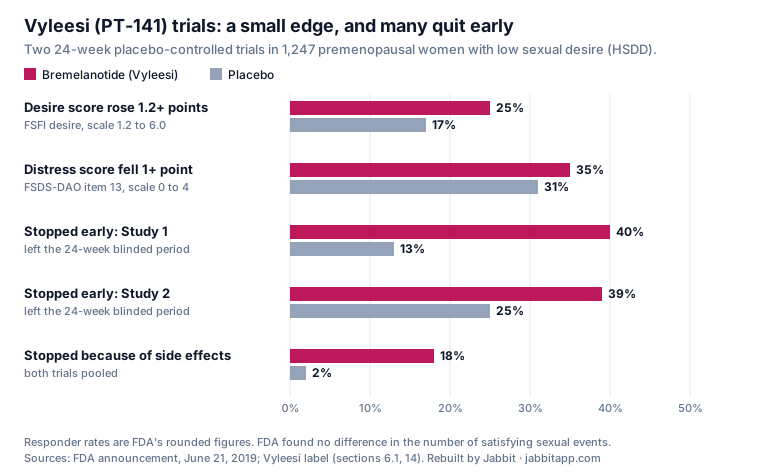
- Desire went up a little. On a desire scale from 1.2 to 6.0, scores rose 0.5 to 0.6 points on the drug and 0.2 points on placebo.[1] About 25% vs 17% of women had a rise of 1.2 points or more.[2]
- Distress went down a little. On a 0-to-4 distress scale, scores fell 0.7 points on the drug and 0.4 points on placebo.[1] About 35% vs 31% had a drop of at least 1 point.[2]
- Sex itself didn’t change. FDA found no difference in the number of satisfying sexual events, and said plainly that “Vyleesi does not enhance sexual performance.”[2]
- Many women stopped. About 40% left Study 1 early on the drug vs 13% on placebo, and 18% vs 2% stopped because of side effects.[1]
- A year of open-label use. Of 684 women who entered the extension, 272 finished it. Without a placebo group, it can’t show how much of any benefit came from the drug.[4]
Our arithmetic, from FDA’s rounded figures: the 8-point gap in desire responders means roughly 1 extra woman responded for every 12 or 13 treated.[2] The label tells women to stop after 8 weeks if they see no improvement.[2]
Does PT-141 work for men?
It has never been approved for men, and the label says so.[1] The men’s story is where PT-141 began, though:
- Early studies did show erections. Melanotan II caused erections in small studies in the 1990s, and PT-141 produced erections at the higher doses tested in Palatin’s 2004 studies, including in men who hadn’t responded well to Viagra.[6][7][8][9]
- Development stopped over blood pressure. By 2008, almost 2,000 people had received bremelanotide. Palatin said it stopped the program after FDA raised concerns about its benefit and risk as a first-line treatment for erectile dysfunction, “primarily because of increases in blood pressure observed in some patients.”[10]
- The biggest men’s trial has an Expression of Concern. A 2008 trial in 342 men who had not responded to sildenafil reported positive results. In January 2023, the journal published an Expression of Concern about that paper.[11] A 2008 trial of bremelanotide in women with arousal disorder by the same lead author was retracted. The journal’s notice says reviewers raised questions about its methods, results and statistics, and that the author did not respond to requests for the original data.[12]
- No trials in men are underway. Of the 10 bremelanotide trials on ClinicalTrials.gov, 8 enroll only women, and none lists erectile dysfunction.[19]
- Reports from men are coming in anyway. FDA’s adverse event database holds 50 reports in men linked to bremelanotide, and the most common term in them is “off label use” (37 reports).[18] These reports don’t prove the drug caused anything, but they show it is being used outside its label.
Side effects and safety
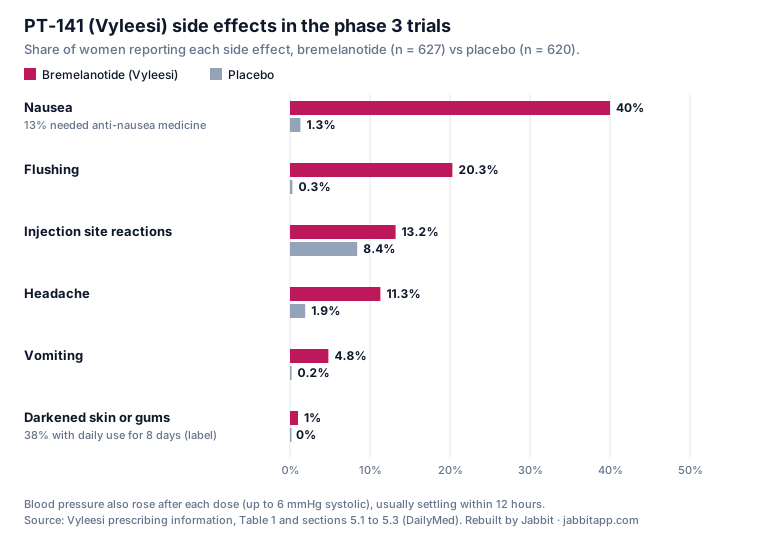
- Nausea. 40% of women had nausea, 13% needed anti-nausea medicine and 8% quit because of it. It was most common after the first dose. In a separate trial of 228 women, taking ondansetron (Zofran) beforehand didn’t help.[1]
- Blood pressure. Each dose briefly raises blood pressure, by up to 6 mmHg systolic, peaking 2 to 4 hours later and usually settling within 12 hours. The drug is contraindicated in uncontrolled high blood pressure or known heart disease.[1]
- Darkened skin and gums. About 1% of women in the trials developed dark patches on the face, gums or breasts. FDA said they did not go away in about half of them after stopping.[1][2] When people took it daily for 8 days, 38% developed patches. The risk is higher with darker skin.[1] This comes from MC1R, the same skin receptor behind melanotan’s tanning effect.[1][6]
- Interactions. It may slow stomach emptying, which can change how well some pills are absorbed. The label says to avoid it with naltrexone taken by mouth.[1]
- Pregnancy. Dog studies at high exposures showed fetal harm, and the label advises effective contraception.[1]
- Unregulated “melanotan-type” products. A 2017 review linked unlicensed melanotan I and II use to changing moles and four reported melanomas, while saying conclusive evidence of a link is lacking.[20] Those findings don’t transfer directly to approved Vyleesi, but they apply to products sold outside the approved supply chain, where purity and dose are unknown.
The weight-loss angle
Bremelanotide also acts on MC4R, a brain receptor that helps control appetite.[1] In two small, short Palatin studies in women with obesity, people on bremelanotide lost about 1.3 kg more than on placebo over 16 days.[16] In 2025, Palatin reported an 8-week phase 2 study combining it with tirzepatide (Zepbound): 4.4% weight loss vs 1.6% in the placebo group, according to the company’s press release. Its CEO said the study “was not designed to optimize weight loss,” and the results are topline company data, not a peer-reviewed paper.[14] In September 2026, Palatin said it would not fund further trials of this program on its own and is focusing on more selective MC4R drugs designed to cause less skin darkening.[15] No bremelanotide product is approved for weight loss.[1]
What a careful reader should notice
These points are our analysis of the cited sources.
- The approval is narrow. Vyleesi is approved for one diagnosis in one group: premenopausal women with acquired, generalized HSDD.[1] Claims about men, libido in general or sexual performance go beyond it.
- The benefit is modest. Most women on the drug didn’t reach FDA’s responder threshold, and placebo responses were substantial.[2]
- Dropout matters. When 40% of the drug group leave early, partly because of nausea, the women who stay are not a random sample.[1]
- The men’s evidence is old and thin. The men’s studies are early-phase, and the largest has an Expression of Concern. The men’s program was discontinued in 2008.[8][9][10][11]
- Who paid. The phase 3 trials were funded by Palatin and AMAG, and the obesity data come from Palatin employees and press releases.[3][14][16] That doesn’t make them wrong, but independent replication is limited.
- A legal path exists that most peptides lack. Federal law lets pharmacies compound from bulk substances that are components of FDA-approved drugs, and bremelanotide is one. Other conditions apply, including limits on copying approved products.[21] That differs from peptides like BPC-157 that are in no approved drug. This is our reading of the statute, not legal advice. Vials sold as “research use only” are a separate matter, and FDA’s August letters treat PT-141 sold that way as an unapproved drug.[17]
Frequently asked questions
- Is PT-141 FDA approved?
- Yes, but only as Vyleesi, a bremelanotide injection for premenopausal women with acquired, generalized hypoactive sexual desire disorder. It is not approved for men, for women after menopause or to enhance sexual performance.[1][2]
- Does PT-141 work for men?
- Small studies in the 2000s found erections in men at higher doses, but PT-141 was never approved for men. Its developer stopped the men’s program in 2008 after FDA raised blood pressure concerns, and no trial in men is listed as underway.[8][9][10][19]
- How well does PT-141 work for women?
- Modestly. In the phase 3 trials, about 25% of women on bremelanotide vs 17% on placebo had a meaningful rise in desire, and FDA found no difference in the number of satisfying sexual events.[2]
- What are the side effects of PT-141?
- Nausea affected 40% of women in the trials, followed by flushing (20%), injection site reactions (13%) and headache (11%). It briefly raises blood pressure after each dose, and about 1% developed darkened skin or gums that didn’t always fade.[1][2]
- Is PT-141 the same as melanotan II?
- No. They are closely related, sharing the same ring of seven amino acids, but they differ at one end of the molecule. Melanotan II is not approved, while bremelanotide is approved as Vyleesi.[1][6]
- Does PT-141 cause weight loss?
- It isn’t approved for that. Small company studies found modest short-term weight loss, alone and with tirzepatide, and Palatin said in September 2026 that it won’t fund further trials of the combination on its own.[14][15][16]
- Is “research” PT-141 legal to sell?
- FDA’s August 24, 2026 warning letters treat PT-141 sold online by those companies as an unapproved new drug.[17] Prescribed Vyleesi and, under certain conditions, pharmacy-compounded bremelanotide are different, regulated products.[1][21]
Bottom line
PT-141 is one of the few popular peptides with a real FDA approval, solid phase 3 trials and a full label.[1][3] The approval is narrow, though, and the benefit modest: a small edge over placebo in desire and distress for premenopausal women, with nausea in 40% and many dropouts.[1][2] For men, the evidence is early, its largest trial has an Expression of Concern, and the program stopped over blood pressure.[10][11] Claims that it works for everyone go further than the evidence.
References
- Cosette Pharmaceuticals, Inc. VYLEESI (bremelanotide injection) prescribing information, NDA 210557, label version effective November 13, 2025 (DailyMed / openFDA). Indicated for premenopausal women with acquired, generalized hypoactive sexual desire disorder (HSDD); “not indicated for the treatment of HSDD in postmenopausal women or in men”; “not indicated to enhance sexual performance.” Contraindicated in uncontrolled hypertension or known cardiovascular disease. Section 5.1: transient increases in blood pressure (up to 6 mmHg systolic and 3 mmHg diastolic, peaking 2 to 4 hours after a dose) and heart rate decreases of up to 5 bpm, usually back to baseline within 12 hours. Section 5.2: focal hyperpigmentation (face, gums, breasts) in 1% of phase 3 patients vs none on placebo; in 38% of subjects given the drug daily for 8 days; resolution not confirmed in all patients; more likely in people with darker skin. Section 5.3: nausea 40% (13% needed anti-emetics; 8% discontinued); pretreatment with ondansetron did not reduce nausea in a phase 4 trial of 228 women. Section 6.1, Table 1 (n = 627 vs 620): nausea 40.0% vs 1.3%, flushing 20.3% vs 0.3%, injection site reactions 13.2% vs 8.4%, headache 11.3% vs 1.9%, vomiting 4.8% vs 0.2%; discontinued for adverse reactions 18% vs 2%. Section 7: may slow gastric emptying; avoid with oral naltrexone. Section 12.1: nonselective melanocortin receptor agonist (MC1R > MC4R > MC3R > MC5R > MC2R); the mechanism in HSDD is unknown. Section 14: Studies 1 and 2 (NCT02333071, NCT02338960), 24 weeks, 1,247 women; FSFI desire change 0.5 vs 0.2 (Study 1) and 0.6 vs 0.2 (Study 2); FSDS-DAO item 13 change −0.7 vs −0.4 in both; discontinued the double-blind period 40% vs 13% (Study 1) and 39% vs 25% (Study 2). https://dailymed.nlm.nih.gov/dailymed/drugInfo.cfm?setid=f1d0c1b5-2f39-4bad-a6a4-0066e3ad5dcf. Checked October 24, 2026.
- U.S. Food and Drug Administration. “FDA approves new treatment for hypoactive sexual desire disorder in premenopausal women,” news release, June 21, 2019 (approval to AMAG Pharmaceuticals). About 25% on Vyleesi vs 17% on placebo had a desire score increase of 1.2 or more (scale 1.2 to 6.0); about 35% vs 31% had a distress score decrease of 1 or more (scale 0 to 4); “There was no difference between treatment groups in the change from beginning to end of the trial in the number of satisfying sexual events”; “Vyleesi does not enhance sexual performance”; darkening of the gums and skin in about 1%, which “did not resolve in about half of the patients after stopping treatment”; stop after 8 weeks if no improvement. The fda.gov page now returns 404; archived copy: https://web.archive.org/web/20191225234451/https://www.fda.gov/news-events/press-announcements/fda-approves-new-treatment-hypoactive-sexual-desire-disorder-premenopausal-women. Checked October 24, 2026.
- Kingsberg SA, Clayton AH, Portman D, et al. Bremelanotide for the treatment of hypoactive sexual desire disorder: two randomized phase 3 trials. Obstet Gynecol. 2019;134(5):899-908. doi:10.1097/AOG.0000000000003500. PMID 31599840. RECONNECT, 1,267 randomized, January 2015 to August 2016; placebo-adjusted change in desire 0.30 and 0.42 (integrated 0.35) and in distress −0.37 and −0.29 (integrated −0.33). Funded by Palatin Technologies and AMAG Pharmaceuticals. Abstract read. https://pubmed.ncbi.nlm.nih.gov/31599840/. Checked October 24, 2026.
- Simon JA, Kingsberg SA, Portman D, et al. Long-term safety and efficacy of bremelanotide for hypoactive sexual desire disorder. Obstet Gynecol. 2019;134(5):909-917. PMID 31599847. Open-label extension: 684 women elected to enter, 272 completed it; no placebo group. Abstract read. https://pubmed.ncbi.nlm.nih.gov/31599847/. Checked October 24, 2026.
- Clayton AH, Althof SE, Kingsberg S, et al. Bremelanotide for female sexual dysfunctions in premenopausal women: a randomized, placebo-controlled dose-finding trial. Womens Health (Lond). 2016;12(3):325-337. PMID 27181790. NCT01382719. Abstract read. https://pubmed.ncbi.nlm.nih.gov/27181790/. Checked October 24, 2026.
- Dorr RT, Lines R, Levine N, et al. Evaluation of melanotan-II, a superpotent cyclic melanotropic peptide in a pilot phase-I clinical study. Life Sci. 1996;58(20):1777-1784. PMID 8637402. University of Arizona; 3 men; reported spontaneous penile erections and increased skin pigmentation. Abstract read. https://pubmed.ncbi.nlm.nih.gov/8637402/. Checked October 24, 2026.
- Wessells H, Fuciarelli K, Hansen J, et al. Synthetic melanotropic peptide initiates erections in men with psychogenic erectile dysfunction: double-blind, placebo controlled crossover study. J Urol. 1998;160(2):389-393. PMID 9679884. Melanotan-II in 10 men; erections in 8 of 10 on the drug. Abstract read. https://pubmed.ncbi.nlm.nih.gov/9679884/. Checked October 24, 2026.
- Diamond LE, Earle DC, Rosen RC, et al. Double-blind, placebo-controlled evaluation of the safety, pharmacokinetic properties and pharmacodynamic effects of intranasal PT-141, a melanocortin receptor agonist, in healthy males and patients with mild-to-moderate erectile dysfunction. Int J Impot Res. 2004;16(1):51-59. PMID 14963471. Significant erectile response at the higher doses tested; flushing and nausea most common. Abstract read. https://pubmed.ncbi.nlm.nih.gov/14963471/. Checked October 24, 2026.
- Rosen RC, Diamond LE, Earle DC, et al. Evaluation of the safety, pharmacokinetics and pharmacodynamic effects of subcutaneously administered PT-141, a melanocortin receptor agonist, in healthy male subjects and in patients with an inadequate response to Viagra. Int J Impot Res. 2004;16(2):135-142. PMID 14999221. Abstract read. https://pubmed.ncbi.nlm.nih.gov/14999221/. Checked October 24, 2026.
- Palatin Technologies, Inc. Form 10-K for the fiscal year ended June 30, 2008 (filed September 29, 2008). “almost 2,000 patients received at least one dose of bremelanotide”; “We discontinued development of bremelanotide for sexual dysfunction after the FDA raised concerns about the acceptable benefit/risk ratio of bremelanotide as a first-line therapy for erectile dysfunction, primarily because of increases in blood pressure observed in some patients.” Company statements. https://www.sec.gov/Archives/edgar/data/911216/000108802008000050/form10k_063008.htm. Checked October 24, 2026.
- Safarinejad MR, Hosseini SY. Salvage of sildenafil failures with bremelanotide: a randomized, double-blind, placebo controlled study. J Urol. 2008;179(3):1066-1071. PMID 18206919. 342 men who had not responded to sildenafil. The journal published an Expression of Concern about this article on January 10, 2023 (J Urol, doi:10.1097/JU.0000000000003117, PMID 36626345). https://pubmed.ncbi.nlm.nih.gov/18206919/ and https://pubmed.ncbi.nlm.nih.gov/36626345/. Checked October 24, 2026.
- Safarinejad MR. RETRACTED: Evaluation of the safety and efficacy of bremelanotide, a melanocortin receptor agonist, in female subjects with arousal disorder. J Sex Med. 2008;5(4):887-897. PMID 18179455. Retraction notice: “retracted at the request of the Editor-in-Chief”; reviewers “raised multiple concerning questions about the methodology, results, and statistical interpretation”; the author “was contacted to provide his original data … Dr Safarinejad chose not to respond. Consequently, we can no longer verify the results or methods as presented.” https://pubmed.ncbi.nlm.nih.gov/18179455/. Checked October 24, 2026.
- Palatin Technologies, Inc. Form 8-K, December 20, 2023, exhibit 99.1: Vyleesi sold to Cosette Pharmaceuticals for $12 million upfront and up to $159 million in sales milestones. Company statements. https://www.sec.gov/Archives/edgar/data/911216/000165495423015795/ptn_ex991.htm. Checked October 24, 2026.
- Palatin Technologies, Inc. Form 8-K, March 31, 2025, exhibit 99.2 (press release): phase 2 BMT-801 study (NCT06565611) of bremelanotide with tirzepatide; “Co-administered group had a 4.4% reduction in weight compared to 1.6% for the placebo group” over 8 weeks; 40% vs 27% on tirzepatide alone reached 5% weight loss; “Low dose bremelanotide arm stopped weight regain seen post tirzepatide treatment”; CEO Carl Spana: “the study was not designed to optimize weight loss.” Topline company data, not peer reviewed. https://www.sec.gov/Archives/edgar/data/911216/000165495425003600/ptn_ex992.htm and https://clinicaltrials.gov/study/NCT06565611. Checked October 24, 2026.
- Palatin Technologies, Inc. Form 10-K for the fiscal year ended June 30, 2026 (filed September 28, 2026). On bremelanotide with tirzepatide: “We do not currently intend to independently fund additional clinical development of this program”; cash and cash equivalents $7.5 million at June 30, 2026; net loss $8.4 million; management concluded “substantial doubt exists about our ability to continue as a going concern”; developing selective MC4R agonists designed for “reduced off-target effects, including hyperpigmentation.” Company statements. https://www.sec.gov/Archives/edgar/data/911216/000149315226044572/form10-k.htm. Checked October 24, 2026.
- Spana C, Jordan R, Fischkoff S. Effect of bremelanotide on body weight of obese women: data from two phase 1 randomized controlled trials. Diabetes Obes Metab. 2022;24(6):1084-1093. PMID 35170192. Authors employed by Palatin; small, short trials. Abstract read. https://pubmed.ncbi.nlm.nih.gov/35170192/. Checked October 24, 2026.
- U.S. Food and Drug Administration. Five warning letters dated August 24, 2026, each listing PT-141 among products FDA described as unapproved new drugs: MARCS-CMS 733652, 734884, 735063, 735067 and 735127. Example: https://www.fda.gov/inspections-compliance-enforcement-and-criminal-investigations/warning-letters/peptide-partners-llc-735063-08242026; also https://www.fda.gov/inspections-compliance-enforcement-and-criminal-investigations/warning-letters/nuscience-peptides-llc-733652-08242026, https://www.fda.gov/inspections-compliance-enforcement-and-criminal-investigations/warning-letters/royal-peptides-llc-734884-08242026, https://www.fda.gov/inspections-compliance-enforcement-and-criminal-investigations/warning-letters/txp-innovations-llc-dba-tex-peptides-735067-08242026 and https://www.fda.gov/inspections-compliance-enforcement-and-criminal-investigations/warning-letters/peak-performance-peptides-735127-08242026. A warning letter states FDA’s view; recipients may respond. Checked October 24, 2026.
- FDA Adverse Event Reporting System via openFDA, search patient.drug.openfda.generic_name:"bremelanotide" (openFDA last updated July 30, 2026; reports through June 30, 2026): 1,004 reports; 883 female, 50 male, 71 sex not given; by year received 40 (2019), 50 (2020), 18 (2021), 45 (2022), 150 (2023), 155 (2024), 341 (2025), 205 (January to June 2026). Top terms in male reports: off label use 37, nausea 20. Reports are unverified, can be duplicated and do not show that a drug caused an event. Counts and query: https://jabbitapp.com/research/sources/pt-141-bremelanotide-2026-10-24.json. Checked October 24, 2026.
- ClinicalTrials.gov API v2, interventions matching bremelanotide or PT-141, pulled October 24, 2026: 10 records; 8 enroll women only; 2 are open to men (a kidney study, NCT05709444, and the obesity study NCT06565611); none lists erectile dysfunction; 4 have posted results; 1 active (NCT06565611). Jabbit census: https://jabbitapp.com/research/sources/pt-141-bremelanotide-2026-10-24.json. Checked October 24, 2026.
- Habbema L, Halk AB, Neumann M, Bergman W. Risks of unregulated use of alpha-melanocyte-stimulating hormone analogues: a review. Int J Dermatol. 2017;56(10):975-980. PMID 28266027. Unlicensed melanotan I and II are associated with changes in moles and case reports of melanoma, though the authors say a causal link is not proven. Abstract read. https://pubmed.ncbi.nlm.nih.gov/28266027/. Checked October 24, 2026.
- 21 U.S.C. § 353a (FD&C Act section 503A), subsection (b)(1)(A)(i): a pharmacy may compound with bulk drug substances that meet a USP or NF monograph, or, “if such a monograph does not exist, are drug substances that are components of drugs approved by the Secretary,” or appear on FDA’s 503A bulks list; other conditions apply, including limits on compounding copies of commercially available drugs (subsection (b)(1)(D)). https://www.law.cornell.edu/uscode/text/21/353a. Checked October 24, 2026.
- Office of Information and Regulatory Affairs (OMB). Pending EO 12866 Regulatory Review: Interim Access Policy for Compounding Using Certain Peptides, RIN 0910-ZD94, received 10/14/2026, stage: Notice. The text and the list of peptides are not public. https://www.reginfo.gov/public/do/eoDetails?rrid=1568964. Checked October 24, 2026.
This page analyzes FDA documents, published trials, SEC filings and registry records. It is not medical or legal advice and does not recommend any medication or dose. Vyleesi is approved only for premenopausal women with acquired, generalized HSDD. Charts were rebuilt by Jabbit from the sources cited in each caption.