Study teardown · Metformin for longevity and the TAME trial · The mouse lifespan studies, the observational survival studies, the large randomized trials and every 2025-2026 trial in older adults that we found, the US drug label, registry records and PubMed counts · Sources checked October 26, 2026
Published · Updated
Metformin for longevity: does the diabetes drug slow aging, and is it safe? No human trial has tested whether it extends life, and the TAME trial proposed in 2016 has no registry record we could find. Mouse results are mixed, the famous survival data are observational and disputed, and most recent trials in older adults missed their main goals. It carries a boxed warning for lactic acidosis.
Metformin is a decades-old prescription drug for type 2 diabetes, and researchers have proposed it as the first drug to be tested against aging itself.[1][2] In 2016, a perspective paper proposed doing that in a trial called TAME (Targeting Aging with Metformin).[3] Does it work? In mice, results are mixed: one 2013 NIA lab study found longer life in male mice, but the multi-site NIA testing program found metformin alone “did not significantly extend lifespan.”[4][5] In people, no trial has measured lifespan, and we found no ClinicalTrials.gov record for TAME.[25][24] The survival data that made metformin famous are observational and conflicting.[7][8] Of the five randomized trials in older adults in our chart, four missed their main goals or showed no benefit, and the fifth, posted as a preprint, had mixed results.[12][14][15][17][19] Is it safe? It has a boxed warning for lactic acidosis, can lower vitamin B12, and commonly causes stomach side effects.[1]
Why this matters now
2026 has brought a run of metformin-in-aging results, and most are negative or mixed. On July 30, 2026, The Lancet Healthy Longevity published DEMFOS, a 114-person randomized trial in adults aged 65-85 with obesity. Adding metformin to an intensive lifestyle program did not improve physical function, and the authors wrote that the results “support prioritising lifestyle-based strategies.”[15] An accompanying commentary was titled “Adjunctive metformin for obesity and frailty in older people-puncturing inflated expectations?”[16] In April, the METFORAGING pilot in older people with HIV missed its main goal on epigenetic age.[17] In July, a 145-person frailty trial was posted as a preprint, not yet peer reviewed: metformin improved one frailty measure but not the trial’s registered main measure.[19] Small, short trials and a meta-analysis reported some positive marker or test results.[20][21] A September 2026 review still describes “limited randomized clinical evidence.”[22] Our analysis: the evidence that metformin slows aging in people without diabetes has not grown stronger this year.
Timeline
| Date | Event |
|---|---|
| 2002 | The Diabetes Prevention Program reports that metformin cut new type 2 diabetes by 31% versus placebo; the lifestyle program cut it by 58%.[10] |
| 2013 | An NIA lab study reports longer life in male mice given metformin from middle age.[4] |
| 2014 | A UK records study reports that people with diabetes started on metformin outlived matched people without diabetes.[7] |
| 2016 | The multi-site NIA Interventions Testing Program finds metformin alone did not significantly extend mouse lifespan; a perspective paper proposes the TAME trial.[5][3] |
| 2019 | MASTERS: older adults taking metformin gained less muscle from strength training than those on placebo.[12] |
| 2022 | A Danish register study including twins does not find the survival advantage; the 3,649-person MA.32 breast cancer trial misses its main goal.[8][11] |
| 2024 | A reanalysis of NIA mouse data with a different statistical test reports a male-only survival effect.[6] |
| 2025 | MET-PREVENT in frail older people misses its main goal and finds metformin poorly tolerated (March); an observational analysis of US women links metformin with more survival to 90 than a sulfonylurea (June).[14][9] |
| 2026 | METFORAGING misses its main goal (April); a frailty trial preprint reports mixed results (July 28); DEMFOS finds no added benefit (July 30); an Indian 24-week trial reports longer telomeres (September); a meta-analysis reports a small cognitive effect (October 2).[17][19][15][20][21] |
What metformin is
Metformin is a prescription tablet approved in the US “as an adjunct to diet and exercise to improve glycemic control in adults and pediatric patients 10 years of age and older with type 2 diabetes mellitus.”[1] The aging idea comes from its effects on metabolism: a 2013 mouse study reported that it “mimics some of the benefits of calorie restriction,” and a small crossover trial in about 70-year-olds found it changed the activity of metabolic and other genes in muscle and fat.[4][13] Researchers have called it “the first drug tested to target aging” in people, while noting that it is not clear whether its benefits apply to people without age-related disease.[2]
The evidence, rung by rung
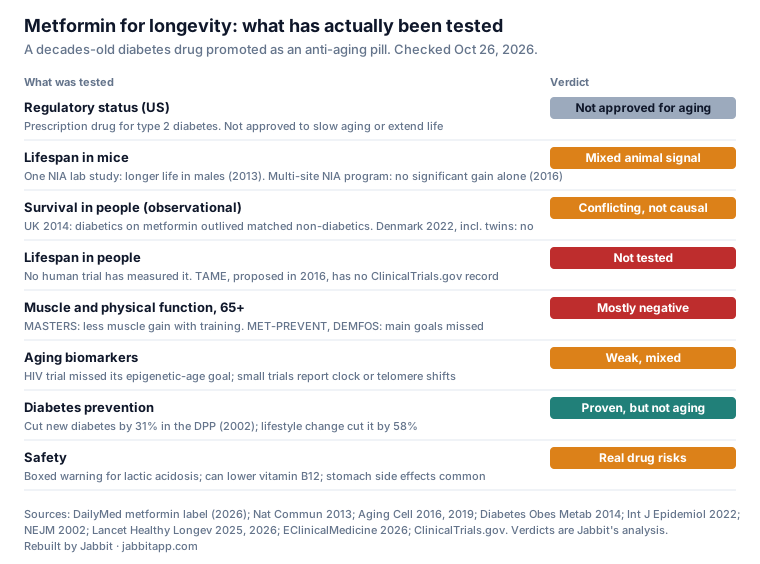
- Mice. A 2013 NIA lab study found metformin from middle age extended healthspan and lifespan in male mice.[4] The NIA Interventions Testing Program, which tests compounds at three sites in genetically varied mice, found metformin alone did not significantly extend lifespan; metformin plus rapamycin did, but that comparison was against earlier rapamycin-only studies.[5] A 2024 reanalysis using a test more sensitive to earlier deaths reported that metformin increased survival in males only.[6]
- People: lifespan. We found no human trial that measured whether metformin extends life. A PubMed search for randomized trials of metformin mentioning lifespan or longevity returned 5 records: a mouse study, a trial design paper and three studies of blood or tissue markers.[25]
- Survival studies (observational). A 2014 UK records study of 78,241 people on metformin found they had longer survival than matched people without diabetes.[7] A 2022 Danish register study, including twin pairs, found higher mortality with metformin than without diabetes and concluded it “was not associated with survival equal or superior” to the general population without diabetes.[8] A 2025 analysis of 438 matched women aged 60 or older found lower risk of death before 90 on metformin than on a sulfonylurea, but the authors write that “causality cannot be inferred.”[9]
- Muscle and physical function in older adults. In MASTERS, placebo users gained more lean mass and thigh muscle from strength training than metformin users.[12] MET-PREVENT, in 72 people with a mean age of 80, found no difference in walk speed and more hospital admissions on metformin.[14] DEMFOS, in 114 older adults with obesity, found no added benefit over lifestyle change.[15]
- Frailty. In a 145-person, two-year trial posted as a preprint, metformin improved a frailty index but not the Fried frailty score, which the registry lists as the main outcome; the Fried score worsened in year 1, which the authors attribute to weight loss.[19]
- Aging biomarkers. METFORAGING, in 40 older people with HIV, found no significant difference in epigenetic age, its main goal.[17] A secondary analysis found metformin users lost 2.8 kg more than placebo users, and their weight drifted back toward baseline after stopping.[18] The frailty preprint reported lower readings on two epigenetic clocks, and a 24-week Indian trial in 127 people with prediabetes reported telomere lengthening that the authors say “requires cautious interpretation.”[19][20]
- Brain. A 2026 meta-analysis of five studies reported “a small but positive effect” on overall cognitive function in older adults.[21] Our analysis: five pooled studies is a thin base.
- Diabetes and cancer. Metformin prevents some new cases of type 2 diabetes, though the DPP lifestyle program did better.[10] In the MA.32 trial in 3,649 people with breast cancer, adding metformin did not improve disease-free survival.[11]
The key trials, in one chart
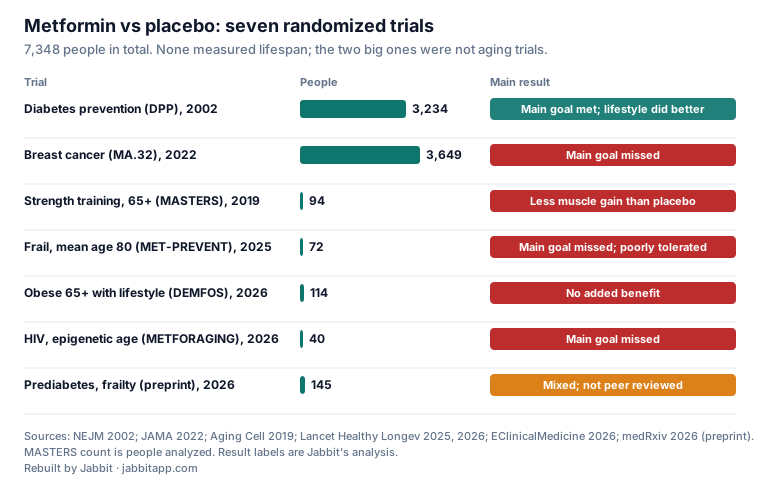
Our analysis: the two large trials were not aging trials. The DPP was about preventing diabetes and MA.32 about breast cancer, and only the DPP met its main goal.[10][11] The five trials aimed at aging-related outcomes were small, and none met a main goal cleanly.[12][14][15][17][19]
The case for metformin, in fairness
Metformin has been used for decades, and its main risks are well described on its label.[1] It prevents some new diabetes, and diabetes speeds many age-related diseases.[10][22] Some mouse data, the 2024 reanalysis and some observational studies point toward longer survival.[4][6][7][9] In 2026, small trials reported improvements in a frailty index, epigenetic clocks, telomeres and, in a meta-analysis, cognition.[19][20][21] Large trials are still running: VA-IMPACT plans to enroll an estimated 7,410 people with prediabetes and artery disease, and ANTHEM has finished and posted results.[23] Our analysis: these are reasons to keep testing, not evidence that metformin slows aging in healthy people.
Safety
- Lactic acidosis. The label carries a boxed warning: postmarketing cases “have resulted in death, hypothermia, hypotension, and resistant bradyarrhythmias.” Listed risk factors include kidney impairment, age 65 or older, contrast imaging, surgery, heavy drinking and liver impairment.[1]
- Vitamin B12. “Metformin may lower vitamin B12 levels,” the label says.[1]
- Common side effects. The most common are diarrhea, nausea and vomiting, gas, weakness, indigestion, abdominal discomfort and headache. Low blood sugar risk rises when it is combined with insulin or drugs that increase insulin release.[1]
- In older trial participants. In MET-PREVENT, adverse events were more common on metformin (108 vs 77), and 34% on metformin had hospital admissions versus 8% on placebo; the authors call it “poorly tolerated in this population.”[14]
- Exercise. MASTERS suggests metformin may blunt muscle gains from strength training in healthy older people.[12]
Legal status
In the US, metformin is a prescription drug approved for type 2 diabetes. It is not approved to slow aging, prevent frailty or extend life, so prescribing it for those purposes would be off-label.[1] We do not name or rate sellers, pharmacies or clinics.
What a careful reader should notice
These points are our analysis of the sources cited.
- “Extends lifespan” is a mouse claim, and even there the NIA’s multi-site program did not confirm it for metformin alone.[4][5]
- The famous human survival result is observational. A later study including twins did not reproduce it.[7][8]
- TAME has been discussed since 2016, but we found no ClinicalTrials.gov record for it, so there are no TAME results to cite.[3][24]
- Check the main goal. MET-PREVENT, DEMFOS and METFORAGING missed theirs, and the frailty preprint’s positive finding was on a different measure than its registered main outcome.[14][15][17][19]
- A preprint is not peer reviewed. Its findings may change.[19]
- Biomarkers are not outcomes. Lower clock readings or longer telomeres in short trials do not show that people live longer or healthier.[19][20][17]
- Read the disclosures. An author of MET-PREVENT and the DEMFOS commentary discloses consultancy fees from companies including Rejuvenate Biomed; the DEMFOS authors declare none. That does not make either paper wrong.[14][16][15]
Frequently asked questions
- Does metformin slow aging?
- Not shown in people. No human trial has measured lifespan, and recent trials in older adults mostly missed their main goals.[25][12][14][15][17]
- What is the TAME trial?
- TAME (Targeting Aging with Metformin) was proposed in 2016 as a trial of metformin against aging. We found no ClinicalTrials.gov record for it, and it has no published results.[3][24]
- Does metformin extend lifespan in mice?
- Mixed. A 2013 NIA lab study found longer life in male mice, but the multi-site NIA testing program found no significant gain from metformin alone; a 2024 reanalysis reported a male-only effect.[4][5][6]
- Do people with diabetes on metformin live longer than people without diabetes?
- A 2014 UK study suggested so, but a 2022 Danish study including twins did not find it. Both are observational.[7][8]
- Does metformin interfere with exercise?
- In the MASTERS trial, healthy people 65 and older on metformin gained less muscle from strength training than those on placebo.[12]
- Is metformin safe?
- It has a boxed warning for lactic acidosis, which can be fatal, can lower vitamin B12 and commonly causes stomach side effects. In one trial in frail older people it was poorly tolerated.[1][14]
- Is metformin approved for anti-aging?
- No. In the US it is approved for type 2 diabetes; use for aging would be off-label.[1]
Bottom line
Metformin is a useful diabetes drug, but the case that it slows aging rests on mixed mouse data and disputed observational studies.[4][5][7][8] No human trial has tested lifespan, TAME has no registry record we could find, and 2025-2026 trials in older adults mostly missed their main goals.[25][24][14][15][17][19] It carries a boxed warning for lactic acidosis.[1]
References
- DailyMed. Metformin hydrochloride tablets, film coated, Zydus Pharmaceuticals USA Inc., SPL version 17, effective July 15, 2026. Boxed warning: “WARNING: LACTIC ACIDOSIS”; “Postmarketing cases of metformin-associated lactic acidosis have resulted in death, hypothermia, hypotension, and resistant bradyarrhythmias.” “Risk factors for metformin-associated lactic acidosis include renal impairment, concomitant use of certain drugs (e.g. carbonic anhydrase inhibitors such as topiramate), age 65 years old or greater, having a radiological study with contrast, surgery and other procedures, hypoxic states (e.g., acute congestive heart failure), excessive alcohol intake, hepatic impairment,” and mitochondrial diseases. Indication: “Metformin hydrochloride tablets are indicated as an adjunct to diet and exercise to improve glycemic control in adults and pediatric patients 10 years of age and older with type 2 diabetes mellitus.” Warnings: “Metformin may lower vitamin B12 levels”; “Increased risk of hypoglycemia when used in combination with insulin and/or an insulin secretagogue.” Adverse reactions: “the most common adverse reactions (>5.0%) are diarrhea, nausea/vomiting, flatulence, asthenia, indigestion, abdominal discomfort, and headache.” https://dailymed.nlm.nih.gov/dailymed/drugInfoBySetId.cfm?setid=c82a10fa-1e8e-46b6-890a-737de3f34ee1. Checked October 26, 2026.
- Kumari S, Bubak MT, Schoenberg HM, et al. Antecedent Metabolic Health and Metformin (ANTHEM) Aging Study: Rationale and Study Design for a Randomized Controlled Trial. J Gerontol A Biol Sci Med Sci. 2022;77(12):2373-2377. PMID 34865016. Design paper for the ANTHEM trial (Oklahoma Medical Research Foundation; NCT04264897): “The antidiabetic medication metformin has been proposed to be the first drug tested to target aging and extend healthspan in humans”; “it is not clear if these protective effects apply to those free of age-related disease.” Abstract read. https://pubmed.ncbi.nlm.nih.gov/34865016/. Checked October 26, 2026.
- Barzilai N, Crandall JP, Kritchevsky SB, et al. Metformin as a Tool to Target Aging. Cell Metab. 2016;23(6):1060-1065. PMID 27304507. Perspective whose authors include researchers at Albert Einstein College of Medicine: metformin “will be tested in the TAME (Targeting Aging with Metformin) trial.” Abstract read. https://pubmed.ncbi.nlm.nih.gov/27304507/. Checked October 26, 2026.
- Martin-Montalvo A, Mercken EM, Mitchell SJ, et al. Metformin improves healthspan and lifespan in mice. Nat Commun. 2013;4:2192. PMID 23900241. National Institute on Aging lab study: long-term metformin “starting at middle age extends healthspan and lifespan in male mice,” while a higher dose was toxic; “Treatment with metformin mimics some of the benefits of calorie restriction”; the authors say the findings “raise the possibility of metformin-based interventions to promote healthy aging.” Abstract read. https://pubmed.ncbi.nlm.nih.gov/23900241/. Checked October 26, 2026.
- Strong R, Miller RA, Antebi A, et al. Longer lifespan in male mice treated with a weakly estrogenic agonist, an antioxidant, an α-glucosidase inhibitor or a Nrf2-inducer. Aging Cell. 2016;15(5):872-84. PMID 27312235. NIA Interventions Testing Program, testing at three sites in genetically varied mice: “Metformin alone,” at the dose tested, “did not significantly extend lifespan.” Metformin combined with rapamycin “robustly extended lifespan, suggestive of an added benefit, based on historical comparison with earlier studies of rapamycin given alone.” Abstract read. https://pubmed.ncbi.nlm.nih.gov/27312235/. Checked October 26, 2026.
- Jiang N, Gelfond J, Liu Q, et al. The Gehan test identifies life-extending compounds overlooked by the log-rank test in the NIA Interventions Testing Program: Metformin, Enalapril, caffeic acid phenethyl ester, green tea extract, and 17-dimethylaminoethylamino-17-demethoxygeldanamycin hydrochloride. Geroscience. 2024;46(5):4533-4541. PMID 38630424. UT Health San Antonio-led reanalysis: “We therefore reanalyzed all data collected by the ITP from 2004-2022 using the Gehan test,” a test more sensitive to earlier deaths; metformin was among compounds that significantly increased survival, and “Three (metformin, enalapril, and 17-DMAG) were only effective in males.” “The authors declare no competing interests.” Abstract read. https://pubmed.ncbi.nlm.nih.gov/38630424/. Checked October 26, 2026.
- Bannister CA, Holden SE, Jenkins-Jones S, et al. Can people with type 2 diabetes live longer than those without? A comparison of mortality in people initiated with metformin or sulphonylurea monotherapy and matched, non-diabetic controls. Diabetes Obes Metab. 2014;16(11):1165-73. PMID 25041462. Cardiff University-led observational study of UK primary-care records: “We identified 78,241 subjects treated with metformin,” plus people on sulphonylureas and matched people without diabetes; “Patients with type 2 diabetes initiated with metformin monotherapy had longer survival than did matched, non-diabetic controls.” Abstract read. https://pubmed.ncbi.nlm.nih.gov/25041462/. Checked October 26, 2026.
- Keys MT, Thinggaard M, Larsen LA, et al. Reassessing the evidence of a survival advantage in Type 2 diabetes treated with metformin compared with controls without diabetes: a retrospective cohort study. Int J Epidemiol. 2022;51(6):1886-1898. PMID 36287641. University of Southern Denmark-led study of Danish national registers, including twin pairs: compared with no diabetes, starting metformin for type 2 diabetes was linked to higher mortality; after adjustment, “these associations were attenuated to 1.32 (95% CI: 1.16, 1.50) and 1.64 (95% CI: 1.10, 2.46), respectively” (singletons and twins); “Treatment initiation by metformin monotherapy in Type 2 diabetes was not associated with survival equal or superior to that of the general population without diabetes.” Abstract read. https://pubmed.ncbi.nlm.nih.gov/36287641/. Checked October 26, 2026.
- Shadyab AH, Espeland MA, Odegaard AO, et al. Comparative Effectiveness of Metformin Versus Sulfonylureas on Exceptional Longevity in Women With Type 2 Diabetes: Target Trial Emulation. J Gerontol A Biol Sci Med Sci. 2025;80(7). PMID 40388602. Women’s Health Initiative target-trial emulation, an observational design: “Among 438 propensity score-matched women with type 2 diabetes,” starting metformin rather than a sulfonylurea was linked to a lower risk of death before age 90 “(hazard ratio, 0.70; 95% CI: 0.56-0.88)”; the authors add that “causality cannot be inferred.” Most authors “declare no conflicts of interest”; one reports lecture fees on unrelated topics. Abstract and disclosure read. https://pubmed.ncbi.nlm.nih.gov/40388602/. Checked October 26, 2026.
- Knowler WC, Barrett-Connor E, Fowler SE, et al. Reduction in the incidence of type 2 diabetes with lifestyle intervention or metformin. N Engl J Med. 2002;346(6):393-403. PMID 11832527. Diabetes Prevention Program randomized trial: “We randomly assigned 3234 nondiabetic persons” with raised blood sugar to placebo, metformin or a lifestyle program; compared with placebo, “The lifestyle intervention reduced the incidence by 58 percent” and “metformin by 31 percent”; “The lifestyle intervention was more effective than metformin.” Abstract read. https://pubmed.ncbi.nlm.nih.gov/11832527/. Checked October 26, 2026.
- Goodwin PJ, Chen BE, Gelmon KA, et al. Effect of Metformin vs Placebo on Invasive Disease-Free Survival in Patients With Breast Cancer: The MA.32 Randomized Clinical Trial. JAMA. 2022;327(20):1963-1973. PMID 35608580. Canadian Cancer Trials Group phase 3 MA.32 trial (NCT01101438), which “enrolled 3649 patients with high-risk nonmetastatic breast cancer” without diabetes: “the addition of metformin vs placebo to standard breast cancer treatment did not significantly improve invasive disease-free survival”; grade 3 non-blood side effects were more common on metformin “(21.5% vs 17.5%, respectively, P = .003).” Abstract read. https://pubmed.ncbi.nlm.nih.gov/35608580/. Checked October 26, 2026.
- Walton RG, Dungan CM, Long DE, et al. Metformin blunts muscle hypertrophy in response to progressive resistance exercise training in older adults: A randomized, double-blind, placebo-controlled, multicenter trial: The MASTERS trial. Aging Cell. 2019;18(6):e13039. PMID 31557380. University of Kentucky-led MASTERS randomized trial (NCT02308228) in healthy adults aged 65 and older doing 14 weeks of supervised strength training: “placebo gained more lean body mass (p = .003) and thigh muscle mass (p < .001) than metformin”; “metformin negatively impacts the hypertrophic response to resistance training in healthy older individuals.” 94 people analyzed (46 metformin, 48 placebo). “The authors have no conflict of interests to disclose.” Abstract and disclosure read. https://pubmed.ncbi.nlm.nih.gov/31557380/. Checked October 26, 2026.
- Kulkarni AS, Brutsaert EF, Anghel V, et al. Metformin regulates metabolic and nonmetabolic pathways in skeletal muscle and subcutaneous adipose tissues of older adults. Aging Cell. 2018;17(2). PMID 29383869. MILES crossover trial led from Albert Einstein College of Medicine (NCT02432287): “~70-year-old participants (n = 14)” were “treated with 6 weeks each of metformin and placebo”; gene activity in muscle and fat changed, and the authors write: “This study provides the first evidence that, in older adults, metformin has metabolic and nonmetabolic effects linked to aging.” Abstract read. https://pubmed.ncbi.nlm.nih.gov/29383869/. Checked October 26, 2026.
- Witham MD, McDonald C, Wilson N, et al. Metformin and physical performance in older people with probable sarcopenia and physical prefrailty or frailty in England (MET-PREVENT): a double-blind, randomised, placebo-controlled trial. Lancet Healthy Longev. 2025;6(3):100695. PMID 40147475. Newcastle University-led MET-PREVENT randomized trial in England: “72 participants were randomly assigned”; “Mean age was 80·4 years”; for the main outcome, 4-metre walk speed at 4 months, the difference was not significant (“p=0·96”); “108 adverse events occurred in 35 (100%) of 35 participants who received metformin and 77 adverse events occurred in 33 (92%) of 36 participants who received placebo”; “12 (34%) of 35 participants had hospital admissions in the metformin group versus three (8%) of 36 participants in the placebo group”; “Metformin did not improve 4-m walk speed and was poorly tolerated in this population.” Disclosure: “MDW reports receiving consultancy fees from Rejuvenate Biomed for work on sarcopenia trials.” Abstract and disclosure read. https://pubmed.ncbi.nlm.nih.gov/40147475/. Checked October 26, 2026.
- Nava MLD, Viola V, Aguilar M, et al. Metformin added to lifestyle intervention for physical function in older adults with obesity (DEMFOS trial): a randomised controlled trial. Lancet Healthy Longev. 2026;7(7):100883. PMID 42532077. Published online July 30, 2026. DEMFOS randomized trial at the Michael E DeBakey VA Medical Center and Baylor College of Medicine (NCT04221750), adults aged 65-85 with obesity: “114 were included in this study”; compared with intensive lifestyle plus placebo, intensive lifestyle plus metformin made no difference to the main physical-performance score “(0·1 points, -1·2 to 1·4; p=0·92)”; “metformin does not provide additional improvement in physical function”; “These results support prioritising lifestyle-based strategies to improve functional outcomes in this population.” “We declare no competing interests.” Abstract and disclosure read. https://pubmed.ncbi.nlm.nih.gov/42532077/. Checked October 26, 2026.
- Witham MD, McDonald C. Adjunctive metformin for obesity and frailty in older people-puncturing inflated expectations? Lancet Healthy Longev. 2026;7(7):100890. PMID 42532078. Newcastle University-affiliated commentary on DEMFOS, published online July 30, 2026 (no abstract; title read). Disclosure: “MDW has received consultancy fees from Rejuvenate Biomed, Istesso, and Novo Nordisk for sarcopenia trial design” and related research design. https://pubmed.ncbi.nlm.nih.gov/42532078/. Checked October 26, 2026.
- Marcelo-Calvo C, Esteban-Cantos A, Jurado F, et al. Metformin and epigenetic age in non-diabetic older people with HIV in Madrid (METFORAGING): a double-blind, randomised, placebo-controlled, pilot trial. EClinicalMedicine. 2026;95:103874. PMID 42023167. Published online April 18, 2026. METFORAGING pilot randomized trial at La Paz University Hospital, Madrid, in non-diabetic people aged 50 and older living with HIV, 96 weeks: “40 were randomly assigned”; “Enrolment was closed at 40 participants because of slow recruitment”; for the main outcome, PhenoAge epigenetic age acceleration, the difference was “-1.02 years (95% confidence interval [CI] -5.30 to 3.26; p = 0.627)”; “no significant difference was noted in the primary outcome.” Abstract read. https://pubmed.ncbi.nlm.nih.gov/42023167/. Checked October 26, 2026.
- Marcelo-Calvo C, Esteban-Cantos A, Jurado F, et al. Metformin and Weight Changes in Non-diabetic Older People With HIV (METFORAGING): A Double-Blind, Randomized, Placebo-Controlled, Pilot Trial. Open Forum Infect Dis. 2026;13(8):ofag489. PMID 42609624. Published online August 6, 2026. Prespecified secondary analysis of METFORAGING: weight fell with metformin versus placebo “(between-group difference -2.8 kg [95% CI -5.2 to -0.4]; P = .025)”; “After discontinuation, weight in the metformin group returned toward baseline.” Abstract read. https://pubmed.ncbi.nlm.nih.gov/42609624/. Checked October 26, 2026.
- Musi N, Wang CP, MacCarthy D, et al. A Randomized Clinical Trial of Metformin to Reduce Frailty in Older Adults with Glucose Intolerance. medRxiv. 2026. PMID 42620010. Preprint posted July 28, 2026; not peer reviewed. Randomized trial of metformin versus placebo for two years in “145 non-frail or pre-frail older adults” with glucose intolerance (registry NCT02570672, lead sponsor The University of Texas Health Science Center at San Antonio): the Fried frailty score showed “an upward trajectory in year 1” (worse) on metformin; “when assessing effect on Fried score without the weight loss criterion, no difference was observed”; “metformin caused a steady improvement in the frailty index”; two epigenetic clocks were lower; “Metformin was well tolerated.” The authors summarize: “metformin led to a significant reduction in the deficit accumulation frailty index but not the Fried frailty phenotype.” Registry, which lists the Fried criteria as the primary outcome and posted results: {a(CT + 'NCT02570672')}. Abstract read. https://pubmed.ncbi.nlm.nih.gov/42620010/. Checked October 26, 2026.
- Bhatt SP, Pandey S, Misra A. Metformin therapy increases leukocyte telomere length, telomerase activity, and longevity gene expression in Asian Indians with prediabetes: A 24-week participant-blind, outcome-assessor-blinded randomized controlled trial. Mech Ageing Dev. 2026;234:112241. PMID 42692117. Published online September 3, 2026. Randomized, placebo-controlled trial in North Indian adults aged 30-60 with prediabetes, led from New Delhi: “127 participants met the eligibility criteria,” treated “for 24 weeks”; telomere length rose “29.6% vs 4.4% elongation”; the authors note “the marked LTL response requires cautious interpretation.” No interest statement in the PubMed record. Abstract read. https://pubmed.ncbi.nlm.nih.gov/42692117/. Checked October 26, 2026.
- Maximiano-Barreto MA, Pereira JADS, Bastos-Silva VJ. Impact of metformin use on neurocognitive functions in older people: a systematic review and meta-analysis. Dement Neuropsychol. 2026;20:e20260527. PMID 42841129. Published online October 2, 2026. Systematic review and meta-analysis: “Thirteen articles met the eligibility criteria,” of which “five provided sufficient data for the meta-analysis”; the authors report “metformin has a small but positive effect on overall cognitive function in older adults.” “The authors report no conflicts of interest.” Abstract read. https://pubmed.ncbi.nlm.nih.gov/42841129/. Checked October 26, 2026.
- Cui H, Nisar A, Duan Z, et al. Geroprotective potential of anti-diabetic medications: Bridging type 2 diabetes and accelerated aging. Pharmacol Res. 2026;233:108443. PMID 42710703. Review, published online September 8, 2026: “translational relevance remains uncertain due to model heterogeneity, limited randomized clinical evidence, and insufficient long-term follow-up.” Abstract read. https://pubmed.ncbi.nlm.nih.gov/42710703/. Checked October 26, 2026.
- ClinicalTrials.gov API v2 records, October 26, 2026: VA-IMPACT https://clinicaltrials.gov/study/NCT02915198 (VA Office of Research and Development; metformin in prediabetes with heart and blood-vessel outcomes; recruiting; 7,410 estimated; primary completion estimated September 2029); ANTHEM https://clinicaltrials.gov/study/NCT04264897 (Oklahoma Medical Research Foundation; completed March 2025; 166 enrolled; results posted); Metformin and Molecular Aging in Prediabetes https://clinicaltrials.gov/study/NCT07302932 (Diabetes Foundation, India; completed; 112 enrolled); MILES https://clinicaltrials.gov/study/NCT02432287 (completed; 16 enrolled). Statuses: https://jabbitapp.com/research/sources/metformin-2026-10-26.json. Checked October 26, 2026.
- ClinicalTrials.gov API v2, October 26, 2026: intervention “metformin” with condition aging, frailty, sarcopenia, longevity or healthspan returned 31 records; 13 are listed as completed and 9 have posted results. A search for the phrase “Targeting Aging with Metformin” returned one record, the CALERIE Legacy Study, not TAME; a search for “TAME AND metformin” added a polycystic kidney disease trial that uses the same acronym. We found no ClinicalTrials.gov record for the aging trial called TAME. Counts and queries: https://jabbitapp.com/research/sources/metformin-2026-10-26.json. Checked October 26, 2026.
- PubMed search, October 26, 2026: metformin with lifespan, life span or longevity in title/abstract, limited to randomized controlled trials: 5 records. None measured lifespan in people: one is a mouse study, one is a trial design paper, and three measured blood or tissue markers. Query and IDs: https://jabbitapp.com/research/sources/metformin-2026-10-26.json. Checked October 26, 2026.
This page analyzes published studies, a preprint, drug labels and registry data. It is not medical or legal advice and does not recommend any product or dose. Metformin is not approved to treat aging. Charts were rebuilt by Jabbit from the sources cited in each caption.