Study teardown · Senolytics: dasatinib plus quercetin (D+Q) and fisetin · The mouse lifespan studies, every human trial with published or posted results that we found, two 2026 reviews, the dasatinib label, FDA’s supplement rules, registry records and PubMed counts · Sources checked October 26, 2026
Published · Updated
Senolytics (fisetin, dasatinib plus quercetin): do the “zombie cell” drugs slow aging, and are they safe? They extended life in old mice, but no human trial has tested lifespan. The human trials are small, and most missed their main goals or had no comparison group; one placebo-controlled trial, in fatty liver disease, published October 2026, met its main goal. Dasatinib is a prescription cancer drug with serious label warnings.
Senolytics are drugs meant to clear senescent cells, the damaged “zombie” cells that stop dividing but linger and release inflammatory signals as we age.[3][4] The best-known are dasatinib plus quercetin (D+Q), a prescription leukemia drug paired with a plant flavonoid, and fisetin, another flavonoid sold as a supplement.[4][6][1] Do they work? In old mice, D+Q increased post-treatment survival and fisetin extended median and maximum lifespan, but no human trial has tested lifespan.[5][6][22] The seven human trials in our chart enrolled 5 to 75 people; three had no comparison group, a bone trial and a fisetin knee trial found no main benefit, and one placebo-controlled trial in 31 people with fatty liver disease, published in October 2026, met its main goal.[8][9][10][11][13][19][15] Are they safe? Side effects were more common on D+Q than placebo, and dasatinib’s label lists serious risks, including low blood counts, bleeding and fluid around the lungs.[15][10][1]
Why this matters now
On October 1, 2026, Nature Metabolism published an Amsterdam UMC-led, placebo-controlled phase 2 trial of D+Q in 31 people with fibrotic MASH (fatty liver disease with scarring). On repeat liver biopsies, 47% improved by at least one fibrosis stage on D+Q, versus 7% on placebo; adverse events were also more common on D+Q (82% vs 43%), though the authors describe them as self-limiting.[15] Our analysis: it is the first placebo-controlled senolytic trial we found that met its main clinical goal. It is also small, and the authors call it “proof-of-principle.”[15] Days later, a systematic review in the British Journal of Clinical Pharmacology concluded that senolytics “should therefore be considered investigational rather than established therapies.”[16] Results are still pending from Mayo Clinic’s fisetin AFFIRM trials, registered in 2018, and from a completed 120-person Danish osteoporosis study.[20]
Timeline
| Date | Event |
|---|---|
| 2015 | A Mayo Clinic-affiliated team names “senolytics” and identifies dasatinib and quercetin as a combination that kills senescent cells in the lab and helps old mice.[4] |
| 2018 | D+Q raises post-treatment survival in old mice; fisetin extends median and maximum lifespan in mice; Mayo Clinic registers the AFFIRM fisetin trials.[5][6][20] |
| 2019 | First human pilots, both open-label: 14 people with lung fibrosis and 9 with diabetic kidney disease.[8][9] |
| 2023 | A 12-person placebo-controlled lung fibrosis pilot finds no meaningful difference in function; a 5-person Alzheimer’s pilot finds dasatinib reaches spinal fluid but no change in thinking tests.[10][11] |
| 2024 | A 60-woman bone trial misses its main goal; a 75-person fisetin knee-arthritis trial posts results with no significant difference from placebo.[13][19] |
| 2025 | Alzheimer’s pilot biomarker follow-up; fisetin improves frailty and grip strength in old mice but not young ones.[12][7] |
| 2026 | A fisetin review finds limited, mixed evidence (September); the MASH trial meets its main goal (October 1); a systematic review calls senolytics investigational (October).[17][15][16] |
What senolytics are
As cells age or get damaged, some enter senescence: they stop dividing but do not die, and they release inflammatory signals. In mice, clearing them delayed or eased many age-related problems, which is the idea behind senolytics.[3] Dasatinib is a kinase inhibitor approved for certain leukemias; quercetin and fisetin are plant flavonoids.[1][4][6] The combination was chosen because, in lab tests, dasatinib cleared one type of senescent cell and quercetin another.[4] The drugs are given intermittently, in short bursts rather than daily, because the aim is to clear cells rather than block a process continuously.[5][10] Patents on senolytic drugs are held by Mayo Clinic, according to disclosures in several of the trial papers.[5][9][13]
The evidence, rung by rung
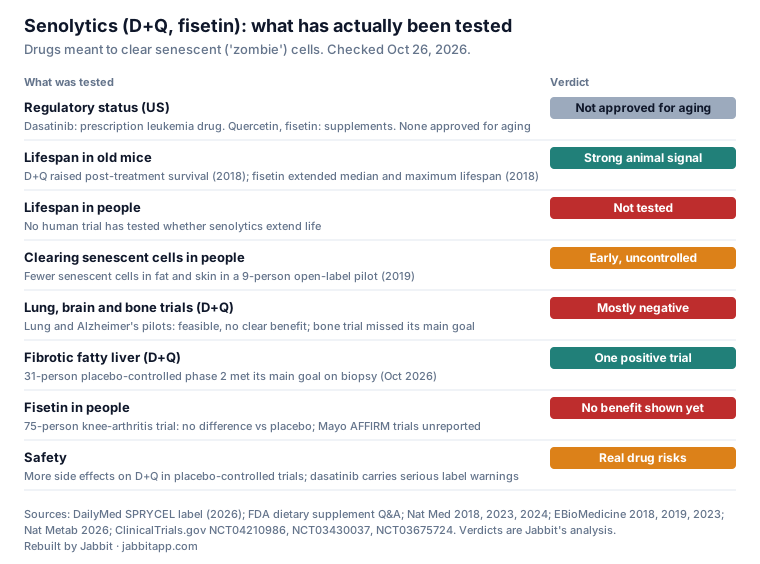
- Mice. In naturally aged mice, intermittent D+Q eased physical decline and increased post-treatment survival by 36%; fisetin given late in life extended median and maximum lifespan.[5][6] A 2025 study by a separate team, reporting no conflicts, found fisetin improved frailty and grip strength in old mice, with no effect in young mice.[7]
- People: lifespan. We found no human trial that measured whether senolytics extend life.[22]
- Do they clear senescent cells in people? In 9 people with diabetic kidney disease, D+Q reduced senescent cells in fat within 11 days, and skin markers and inflammatory blood factors fell; there was no comparison group.[9]
- Lung fibrosis. In a 14-person open-label pilot, walking and chair-stand tests improved, while lung function and frailty were unchanged.[8] A 12-person placebo-controlled pilot found the drugs feasible, but the measures “do not appear to differ meaningfully between groups.”[10]
- Alzheimer’s disease. In a 5-person open-label pilot, dasatinib reached spinal fluid in four people but quercetin was not detected; thinking and brain-imaging measures did not change, and some inflammation markers in spinal fluid went up.[11][12] A 48-person phase 2 trial is under way.[20]
- Bone. In 60 postmenopausal women, D+Q did not change the main bone-breakdown marker; a bone-formation marker rose briefly; in an exploratory subgroup with the most senescent cells, wrist bone density rose 2.7%.[13] The trial’s registry also lists a fisetin group, with no statistical comparison to control posted.[14]
- Fatty liver (MASH). In 31 people, D+Q improved liver scarring on biopsy more often than placebo, 47% vs 7%.[15]
- Fisetin. In 75 people with knee arthritis, the posted results show no significant difference from placebo on any outcome.[19] A 2026 review counted 34 registered fisetin trials, only 4 completed with results, and called the evidence “limited and heterogeneous.”[17] Small trials in obese men measured inflammation markers, not aging outcomes.[18]
The key trials, in one chart
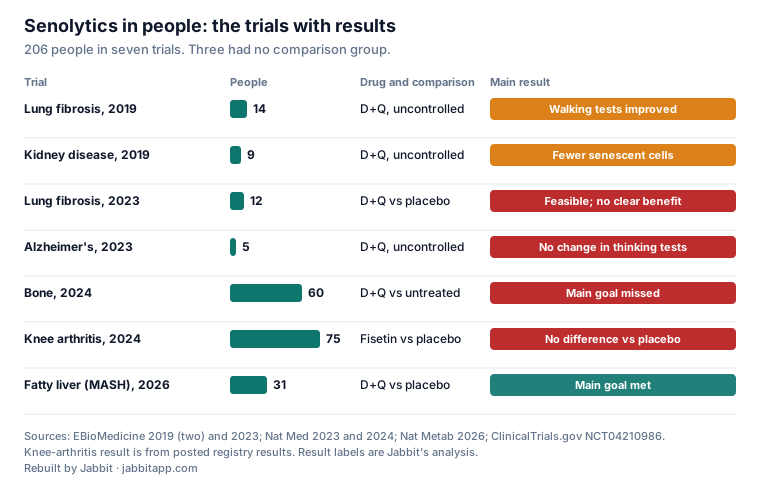
Our analysis: after a decade, the human evidence is seven small trials, three without any comparison group. Of the four trials with a comparison group, one met its main goal, the October 2026 liver trial.[10][13][19][15] Both 2026 reviews describe the evidence as limited, and one says senolytics are investigational.[16][17] The liver result is a disease-treatment signal, not evidence that senolytics slow aging.
The case for senolytics, in fairness
The mouse data are unusually strong for a longevity idea: two different senolytics extended survival or lifespan in old animals, and in 2025 a separate team, reporting no conflicts, also found fisetin eased frailty in old mice.[5][6][7] The first human pilot showed the drugs can reduce senescent cells in people.[9] The October 2026 liver trial was double-blind and placebo-controlled, with a biopsy-based main goal, and it was positive.[15] The bone trial hints that people with more senescent cells may respond better, which the authors say should be tested.[13] Our analysis: these are reasons to run larger trials, which researchers are doing, not proof that senolytics slow human aging.[20]
Safety
- Dasatinib is a cancer drug. Its label lists low blood counts and bleeding, fluid retention including fluid around the lungs, pulmonary arterial hypertension, QT prolongation, severe skin reactions, liver monitoring and harm to a fetus, and says to avoid strong CYP3A4 inhibitors and grapefruit juice.[1]
- Side effects in trials. In the liver trial, 82% had adverse events on D+Q vs 43% on placebo, all described as self-limiting; in the 12-person lung trial, non-serious events were more common on D+Q (65 vs 22), and sleep problems and anxiety occurred in 4 of 6 on D+Q vs 0 of 6 on placebo.[15][10] One serious adverse event was reported in the 14-person open-label pilot; the bone trial reported none.[8][13]
- Fisetin. In the knee trial, adverse events were about as common on fisetin as placebo, with 2 serious events in each group.[19]
- What is unknown. The trials were short and small, and the 2026 systematic review says long-term safety is not established.[16]
Purity
Quercetin and fisetin are sold as dietary supplements, which the FDA does not approve before they are marketed.[2] Our analysis: supplement products are not the same as the study drugs used in trials, and results from trials do not automatically apply to them. Dasatinib is a prescription medicine.[1] We do not name or rate brands or sellers.
Legal status
In the US, no senolytic is approved to treat aging or any age-related disease. Dasatinib is approved for certain leukemias, and its use for other purposes would be off-label.[1] Quercetin and fisetin are sold as supplements, which FDA does not approve before sale.[2]
What a careful reader should notice
These points are our analysis of the sources cited.
- “Extends lifespan” is a mouse result. No human trial has measured lifespan.[5][6][22]
- Check for a comparison group. Three of the seven trials in our chart had none, so their improvements could reflect chance or expectation.[8][9][11]
- Look for the main goal. The bone trial missed its main goal, and its positive finding came from an exploratory subgroup.[13]
- Most registered trials have not reported. Of 55 ClinicalTrials.gov records we found testing fisetin or D+Q, 8 have posted results, and some test the drugs in cancer or other diseases rather than aging.[21]
- One positive trial is a start. The liver trial was in 31 people with a specific disease, and the authors call for further trials.[15]
- Read the disclosures. Several trial papers report authors with financial interests in senolytic patents held by Mayo Clinic; that does not make the results wrong, but independent replication matters.[10][11][13][15]
Frequently asked questions
- What are senolytics?
- Drugs meant to clear senescent cells, damaged cells that stop dividing and release inflammatory signals. The best-known are dasatinib plus quercetin and fisetin.[3][4][6]
- Do senolytics extend lifespan?
- In old mice, yes: D+Q increased post-treatment survival and fisetin extended lifespan. No human trial has measured lifespan.[5][6][22]
- Is dasatinib plus quercetin safe?
- Dasatinib is a prescription leukemia drug whose label warns of low blood counts, bleeding, fluid around the lungs and other risks. In trials, side effects were more common on D+Q than placebo.[1][15][10]
- Does fisetin work in people?
- Not shown yet. A 75-person knee-arthritis trial found no difference from placebo, and Mayo Clinic’s AFFIRM fisetin trials have posted no results.[19][20][17]
- Are senolytics FDA approved?
- Not for aging. Dasatinib is approved for certain leukemias; quercetin and fisetin are supplements, which FDA does not approve before sale.[1][2]
- What did the October 2026 fatty-liver trial find?
- In 31 people with fibrotic MASH, 47% on D+Q improved their liver scarring vs 7% on placebo, with more side effects on D+Q.[15]
- Who holds the senolytic patents?
- Several trial papers disclose that patents on senolytic drugs are held by Mayo Clinic, and some authors disclose a financial interest in them.[5][13][15]
Bottom line
Senolytics have some of the strongest mouse lifespan data in the longevity field.[5][6] In people, the trials are small; most missed their main goals or had no comparison group, and the October 2026 liver trial is the first clear placebo-controlled win we found.[13][19][10][15] Dasatinib carries real drug risks, and reviewers call senolytics investigational.[1][16]
References
- DailyMed. SPRYCEL (dasatinib) tablet, E.R. Squibb & Sons, SPL version 49, published September 21, 2026. Indications: “SPRYCEL (dasatinib) is indicated for the treatment of adult patients with” “newly diagnosed Philadelphia chromosome-positive (Ph+) chronic myeloid leukemia (CML) in chronic phase,” among other leukemia uses including “Philadelphia chromosome-positive acute lymphoblastic leukemia (Ph+ ALL) with resistance or intolerance to prior therapy.” Warnings and precautions include: “Severe thrombocytopenia, neutropenia, and anemia may occur”; “Use caution if used concomitantly with medications that inhibit platelet function or anticoagulants”; “Fluid retention, sometimes severe, including pleural effusions”; “SPRYCEL may increase the risk of developing PAH which may be reversible on discontinuation”; “Use SPRYCEL with caution in patients who have or may develop prolongation of the QT interval”; “Individual cases of severe mucocutaneous dermatologic reactions have been reported”; “Can cause fetal harm”; “Assess liver function before initiation of treatment and monthly thereafter or as clinically indicated.” Interactions: “Avoid the use of concomitant strong CYP3A4 inhibitors and grapefruit juice.” The label carries no boxed warning. https://dailymed.nlm.nih.gov/dailymed/drugInfoBySetId.cfm?setid=4764f37b-c9e6-4ede-bcc2-8a03b7c521df. Checked October 26, 2026.
- U.S. Food and Drug Administration. Questions and Answers on Dietary Supplements: “Under DSHEA, FDA does not have the authority to approve dietary supplements before they are marketed.” https://www.fda.gov/food/information-consumers-using-dietary-supplements/questions-and-answers-dietary-supplements. Checked October 26, 2026.
- Chaib S, Tchkonia T, Kirkland JL. Cellular senescence and senolytics: the path to the clinic. Nat Med. 2022;28(8):1556-1568. PMID 35953721. Review by Mayo Clinic-affiliated authors: “In preclinical models, interventions targeting those senescent cells that are persistent and cause tissue damage have been shown to delay, prevent or alleviate multiple disorders.” Abstract read. https://pubmed.ncbi.nlm.nih.gov/35953721/. Checked October 26, 2026.
- Zhu Y, Tchkonia T, Pirtskhalava T, et al. The Achilles' heel of senescent cells: from transcriptome to senolytic drugs. Aging Cell. 2015;14(4):644-58. PMID 25754370. Mayo Clinic-affiliated lab and mouse study: “we describe the rationale for identification and validation of a new class of drugs termed senolytics, which selectively kill senescent cells”; “Dasatinib eliminated senescent human fat cell progenitors, while quercetin was more effective against senescent human endothelial cells and mouse BM-MSCs”; “In old mice, cardiac function and carotid vascular reactivity were improved 5 days after a single dose”; the authors report “the efficacy of senolytics for alleviating symptoms of frailty and extending healthspan.” Abstract read. https://pubmed.ncbi.nlm.nih.gov/25754370/. Checked October 26, 2026.
- Xu M, Pirtskhalava T, Farr JN, et al. Senolytics improve physical function and increase lifespan in old age. Nat Med. 2018;24(8):1246-1256. PMID 29988130. Mouse study: “intermittent oral administration of senolytics to both senescent cell-transplanted young mice and naturally aged mice alleviated physical dysfunction and increased post-treatment survival by 36% while reducing mortality hazard to 65%”; “senolytics can enhance remaining health- and lifespan in old mice.” Disclosure: “Patents on senolytic drugs (PCT/US2016/041646) are held by Mayo Clinic.” Abstract and disclosure read. https://pubmed.ncbi.nlm.nih.gov/29988130/. Checked October 26, 2026.
- Yousefzadeh MJ, Zhu Y, McGowan SJ, et al. Fisetin is a senotherapeutic that extends health and lifespan. EBioMedicine. 2018;36:18-28. PMID 30279143. Mouse and cell study: “Of the 10 flavonoids tested, fisetin was the most potent senolytic”; “Administration of fisetin to wild-type mice late in life restored tissue homeostasis, reduced age-related pathology, and extended median and maximum lifespan”; “These characteristics suggest the feasibility to translation to human clinical studies.” Funded by NIH grants per the abstract. Abstract read. https://pubmed.ncbi.nlm.nih.gov/30279143/. Checked October 26, 2026.
- Murray KO, Mahoney SA, Ludwig KR, et al. Intermittent Supplementation With Fisetin Improves Physical Function and Decreases Cellular Senescence in Skeletal Muscle With Aging: A Comparison to Genetic Clearance of Senescent Cells and Synthetic Senolytic Approaches. Aging Cell. 2025;24(8):e70114. PMID 40437670. University of Colorado and NIA mouse study: “We found that fisetin mitigated the adverse changes in frailty and grip strength with aging”; “Fisetin had no effects in young mice.” “The authors declare no conflicts of interest.” Abstract read. https://pubmed.ncbi.nlm.nih.gov/40437670/. Checked October 26, 2026.
- Justice JN, Nambiar AM, Tchkonia T, et al. Senolytics in idiopathic pulmonary fibrosis: Results from a first-in-human, open-label, pilot study. EBioMedicine. 2019;40:554-563. PMID 30616998. Open-label pilot (no placebo group) led from Wake Forest in “participants with IPF (n = 14)” (idiopathic pulmonary fibrosis): “The retention rate was 100% with no DQ discontinuation”; “One serious adverse event was reported”; non-serious events included “respiratory symptoms (n = 16 total events), skin irritation/bruising (n = 14), and gastrointestinal discomfort (n = 12)”; “Physical function evaluated as 6-min walk distance, 4-m gait speed, and chair-stands time was significantly and clinically-meaningfully improved (p < .05)”; “Pulmonary function, clinical chemistries, frailty index (FI-LAB), and reported health were unchanged”; the authors call for “larger randomized controlled trials.” Registry: {a(CT + 'NCT02874989')}. Abstract read. https://pubmed.ncbi.nlm.nih.gov/30616998/. Checked October 26, 2026.
- Hickson LJ, Langhi Prata LGP, Bobart SA, et al. Senolytics decrease senescent cells in humans: Preliminary report from a clinical trial of Dasatinib plus Quercetin in individuals with diabetic kidney disease. EBioMedicine. 2019;47:446-456. PMID 31542391. “In an open label Phase 1 pilot study” in 9 people with diabetic kidney disease: “D + Q reduced adipose tissue senescent cell burden within 11 days”; “Skin epidermal p16INK4A+ and p21CIP1+ cells were reduced, as were circulating SASP factors.” Disclosure: “Patents on senolytic drugs are held by Mayo Clinic.” Abstract and disclosure read. https://pubmed.ncbi.nlm.nih.gov/31542391/. Checked October 26, 2026.
- Nambiar A, Kellogg D, Justice J, et al. Senolytics dasatinib and quercetin in idiopathic pulmonary fibrosis: results of a phase I, single-blind, single-center, randomized, placebo-controlled pilot trial on feasibility and tolerability. EBioMedicine. 2023;90:104481. PMID 36857968. Pilot randomized trial: “Twelve participants with IPF aged >50 years were blinded and randomized at a 1:1 ratio” to D+Q or placebo; “While the placebo arm reported fewer overall non-serious AEs (65 vs 22), there were no serious adverse events related to D + Q”; “Sleep disturbances and anxiety were disproportionately represented in the D + Q arm (4/6 vs 0/6)”; for physical-function and other clinical measures, “these measures do not appear to differ meaningfully between groups”; “Intermittently-dosed D + Q in patients with IPF is feasible and generally well-tolerated.” Disclosure: “TT and JK have a financial interest related to this research including patents and pending patents on senolytic drugs, and their uses are held by Mayo Clinic.” Abstract and disclosure read. https://pubmed.ncbi.nlm.nih.gov/36857968/. Checked October 26, 2026.
- Gonzales MM, Garbarino VR, Kautz TF, et al. Senolytic therapy in mild Alzheimer's disease: a phase 1 feasibility trial. Nat Med. 2023;29(10):2481-2488. PMID 37679434. Open-label phase 1 pilot in early Alzheimer’s disease (NCT04063124): “Five participants (mean age = 76 + 5 years; 40% female) completed the 12-week pilot study”; in spinal fluid, dasatinib “levels were detected in four participants (80%)” and “Q was not detected”; “The treatment was well-tolerated, with no early discontinuation”; “Secondary cognitive and neuroimaging endpoints did not significantly differ from baseline to post-treatment”; spinal-fluid IL-6 and GFAP increased; biomarker findings “need to be confirmed in fully powered, placebo-controlled studies.” Disclosure: “J.L.K. and T.T. have a patent for Killing Senescent Cells and Treating Senescence-Associated Conditions Using an SRC Inhibitor and a Flavonoid with royalties paid to Mayo Clinic by Unity Biotechnologies.” Abstract and disclosure read. https://pubmed.ncbi.nlm.nih.gov/37679434/. Checked October 26, 2026.
- Garbarino VR, Palavicini JP, Melendez J, et al. Evaluation of exploratory fluid biomarkers from a phase 1 senolytic trial in mild Alzheimer's disease. Neurotherapeutics. 2025;22(4):e00591. PMID 40274471. Further biomarker analysis of the same five-person pilot: “Targeted cytokine and chemokine analyses revealed increases in plasma fractalkine and MMP-7 and CSF IL-6 from baseline to post-treatment”; “Independent validation will be necessary.” Abstract read. https://pubmed.ncbi.nlm.nih.gov/40274471/. Checked October 26, 2026.
- Farr JN, Atkinson EJ, Achenbach SJ, et al. Effects of intermittent senolytic therapy on bone metabolism in postmenopausal women: a phase 2 randomized controlled trial. Nat Med. 2024;30(9):2605-2612. PMID 38956196. Phase 2 randomized trial in postmenopausal women “(n = 60 participants)” comparing intermittent D+Q with no treatment (NCT04313634): the primary endpoint, change in the bone-breakdown marker CTx at 20 weeks, “did not differ between groups” (P = 0.611); the bone-formation marker P1NP rose at 2 weeks “(+16%, P = 0.020)” and 4 weeks but not at 20 weeks; “No serious adverse events were observed”; “intermittent D + Q treatment did not reduce bone resorption in the overall group of postmenopausal women.” In exploratory analyses of women with the highest senescent-cell burden, D+Q “increased radius bone mineral density (+2.7%, P = 0.004) at 20 weeks”; the authors say further studies should test whether “the underlying senescent cell burden may dictate the clinical response to senolytics.” Disclosure: “N.K.L., T.T. and J.L.K. have a financial interest related to this research, including patents and pending patents covering senolytic drugs and their uses that are held by Mayo Clinic.” Abstract and disclosure read. https://pubmed.ncbi.nlm.nih.gov/38956196/. Checked October 26, 2026.
- ClinicalTrials.gov, NCT04313634 (Targeting Cellular Senescence With Senolytics to Improve Skeletal Health in Older Humans), results first posted July 22, 2024: 74 enrolled in three groups, D+Q, fisetin and untreated control; the posted statistical analysis of the primary outcome compares D+Q with control only, with no fisetin-versus-control test. https://clinicaltrials.gov/study/NCT04313634. Data: https://jabbitapp.com/research/sources/senolytics-2026-10-26.json. Checked October 26, 2026.
- Koning M, Kovynev A, Fondevila MF, et al. Senolytics dasatinib and quercetin in metabolic dysfunction-associated steatohepatitis: a proof-of-principle randomized, controlled trial. Nat Metab. 2026. PMID 42823536. Nature Metabolism, published online October 1, 2026. Amsterdam UMC-led “phase-2, double-blind, randomized, placebo-controlled trial” (registry NCT05506488, lead sponsor Academisch Medisch Centrum - Universiteit van Amsterdam) in fibrotic MASH (fatty liver disease with inflammation and scarring): “Thirty-one participants (median age 56 years; 76% male; 58% with type 2 diabetes) were randomized (1:1)”; the primary endpoint, at least one stage of fibrosis improvement without MASH worsening on paired liver biopsies, “is achieved in 47% of D + Q-treated participants versus 7% with placebo (P = 0.02)”; “MASH resolution occurs more frequently with D + Q than placebo (53% versus 7%; P = 0.02)”; “Although adverse events are more frequent in the D + Q group (82% versus 43%), these are all self-limiting”; “this proof-of-principle trial supports the need for future trials of senolytic therapy in fibrotic MASH.” Disclosure: “T.T. and J.L.K. have a financial interest related to this research, including patents and pending patents covering senolytic drugs and their uses held by Mayo Clinic.” Abstract and disclosure read. https://pubmed.ncbi.nlm.nih.gov/42823536/. Checked October 26, 2026.
- Trivedi H, Tripathi S, Thacker J, et al. Therapeutic reversal of cellular senescence: A systematic review of senolytics, senomorphics and anti-ageing therapies in human clinical trials. Br J Clin Pharmacol. 2026. PMID 42834340. Systematic review, published online October 5, 2026: “Six completed clinical studies were included in the evidence synthesis”; “evidence remains insufficient to establish clinical efficacy or long-term safety”; “Senolytic and senomorphic strategies should therefore be considered investigational rather than established therapies.” No interest statement in the PubMed record. Abstract read. https://pubmed.ncbi.nlm.nih.gov/42834340/. Checked October 26, 2026.
- Sandoval-Caballero C, Roemer Z, Kotz CM, et al. Clinical Translation of Fisetin for Age-Related Diseases: Current Evidence and Future Opportunities. Nutrients. 2026;18(18). PMID 42796982. Review of fisetin trials: “we evaluated 34 registered clinical trials,” with “4 completed trials with available results”; “the completed trials indicate that clinical evidence for fisetin remains limited and heterogeneous”; some trials reported signals while “others found no clear or significant clinical benefit.” “The authors declare no conflicts of interest.” Abstract read. https://pubmed.ncbi.nlm.nih.gov/42796982/. Checked October 26, 2026.
- Alipour M, Saeidi A, Hejazi K, et al. 12‑weeks fisetin supplementation and interval resistance with aerobic training: changes in Maresin‑1 and inflammatory markers in men with obesity: a randomized controlled trial. J Int Soc Sports Nutr. 2026;23(1):2679718. PMID 42218768. Randomized trial of fisetin with or without exercise training in “44 obese adult males,” measuring inflammatory blood markers; the authors cite “fisetin’s anti‑inflammatory properties.” “No potential conflict of interest was reported by the author(s).” Abstract read; markers only, no aging or clinical outcomes. https://pubmed.ncbi.nlm.nih.gov/42218768/. Checked October 26, 2026.
- ClinicalTrials.gov, NCT04210986 (Senolytic Drugs Attenuate Osteoarthritis-Related Articular Cartilage Degeneration: A Clinical Trial), lead sponsor Steadman Philippon Research Institute; completed; 75 enrolled; fisetin vs placebo in knee osteoarthritis; results first posted September 19, 2024. Primary outcome: participants with one or more treatment-emergent adverse events, 28 of 34 on fisetin vs 33 of 40 on placebo (p >0.9); serious adverse events 2 of 34 vs 2 of 40. None of the posted statistical comparisons of function, pain (WOMAC), walking or other outcomes reached p < 0.05 (lowest posted p-value above 0.05). https://clinicaltrials.gov/study/NCT04210986. Data: https://jabbitapp.com/research/sources/senolytics-2026-10-26.json. Checked October 26, 2026.
- ClinicalTrials.gov API v2 records, October 26, 2026: Mayo Clinic fisetin trials AFFIRM https://clinicaltrials.gov/study/NCT03430037 (older women; started February 2018) and AFFIRM-LITE https://clinicaltrials.gov/study/NCT03675724 (older adults; started November 2018), both “enrolling by invitation,” 40 estimated each, primary completion estimated November 2026, no results posted; SToMP-AD phase 2 https://clinicaltrials.gov/study/NCT04685590 (Washington University; active, not recruiting; 48 estimated; primary completion January 2028); Odense University Hospital osteoporosis study https://clinicaltrials.gov/study/NCT06018467 (completed April 2026; 120 enrolled; no results posted); University of Colorado Boulder fisetin vascular study https://clinicaltrials.gov/study/NCT06133634 (active, not recruiting; 70; primary completion March 2026; no results posted); Sunnybrook fisetin pilot in mild Alzheimer’s https://clinicaltrials.gov/study/NCT07279714 (completed July 2026; 5 enrolled; no results posted); Mayo Clinic chronic kidney disease study https://clinicaltrials.gov/study/NCT02848131 (enrolling by invitation; primary completion April 2027); a single-arm 15-person D+Q study in older adults at risk for Alzheimer’s https://clinicaltrials.gov/study/NCT05422885 (completed; results posted; no comparison group); MASH trial https://clinicaltrials.gov/study/NCT05506488. Statuses: https://jabbitapp.com/research/sources/senolytics-2026-10-26.json. Checked October 26, 2026.
- ClinicalTrials.gov API v2, October 26, 2026: intervention “fisetin,” 37 records; intervention “dasatinib AND quercetin,” 22 records; 55 unique, of which Mayo Clinic is the lead sponsor on 10, 15 are listed as completed and 8 have posted results. Some records test these drugs in cancer or other diseases rather than aging. Counts: https://jabbitapp.com/research/sources/senolytics-2026-10-26.json. Checked October 26, 2026.
- PubMed searches, October 26, 2026: dasatinib and quercetin in title/abstract, limited to clinical or randomized trials: 7 records; fisetin, same limits: 8 records (several are not senolytic trials); senolytic*, same limits: 20 records. A search for senolytics, dasatinib or fisetin with lifespan or longevity among human randomized trials returned 1 record, a mouse study (MyMD-1 vs rapamycin) indexed under humans; we found no human trial that measured lifespan. Queries and IDs: https://jabbitapp.com/research/sources/senolytics-2026-10-26.json. Checked October 26, 2026.
This page analyzes published studies, regulator documents, drug labels and registry data. It is not medical or legal advice and does not recommend any product or dose. No senolytic is approved to treat aging. Charts were rebuilt by Jabbit from the sources cited in each caption.