Study teardown · Rapamycin (sirolimus; Rapamune; related mTOR drugs everolimus and RTB101) · The FDA label, Drugs@FDA, the mouse lifespan studies, every randomized human aging trial we found, dog trials, registry records and PubMed counts · Sources checked October 25, 2026
Published · Updated
Rapamycin for longevity: does the anti-aging drug work, and is it safe? It reliably extends lifespan in mice, but no human trial has tested whether it extends life; the human aging trials are small or short with mixed results, and as sirolimus it is an FDA-approved transplant immunosuppressant with a boxed warning for infection and cancer risk.
Rapamycin, also called sirolimus, is a prescription drug that calms the immune system. In the US it is approved to prevent rejection of kidney transplants and to treat a rare lung disease, LAM, and its label carries a boxed warning about infections and cancer.[1][2] It is now prescribed off-label and discussed widely as a longevity drug.[23] Does it work for that? In mice, yes: a national testing program found it extended lifespan at three sites, even when started late in life.[5] In people, no trial has tested whether it extends life; the randomized aging trials in our chart enrolled 25 to 1,024 people, the three largest tested related drugs, and the results are mixed.[26][10][12][13] Is it safe? In small, short aging trials in healthy people, serious side effects were uncommon, but the label lists real risks, and one 2026 trial reported more adverse events on the drug than on placebo.[19][12][13][1]
Why this matters now
In March 2026, UT Health San Antonio announced an NIA-funded rapamycin study whose largest part is a placebo-controlled trial in about 84 older adults, and its release says some people are “experimenting with the drug on their own, often without medical supervision.”[23] An April 2026 randomized trial found rapamycin did not help older adults gain more from exercise and may have blunted the gains.[13] A University of Wisconsin everolimus aging study listed as completed in June 2026 has not posted results, a September 2026 paper on rapamycin in frail older adults with heart failure is out but has no public abstract, and the FDA approved a new topical sirolimus cream in July 2026.[24][22][2]
Timeline
| Date | Event |
|---|---|
| 1975 | Scientists report an antifungal compound from a soil bacterium found on Easter Island and name it rapamycin.[4] |
| 1999 to 2000 | FDA approves Rapamune oral solution and tablets for kidney transplant patients.[2] |
| 2009 | The NIA’s Interventions Testing Program reports rapamycin extends lifespan in male and female mice, even when started late in life.[5] |
| 2014 | A mouse study finds bigger lifespan gains in females; a Novartis-affiliated trial reports better flu-vaccine responses in older people on everolimus, a related drug.[6][8] |
| 2016 | A mouse study reports three months of treatment in middle age extended life expectancy; one dose shifted cancers toward aggressive blood cancers.[7] |
| 2017 to 2018 | A 10-week pilot in 24 dogs reports no clinical side effects; a 25-person safety pilot in older adults; a 264-person phase 2a trial of two related drugs reports fewer infections.[20][11][9] |
| 2019 | A skin trial reports lower aging markers with a topical cream; more than half of 36 participants dropped out.[14] |
| 2021 | In resTORbio’s trials of the related drug RTB101, phase 3 (1,024 people) did not meet its main goal.[10] FDA approves FYARRO, an IV form of sirolimus.[2] |
| 2024 | A systematic review of 19 human studies finds improvements in some body systems, none in others, and more infections and higher lipids in people with age-related diseases.[19] |
| 2025 | PEARL, a 48-week trial, reports no change in its main measure, belly fat around the organs; an open-label trial finds rapamycin did not reach spinal fluid; the dog TRIAD trial design is published.[12][17][21] |
| 2026 | RAPA-EX-01 reports no added exercise benefit (April); UT Health San Antonio launches a larger study (March); FDA approves SCOMARA topical cream (July).[13][23][2] |
What rapamycin is
Rapamycin was first described in 1975 as an antifungal compound.[4] Today, as sirolimus, it is a pill or oral solution approved for kidney-transplant patients aged 13 and older and for lymphangioleiomyomatosis (LAM), plus an IV form and two skin products; Drugs@FDA lists 16 sirolimus applications in all, including 11 generics.[1][2][3] It blocks mTOR, a protein that helps cells decide when to grow; blocking this pathway extends lifespan in yeast, worms and flies, which is why aging researchers tested it in mice.[5] Everolimus (RAD001) and RTB101 are related mTOR-blocking drugs, and several of the biggest “rapamycin for aging” trials actually tested them.[8][9][10]
The evidence, rung by rung
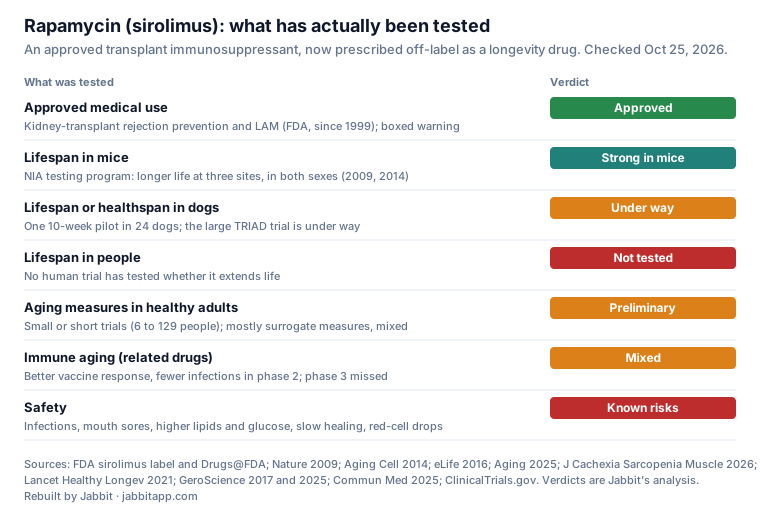
- Mice. The NIA program found rapamycin extended median and maximum lifespan in both sexes at three independent test sites, even when feeding started at 600 days of age, which the authors’ title calls “late in life.”[5] A later study found larger gains at a higher dose and more benefit in females.[6] Another found a short course in middle age helped, but at one dose female mice got more aggressive blood cancers without living longer.[7] The 2009 authors wrote that rapamycin may work “by postponing death from cancer, by retarding mechanisms of ageing, or both.”[5]
- Dogs. A 10-week trial in 24 healthy middle-aged dogs reported no clinical side effects and some changes in heart measures.[20] The TRIAD trial is designed to test lifespan and healthspan in pet dogs; we found no published results yet.[21]
- People: lifespan. We found no human trial that measured whether rapamycin extends life. A PubMed search returned 18 randomized trials mentioning rapamycin or sirolimus with aging terms; seven tested a rapamycin-type drug in people for aging-related outcomes, and none measured lifespan.[26]
- People: aging measures. In PEARL (129 enrolled per the registry), the main measure, visceral fat, did not change; the authors, seven of whom disclose they are employees and shareholders of AgelessRx, reported gains in lean mass and pain in women.[12][24] A 25-person pilot found no changes in physical, cognitive or self-rated health measures, but some red-blood-cell values fell.[11] A 13-person heart-rehab pilot noted “no improvement in frailty.”[16] A six-man open-label study reported better heart-filling and blood-vessel measures.[15] The 2024 review of 19 studies found improvements in immune, heart and skin measures but none in hormone, muscle or nerve systems.[19]
- Exercise. In RAPA-EX-01, 40 sedentary adults aged 65 to 85 did home exercise with sirolimus or placebo; both groups improved, and sensitivity analyses favored placebo.[13]
- Brain. In a 10-person open-label trial in early Alzheimer’s or mild cognitive impairment, rapamycin was not detectable in spinal fluid, cognition did not change, and some Alzheimer’s and inflammation markers rose.[17] A 40-person phase 2 trial, REACH, is listed as active but not recruiting and has not posted results.[24]
- Skin. A topical cream lowered a cell-aging marker in skin samples, but 19 of 36 participants dropped out.[14]
The key trials, in one chart
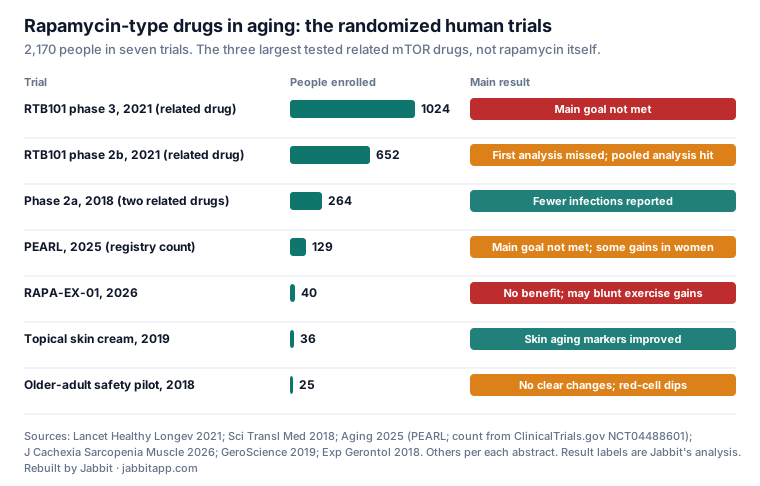
Our analysis: the biggest human test of the mTOR idea, a 1,024-person phase 3 trial of a related drug, did not reduce respiratory illness, though its authors, who include resTORbio employees, reported that more antiviral immune genes were switched on with the drug.[10] Of the trials that used rapamycin itself, the largest had 129 people and missed its main goal; the clearest positive results came from a skin cream with heavy dropout and a six-person open-label study.[12][24][14][15]
The case for rapamycin, in fairness
The mouse data are strong: the NIA program tested rapamycin at three independent sites in genetically mixed mice, and it worked in both sexes and even when started late.[5][6] Phase 2 trials of related drugs reported better vaccine responses and fewer reported infections in older people.[8][9] A systematic review found no serious side effects attributed to the drugs in healthy people in the trials it covered.[19] A pharmacology study found weekly dosing kept blood levels below immunosuppressive levels between doses in 13 patients.[18] Our analysis: these are reasons to run bigger trials, which is what the UT Health San Antonio and dog studies are doing, not proof that it slows human aging.[23][21] The university release puts it this way: “there’s a difference between something that is biologically plausible and something that has been rigorously tested in people.”[23]
Safety
- Infections and cancer. The label’s boxed warning says immunosuppression can increase “susceptibility to infection and the possible development of lymphoma and other malignancies,” including serious and fatal infections; it also notes a higher skin cancer risk on immunosuppressants.[1] The review found more infections in people with age-related diseases taking these drugs.[19]
- Lipids and blood sugar. The label lists raised cholesterol and triglycerides needing treatment, and postmarketing reports of high blood sugar and diabetes.[1] The review found higher cholesterol and triglycerides in people with age-related diseases; in the 10-person brain trial, HbA1c and blood pressure rose.[19][17]
- Mouth sores, healing and lungs. The label lists mouth sores (stomatitis), slow wound healing and lung inflammation, some fatal.[1] Mouth sores and rash showed up in the 25-person pilot.[11]
- Blood counts. Red-blood-cell values fell in the 25-person and 10-person trials.[11][17]
- More adverse events in one trial. RAPA-EX-01 counted 99 adverse events on sirolimus vs 63 on placebo, including one serious pneumonia possibly related to the drug.[13]
- Other label cautions. Avoid live vaccines; grapefruit juice must not be taken with it; it can cause fetal harm; it may lower sperm counts.[1]
Purity
Sirolimus is sold as FDA-approved brand and generic products.[2] PEARL used compounded rapamycin, and its sponsor registered a separate study comparing compounded and generic versions; that study has not posted results.[12][24] Our analysis: compounded products are not FDA-approved, so their strength and absorption cannot be assumed to match approved tablets. We do not name or rate sellers, pharmacies or telehealth services.
Legal status
In the US, sirolimus is a prescription drug approved for kidney-transplant rejection prevention, and LAM, with an IV form (FYARRO) and topical products approved for other conditions; aging and longevity are not approved uses.[1][2][3] Doctors can prescribe approved drugs off-label, which is how it is used for longevity now; the UT Health San Antonio release describes a shift away from “off-label and speculative use.”[23]
What a careful reader should notice
These points are our analysis of the sources cited.
- “Extends lifespan” is a mouse result. No human trial has measured lifespan.[5][26]
- The biggest human trials tested different drugs. RTB101 and everolimus are related, but results do not automatically transfer.[8][9][10]
- Look at who ran the trial. Company employees co-wrote the RTB101 and PEARL papers, as they disclosed. That does not make the results wrong, but independent replication matters.[10][12][11][13]
- Surrogate measures are not outcomes. Vaccine responses, skin markers and heart-filling scores can move without changing how long or how well people live.[8][14][15]
- The one randomized trial pairing rapamycin with exercise pointed the wrong way.[13]
Frequently asked questions
- Does rapamycin extend lifespan in humans?
- Nobody knows. It extends lifespan in mice, but no human trial has measured lifespan. Human trials have been small or short and used aging-related measures.[5][26]
- Is rapamycin safe for anti-aging?
- Small, short trials in healthy people found few serious side effects, but one 2026 trial counted more adverse events on the drug. The FDA label warns of infections, cancer risk, high lipids and blood sugar, mouth sores and slow healing.[19][13][1]
- Is rapamycin FDA approved?
- Yes, as sirolimus, for preventing kidney-transplant rejection and for LAM, plus IV and topical forms for other conditions. It is not approved for aging.[1][2][3]
- What did the PEARL trial find?
- Its main measure, visceral fat, did not change after 48 weeks. The authors reported gains in lean mass and pain in women and similar side effects across groups.[12]
- Does rapamycin help muscle or exercise in older adults?
- In RAPA-EX-01, it did not add to exercise gains and may have blunted them. The 2024 review found no significant muscle effects.[13][19]
- Does rapamycin weaken the immune system?
- It is an immunosuppressant at transplant doses, with a boxed warning. Trials of related drugs in older people reported better vaccine responses, but phase 3 did not reduce respiratory illness.[1][8][10]
- Is rapamycin being tested in larger trials?
- Yes. UT Health San Antonio has a placebo-controlled trial of about 84 older adults, the TRIAD dog trial is under way, and a completed Wisconsin everolimus study has not posted results.[23][21][24]
Bottom line
Rapamycin is one of the best-supported lifespan drugs in mice.[5][6] In people, it has not been tested for lifespan, and the small aging trials give a mixed picture: some immune, skin and heart signals, missed main goals, and one trial suggesting it may blunt exercise gains.[26][10][12][13][19] As sirolimus, it is a powerful immunosuppressant with a boxed warning, and larger placebo-controlled trials are under way.[1][23]
References
- Glenmark Pharmaceuticals. Sirolimus tablets (generic of RAPAMUNE), FDA-approved prescribing information, DailyMed setid 57fb4d90-3ccb-4a69-af1e-53be83f7a504 (effective January 28, 2026). Boxed warning: “WARNING: IMMUNOSUPPRESSION, USE IS NOT RECOMMENDED IN LIVER OR LUNG TRANSPLANT PATIENTS”; “Increased susceptibility to infection and the possible development of lymphoma and other malignancies may result from immunosuppression.” Indications: “Sirolimus tablets are indicated for the prophylaxis of organ rejection in patients aged 13 years or older receiving renal transplants”; “Sirolimus tablets are indicated for the treatment of patients with lymphangioleiomyomatosis (LAM).” Warnings include: “Oversuppression of the immune system can also increase susceptibility to infection, including opportunistic infections such as tuberculosis, fatal infections, and sepsis”; “There have been reports of impaired or delayed wound healing in patients receiving sirolimus”; “Increased serum cholesterol and triglycerides requiring treatment occurred more frequently in patients treated with sirolimus”; “Cases of interstitial lung disease (including pneumonitis, bronchiolitis obliterans organizing pneumonia [BOOP], and pulmonary fibrosis), some fatal”; “Patients on immunosuppressive therapy are at increased risk for skin cancer”; “The use of live vaccines should be avoided during treatment with sirolimus”; grapefruit juice “must not be taken with or be used for dilution of sirolimus”; “sirolimus can cause fetal harm when administered to a pregnant woman”; “Azoospermia or oligospermia may be observed.” Common reactions in the LAM study include “stomatitis, diarrhea, abdominal pain, nausea, nasopharyngitis, acne, chest pain, peripheral edema”; postmarketing reports include “hypophosphatemia, hyperglycemia, diabetes mellitus.” We could not retrieve Pfizer’s RAPAMUNE label through the DailyMed or openFDA interfaces and used this generic label, which follows it. https://dailymed.nlm.nih.gov/dailymed/drugInfo.cfm?setid=57fb4d90-3ccb-4a69-af1e-53be83f7a504. Checked October 25, 2026.
- U.S. Food and Drug Administration, Drugs@FDA via openFDA, active ingredient sirolimus, October 25, 2026: 16 applications. RAPAMUNE oral solution (NDA 021083, original approval September 15, 1999) and tablets (NDA 021110, August 25, 2000); FYARRO, an intravenous form (NDA 213312, November 22, 2021); HYFTOR topical gel (NDA 213478, March 22, 2022); SCOMARA topical cream (NDA 218528, AFT Pharmaceuticals, July 20, 2026, listed as a new dosage form); and 11 generic (ANDA) approvals. https://www.accessdata.fda.gov/scripts/cder/daf/index.cfm?event=overview.process&ApplNo=021110; list: https://jabbitapp.com/research/sources/rapamycin-2026-10-25.json. Checked October 25, 2026.
- Nobelpharma. HYFTOR (sirolimus topical gel) prescribing information, DailyMed setid edb3ea90-5adc-48ec-99f5-ab963e302f18: “HYFTOR is indicated for the treatment of facial angiofibroma associated with tuberous sclerosis in adults and pediatric patients 6 years of age and older.” https://dailymed.nlm.nih.gov/dailymed/drugInfo.cfm?setid=edb3ea90-5adc-48ec-99f5-ab963e302f18. Checked October 25, 2026.
- Vézina C, Kudelski A, Sehgal SN. Rapamycin (AY-22,989), a new antifungal antibiotic. I. Taxonomy of the producing streptomycete and isolation of the active principle. J Antibiot (Tokyo). 1975;28(10):721-6. PMID 1102508. Discovery paper: “A streptomycete was isolated from an Easter Island soil sample”; the antifungal compound was “isolated in crystalline form and named rapamycin.” Abstract read. https://pubmed.ncbi.nlm.nih.gov/1102508/. Checked October 25, 2026.
- Harrison DE, Strong R, Sharp ZD, et al. Rapamycin fed late in life extends lifespan in genetically heterogeneous mice. Nature. 2009;460(7253):392-5. PMID 19587680. NIA Interventions Testing Program. Background: inhibiting the TOR pathway “extends lifespan in invertebrates, including yeast, nematodes and fruitflies.” Rapamycin “extends median and maximal lifespan of both male and female mice when fed beginning at 600 days of age”; “On the basis of age at 90% mortality, rapamycin led to an increase of 14% for females and 9% for males”; “The effect was seen at three independent test sites in genetically heterogeneous mice”; “Rapamycin may extend lifespan by postponing death from cancer, by retarding mechanisms of ageing, or both.” Abstract read. https://pubmed.ncbi.nlm.nih.gov/19587680/. Checked October 25, 2026.
- Miller RA, Harrison DE, Astle CM, et al. Rapamycin-mediated lifespan increase in mice is dose and sex dependent and metabolically distinct from dietary restriction. Aging Cell. 2014;13(3):468-77. PMID 24341993. Mouse study: median lifespan rose 23% in males and 26% in females at the highest dose tested; “Rapamycin increased lifespan more in females than in males at each dose evaluated.” Abstract read. https://pubmed.ncbi.nlm.nih.gov/24341993/. Checked October 25, 2026.
- Bitto A, Ito TK, Pineda VV, et al. Transient rapamycin treatment can increase lifespan and healthspan in middle-aged mice. Elife. 2016;5. PMID 27549339. Mouse study: “3 months of rapamycin treatment is sufficient to increase life expectancy by up to 60% and improve measures of healthspan in middle-aged mice”; at one dose in female mice that did not extend lifespan, “a striking shift in cancer prevalence toward aggressive hematopoietic cancers.” Abstract read. https://pubmed.ncbi.nlm.nih.gov/27549339/. Checked October 25, 2026.
- Mannick JB, Del Giudice G, Lattanzi M, et al. mTOR inhibition improves immune function in the elderly. Sci Transl Med. 2014;6(268):268ra179. PMID 25540326. Randomized trial of everolimus (RAD001), a related mTOR drug, in older volunteers: “RAD001 enhanced the response to the influenza vaccine by about 20% at doses that were relatively well tolerated”; “These results raise the possibility that mTOR inhibition may have beneficial effects on immunosenescence in the elderly.” Author affiliations include Novartis. Abstract read. https://pubmed.ncbi.nlm.nih.gov/25540326/. Checked October 25, 2026.
- Mannick JB, Morris M, Hockey HP, et al. TORC1 inhibition enhances immune function and reduces infections in the elderly. Sci Transl Med. 2018;10(449). PMID 29997249. Phase 2a randomized, placebo-controlled trial in “264 elderly subjects given the study drugs for 6 weeks”: a combination of two related mTOR drugs (BEZ235 and RAD001) “was safe and was associated with a significant (P = 0.001) decrease in the rate of infections reported by elderly subjects for a year after study drug initiation.” Author affiliations include Novartis. Abstract read. https://pubmed.ncbi.nlm.nih.gov/29997249/. Checked October 25, 2026.
- Mannick JB, Teo G, Bernardo P, et al. Targeting the biology of ageing with mTOR inhibitors to improve immune function in older adults: phase 2b and phase 3 randomised trials. Lancet Healthy Longev. 2021;2(5):e250-e262. PMID 33977284. Phase 2b and phase 3 randomized trials of RTB101 (formerly BEZ235), a related mTOR drug: phase 2b, “we recruited 652 participants in total”; the first prespecified analysis “did not meet statistical significance but, in our second prespecified analysis, which included data from part 1 and part 2, we found a statistically significant reduction in the proportion of patients who had one or more laboratory-confirmed RTIs”; phase 3, “we enrolled 1024 patients” and “RTB101 did not reduce the proportion of patients with clinically symptomatic respiratory illness”; “In both trials, significantly more IFN-induced antiviral genes were upregulated in patients treated with RTB101 as compared with placebo”; “The study drug was found to be safe and well-tolerated across trials and treatment groups.” Disclosure: six authors “were employees of, and had equity in, resTORbio who manufactured RTB101.” Abstract read. https://pubmed.ncbi.nlm.nih.gov/33977284/. Checked October 25, 2026.
- Kraig E, Linehan LA, Liang H, et al. A randomized control trial to establish the feasibility and safety of rapamycin treatment in an older human cohort: Immunological, physical performance, and cognitive effects. Exp Gerontol. 2018;105:53-69. PMID 29408453. Randomized “placebo-controlled pilot study in 25 generally healthy older adults (aged 70-95 years)”: side effects “were limited to facial rash (1 subject), stomatitis (1 subject) and gastrointestinal issues (2 subjects)”; “statistically significant decrements in several erythrocyte parameters including hemoglobin (HgB) and hematocrit (Hct)”; “no changes were noted in any other clinical laboratory, cognitive, physical performance, or self-perceived health status measure over the study period”; “the OGTTs revealed no RAPA-induced change in blood glucose concentration, insulin secretion, and insulin sensitivity.” Abstract read. https://pubmed.ncbi.nlm.nih.gov/29408453/. Checked October 25, 2026.
- Moel M, Harinath G, Lee V, et al. Influence of rapamycin on safety and healthspan metrics after one year: PEARL trial results. Aging (Albany NY). 2025;17(4):908-936. PMID 40188830. PEARL: “This 48-week decentralized, double-blinded, randomized, placebo-controlled trial (NCT04488601)” used compounded rapamycin; “The primary outcome measure was visceral adiposity (by DXA scan)”; “Visceral adiposity did not change significantly”; “Adverse and serious adverse events were similar across all groups”; the authors conclude it “is relatively safe in healthy, normative-aging adults, and was associated with significant improvements in lean tissue mass and pain in women”; “Future work will evaluate benefits of a broader range of rapamycin doses on healthspan metrics for longevity, and will aim to more comprehensively establish efficacy.” Disclosure: seven authors “are employees and shareholders of AgelessRx.” Abstract read. https://pubmed.ncbi.nlm.nih.gov/40188830/. Checked October 25, 2026.
- Stanfield B, Leroux B, Kaeberlein M, et al. Exercise and Weekly Sirolimus (Rapamycin) in Older Adults: RAPA-EX-01 Randomised, Double-Blind, Placebo-Controlled Trial. J Cachexia Sarcopenia Muscle. 2026;17(2):e70274. PMID 41985884. RAPA-EX-01 randomized, double-blind, placebo-controlled trial in “40 sedentary adults aged 65-85 years” doing a home exercise program (registered ACTRN12624000790549): “Both groups improved chair-stand performance”; “Sensitivity analyses favoured placebo and reached statistical significance”; “Seventeen participants (85%) in each arm reported ≥ 1 adverse event, but the total burden was higher with sirolimus (99 vs. 63 events), including one possibly drug-related serious adverse event (pneumonia)”; sirolimus did not enhance, and “in sensitivity analyses, it may have modestly attenuated short-term functional improvements from a home exercise programme in older adults.” Abstract read. https://pubmed.ncbi.nlm.nih.gov/41985884/. Checked October 25, 2026.
- Chung CL, Lawrence I, Hoffman M, et al. Topical rapamycin reduces markers of senescence and aging in human skin: an exploratory, prospective, randomized trial. Geroscience. 2019;41(6):861-869. PMID 31761958. Randomized trial of topical rapamycin on the skin of older adults: “Thirty-six participants were enrolled in the study, and nineteen discontinued or were lost to follow-up”; “A significant (P = 0.008) reduction in p16INK4A protein levels and an increase in collagen VII protein levels (P = 0.0077) were observed.” Abstract read. https://pubmed.ncbi.nlm.nih.gov/31761958/. Checked October 25, 2026.
- Moody AJ, Wu Y, Romo TQ, et al. Short-term mTOR inhibition by rapamycin improves cardiac and endothelial function in older men: a proof-of concept pilot study. Geroscience. 2026;48(3):4121-4137. PMID 40971115. Proof-of-concept pilot, “the open-label study”: “In all 6 subjects, transmitral blood flow, peak flow rate, and maximal blood acceleration showed statistically significant improvements while endothelial function also improved”; results “support future placebo-controlled studies in larger cohorts.” Abstract read. https://pubmed.ncbi.nlm.nih.gov/40971115/. Checked October 25, 2026.
- Singh M, Jensen MD, Lerman A, et al. Effect of Low-Dose Rapamycin on Senescence Markers and Physical Functioning in Older Adults with Coronary Artery Disease: Results of a Pilot Study. J Frailty Aging. 2016;5(4):204-207. PMID 27883166. Pilot study, “13 patients”, in “elderly undergoing cardiac rehabilitation (CR)” (NCT01649960): “no improvement in frailty with rapamycin was noted.” Abstract read. https://pubmed.ncbi.nlm.nih.gov/27883166/. Checked October 25, 2026.
- Gonzales MM, Garbarino VR, Kautz TF, et al. Rapamycin treatment for Alzheimer's disease and related dementias: a pilot phase 1 clinical trial. Commun Med (Lond). 2025;5(1):189. PMID 40394335. CARPE DIEM, a “single-site open-label phase 1 clinical trial” (NCT04200911) in mild cognitive impairment or early dementia: “In ten participants (mean age 74 ± 4 years, 60% female), we find that rapamycin is not detectable in the CSF before or after treatment”; after treatment “systolic blood pressure and hemoglobin A1c increase, multiple erythrocyte parameters decrease, and there are no significant cognitive changes”; “several Alzheimer's disease and inflammatory biomarkers increase after treatment.” Abstract read. https://pubmed.ncbi.nlm.nih.gov/40394335/. Checked October 25, 2026.
- Wallgren HA, Kivipelto M, Plavén-Sigray P, et al. Pharmacokinetic analysis of intermittent rapamycin administration in early-stage Alzheimer's Disease. Geroscience. 2026;48(3):3295-3304. PMID 41046300. Open-label pilot of weekly rapamycin in “13 patients with early-stage AD” (NCT06022068): “Blood concentrations at Cmin were below immunosuppressive levels in all participants.” Abstract read. https://pubmed.ncbi.nlm.nih.gov/41046300/. Checked October 25, 2026.
- Lee DJW, Hodzic Kuerec A, Maier AB. Targeting ageing with rapamycin and its derivatives in humans: a systematic review. Lancet Healthy Longev. 2024;5(2):e152-e162. PMID 38310895. Systematic review of rapamycin and related drugs in adults, “resulting in 19 included studies”: improvements in immune, cardiovascular and skin measures; “Overall, no significant effects on the endocrine, muscular, or neurological systems were found”; “No serious adverse events attributed to rapamycin and its derivatives were reported in healthy individuals; however, there were increased numbers of infections and increases in total cholesterol, LDL cholesterol, and triglycerides in individuals with ageing-related diseases”; “Future studies should assess the remaining unexamined systems and test the effects of long-term exposure to rapamycin and its derivatives.” Abstract read. https://pubmed.ncbi.nlm.nih.gov/38310895/. Checked October 25, 2026.
- Urfer SR, Kaeberlein TL, Mailheau S, et al. A randomized controlled trial to establish effects of short-term rapamycin treatment in 24 middle-aged companion dogs. Geroscience. 2017;39(2):117-127. PMID 28374166. Randomized trial in “24 middle-aged healthy dogs” for 10 weeks: “Our results showed no clinical side effects in the rapamycin-treated group compared to dogs receiving the placebo.” Abstract read. https://pubmed.ncbi.nlm.nih.gov/28374166/. Checked October 25, 2026.
- Coleman AE, Creevy KE, Anderson R, et al. Test of Rapamycin in Aging Dogs (TRIAD): study design and rationale for a prospective, parallel-group, double-masked, randomized, placebo-controlled, multicenter trial of rapamycin in healthy middle-aged dogs from the Dog Aging Project. Geroscience. 2025;47(3):2851-2877. PMID 39951177. Design paper: “The Test of Rapamycin In Aging Dogs (TRIAD) randomized clinical trial is a parallel-group, double-masked, randomized, placebo-controlled, multicenter trial”; the authors call it “the first rigorous test of a pharmacologic intervention against biological aging with lifespan and healthspan metrics as endpoints to be performed outside of the laboratory in any species.” Author disclosures include advisory and consulting roles listed in the paper. Abstract read. https://pubmed.ncbi.nlm.nih.gov/39951177/. Checked October 25, 2026.
- Lane CM, Mill J, Ellingson P, et al. Rapamycin in Frail Older Subjects with Heart Failure with Preserved Ejection Fraction. Mayo Clin Proc. 2026. PMID 42759606. Published online September 2026 (doi 10.1016/j.mayocp.2026.09.006). No abstract in PubMed and the full text is paywalled; title read only. We do not summarize its results. https://pubmed.ncbi.nlm.nih.gov/42759606/. Checked October 25, 2026.
- UT San Antonio. “Large rapamycin clinical trial launches at UT Health San Antonio,” March 16, 2026 (university news release): an NIA-funded, multi-part study; the largest part “is a randomized, placebo-controlled clinical trial involving approximately 84 older adults” with six months of treatment and six months of follow-up. A researcher is quoted: “Rapamycin is widely discussed in popular culture as a longevity drug … But there’s a difference between something that is biologically plausible and something that has been rigorously tested in people.” The release also says: “Some individuals are experimenting with the drug on their own, often without medical supervision or reliable information about dosing or risks.” https://news.utsa.edu/2026/03/large-rapamycin-clinical-trial-launches-at-ut-health-san-antonio/. Checked October 25, 2026.
- ClinicalTrials.gov API v2 records, October 25, 2026: PEARL https://clinicaltrials.gov/study/NCT04488601 (AgelessRx; completed; 129 enrolled); RESTOR https://clinicaltrials.gov/study/NCT06658093 (UT Health San Antonio; recruiting; 194 estimated; primary completion July 2028); compounded vs generic rapamycin bioavailability https://clinicaltrials.gov/study/NCT06550271 (AgelessRx; completed; 67 enrolled; no results posted); REACH https://clinicaltrials.gov/study/NCT04629495 (UT Health San Antonio, Alzheimer’s; active, not recruiting; 40 enrolled; primary completion March 2026; no results posted); EVERLAST https://clinicaltrials.gov/study/NCT05835999 (University of Wisconsin, Madison, everolimus; completed; 106 enrolled; primary completion June 30, 2026; no results posted); ApoE4 carriers https://clinicaltrials.gov/study/NCT07728175 (University of Missouri; 225 estimated; start December 2026). Statuses: https://jabbitapp.com/research/sources/rapamycin-2026-10-25.json. Checked October 25, 2026.
- ClinicalTrials.gov API v2, intervention rapamycin or sirolimus with aging-related terms, October 25, 2026: 83 records, a broad search that includes transplant, cancer and other studies; we did not classify them all. Count: https://jabbitapp.com/research/sources/rapamycin-2026-10-25.json. Checked October 25, 2026.
- PubMed search, October 25, 2026: (rapamycin[tiab] OR sirolimus[tiab]) AND (aging OR ageing OR longevity OR healthspan OR lifespan)[tiab] AND randomized controlled trial[pt]: 18 records. Seven are human trials of rapamycin or a related mTOR drug with aging-related outcomes; the rest are dog, mouse, nutrition or exercise-signaling studies, or trials of other drugs. None measured lifespan in people. https://pubmed.ncbi.nlm.nih.gov/?term=%28rapamycin%5Btiab%5D+OR+sirolimus%5Btiab%5D%29+AND+%28aging%5Btiab%5D+OR+ageing%5Btiab%5D+OR+longevity%5Btiab%5D+OR+healthspan%5Btiab%5D+OR+lifespan%5Btiab%5D%29+AND+randomized+controlled+trial%5Bpt%5D; IDs: https://jabbitapp.com/research/sources/rapamycin-2026-10-25.json. Checked October 25, 2026.
This page analyzes published studies, regulator documents, company records and registry data. It is not medical or legal advice and does not recommend any product or dose. Sirolimus is FDA-approved for kidney-transplant rejection prevention and LAM, not for aging. Charts were rebuilt by Jabbit from the sources cited in each caption.