Study teardown · Urolithin A (Mitopure; sold under the Timeline brand per its maker’s disclosure) · FDA’s GRAS letter, EU, UK and Swiss novel-food records, the animal lifespan studies, every randomized trial of urolithin A taken by mouth that we found, two systematic reviews, registry records and PubMed counts · Sources checked October 25, 2026
Published · Updated
Urolithin A (Mitopure): does the mitochondria longevity supplement work, and is it safe? It extended lifespan in worms and in one mouse study, but no human trial has tested lifespan; the human trials are small and short, most were funded by the ingredient’s maker, several missed their main goals, and the newest independent trial, published October 9, 2026, missed its main goal too. Short-term tolerability looks good.
Urolithin A is a compound your gut bacteria can make from ellagitannins in pomegranates, some berries and nuts, and a lab-made version is sold as a supplement ingredient branded Mitopure.[10][2][13] Does it work? It extended lifespan in worms, and one 2023 mouse study reported longer life in normal aging mice, but no human trial has tested lifespan.[5][6][23] In people, the seven randomized trials in our chart enrolled 10 to 88 people for 4 weeks to 4 months; four were funded by the ingredient’s maker, Amazentis SA, and several missed their main goals while reporting gains in secondary measures such as strength, endurance or immune cells.[12][11][13][15][14][17][16] The newest, an independent trial published October 9, 2026, did not improve blood-vessel function, its main goal.[14] Is it safe? Short trials report it was well tolerated, and the FDA had “no questions” about its maker’s conclusion that it is safe as a food ingredient, but there are no long-term data.[11][14][1][19]
Why this matters now
On October 9, 2026, JAMA Network Open published a University of Oklahoma trial in 50 middle-aged adults with obesity; its authors report no conflicts of interest, and the study was supported by the American Heart Association, among others.[14] Four weeks of urolithin A did not improve blood-vessel function, the main measure; some brain blood-flow responses changed while performance on the tasks did not.[14] A 2026 meta-analysis of five trials called the walking-test result “statistically inconclusive” with low certainty.[18] Meanwhile the maker has registered more trials, including a 650-person study listed as finished enrolling with no results posted, and the ingredient is still awaiting a decision in the UK.[21][3]
Timeline
| Date | Event |
|---|---|
| 2016 | An Amazentis-affiliated team reports urolithin A extended lifespan in worms and improved exercise capacity in mice and rats.[5] |
| 2017 | Rat safety studies report no toxic findings and no genotoxicity.[8] |
| 2018 | Amazentis files a GRAS notice with the FDA, which replies in December that it has no questions; an EU novel-food application is submitted in August.[1][2] |
| 2019 | The first human trial reports a favorable safety profile over 4 weeks in sedentary older adults.[9] |
| 2022 | Two maker-funded 4-month trials miss their main goals but report strength or endurance gains.[12][11] |
| 2023 | A Buck Institute mouse study reports longer life in normal aging mice.[6] |
| 2024 | A 10-person heart failure trial finds no benefit; a 20-athlete trial reports some strength gains; a systematic review finds strength and endurance but not physical-function effects.[17][16][19] |
| 2025 | Maker-funded trials report immune-cell changes and less muscle damage, with no gain in race times; Switzerland classes urolithin A as a novel food needing authorisation.[13][15][4] |
| 2026 | A meta-analysis calls the evidence inconclusive; a topical skin study is published; the independent obesity trial misses its main goal (October 9).[18][20][14] |
What urolithin A is
Urolithins are made by gut bacteria from ellagitannins and ellagic acid. In one maker-sponsored study, only 12% of healthy adults had detectable urolithin A in their blood at the start, and about 40% made meaningful amounts after drinking pomegranate juice, which is the main argument for taking it directly.[10] The supplement ingredient is made in a lab: the FDA letter says it “is chemically synthesized,” and the EU application calls it identical in structure to the compound the body makes.[1][2] It is said to work by boosting mitophagy, the recycling of worn-out mitochondria.[5][9] Amazentis SA filed the FDA and EU applications, and a 2026 paper discloses that it “commercializes its products under the brand Timeline.”[1][2][20]
The evidence, rung by rung
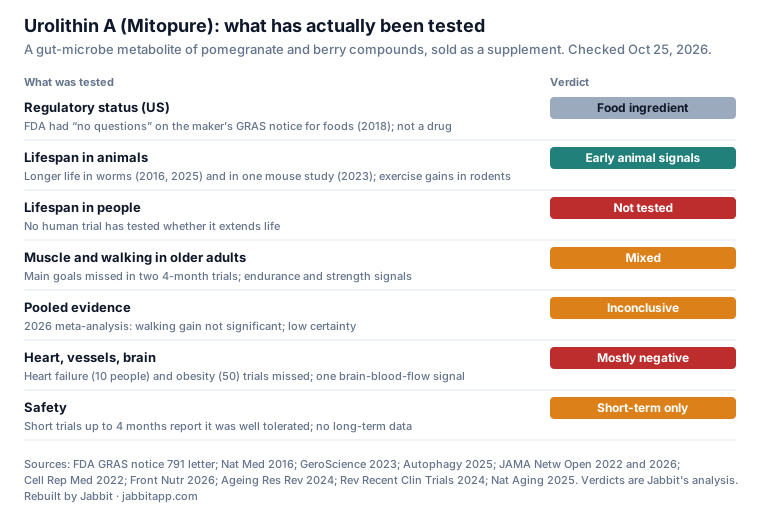
- Animals. Urolithin A extended lifespan in worms in the 2016 paper and in a 2025 study by an independent team.[5][7] A Buck Institute study that mainly tested an Alzheimer’s mouse model also reported that it extended lifespan in normal aging mice; we read the abstract only.[6] Rodents showed better exercise capacity.[5]
- People: lifespan. We found no human trial that measured whether it extends life.[23]
- Muscle and walking. In 88 middle-aged adults, it did not improve leg power (the main goal) but strength rose about 12%; in 66 older adults, walking distance rose in both groups with no significant difference, while some muscle-endurance tests improved.[12][11] The Amazentis-funded 2022 JAMA Network Open paper states the funder had a role in the study’s design, analysis and the decision to publish, and that the original primary end points were replaced after the study started.[11] A 2026 meta-analysis of five trials and 236 people rated the walking-test evidence low certainty.[18]
- Athletes. In 42 elite runners, race time did not improve, though muscle-damage markers fell; in 20 strength athletes, max-lift gains were not significant, while two other muscle measures improved.[15][16]
- Heart, vessels and brain. A 10-person heart failure trial found no effect on heart scans.[17] The October 2026 obesity trial found no blood-vessel benefit; brain blood-flow responses to tasks changed, but task performance did not.[14]
- Immune aging and skin. A 4-week maker-funded trial reported a small rise in “naive-like” immune T cells; maker- and L’Oréal-affiliated authors report fewer fine wrinkles around the eyes with a topical form.[13][20]
- Mitochondria. A 2024 review found it did not change maximal energy (ATP) production or mitochondrial biogenesis in healthy people, though early trials reported changes in mitochondria-related genes and blood markers.[19][9]
The key trials, in one chart
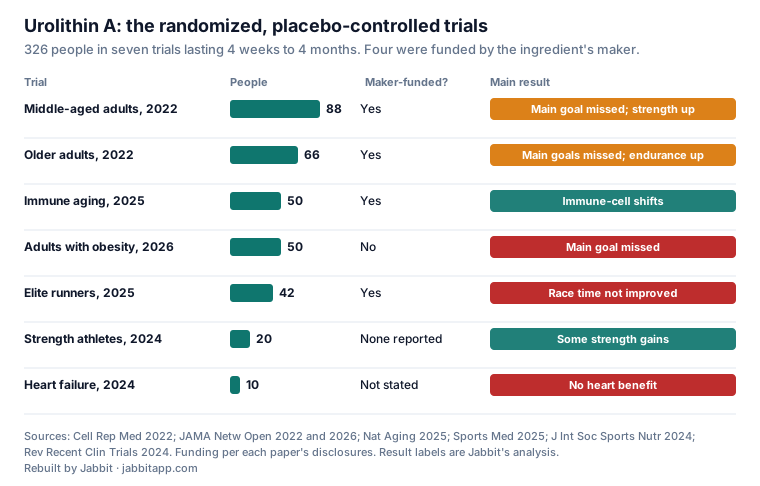
Our analysis: the positive results are mostly secondary measures, such as strength, endurance tests, immune-cell types and blood markers, while the main goals the trials set for themselves were mostly missed.[12][11][14][15][17] The two independent reviews agree the evidence is limited; the 2026 authors call it “not reproducible evidence of efficacy” and ask for “larger, longer” trials.[18][19]
The case for urolithin A, in fairness
The biology is coherent: it triggers mitophagy, and a 2025 worm study by a team reporting no conflicts also found lifespan effects.[5][7] A Buck Institute mouse study, whose authors declare no competing interests, also reported longer life.[6] Strength gained about 12% in one trial and muscle endurance improved in another, and a trial with no reported conflicts found some strength gains in athletes.[12][11][16] Side effects in the trials were mild or moderate, and no more common than on placebo in the 2022 older-adult trial; the FDA did not question the maker’s safety conclusion for food use.[11][19][1] Our analysis: these are reasons to keep testing, which the NIA, NCI and others are doing, not proof that it slows human aging.[21]
Safety
- Short-term tolerability. The first human trial reported a favorable safety profile; the 2022 older-adult trial found no difference in adverse events vs placebo; the 2024 review found adverse events were mild or moderate and unrelated; the 2026 obesity trial called it well tolerated.[9][11][19][14]
- Animal toxicology. Rat studies of up to 90 days found no toxic effects or target organs, and lab tests found no genotoxicity; these studies were by maker-affiliated authors.[8]
- What is unknown. None of the trials in our chart lasted longer than 4 months, and most enrolled healthy adults; one 4-month trial’s participants were all White and mostly women.[11][19] There are no published data we found on long-term use, pregnancy, or people with serious illness beyond the 10-person heart failure trial.[17][23]
- Not a drug. The FDA letter is “not an affirmation” that it is GRAS, and any health claims on labels are subject to labeling rules; it does not mean the FDA reviewed it as a medicine.[1]
Purity
The immune-aging trial used the maker’s Mitopure, and the FDA letter covers the maker’s lab-synthesized ingredient for food use.[13][1] Our analysis: other products labeled “urolithin A,” or pomegranate extracts sold as urolithin boosters, are different products, and the trial results do not automatically apply to them. We do not name or rate brands or sellers.
Legal status
In the US, urolithin A is sold as a food and supplement ingredient after the FDA had no questions about its maker’s GRAS notice; it is not an approved drug for any condition.[1] In the EU, an application was submitted in 2018, and we did not find an authorisation or EFSA opinion.[2] In the UK, the application is listed as in progress at the risk-assessment stage.[3] Switzerland classified it in 2025 as a novel food that needs authorisation.[4]
What a careful reader should notice
These points are our analysis of the sources cited.
- “Extends lifespan” is a worm result, plus one mouse abstract. No human trial has measured lifespan.[5][6][23]
- Look for the main goal. Many headlines report secondary findings from trials whose main goals were missed.[12][11][14]
- Look at who paid. Four of the seven trials in our chart were maker-funded, as the papers disclose; that does not make the results wrong, but independent replication matters, and the newest independent trial was negative on its main goal.[11][12][13][15][14]
- Small and short. The trials enrolled 10 to 88 people for 4 weeks to 4 months.[17][12][14][11]
- GRAS is not approval. The FDA’s letter says it is not an affirmation of safety status, and it is not a review of health benefits.[1]
Frequently asked questions
- Does urolithin A extend lifespan?
- In worms, yes, and one 2023 mouse study reported longer life. No human trial has measured lifespan.[5][6][23]
- Is urolithin A (Mitopure) safe?
- Trials of up to 4 months report it was well tolerated, with mild or moderate side effects. Long-term safety is unknown.[11][19][14]
- Is urolithin A FDA approved?
- No. It is not a drug. The FDA had no questions about its maker’s conclusion that it is GRAS for use in certain foods, which is not an approval or an endorsement of health benefits.[1]
- Does urolithin A build muscle or strength?
- One maker-funded trial reported about 12% more strength but missed its main goal, leg power; a 2026 meta-analysis called the walking-test effect inconclusive.[12][18]
- What did the October 2026 JAMA Network Open trial find?
- In 50 adults with obesity, 4 weeks of urolithin A did not improve blood-vessel function, the main goal. Brain blood-flow responses changed, but task performance did not.[14]
- Can I get urolithin A from pomegranate?
- Only if your gut bacteria make it. In one maker-sponsored study, about 40% of people converted pomegranate juice compounds into meaningful amounts.[10]
- Who funds urolithin A research?
- Amazentis SA funded four of the seven trials in our chart, as the papers disclose, and leads 13 of 38 registry records. The NIA, NCI and university teams also run trials.[11][12][13][15][22][21]
Bottom line
Urolithin A has a plausible mechanism and lifespan results in worms and one mouse study.[5][7][6] In people, the trials are small, short and mostly maker-funded; several missed their main goals while reporting secondary signals, and the newest independent trial was negative on its main goal.[12][11][14][18] It appears well tolerated over a few months, and larger trials are under way.[19][21]
References
- U.S. Food and Drug Administration. Response letter to GRAS Notice No. GRN 000791 (urolithin A; notifier Amazentis SA), signed December 20, 2018; FDA inventory lists the notice as filed June 15, 2018 and closed with “FDA has no questions.” The letter: “The notice informs us of Amazentis’ view that this use of urolithin A is GRAS through scientific procedures”; intended uses are as an ingredient in foods including protein and meal-replacement shakes and drinks, bars and yogurts; “Urolithin A is chemically synthesized using one of two alternative processes”; “we have no questions at this time regarding Amazentis’ conclusion that urolithin A is GRAS under its intended conditions of use”; “This letter is not an affirmation that urolithin A is GRAS under 21 CFR 170.35”; health or nutrient content claims on labels “are subject to the applicable requirements.” Letter: https://www.fda.gov/media/120300/download; signed copy: https://www.fda.gov/media/187487/download; inventory: https://cfsanappsexternal.fda.gov/scripts/fdcc/index.cfm?set=GRASNotices&id=791. Checked October 25, 2026.
- European Commission. Summary of novel food application 2018-0538, “APPLICATION FOR THE APPROVAL OF UROLITHIN A AS A NOVEL FOOD INGREDIENT IN THE EUROPEAN UNION,” submitted August 31, 2018: “Amazentis SA’s ingredient is a synthetic version of urolithin A that is identical in structure to the compound formed endogenously following consumption of ellagic acid and ellagitannins.” On October 25, 2026 we did not find an EU authorisation or a published EFSA opinion for it; we could not confirm the application’s current status. https://food.ec.europa.eu/system/files/2019-05/novel-food_sum_ongoing-app_2018-0538.pdf. Checked October 25, 2026.
- Food Standards Agency (UK). Register of regulated product applications, RP-1777, Urolithin A: “Application for the approval of Urolithin A as a novel food”; applicant Amazentis SA; status “In progress”; phase of assessment “Risk assessment.” https://data.food.gov.uk/regulated-product-applications/products-list/RP-1777. Checked October 25, 2026.
- Swiss Federal Food Safety and Veterinary Office (FSVO/BLV). Classification of urolithin A as a novel food, July 29, 2025: as a substance it “is not known to be found in any food source”; “Urolithin A is therefore subject to the authorisation requirement for novel foods under Article 17 FUAO.” https://www.blv.admin.ch/dam/en/sd-web/b0gsH3ZLYwUB/einstufung-als-neuartiges-lebensmittel-urolithin-a-2025-en.pdf. Checked October 25, 2026.
- Ryu D, Mouchiroud L, Andreux PA, et al. Urolithin A induces mitophagy and prolongs lifespan in C. elegans and increases muscle function in rodents. Nat Med. 2016;22(8):879-88. PMID 27400265. Animal study: “In C. elegans, UA prevented the accumulation of dysfunctional mitochondria with age and extended lifespan”; “UA improved exercise capacity in two different mouse models of age-related decline of muscle function, as well as in young rats.” Author affiliations include Amazentis. Abstract read. https://pubmed.ncbi.nlm.nih.gov/27400265/. Checked October 25, 2026.
- Ballesteros-Álvarez J, Nguyen W, Sivapatham R, et al. Urolithin A reduces amyloid-beta load and improves cognitive deficits uncorrelated with plaque burden in a mouse model of Alzheimer's disease. Geroscience. 2023;45(2):1095-1113. PMID 36576642. Buck Institute mouse study, mainly in an Alzheimer’s model: “WT and 3xTg-AD mice were administered long-term intermittent dietary supplementation with UA”; “UA was also found to extend lifespan in normal aging mice.” Authors declare no competing interests. Abstract read; we did not review the lifespan data in the full text. https://pubmed.ncbi.nlm.nih.gov/36576642/. Checked October 25, 2026.
- Roussos A, Kitopoulou K, Borbolis F, et al. Urolithin Α modulates inter-organellar communication via calcium-dependent mitophagy to promote healthy ageing. Autophagy. 2025;21(12):3097-3122. PMID 40944367. Worm and cell study: “Calcium chelation abolishes UA-induced mitophagy, blocking its beneficial impact on muscle function and lifespan.” Abstract read. https://pubmed.ncbi.nlm.nih.gov/40944367/. Checked October 25, 2026.
- Heilman J, Andreux P, Tran N, et al. Safety assessment of Urolithin A, a metabolite produced by the human gut microbiota upon dietary intake of plant derived ellagitannins and ellagic acid. Food Chem Toxicol. 2017;108(Pt A):289-297. PMID 28757461. Animal and lab safety studies: “The battery of genotoxicity assays demonstrated that UA is not genotoxic”; in rats the substance “showed no alterations in clinical parameters, blood chemistry, or hematology, and did not indicate any target organs, or any specific toxic mechanisms.” Author affiliations include Amazentis. Abstract read. https://pubmed.ncbi.nlm.nih.gov/28757461/. Checked October 25, 2026.
- Andreux PA, Blanco-Bose W, Ryu D, et al. The mitophagy activator urolithin A is safe and induces a molecular signature of improved mitochondrial and cellular health in humans. Nat Metab. 2019;1(6):595-603. PMID 32694802. A “first-in-human clinical trial” given “to healthy, sedentary elderly individuals” as a single dose or over 4 weeks: “We show that UA has a favourable safety profile (primary outcome).” Author affiliations include Amazentis. Abstract read. https://pubmed.ncbi.nlm.nih.gov/32694802/. Checked October 25, 2026.
- Singh A, D'Amico D, Andreux PA, et al. Direct supplementation with Urolithin A overcomes limitations of dietary exposure and gut microbiome variability in healthy adults to achieve consistent levels across the population. Eur J Clin Nutr. 2022;76(2):297-308. PMID 34117375. Study in healthy adults: “Only 12% of subjects had detectable levels of UA at baseline”; after pomegranate juice “~40% of the subjects converted significantly the precursor compounds into UA.” Disclosure: authors include employees, board members and advisers of “Amazentis SA, who is the sponsor of this clinical study.” Abstract read. https://pubmed.ncbi.nlm.nih.gov/34117375/. Checked October 25, 2026.
- Liu S, D'Amico D, Shankland E, et al. Effect of Urolithin A Supplementation on Muscle Endurance and Mitochondrial Health in Older Adults: A Randomized Clinical Trial. JAMA Netw Open. 2022;5(1):e2144279. PMID 35050355. Randomized trial in older adults over 4 months (NCT03283462): “A total of 66 participants were randomized,” who “were predominantly women (50 [75.8%]), and were all White individuals”; the 6-minute walk distance rose 60.8 m on urolithin A and 42.5 m on placebo, and “These results showed no significant improvement with urolithin A supplementation compared with placebo”; “Urolithin A, compared with placebo, significantly improved muscle endurance” in some muscle tests; “No statistical differences in adverse events were observed between the 2 groups.” Full text (PMC8777576): “Funding/Support: This research was supported by Amazentis SA”; “After the study started, the original primary end points of change from baseline of hand maximal ATP production and of hand muscle endurance were replaced by change from baseline of 6-minute walk distance and hand maximal ATP production”; “The funder had a role in the design and conduct of the study; collection, management, analysis, and interpretation of the data; preparation, review, or approval of the manuscript; and decision to submit the manuscript for publication.” Abstract and funding statement read; https://pmc.ncbi.nlm.nih.gov/articles/PMC8777576/. https://pubmed.ncbi.nlm.nih.gov/35050355/. Checked October 25, 2026.
- Singh A, D'Amico D, Andreux PA, et al. Urolithin A improves muscle strength, exercise performance, and biomarkers of mitochondrial health in a randomized trial in middle-aged adults. Cell Rep Med. 2022;3(5):100633. PMID 35584623. Randomized trial in middle-aged adults over 4 months (NCT03464500): the authors “do not notice a significant improvement on peak power output (primary endpoint)”; “The data show significant improvements in muscle strength (∼12%) with intake of Urolithin A”; they report improvements on aerobic endurance and the 6-minute walk test. Disclosure: authors include employees, board members and advisers of “Amazentis SA, who is the sponsor of this clinical study.” Registry lists 90 enrolled; the analysis groups total 88. Abstract read. https://pubmed.ncbi.nlm.nih.gov/35584623/. Checked October 25, 2026.
- Denk D, Singh A, Kasler HG, et al. Effect of the mitophagy inducer urolithin A on age-related immune decline: a randomized, placebo-controlled trial. Nat Aging. 2025;5(11):2309-2322. PMID 41174221. Randomized trial in “50 healthy middle-aged adults” for 4 weeks: “UA expanded peripheral naive-like, less terminally exhausted CD8+ cells (treatment difference 0.50 percentage points; 95% CI = 0.16 to 0.83; P = 0.0437)”; the authors say this supports “its potential to counteract age-related immune decline and inflammaging.” Disclosure: authors include employees and the board president of “Amazentis SA, which funded this clinical study and provided the investigational product (Mitopure).” Abstract read. https://pubmed.ncbi.nlm.nih.gov/41174221/. Checked October 25, 2026.
- da Costa Pinaffi-Langley AC, Gulej R, Kaposzta Z, et al. Urolithin A and Endothelial and Cerebrovascular Function in Middle-Aged Adults With Obesity: A Randomized Clinical Trial. JAMA Netw Open. 2026;9(10):e2638047. PMID 42853569. University of Oklahoma randomized trial in middle-aged adults with obesity for 4 weeks (NCT05921266): “Overall, 50 participants were included”; “Seven participants were lost to follow-up (14% dropout rate)”; “Change in mean (SD) FMD did not differ significantly based on group allocation”; “there was no significant treatment effect on secondary peripheral endothelial function outcomes”; brain blood-flow responses changed during tasks “while task performance remained unchanged”; the authors conclude that “4 weeks of UA supplementation did not significantly improve peripheral endothelial function in middle-aged adults with obesity” and that it “was well tolerated and feasible.” Full text (PMC13653284): “Published: October 9, 2026”; “Conflict of Interest Disclosures: None reported”; supported by the American Heart Association, among others; “The sponsor had no role in the design and conduct of the study”; limitations: “this study had a small sample size, short duration, and was conducted at a single site.” Abstract and full-text statements read; https://pmc.ncbi.nlm.nih.gov/articles/PMC13653284/. https://pubmed.ncbi.nlm.nih.gov/42853569/. Checked October 25, 2026.
- Whitfield J, McKay AKA, Tee N, et al. Evaluating the Impact of Urolithin A Supplementation on Running Performance, Recovery, and Mitochondrial Biomarkers in Highly Trained Male Distance Runners. Sports Med. 2025;55(12):3183-3200. PMID 40839339. Randomized trial in “competitive male distance runners (n = 42” over a 4-week altitude camp: “Running performance (3000 m time trial) was not significantly improved in either treatment group”; urolithin A “reduced indirect markers of post-exercise muscle damage”; “UA supplementation did not further enhance performance in highly trained male endurance athletes.” Funding: “This work was supported by research funding from Amazentis SA.” Abstract and declarations read. https://pubmed.ncbi.nlm.nih.gov/40839339/. Checked October 25, 2026.
- Zhao H, Zhu H, Yun H, et al. Assessment of Urolithin A effects on muscle endurance, strength, inflammation, oxidative stress, and protein metabolism in male athletes with resistance training: an 8-week randomized, double-blind, placebo-controlled study. J Int Soc Sports Nutr. 2024;21(1):2419388. PMID 39487653. 8-week randomized trial “with twenty resistance-trained male athletes”: one-rep-max gains vs placebo occurred “although statistical significance was not reached”; the urolithin A group “showed significant improvements in MVIC and RTF” (maximal voluntary contraction and repetitions to fatigue). “No potential conflict of interest was reported by the author(s).” Abstract read. https://pubmed.ncbi.nlm.nih.gov/39487653/. Checked October 25, 2026.
- Jamialahmadi T, Hasanpour M, Vakilian F, et al. Evaluation of Urolithin A Efficacy in Heart Failure Patients with Reduced Ejection Fraction: A Randomized, Double-blind, Crossover, Placebo-controlled Clinical Trial. Rev Recent Clin Trials. 2024;19(3):221-228. PMID 38415449. Crossover randomized trial “conducted on 10 patients with HF with reduced ejection fraction (HFrEF)” with two 4-week periods: “The results failed to reveal any significant effect of UA supplementation on echocardiographic measures”; “The results of the present study do not support any positive effect of UA supplementation in improving echocardiographic and biochemical indices of HFrEF.” Abstract read; funding not stated in the PubMed record. https://pubmed.ncbi.nlm.nih.gov/38415449/. Checked October 25, 2026.
- Dao T, Nguyen TT, Gariani K, et al. Effects of Urolithin A supplementation on muscle health outcomes in humans from randomized controlled trials. Front Nutr. 2026;13:1834344. PMID 42559151. Systematic review and meta-analysis: “Five randomized controlled trials (n = 236) were included”; the 6-minute walk result “showed a directionally favorable but statistically inconclusive effect with low GRADE certainty”; “The certainty of evidence for the 6MWT outcome was rated as low (GRADE)”; other findings “are exploratory and hypothesis-generating, not reproducible evidence of efficacy”; “Larger, longer, and methodologically standardized trials in better-defined populations are required before firm clinical recommendations can be made.” The authors state the work was “conducted in the absence of any commercial or financial relationships.” Abstract read. https://pubmed.ncbi.nlm.nih.gov/42559151/. Checked October 25, 2026.
- Kuerec AH, Lim XK, Khoo AL, et al. Targeting aging with urolithin A in humans: A systematic review. Ageing Res Rev. 2024;100:102406. PMID 39002645. Systematic review: “In five studies including 250 healthy individuals”; urolithin A “did not affect mitochondrial maximal adenosine triphosphate production, biogenesis, dynamics, or gut microbiota composition”; “UA increased muscle strength and endurance, however, had no effect on anthropometrics, cardiovascular outcomes, and physical function”; “Unrelated adverse events were mild or moderate.” Abstract read. https://pubmed.ncbi.nlm.nih.gov/39002645/. Checked October 25, 2026.
- D'Amico D, Faitg J, Amaral F, et al. Topical application of urolithin A activates mitophagy and enhances mitochondrial function to promote skin longevity. iScience. 2026;29(10):117646. PMID 42866687. Topical study: “In randomized, placebo-controlled clinical studies, UA reduced periorbital wrinkle depth after 8 weeks and attenuated UVB-induced erythema.” Disclosure: five authors “are employees and shareholders of Amazentis SA, who is the sponsor of these clinical studies and commercializes its products under the brand Timeline”; other authors are L’Oréal and Lancôme employees. Abstract read. https://pubmed.ncbi.nlm.nih.gov/42866687/. Checked October 25, 2026.
- ClinicalTrials.gov API v2 records, October 25, 2026: NIA glucose-metabolism trial https://clinicaltrials.gov/study/NCT06274749 (recruiting; 180 estimated; primary completion March 2027); Amazentis study https://clinicaltrials.gov/study/NCT07060898 (active, not recruiting; 650 enrolled; primary completion November 2025; no results posted); Akershus University Hospital Alzheimer’s study https://clinicaltrials.gov/study/NCT07842146 (recruiting; 60 estimated; primary completion October 2028); NCI prostate cancer study https://clinicaltrials.gov/study/NCT06022822 (recruiting; 90 estimated; primary completion November 2026); Amazentis muscle-strength study https://clinicaltrials.gov/study/NCT07231783 (recruiting; 120 estimated; primary completion October 2027); completed trials behind the published papers include https://clinicaltrials.gov/study/NCT03283462, https://clinicaltrials.gov/study/NCT03464500, https://clinicaltrials.gov/study/NCT04783207 and https://clinicaltrials.gov/study/NCT05921266. Statuses: https://jabbitapp.com/research/sources/urolithin-a-2026-10-25.json. Checked October 25, 2026.
- ClinicalTrials.gov API v2, intervention “urolithin,” October 25, 2026: 38 records, of which Amazentis SA is the lead sponsor on 13. The search is broad and includes pomegranate, walnut and pecan studies that measure urolithins. Counts: https://jabbitapp.com/research/sources/urolithin-a-2026-10-25.json. Checked October 25, 2026.
- PubMed searches, October 25, 2026: urolithin[tiab] AND randomized controlled trial[pt]: 37 records, many of them pomegranate, nut or other food studies that measure urolithins; we did not classify them all. A second search for urolithin with lifespan, longevity or survival in mice or rats returned 30 records; the abstracts reporting a lifespan result for urolithin A were the 2016 and 2025 worm studies and one 2023 mouse study. https://pubmed.ncbi.nlm.nih.gov/?term=urolithin%5Btiab%5D+AND+randomized+controlled+trial%5Bpt%5D; IDs: https://jabbitapp.com/research/sources/urolithin-a-2026-10-25.json. Checked October 25, 2026.
This page analyzes published studies, regulator documents, company records and registry data. It is not medical or legal advice and does not recommend any product or dose. Urolithin A is not an approved drug. Charts were rebuilt by Jabbit from the sources cited in each caption.