Study teardown · PEG-MGF (pegylated mechano growth factor, sold online as a muscle-recovery peptide) · FDA documents, the MGF lab and animal studies and the challenges to them, doping-lab findings, registry, FAERS and PubMed counts, the patents · Sources checked October 24, 2026
Published · Updated
PEG-MGF (pegylated mechano growth factor): does it build muscle, and is it safe? Nobody has published a study of PEG-MGF itself, the MGF peptide’s lab effects are disputed, FDA says it has no human exposure data, and anti-doping rules have banned MGF since 2005.
PEG-MGF is a synthetic peptide, a short fragment linked to the muscle growth hormone IGF-1, with polyethylene glycol (PEG) attached so it lasts longer in the body.[5][22][23] We found no published study of PEG-MGF itself in animals or people, and no registered human trial.[26][27] FDA says it “has not identified any human exposure data” and lacks the information to know whether it would harm people.[1] The unpegylated MGF peptide it is based on showed muscle-cell effects in early lab work, but researchers at two drug companies could not reproduce them, and a natural MGF peptide has never been found in the body.[6][12][5] The honest answer is that nobody knows whether it builds muscle or whether it is safe.
Why this matters now
FDA says its Pharmacy Compounding Advisory Committee will discuss PEG-MGF at a meeting before the end of February 2027, together with LL-37, GHK-Cu, dihexa acetate and melanotan II. All five are being considered for the list of substances pharmacies may compound.[2] No date or briefing materials have been posted. FDA’s separate interim peptide compounding policy has been under White House review since October 14, 2026, and because its list of peptides is not public, it is unknown whether it covers PEG-MGF.[3] Meanwhile PEG-MGF is promoted online for muscle growth and recovery. This page sets out what the record actually contains before that meeting. For the wider policy, see our FDA peptide compounding explainer.
Timeline
| Date | Event |
|---|---|
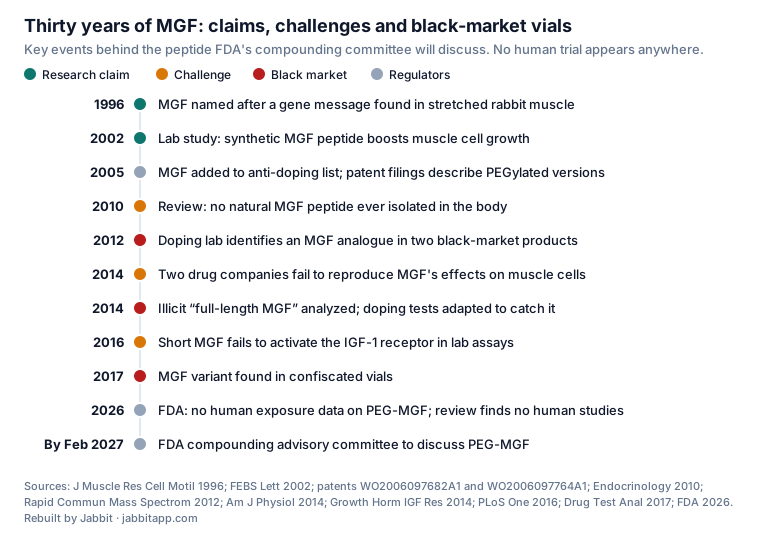
| 1996 | Researchers in London describe a stretch-responsive splice variant of the IGF-1 gene in rabbit muscle, later called mechano growth factor.[4] |
| 2002 | A cell study reports that the MGF E-domain peptide increases muscle precursor cell growth.[6] |
| 2005 | MGF becomes prohibited in sport; patent applications filed that year describe stabilized MGF peptides that “may be PEGylated.”[19][22] |
| 2010 | A review notes that no natural MGF peptide has been isolated from cells, tissue or body fluids.[5] |
| 2012 | A doping lab identifies an MGF analogue in two black-market products.[18] |
| 2014 | Pharmaceutical researchers report that MGF had “no apparent effect” on muscle cells; a “full-length MGF” sold through illicit channels is characterized for doping tests.[12][19] |
| 2016 | Receptor assays find no IGF-1 receptor activation by the short MGF peptide.[13] |
| 2017 | An MGF variant is identified in confiscated vials.[20] |
| Apr 2026 | FDA’s category 2 page lists PEG-MGF among withdrawn compounding nominations, with no human exposure data.[1] |
| 2026 | A review in Frontiers in Endocrinology puts PEG-MGF in its lowest evidence tier: “No peer-reviewed human studies.”[23] |
| By Feb 2027 | FDA compounding advisory committee due to discuss PEG-MGF.[2] |
What PEG-MGF is
The IGF-1 gene can be spliced in different ways. One version, called IGF-1Ec in humans and IGF-1Eb in rodents, carries a distinct tail region (the E domain), and its message rises in muscle that is stretched or damaged. Its discoverers named it mechano growth factor.[4][8][5] The “MGF” sold as a peptide is not that whole protein. It is a synthetic copy of the last 24 amino acids of the tail, often with changes to make it more stable.[5][19] PEG-MGF adds a polyethylene glycol chain, an approach described in patent applications filed in 2005 that are now listed as ceased or abandoned.[22] A 2010 review in Endocrinology pointed out a basic gap: “no analogous peptide product of the Igf1 gene has been identified in or isolated from cultured cells, their conditioned medium, or in vivo animal tissues or biological fluids.”[5] In other words, the peptide sold as MGF has not been shown to exist naturally in the form that is sold.
PEG-MGF has no approved use anywhere we found, and no FDA-approved product.[28] PubMed has 194 papers on mechano growth factor, but only one record mentions PEG-MGF, and that is the 2026 review saying human studies are missing.[26][23]
The evidence, rung by rung
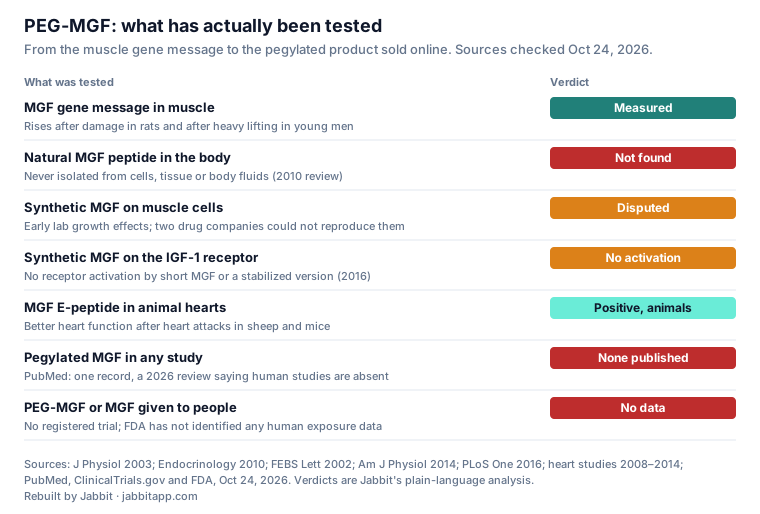
- The gene message responds to exercise and injury: in rats, MGF messenger RNA rose quickly after muscle damage and fell within days, and older rats made much less after overload.[8][7] In a human study of 8 young and 7 older adults, one bout of heavy leg exercise raised MGF messenger RNA in the young but not the older participants.[9] In older men, weeks of resistance training raised it, more so when growth hormone was added.[10] But a small randomized crossover trial in 7 young men found no change after either exercise or growth hormone.[11] These studies measured the body’s own gene activity. None gave anyone MGF.[26]
- Synthetic MGF in muscle cells, contested: a 2002 cell study found the E-domain peptide increased muscle precursor cell growth and delayed their maturation.[6] In 2014, scientists at Novartis and, per the paper, a second pharmaceutical company tested native and stabilized MGF peptides on mouse and human muscle cells and on primary muscle stem cells and found no effect. They wrote: “These results call in to question whether there is a physiological role for MGF.”[12]
- Synthetic MGF at the IGF-1 receptor: in receptor assays, the short human MGF peptide and a stabilized analog produced no IGF-1 receptor activation. A much larger “full-length MGF” did activate the IGF-1 receptor and insulin receptors.[13] The cell study above had proposed that MGF works through a different receptor, which has not been identified in the work we reviewed (our analysis).[6][13]
- Heart studies in animals, the most positive data: in sheep after a heart attack, the E-domain peptide preserved heart function, with 35% less compromised heart muscle.[14] In mice, it reduced cell death and preserved pumping function, and a stabilized version delayed heart failure but did not prevent harmful heart enlargement.[15][16] These used the unpegylated peptide in heart attack models, not muscle building, and have not been tested in people.[27]
- PEG-MGF itself: we found no published study in cells, animals or people, and no registered trial.[26][27] The 2026 review says the pegylated product’s half-life is “not reported” and that effects of the native peptide “cannot be assumed to apply to PEG-conjugated constructs.”[23]
Safety: what is and isn’t known
- FDA’s view: FDA says compounded PEG-MGF “may pose significant risk for immunogenicity for certain routes of administration” and may have problems with “peptide-related impurities and API characterization.” It says it “has not identified any human exposure data” for any route and lacks information on “whether it would cause harm if administered to humans.”[1]
- No human safety data at all: with no trials, there is no measured rate of side effects to report. FAERS has no reports naming PEG-MGF or MGF, which reflects how rarely unapproved products are reported, not safety.[27][28]
- Growth signaling and cancer: the 2026 review lists a “theoretical proliferative concern.”[23] In 83 prostate cancer specimens, higher IGF-1Ec levels were associated with more advanced tumors, and a 2020 review discusses IGF-1 isoforms including MGF in several human cancers.[24][25] These are associations involving the body’s own protein, not evidence that the peptide causes cancer. Whether added MGF could feed existing tumors has not been studied (our analysis).
- Not knowing what is in the vial: doping laboratories have found an unidentified MGF analogue in two black-market products (later shown to be a chemically modified, amidated form), a “full-length MGF” sold through illicit channels, and a different MGF variant in confiscated vials.[18][19][20] The one MGF bulk listing we found in FDA’s NDC directory codes its active ingredient as mecasermin, which is the name for full-length IGF-1, a different molecule (our analysis).[29] The full-length form can activate insulin receptors in the lab.[13] Buyers cannot easily tell which of these molecules they have.
- Athletes: the group that described MGF flagged its potential for misuse in doping as early as 2005.[17] MGFs are on the World Anti-Doping Agency’s 2026 Prohibited List under growth factors, banned at all times, and doping labs have built tests to detect them.[21][19][18]
Legal status
No PEG-MGF or MGF product is approved by FDA.[28] FDA lists PEG-MGF among bulk substances whose compounding nominations were withdrawn, with the safety summary quoted above, and its advisory committee is due to discuss it by February 2027.[1][2] Whether the pending interim peptide policy covers PEG-MGF is not public.[3] In sport, MGFs are prohibited at all times.[21]
What a careful reader should notice
These points are our analysis of the cited sources.
- “Your muscles make MGF” describes a gene message measured in biopsies. The short peptide sold as MGF has not been isolated from the body.[9][5]
- The key muscle-cell result did not hold up when researchers at two drug companies tried to repeat it.[6][12]
- The most encouraging data are from heart attack models in sheep and mice, not muscle growth in healthy people.[14][15][16]
- Adding PEG changes how a peptide behaves, so even the MGF lab data do not carry over to PEG-MGF, a point the 2026 review makes directly.[23]
- Every human study we found measured the body’s own MGF message. We found no study of anyone taking MGF or PEG-MGF.[26][27]
- FDA’s committee will be weighing a substance for which FDA says it has found no human exposure data at all.[1][2]
Frequently asked questions
- Does PEG-MGF build muscle?
- There is no evidence that it does in people. No published study has tested PEG-MGF, and no human trial of MGF or PEG-MGF is registered. The unpegylated MGF peptide showed muscle-cell effects in a 2002 lab study, but researchers at two drug companies could not reproduce them in 2014.[26][27][6][12]
- Is PEG-MGF safe?
- No one knows. FDA says it has not identified any human exposure data and lacks the information to know whether PEG-MGF would cause harm, and it flags immunogenicity and impurity concerns. There are no trials and no adverse event reports to go on.[1][27][28]
- What is the difference between MGF and PEG-MGF?
- MGF, as sold, is a synthetic 24-amino-acid copy of the tail region of one IGF-1 variant. PEG-MGF has a polyethylene glycol chain attached to make it last longer. A 2026 review says results from the unpegylated peptide cannot be assumed to apply to the pegylated version.[5][22][23]
- Is PEG-MGF FDA approved or legal to compound?
- No PEG-MGF product is FDA approved. FDA lists it among withdrawn compounding nominations with safety concerns, and its advisory committee is due to discuss it before the end of February 2027.[28][1][2]
- Is MGF banned in sport?
- Yes. Mechano growth factors are on the World Anti-Doping Agency’s 2026 Prohibited List and are banned at all times. They have been considered prohibited since 2005, and doping labs can detect several versions.[21][19][18][20]
- Can PEG-MGF cause cancer?
- There is no evidence either way in people. Higher levels of the body’s own IGF-1Ec have been associated with more advanced prostate cancer, and a 2026 review lists a theoretical proliferative concern. That is an association, not proof of harm.[24][25][23]
- Does exercise raise MGF naturally?
- In some studies, yes. Heavy exercise raised MGF messenger RNA in young adults and resistance training raised it in older men, but another small trial in young men found no change. These studies measured gene activity, not a circulating peptide.[9][10][11][5]
Bottom line
MGF began as an interesting finding about how stretched and damaged muscle switches on the IGF-1 gene, and its tail peptide has shown benefit in animal heart attack models.[4][14][15] But the muscle-cell effects behind the bodybuilding claims were not reproduced, the peptide has never been found in the body in the form that is sold, and PEG-MGF itself has never been studied.[12][5][26] FDA says it has no human exposure data, black-market versions have turned out to be different molecules, and the substance is banned in sport.[1][18][19][21] Anyone using it would be relying on lab and animal data about a different molecule.
References
- U.S. Food and Drug Administration. “Certain Bulk Drug Substances for Use in Compounding that May Present Significant Safety Risks” (content current as of 04/22/2026). Mechano growth factor pegylated (PEG-MGF) is listed under bulk drug substances nominated for compounding whose nominations were later withdrawn. FDA’s summary: “Compounded drugs containing Mechano Growth Factor Pegylated (PEG-MGF) may pose significant risk for immunogenicity for certain routes of administration and may have complexities with regard to peptide-related impurities and API characterization. FDA has not identified any human exposure data on drug products containing PEG-MGF administered via any route of administration. FDA lacks important information regarding any safety issues raised by PEG-MGF, including whether it would cause harm if administered to humans.” https://www.fda.gov/drugs/human-drug-compounding/certain-bulk-drug-substances-use-compounding-may-present-significant-safety-risks. Checked October 24, 2026.
- U.S. Food and Drug Administration. “Meeting of the Pharmacy Compounding Advisory Committee” (content current as of 04/15/2026). “FDA will host an advisory committee meeting before the end of February 2027”; agenda: Cathelicidin (LL-37), GHK-Cu, Dihexa acetate, Melanotan II and “Mechano Growth Factor, Pegylated (PEG-MGF),” “being considered for inclusion on the 503A bulks list.” Time, location and materials not yet posted. https://www.fda.gov/advisory-committees/pharmacy-compounding-advisory-committee/meeting-pharmacy-compounding-advisory-committee. Checked October 24, 2026.
- Office of Information and Regulatory Affairs (OMB). Pending EO 12866 Regulatory Review: Interim Access Policy for Compounding Using Certain Peptides, RIN 0910-ZD94, received 10/14/2026, stage: Notice. The text and the list of peptides are not public. https://www.reginfo.gov/public/do/eoDetails?rrid=1568964. Checked October 24, 2026.
- Yang S, Alnaqeeb M, Simpson H, Goldspink G. Cloning and characterization of an IGF-1 isoform expressed in skeletal muscle subjected to stretch. J Muscle Res Cell Motil. 1996;17(4):487-495. PMID 8884603. Rabbit muscle; describes the stretch-responsive IGF-1 splice variant later called mechano growth factor. https://pubmed.ncbi.nlm.nih.gov/8884603/. Checked October 24, 2026.
- Matheny RW Jr, Nindl BC, Adamo ML. Minireview: Mechano-growth factor: a putative product of IGF-I gene expression involved in tissue repair and regeneration. Endocrinology. 2010;151(3):865-875. PMID 20130113. Review: the synthetic “MGF” peptide corresponds to the 24 most C-terminal residues of the IGF-IEc (human) / IGF-IEb (rodent) E domain, and “no analogous peptide product of the Igf1 gene has been identified in or isolated from cultured cells, their conditioned medium, or in vivo animal tissues or biological fluids.” Abstract read. https://pubmed.ncbi.nlm.nih.gov/20130113/. Checked October 24, 2026.
- Yang SY, Goldspink G. Different roles of the IGF-I Ec peptide (MGF) and mature IGF-I in myoblast proliferation and differentiation. FEBS Lett. 2002;522(1-3):156-160. PMID 12095637. Cell study: the MGF E-domain peptide increased muscle precursor cell proliferation and inhibited differentiation, apparently through a receptor other than the IGF-1 receptor. Abstract read. https://pubmed.ncbi.nlm.nih.gov/12095637/. Checked October 24, 2026.
- Owino V, Yang SY, Goldspink G. Age-related loss of skeletal muscle function and the inability to express the autocrine form of insulin-like growth factor-1 (MGF) in response to mechanical overload. FEBS Lett. 2001;505(2):259-263. PMID 11566187. Rats: older muscle expressed considerably less MGF after overload. Abstract read. https://pubmed.ncbi.nlm.nih.gov/11566187/. Checked October 24, 2026.
- Hill M, Goldspink G. Expression and splicing of the insulin-like growth factor gene in rodent muscle is associated with muscle satellite (stem) cell activation following local tissue damage. J Physiol. 2003;549(Pt 2):409-418. PMID 12692175. Rat muscle: MGF mRNA was rapidly expressed after damage and declined within a few days. Abstract read. https://pubmed.ncbi.nlm.nih.gov/12692175/. Checked October 24, 2026.
- Hameed M, Orrell RW, Cobbold M, Goldspink G, Harridge SD. Expression of IGF-I splice variants in young and old human skeletal muscle after high resistance exercise. J Physiol. 2003;547(Pt 1):247-254. PMID 12562960. 8 young and 7 elderly adults; muscle biopsies 2.5 hours after one bout of heavy leg exercise. Resting MGF mRNA about 100-fold lower than IGF-IEa; MGF mRNA rose in the young but not the elderly. Abstract read. https://pubmed.ncbi.nlm.nih.gov/12562960/. Checked October 24, 2026.
- Hameed M, Lange KH, Andersen JL, et al. The effect of recombinant human growth hormone and resistance training on IGF-I mRNA expression in the muscles of elderly men. J Physiol. 2004;555(Pt 1):231-240. PMID 14565994. Healthy elderly men assigned to training with placebo, training with growth hormone, or growth hormone alone; MGF mRNA rose 163% after 5 weeks of training and 456% with training plus growth hormone. MGF itself was not given. Abstract read. https://pubmed.ncbi.nlm.nih.gov/14565994/. Checked October 24, 2026.
- Aperghis M, Velloso CP, Hameed M, et al. Serum IGF-I levels and IGF-I gene splicing in muscle of healthy young males receiving rhGH. Growth Horm IGF Res. 2009;19(1):61-67. PMID 18799338. Randomized double-blind crossover in 7 young men: neither growth hormone nor an exercise bout changed muscle MGF transcripts. Abstract read. https://pubmed.ncbi.nlm.nih.gov/18799338/. Checked October 24, 2026.
- Fornaro M, Hinken AC, Needle S, et al. Mechano-growth factor peptide, the COOH terminus of unprocessed insulin-like growth factor 1, has no apparent effect on myoblasts or primary muscle stem cells. Am J Physiol Endocrinol Metab. 2014;306(2):E150-E156. PMID 24253050. Novartis Institutes for BioMedical Research and, per the abstract, a second pharmaceutical company: native and stabilized MGF peptides failed to increase proliferation or inhibit differentiation of muscle cells; “These results call in to question whether there is a physiological role for MGF.” Abstract read. https://pubmed.ncbi.nlm.nih.gov/24253050/. Checked October 24, 2026.
- Janssen JA, Hofland LJ, Strasburger CJ, van den Dungen ES, Thevis M. Potency of full-length MGF to induce maximal activation of the IGF-I R is similar to recombinant human IGF-I at high equimolar concentrations. PLoS One. 2016;11(3):e0150453. PMID 26991004. Receptor assays: “full-length MGF” (the whole IGF-1Ec prohormone) activated the IGF-1 receptor and insulin receptors, less potently than IGF-1 or insulin; “No IGF-IR activation was observed by human MGF” or its stabilized analog. Abstract read. https://pubmed.ncbi.nlm.nih.gov/26991004/. Checked October 24, 2026.
- Carpenter V, Matthews K, Devlin G, et al. Mechano-growth factor reduces loss of cardiac function in acute myocardial infarction. Heart Lung Circ. 2008;17(1):33-39. PMID 17581790. Sheep heart attack model: the MGF E-domain peptide preserved heart function, with 35% less compromised cardiac muscle. Abstract read. https://pubmed.ncbi.nlm.nih.gov/17581790/. Checked October 24, 2026.
- Mavrommatis E, Shioura KM, Los T, Goldspink PH. The E-domain region of mechano-growth factor inhibits cellular apoptosis and preserves cardiac function during myocardial infarction. Mol Cell Biochem. 2013;381(1-2):69-83. PMID 23712705. Cells and mice: the E-peptide reduced cell death and preserved function after heart attack; its uptake did not involve IGF-1 receptor activation. Abstract read. https://pubmed.ncbi.nlm.nih.gov/23712705/. Checked October 24, 2026.
- Shioura K, Pena J, Goldspink P. Delivery of the human mechano-growth factor E-domain peptide to the heart post-myocardial infarction delays decompensation. Int J Cardiovasc Res. 2014;3(3):1000169. PMID 25606570. Mice: a stabilized E-domain peptide delayed decompensation but did not prevent pathologic hypertrophy. Abstract read. https://pubmed.ncbi.nlm.nih.gov/25606570/. Checked October 24, 2026.
- Goldspink G. Research on mechano growth factor: its potential for optimising physical training as well as misuse in doping. Br J Sports Med. 2005;39(11):787-788. PMID 16244184. Commentary by the group that described MGF, noting its doping potential. https://pubmed.ncbi.nlm.nih.gov/16244184/. Checked October 24, 2026.
- Esposito S, Deventer K, Van Eenoo P. Characterization and identification of a C-terminal amidated mechano growth factor (MGF) analogue in black market products. Rapid Commun Mass Spectrom. 2012;26(6):686-692. PMID 22328223. Ghent doping laboratory: MGF “has not yet been approved for therapeutic use. Nevertheless, it is readily available on the black market”; two black-market preparations contained an “unknown MGF analogue,” identified as C-terminally amidated MGF. Abstract read. https://pubmed.ncbi.nlm.nih.gov/22328223/. Checked October 24, 2026.
- Thevis M, Thomas A, Geyer H, Schänzer W. Mass spectrometric characterization of a biotechnologically produced full-length mechano growth factor (MGF) relevant for doping controls. Growth Horm IGF Res. 2014;24(6):276-280. PMID 25466910. MGF considered prohibited under WADA rules “since 2005”; a “full-length MGF” offered through illicit channels in 2014 was characterized and added to modified routine doping controls. Abstract read. https://pubmed.ncbi.nlm.nih.gov/25466910/. Checked October 24, 2026.
- Cox HD, Miller GD, Eichner D. Detection and in vitro metabolism of the confiscated peptides BPC 157 and MGF R23H. Drug Test Anal. 2017;9(10):1490-1498. PMID 28035768. Sports Medicine Research and Testing Laboratory: an MGF variant, MGF R23H, was identified in confiscated vials and was stable in plasma. Abstract read. https://pubmed.ncbi.nlm.nih.gov/28035768/. Checked October 24, 2026.
- World Anti-Doping Agency. 2026 Prohibited List (in force January 1, 2026). Section S2.3, Growth Factors and Growth Factor Modulators, names “Mechano growth factors (MGFs)”; S2 substances are prohibited at all times, in and out of competition, and are non-Specified. https://www.wada-ama.org/sites/default/files/2025-09/2026list_en_final_clean_september_2025.pdf. Checked October 24, 2026.
- Google Patents. WO2006097682A1, “Peptides” (applicants UCL Biomedica / UCL Business and the University of Illinois; priority March 18, 2005; published September 21, 2006; status listed as ceased), which says the MGF E-domain peptides “may be PEGylated, preferably at the N-terminus.” Related: WO2006097764A1, “Mechano growth factor peptides and their use” (ceased), and US20060211606A1 (status listed as abandoned). https://patents.google.com/patent/WO2006097682A1/en; https://patents.google.com/patent/WO2006097764A1/en; https://patents.google.com/patent/US20060211606A1/en. Checked October 24, 2026.
- Dominikowski A, Rękoś Z, Olejarz M, Szczepanek-Parulska E, Domin R, Ruchała M. The emerging landscape of performance-enhancing peptides modulating GH-IGF1 axis: bridging the gap between clinical evidence and patient self-administration. Front Endocrinol (Lausanne). 2026;17:1822475. doi:10.3389/fendo.2026.1822475; PMC13322892. PMID 42395176. Places PEG-MGF in its lowest evidence tier, “No peer-reviewed human studies”; notes “pegylation extends stability, t½ not reported”; says effects of native IGF-1Ec or E-domain peptides “cannot be assumed to apply to PEG-conjugated constructs” and that claims of faster recovery or better body composition “remain unproven.” Lists a theoretical proliferative concern. Full text read; its table of self-reported doses from non-peer-reviewed sources is not reproduced here. https://pubmed.ncbi.nlm.nih.gov/42395176/. Checked October 24, 2026.
- Savvani A, Petraki C, Msaouel P, et al. IGF-IEc expression is associated with advanced clinical and pathological stage of prostate cancer. Anticancer Res. 2013;33(6):2441-2445. PMID 23749893. 83 prostate cancer specimens: higher IGF-IEc in more advanced tumors and a weak correlation with Gleason score (r=0.247). Association only. Abstract read. https://pubmed.ncbi.nlm.nih.gov/23749893/. Checked October 24, 2026.
- Kasprzak A, Szaflarski W. Role of alternatively spliced messenger RNA (mRNA) isoforms of the insulin-like growth factor 1 (IGF1) in selected human tumors. Int J Mol Sci. 2020;21(19):6995. PMID 32977489. Review of IGF1 isoforms, including IGF1Ec (MGF), in human tumors. https://pubmed.ncbi.nlm.nih.gov/32977489/. Checked October 24, 2026.
- PubMed searches, October 24, 2026: “PEG-MGF” returns 1 record (the 2026 review above); a broader pegylated-MGF query returns 7, the rest about other PEGylated growth hormone or IGF-1 products or unrelated nanoparticles; “mechano growth factor”[tiab] OR “mechano-growth factor”[tiab] returns 194; of the 6 tagged as randomized or clinical trials, all measure MGF mRNA after exercise, ultrasound, electrical stimulation or growth hormone, and none gives MGF. Queries and counts: https://jabbitapp.com/research/sources/peg-mgf-2026-10-24.json. Checked October 24, 2026.
- ClinicalTrials.gov API v2, pulled October 24, 2026. Searches “mechano growth factor,” “mechano-growth factor,” “PEG-MGF,” “IGF-1Ec” and “pegylated MGF”: 506 unique records (the search matches loosely, mostly growth hormone and growth factor studies). None lists MGF, PEG-MGF, IGF-1Ec or an MGF E-peptide as an intervention. Census: https://jabbitapp.com/research/sources/peg-mgf-2026-10-24.json. Checked October 24, 2026.
- openFDA, October 24, 2026. FDA Adverse Event Reporting System searches of patient.drug.medicinalproduct for “PEG-MGF,” “PEG MGF,” “MGF,” “mechano growth factor” and “pegylated mechano growth factor” return no matches; Drugs@FDA returns no matching product (no approved US product); the enforcement (recall) database returns no matches. Zero reports is not evidence of safety: unapproved products bought online are rarely reported. openFDA returns a “No matches found” error for these queries; API documentation: https://open.fda.gov/apis/drug/event/; counts: https://jabbitapp.com/research/sources/peg-mgf-2026-10-24.json. Checked October 24, 2026.
- openFDA NDC directory, October 24, 2026. One bulk-ingredient (powder) listing is named “MGF (Mechano Growth Factor) Acetate,” marketing start date March 30, 2021, with its active ingredient coded as mecasermin, the name for full-length recombinant IGF-1. No pegylated MGF listing was found. A listing is a registration, not FDA approval; the labeler is not named here. https://api.fda.gov/drug/ndc.json?search=generic_name:%22MECHANO%22. Checked October 24, 2026.
This page analyzes regulator documents, published studies, patent records and registry data. It is not medical or legal advice and does not recommend any product or dose. PEG-MGF is not approved by FDA. Charts were rebuilt by Jabbit from the sources cited in each caption.