Evidence check · BPC-157, TB-500, semaglutide (Ozempic, Wegovy), retatrutide, GHK-Cu, MOTS-c and 12 more · TikTok statements, Drugs@FDA, ClinicalTrials.gov, PubMed, X · Sources checked October 20, 2026
Published · Updated
Why did TikTok block searches for BPC-157, TB-500 and semaglutide, and what is actually behind those peptides? We found no public TikTok explanation of this week’s blocks. For the names people post about most, the approved drugs have hundreds of trials, while BPC-157, TB-500 and KPV have no published randomized trial we could find.
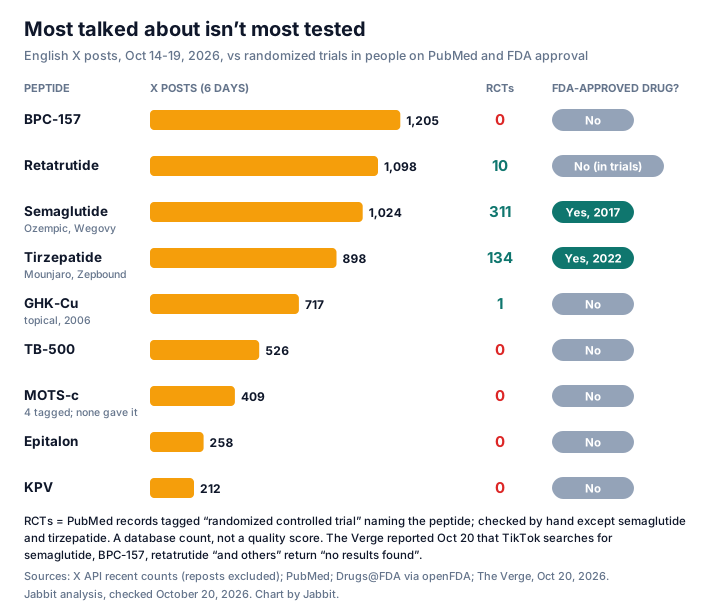
On the night of October 19, posts on X said TikTok searches for BPC-157 and melanotan had started returning “No results found.”[5] The next day The Verge reported the same for semaglutide, BPC-157, retatrutide “and others,” and noted that a plain “peptides” search still shows videos.[3] TikTok hadn’t responded to The Verge when it published, but in July a TikTok spokesperson told Australia’s ABC that it hides search results for retatrutide “or other related terms or names” and adds terms daily.[3][1] So we did a count of our own. For 18 peptide names popular on social video, we checked FDA approvals, registered trials, randomized trials in PubMed and how often each was posted about on X. The names people post about most split cleanly. Semaglutide and tirzepatide are approved drugs with hundreds of randomized trials. BPC-157, the most-posted of all, has none we could find.[7][11][6] Where we count, compare or interpret, we say so.
Why this matters now
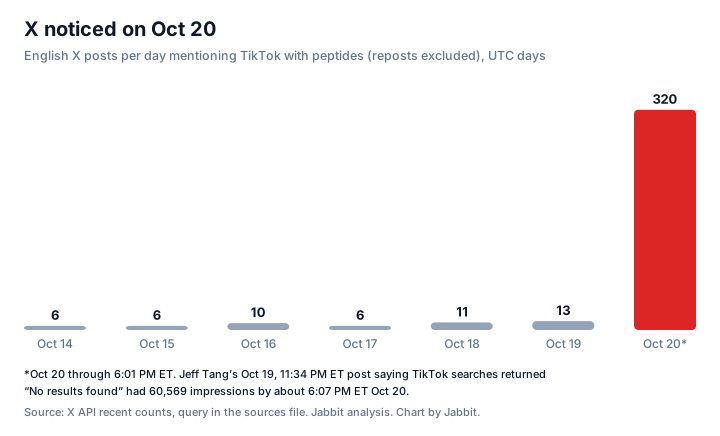
Jeff Tang’s October 19 post, “TikTok has fully banned all content about peptides,” had 60,569 impressions by early evening on October 20, and X ran a trending story on it.[5] By our count, English posts on X mentioning TikTok with peptides went from 6 to 13 a day the week before to 320 on October 20 by 6 PM ET.[6] TikTok is where many people first hear about these products: an analysis cited by ABC Media Watch in August found peptide-related hashtags had been viewed more than 230 million times on TikTok alone.[2] If search is closing, some of those viewers will look elsewhere for answers, and this page tries to give them.
The short answer
- We found no public TikTok explanation of this week’s change. Its July statement to the ABC says searches for retatrutide and related names show no videos, calling them “regulated, prohibited, or high-risk goods,” and that the list grows daily. We can’t tell whether October 20 is new or a wider rollout of that.[1][3]
- It isn’t a full ban, as far as reporting shows. The Verge found videos still up and reachable through the word “peptides” or small spelling changes.[3]
- The blocked names mix very different things. Semaglutide is in FDA-approved Ozempic and Wegovy. BPC-157 and TB-500 have no approved product, and retatrutide is still in trials.[7][3]
- Talk and testing don’t match. BPC-157 drew 1,205 English X posts in 6 days and has 0 randomized-trial records in PubMed. TB-500, KPV, epitalon and MOTS-c are also at 0 by our count.[6][11]
- Five of the 18 names are approved drugs: semaglutide, tirzepatide, tesamorelin, bremelanotide (PT-141) and elamipretide (SS-31).[7]
Finding 1: what TikTok has actually said
We found no TikTok announcement about peptides this week. The Verge says “TikTok’s US owner didn’t respond immediately when asked for comment.”[3] TikTok did speak to Australia’s ABC Media Watch for an August 3 episode. Its spokesperson’s statement, dated July 31, reads: “We do not allow buying, selling, marketing or providing access to regulated, prohibited, or high-risk goods and services such as ‘retatrutide’. When people search for it, or other related terms or names, they are not shown any videos as they are in breach of our strict Community Guidelines. We are expanding our detection and list of search terms daily.”[1] That matches what people reported on October 20, but the statement was given to Australian media, and we can’t confirm when or where each block started.[1][5]
TikTok’s current guidelines, effective September 24, 2026, say: “We don’t allow trading, marketing, or providing access to regulated, prohibited, or high-risk goods and services.” The page doesn’t use the word “peptide.”[4] Australia’s drug regulator described the enforcement problem on the same Media Watch episode: “Policing this is very much whack a mole.”[2]
We tried to test TikTok search ourselves. Logged-out web search shows a log-in wall, so we couldn’t, and we rely on The Verge’s checks and users’ reports here.[3][5]
Finding 2: our count of 18 peptide names
For each name, we searched Drugs@FDA for an approved product, ClinicalTrials.gov for registered interventional studies, and PubMed for records tagged as randomized controlled trials. We also counted English X posts from October 14 to 19.[7][8][11][6] For the smaller sets we read every PubMed record by hand to check that people were actually given the peptide.[11] These are database counts, not quality scores. A big trial count says a drug has been studied, not that every use of it is safe or works.
| Name | FDA-approved product? | Registered studies | With posted results | Randomized trials in PubMed | English X posts, Oct 14-19 |
|---|---|---|---|---|---|
| BPC-157 | No | 3 | 0 | 0 | 1,205 |
| Retatrutide | No | 32 | 2 | 10 | 1,098 |
| Semaglutide | Yes: Ozempic (2017), Rybelsus, Wegovy | 643 | 107 | 311 | 1,024 |
| Tirzepatide | Yes: Mounjaro (2022), Zepbound | 248 | 47 | 134 | 898 |
| GHK-Cu | No | 0 | 0 | 1 | 717 |
| TB-500 | No | 0 | 0 | 0 | 526 |
| MOTS-c | No | 0 | 0 | 0 (of 4 tagged) | 409 |
| Semax | No | 0 | 0 | 1 | 297 (combined) |
| Selank | No | 0 | 0 | 2 | 297 (combined) |
| Tesamorelin | Yes: Egrifta (2010) | 20 | 10 | 21 | 283 |
| CJC-1295 | No | 1 | 0 | 1 | 265 (combined) |
| Ipamorelin | No | 2 | 0 | 2 | 265 (combined) |
| Epitalon | No | 0 | 0 | 0 | 258 |
| KPV | No | 0 | 0 | 0 | 212 |
| Bremelanotide (PT-141) | Yes: Vyleesi (2019) | 10 | 4 | 14 | 119 |
| Melanotan II | No | 0 | 0 | 1 (of 4 tagged) | 99 |
| Elamipretide (SS-31) | Yes: Forzinity (2025) | 29 | 14 | 19 | 68 |
| Thymosin beta-4 (full protein, for comparison) | No | 18 | 9 | 5 | not counted |
A few rows need context. Retatrutide’s 10 randomized-trial records all come from Lilly-sponsored trials, and it remains unapproved while phase 3 continues.[11][7] The full thymosin beta-4 protein has eye-drop and wound trials, but TB-500 is a short fragment of it, and those trials don’t test TB-500.[11][8] CJC-1295’s one trial dosed healthy adults in 2006, and ipamorelin’s two were a bowel-recovery trial after surgery and a dosing study in healthy volunteers, not tests for muscle or sleep.[13][14] The melanotan II trial is 19 men with erectile dysfunction in 2000.[15] GHK-Cu’s one tagged trial is a skin product after laser resurfacing, not an injection.[12] The Semax and Selank records are Russian-language studies in motor neuron disease and anxiety.[11]
Finding 3: the registry records behind the most-posted names
BPC-157. Outside the sponsor discussed below, ClinicalTrials.gov lists 3 BPC-157 studies. A 30-person rotator-cuff study at the University of Arkansas is not yet recruiting. A 40-person, single-group study of BPC-157 gummies, sponsored by their seller, is marked completed with no results posted. A 2015 oral safety study in healthy volunteers has an unknown status and no results.[10]
A sponsor whose records describe themselves as examples. Eight records across these names come from a lead sponsor listed as Hudson Biotech, at a site listed as Peking University Shenzhen Hospital. The TB-500 record’s summary begins, “This fictional study is an example of a ClinicalTrials.gov-style record.” The melanotan II record calls itself an “example interventional study record,” and the tesamorelin record’s title ends “(Mock Study).” We set all eight aside, including the BPC-157 record, where we did not find that wording. That makes TB-500’s registry count 0.[9][8]
Safety
For unapproved peptides, harm is poorly measured too. NSW Health in Australia counted 1,180 emergency department visits mentioning unapproved peptide use from July 2025 to September 2026, rising from 5 a month to 217. Of those, 833 mentioned retatrutide only, and 18% led to a hospital admission. The report is careful: “We cannot conclude that peptide use caused the presentation.”[16] Our NSW teardown goes through those data and the vial testing behind them. Approved drugs have their own risks, which are listed on their labels.
Strengths and limits
The case against the block. Blocking “semaglutide” hides videos about an approved, widely prescribed medicine along with gray-market ones. People who use these products may lose a place where users compare side effects. And by The Verge’s account the blocks are easy to get around.[3][7] The case for caution. No trials isn’t the same as no effect. BPC-157 has 230 PubMed records, and our BPC-157 teardown describes decades of mostly single-lab animal work; a placebo-controlled pilot in people is planned.[11][10] Our limits. PubMed tags can miss older trials filed under other names. For example, GHK-Cu’s 1994 wound-gel trials, which our GHK-Cu teardown covers, aren’t tagged this way. Name searches on ClinicalTrials.gov can miss code names. X counts include sellers, critics and jokes alike.[11][8][6]
Bottom line
TikTok hasn’t said why searches for these names stopped working, and the videos appear to still be there.[3] In our view, the more useful question is what each name has behind it. The approved drugs among them (semaglutide, tirzepatide, tesamorelin, bremelanotide, elamipretide) have labels and trials. The most-posted unapproved ones, BPC-157 and TB-500, have no published randomized trial we could find.[7][11] If you use any peptide, involve a prescriber, and keep a dated log of what you take, the dose and any side effects to show them. Jabbit is a private iPhone log built for that.
Frequently asked questions
- Did TikTok ban all peptide content?
- Not as far as anyone has shown. The Verge reported on October 20, 2026 that searches for names like semaglutide, BPC-157 and retatrutide return “no results found,” but that a plain “peptides” search still shows videos and slight spelling changes still find them. TikTok had not commented to The Verge. In July, a TikTok spokesperson told Australia’s ABC that searches for retatrutide and related names show no videos, and that the list of blocked terms grows daily.
- Why would TikTok block semaglutide if it is FDA-approved?
- TikTok hasn’t said. Semaglutide is the active ingredient of Ozempic, Wegovy and Rybelsus, which FDA first approved in 2017. Its guidelines bar “trading, marketing, or providing access to” regulated or high-risk goods, but we can only guess at how that applies here. Blocking the name also hides videos from people taking the approved drug.
- Is BPC-157 proven to work in people?
- Not by any trial we could find. PubMed has 230 records that mention BPC-157 and none is tagged as a randomized controlled trial. ClinicalTrials.gov lists 3 studies outside one sponsor whose records we set aside; none has posted results. One placebo-controlled pilot, at the University of Arkansas, is not yet recruiting. Our BPC-157 teardown covers the animal research.
- Which popular peptides are FDA-approved?
- Of the 18 names we checked, 5 have FDA-approved products: semaglutide (Ozempic, Wegovy, Rybelsus), tirzepatide (Mounjaro, Zepbound), tesamorelin (Egrifta), bremelanotide or PT-141 (Vyleesi) and elamipretide or SS-31 (Forzinity). Retatrutide is still in Lilly’s trials. Drugs@FDA returned no approved product for BPC-157, TB-500, GHK-Cu, CJC-1295, ipamorelin, MOTS-c, KPV, melanotan II, epitalon, Semax or Selank.
- Are unapproved peptides dangerous?
- Nobody has measured it well, which is part of the problem. In Australia, NSW Health counted 1,180 emergency visits that mentioned unapproved peptides between July 2025 and September 2026, 833 of them naming retatrutide only, with 18% admitted. The report says it cannot conclude that the peptides caused those visits. Our NSW teardown covers what testing of seized and purchased vials has found.
- Where can I get reliable information now?
- Start with primary sources: the FDA label for approved drugs, ClinicalTrials.gov for trials and PubMed for published studies. Talk to a prescriber or pharmacist before you use any of these products. Our peptide teardowns trace each claim to its original paper and say plainly where the evidence stops.
References
- TikTok spokesperson. Statement to ABC Media Watch, dated 31 July 2026 (PDF): “We do not allow buying, selling, marketing or providing access to regulated, prohibited, or high-risk goods and services such as 'retatrutide'. When people search for it, or other related terms or names, they are not shown any videos as they are in breach of our strict Community Guidelines. We are expanding our detection and list of search terms daily, as the way people discuss these products rapidly evolves.” https://live-production.wcms.abc-cdn.net.au/c4a68c9524317a41391f512a3114b563. Checked October 20, 2026.
- ABC Media Watch. “Pep-tidal wave.” Broadcast Monday August 3, 2026 (cites an analysis that “peptide-related hashtags, on TikTok alone, have been viewed more than 230 million times”; Tracey Lutton, Regulatory Compliance Branch, Therapeutic Goods Administration, July 29, 2026: “Policing this is very much whack a mole”). https://www.abc.net.au/mediawatch/episodes/peptides/106992010. Checked October 20, 2026.
- Lawler R. “TikTok has started censoring searches for popular peptides.” The Verge, October 20, 2026, 8:16 PM UTC (4:16 PM ET): searches return a “no results found” page “for terms like semaglutide, BPC-157, retratutide, and others”; “searching for “peptides” on TikTok still pulls up plenty of short videos, and there’s no sign that actual videos have been removed”; “slight variations of either name still pull up published videos”; “TikTok’s US owner didn’t respond immediately when asked for comment.” https://www.theverge.com/science/1014825/peptide-tiktok-search-ban. Checked October 20, 2026.
- TikTok Community Guidelines. “Regulated Goods, Services, and Commercial Activities.” Released August 25, 2026; effective September 24, 2026 (“We don’t allow trading, marketing, or providing access to regulated, prohibited, or high-risk goods and services”; the page does not use the word “peptide”). https://www.tiktok.com/community-guidelines/en/regulated-commercial-activities. Checked October 20, 2026.
- @jefftangx (Jeff Tang), X post, Oct 19, 2026, 11:34 PM ET: “TikTok has fully banned all content about peptides / Searching “bpc-157” “melanotan” shows “No results found” / Searching “reta” gives you eating disorder resources”; 60,569 impressions, 579 likes and 112 bookmarks at about 6:07 PM ET October 20. https://x.com/jefftangx/status/2112387052075643279; X trending story “TikTok Bans Peptide-Related Content Amid FDA Scrutiny” (updated 3:24 PM ET October 20): https://x.com/i/trending/2112623562326442180. X API post lookup; the trending story is an automated summary of posts, and its headline is X’s, not TikTok’s.
- Jabbit count of English posts on X (reposts excluded) via the X API recent-counts endpoint. Posts mentioning TikTok with peptides, by UTC day October 14-20, 2026: 6, 6, 10, 6, 11, 13, 320 (October 20 through 6:01 PM ET). Peptide names, October 14-19 (6 full UTC days): BPC-157 1,205; retatrutide 1,098; semaglutide 1,024; tirzepatide 898; GHK-Cu 717; TB-500 526; MOTS-c 409; Semax or Selank 297; tesamorelin 283; CJC-1295 or ipamorelin 265; epitalon 258; KPV 212; PT-141 119; melanotan 99; SS-31 68. Exact queries: https://jabbitapp.com/research/sources/tiktok-peptide-search-block-evidence-2026-10-20.json. Checked October 20, 2026.
- US Food and Drug Administration. Drugs@FDA, queried via the openFDA drugsfda endpoint by active ingredient, October 20, 2026: semaglutide (Ozempic NDA 209637, first approved December 5, 2017; Rybelsus; Wegovy NDA 215256), tirzepatide (Mounjaro NDA 215866, May 13, 2022; Zepbound NDA 217806), tesamorelin (Egrifta, November 10, 2010), bremelanotide (Vyleesi NDA 210557, June 21, 2019), elamipretide (Forzinity NDA 215244, September 19, 2025). No application was returned for retatrutide, BPC-157, TB-500, thymosin beta-4, GHK-Cu (including prezatide copper acetate), CJC-1295, ipamorelin, MOTS-c, KPV, melanotan II, epitalon, Semax or Selank. Drugs@FDA; queries: https://jabbitapp.com/research/sources/tiktok-peptide-search-block-evidence-2026-10-20.json. Checked October 20, 2026.
- Jabbit review of ClinicalTrials.gov (API v2), October 20, 2026: interventional studies whose interventions match each name and its aliases (for example BPC-157, BPC 157, PL 14736). We set aside 8 records from lead sponsor Hudson Biotech (see the next reference) and 6 hand-identified off-target matches (for example a HydraFacial device study and studies that only measure blood MOTS-c). Counts and record lists: https://jabbitapp.com/research/sources/tiktok-peptide-search-block-evidence-2026-10-20.json. Checked October 20, 2026.
- ClinicalTrials.gov records from lead sponsor Hudson Biotech (site listed as Peking University Shenzhen Hospital): NCT07437547, NCT07437560, NCT07437586, NCT07467447, NCT07481734, NCT07481747, NCT07487363, NCT07505745. NCT07487363 (TB-500) summary: “This fictional study is an example of a ClinicalTrials.gov-style record.” NCT07437560 (melanotan II): “This example interventional study record describes…”. NCT07481734 (tesamorelin) title ends “(Mock Study)”. We did not find such wording in the BPC-157 record NCT07437547. Checked October 20, 2026.
- ClinicalTrials.gov BPC-157 records outside Hudson Biotech: NCT07803250 (University of Arkansas, rotator cuff repair, 30 planned, not yet recruiting); NCT07752381 (Parlay Wellness, “peptide gummies containing Body Protection Compound (BPC)-157 (500 µg per serving)”, 40 people, single group, completed, no results posted); NCT02637284 (PharmaCotherapia, oral PCO-02 safety and pharmacokinetics in healthy volunteers, placebo-controlled, 42 planned, status unknown, no results posted). Checked October 20, 2026.
- Jabbit PubMed counts (esearch, title/abstract), October 20, 2026: all records and records with the publication type “randomized controlled trial”, per name and aliases. Semaglutide 5,719 and 311; tirzepatide 2,644 and 134; retatrutide 207 and 10; BPC-157 230 and 0; TB-500 34 and 0; KPV 133 and 0; epitalon 146 and 0. For the smaller sets we read every tagged record: the 4 MOTS-c records measured people’s own MOTS-c and gave none; 3 of the 4 melanotan records tested melanotan-I, a different molecule. Tags can miss older trials indexed under other names. Queries and IDs: https://jabbitapp.com/research/sources/tiktok-peptide-search-block-evidence-2026-10-20.json. Checked October 20, 2026.
- Miller TR, Wagner JD, Baack BR, Eisbach KJ. Effects of topical copper tripeptide complex on CO2 laser-resurfaced skin. Arch Facial Plast Surg. 2006;8(4):252-259. PMID 16847171 (the only randomized-trial-tagged GHK-Cu record our search found; a skin product, not an injection). https://pubmed.ncbi.nlm.nih.gov/16847171/. Checked October 20, 2026.
- Teichman SL, Neale A, Lawrence B, et al. Prolonged stimulation of growth hormone (GH) and insulin-like growth factor I secretion by CJC-1295, a long-acting analog of GH-releasing hormone, in healthy adults. J Clin Endocrinol Metab. 2006;91(3):799-805. PMID 16352683 (“CJC-1295 or placebo was administered sc” in healthy adults aged 21-61). https://pubmed.ncbi.nlm.nih.gov/16352683/. Checked October 20, 2026.
- Beck DE, Sweeney WB, McCarter MD; Ipamorelin 201 Study Group. Prospective, randomized, controlled, proof-of-concept study of the Ghrelin mimetic ipamorelin for the management of postoperative ileus in bowel resection patients. Int J Colorectal Dis. 2014;29(12):1527-1534. PMID 25331030. https://pubmed.ncbi.nlm.nih.gov/25331030/; registry records NCT00672074 and NCT01280344 (Helsinn; completed; no results posted). Checked October 20, 2026.
- Wessells H, Gralnek D, Dorr R, Hruby VJ, Hadley ME, Levine N. Effect of an alpha-melanocyte stimulating hormone analog on penile erection and sexual desire in men with organic erectile dysfunction. Urology. 2000;56(4):641-646. PMID 11018622 (“Melanotan II initiated subjectively reported erections in 12 of 19” men; nausea and stretching/yawning were more frequent with the drug). https://pubmed.ncbi.nlm.nih.gov/11018622/. Checked October 20, 2026.
- NSW Ministry of Health. Emergency department presentations mentioning unapproved peptide use, NSW, July 2025 to September 2026. SHPN (CEE) 260832, October 2026 (“There were 1,180 ED presentations among people aged 16 years and over that mentioned unapproved peptide use”; “from 5 presentations in July 2025 to 217 presentations in September 2026”; “833 (71%) ED presentations mentioned ‘retatrutide’ only”; “18% … resulted in a hospital admission”; “We cannot conclude that peptide use caused the presentation”). https://www.health.nsw.gov.au/epidemiology/Publications/unapproved-peptide-use.pdf. Checked October 20, 2026.
This page analyzes a platform statement, news reports, posts on X, FDA approval records, trial registries and PubMed. It is not medical advice and does not recommend any drug, dose, product or seller. Don’t start, stop or change a medicine without your prescriber. The trial, PubMed, Drugs@FDA and X counts are Jabbit’s own analysis; their inputs and queries are linked above, and the text labels them as ours. Statements about named people and organizations quote or summarize the linked documents as they read on October 20, 2026. TikTok had not publicly explained the October 2026 search changes when we checked. Spot an error? See our corrections policy.