Study teardown · Melanotan II (MT-II, MT2, “Melanotan 2,” tanning nasal sprays and injections) · TGA and FDA documents, 1990s trials, 17 case reports, a lab study, FAERS and registry counts, and the approved relative Scenesse · Sources checked October 24, 2026
Published · Updated
Melanotan II (MT2, the “tanning peptide” sold as nasal sprays and injections): is it safe? It does darken skin, but it has never been approved anywhere, it won’t protect you from the sun, lab tests found products far off their labels, and doctors have published reports of melanoma, priapism, kidney injury and brain swelling in users.
Melanotan II is a lab-made, ring-shaped copy of α-MSH, the body’s hormone that tells skin cells to make melanin. It switches on several melanocortin receptors at once, so it darkens skin and can also cause erections, nausea and loss of appetite.[30][7][8] University of Arizona researchers tested it in small studies in the 1990s, but it was never developed into an approved medicine.[10] FDA has no approved melanotan product, Australia’s TGA lists it as prescription-only with no approved products, and the only approved drug in its family for skin is a different molecule, afamelanotide (Scenesse), for a rare light-sensitivity disease.[40][1][13] The TGA says melanotan “will not protect against UV exposure the way a suitable sunscreen will.”[2]
Why this matters now
On August 17, 2026, the TGA reported that 5 seized melanotan II nasal sprays, all with the same label, held an estimated 22 to 54 mg against a labelled 30 mg, and that it had issued 27 infringement notices totalling A$101,412 for alleged unlawful supply.[1] In the US, FDA says its Pharmacy Compounding Advisory Committee will discuss melanotan II, with four other peptides, at a meeting before the end of February 2027, as a candidate for the list of substances pharmacies may compound.[5] FDA’s separate peptide compounding policy, under White House review since October 14, 2026, has no public list, so whether it covers melanotan II is unknown.[6] Dermatologists have also documented melanotan promotion on TikTok and other social media, where it is nicknamed the “Barbie drug.”[36] We covered TikTok’s October 2026 peptide search block here.
Thirty years in one table
| Year | What happened | Source |
|---|---|---|
| 1996 | University of Arizona pilot study in 3 men: skin darkens, and spontaneous erections and nausea appear | Life Sci[7] |
| 1998–2000 | Small placebo-controlled studies: erections in 8 of 10 and 12 of 19 men with erectile dysfunction | J Urol, Urology[8][9] |
| 2000–2004 | Melanotan I, its linear cousin, raises skin melanin and tans volunteers in small studies | Photochem Photobiol, Arch Dermatol[11][12] |
| 2006 | PT-141 (bremelanotide), a melanotan II analog, heads for phase 3; melanotan II itself is not developed further | Peptides[10] |
| 2007 | FDA warns an online seller marketing melanotan II as a tanning shot that protects against skin cancer | FDA[3] |
| 2009–2014 | Case reports of changing moles and melanoma in users begin to appear | BMJ, Br J Dermatol, others[16][20][22] |
| 2014 / 2019 | Afamelanotide (Scenesse, melanotan I) approved in the EU, then the US, for the light-sensitivity disease EPP | EMA, FDA[14][13] |
| 2015 | Lab study: online melanotan II vials hold 43% to 88% of the labelled amount, plus impurities | Drug Test Anal[33] |
| 2025–2026 | New case reports: oral melanoma after a nasal spray, injection-site ulcers, gum pigmentation, five melanomas in situ | Various[23][31][32][24] |
| Aug 2026 | TGA: seized nasal sprays inconsistently dosed; A$101,412 in infringement notices | TGA[1] |
| By Feb 2027 | FDA advisory committee to discuss melanotan II for the compounding list | FDA[5] |
What the studies actually showed
The case for melanotan II rests on a handful of small studies from one university group, all more than 25 years old:
- It darkens skin. In the first human study, 2 of 3 men developed more pigment on the face and upper body.[7] That’s the effect sellers advertise.
- It causes erections. In placebo-controlled crossover studies, erections followed melanotan II in 8 of 10 men with psychogenic erectile dysfunction and 12 of 19 with organic causes.[8][9] That line of research led to PT-141 (bremelanotide), now approved as Vyleesi for low sexual desire in premenopausal women; we cover it here.[10]
- Side effects showed up right away. Nausea, stretching and yawning, and loss of appetite were more common than on placebo, and 4 of 19 injections in the 2000 study caused severe nausea.[8][9]
- Nothing since. We found no registered melanotan II trial on ClinicalTrials.gov; the one record matching “melanotan” is an example entry.[38] PubMed holds 280 records mentioning melanotan, many of them case reports and reviews.[39]
These studies were small and short, and none was designed to test long-term safety or skin cancer risk.[7][8][9]
Does a melanotan tan protect you from the sun?
No regulator says it does. The TGA says melanotan “will not protect against UV exposure the way a suitable sunscreen will,” and that “no tan, fake or real, will protect skin against damage from sun exposure.”[2] In 2007, FDA’s drug center director called melanotan II “mislabeled, marketed and sold illegally as a preventative against skin cancer and as a tanning agent.”[3]
The closest evidence comes from melanotan I, a different molecule. In a 2004 study, 3 of 4 people given it tanned and had 47% fewer sunburn cells at one test site.[12] That molecule became afamelanotide, which is approved only to help people with EPP tolerate more light, not for tanning or preventing skin cancer.[13][14] Those results don’t transfer to melanotan II bought online.
What’s actually in the bottle
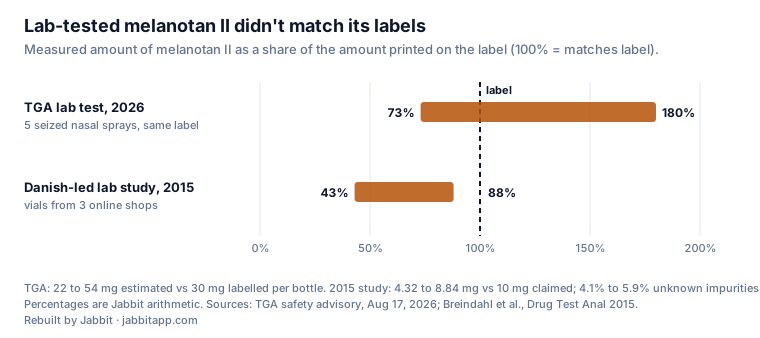
- Nasal sprays, 2026. The TGA’s estimate of 22 to 54 mg against a 30 mg label means some bottles held about 73% of the label and others about 180%, a 2.5-fold spread between bottles with identical labels (our arithmetic).[1]
- Injectable vials, 2015. Vials from three online shops claimed 10 mg and held 4.32 to 8.84 mg, with impurities of 4.1% to 5.9% in products from two shops.[33]
- Why that matters. FDA says compounded melanotan II may pose an immune-reaction risk because of aggregation or peptide-related impurities.[4] The UK medicines regulator has also warned about impurities and about shared needles spreading blood-borne viruses.[34]
Safety: what doctors have reported
Melanotan II has no large safety trials, so most of what’s known about harm comes from case reports: published accounts of individual users seen by doctors. We read 17 of them.
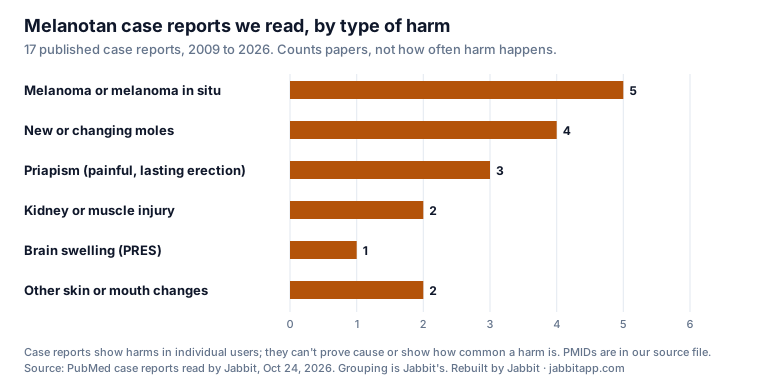
- Moles and melanoma. Doctors have reported new or rapidly darkening moles, including within 24 hours of a single injection.[16][17][18][19] Melanoma or melanoma in situ has been reported in users, including a 20-year-old woman who also used sunbeds, a 22-year-old woman who developed melanoma inside her mouth after using a nasal spray, and a patient with five melanomas in situ who also used tanning beds and anabolic hormones.[20][21][22][23][24] A 2017 review said “conclusive evidence linking these phenomena is lacking,” and many users also tan with UV, which itself causes melanoma.[15]
- Priapism. Painful, lasting erections needing emergency treatment have been reported; one man had not regained erectile function a month later, and another needed surgery.[27][28][29]
- Kidneys and muscles. One user had sympathomimetic toxicity (racing heart, agitation, sweating), muscle breakdown and kidney injury and spent 3 days in intensive care; the substance was confirmed as melanotan II by lab testing.[25] Swedish doctors reported a kidney infarction they judged “most likely attributed” to melanotan II.[30]
- Brain swelling. A 2013 report described posterior reversible encephalopathy syndrome (PRES), a type of brain swelling, in a melanotan user.[26] The TGA and FDA both cite brain swelling among reported harms.[2][4]
- Other skin and mouth changes. Ulcers at injection sites (pyoderma gangrenosum) and dark gum patches that persisted 3 months after stopping have been reported.[31][32]
- FDA’s database. FAERS holds 10 reports mentioning melanotan, 9 coded serious and none as death. Five describe a renal artery clot and also list a testosterone product; three describe a kidney infarct in Sweden. Several look like duplicates of the same case, and none proves cause.[37]
The TGA’s list of common effects is headache, nausea, vomiting, loss of appetite and facial redness, and it calls the risk of serious skin cancers “the most concerning.”[2]
The approved relative: afamelanotide (Scenesse)
Afamelanotide, once called melanotan I, is the only approved drug in this family for skin.[15][13] It shows what a properly tested version looks like:
- Narrow use. FDA approved it in 2019 for adults with erythropoietic protoporphyria (EPP), a rare disease in which light causes severe pain. The EU approved it in 2014 under “exceptional circumstances.”[13][14]
- Measured benefit. In one trial, patients spent a median 64.1 hours in direct sunlight without pain over 6 months, vs 40.5 hours on a dummy implant.[13]
- Controlled delivery. It is a small implant placed under the skin by a trained clinician, not a self-injected powder or spray.[13]
- Skin checks built in. The label warns it may darken moles and freckles and calls for a full-body skin exam twice a year. Darker skin patches occurred in 4% vs 0% and new moles in 4% vs 2%.[13]
- Still studied. Its maker, Clinuvel, sponsors all 23 afamelanotide records on ClinicalTrials.gov, including an active vitiligo trial.[38]
Is melanotan II legal?
- United States. No melanotan product is FDA approved.[40] FDA warned a seller in 2007 that claims like tanning and skin cancer protection made it an unapproved new drug.[3] An earlier nomination to let pharmacies compound it was withdrawn, and FDA’s advisory committee is due to discuss it again by February 2027.[4][5]
- Australia. It is prescription-only with no approved products, and the TGA says supplying it without a prescription or advertising it to the public, including by influencers, is illegal.[1][2] Australian dermatologists have called its unregulated use a public health concern.[35]
- UK and EU. UK clinicians describe it as unlicensed and say its sale is illegal there and in many other countries.[23]
This is a summary of public sources, not legal advice.
What a careful reader should notice
These points are our analysis of the cited sources.
- The tan is real, the safety data aren’t there. Small studies show melanotan II darkens skin.[7] No study has followed users long enough to measure skin cancer risk.[7][8][9][38]
- Case reports can’t give a rate. They show what can happen, not how often. Many users also use sunbeds or other drugs, which makes cause hard to pin down.[15][24][37]
- Doses printed on labels can’t be trusted. Two independent tests a decade apart found products well below or well above their labels.[1][33]
- Melanotan I and II aren’t the same drug. Evidence for afamelanotide, a different molecule given as a regulated implant to EPP patients, doesn’t carry over to melanotan II sprays or vials.[13][10]
- A committee discussion isn’t an approval. FDA’s plan to discuss melanotan II for compounding means it is under consideration, nothing more.[5]
Frequently asked questions
- Is melanotan II safe?
- Its safety has never been tested in large trials. Small 1990s studies found nausea, yawning and loss of appetite, and doctors have since published case reports of changing moles, melanoma, priapism, kidney injury and brain swelling in users. Lab tests also found products far off their labels.[9][15][1][33]
- Is melanotan II legal in the US?
- No melanotan product is FDA approved. FDA has warned a seller that marketing it for tanning or skin cancer protection made it an unapproved new drug, and an FDA advisory committee is due to discuss it for pharmacy compounding by February 2027.[40][3][5]
- Is melanotan legal in Australia?
- Melanotan II is prescription-only in Australia, with no approved products. The TGA says supplying it without a prescription or advertising it to the public is illegal, and it issued A$101,412 in infringement notices in 2026 over alleged unlawful supply.[1][2]
- Does a melanotan tan protect against sunburn or skin cancer?
- No regulator says so. The TGA says it will not protect against UV the way sunscreen does, and FDA called skin cancer prevention claims for melanotan II illegal.[2][3]
- What is the difference between melanotan I and melanotan II?
- Melanotan I (afamelanotide) is a linear peptide that became Scenesse, an implant approved for the rare disease EPP. Melanotan II is a smaller ring-shaped peptide that also causes erections and nausea, and it has never been approved.[10][13]
- Is melanotan II the same as PT-141?
- No. PT-141 (bremelanotide) is a close analog of melanotan II that was developed into Vyleesi, approved for low sexual desire in premenopausal women.[10]
- Are melanotan nasal sprays safer than injections?
- There is no evidence that they are. TGA testing of seized nasal sprays found inconsistent amounts between bottles, and one published case of melanoma inside the mouth followed nasal spray use.[1][23]
Bottom line
Melanotan II does what tanning forums say it does: it darkens skin, along with causing nausea and erections.[7][8] But it has never been approved, it won’t protect against UV, products tested by labs didn’t contain what their labels said, and doctors keep reporting serious harms in users.[40][2][1][33][15] The one tested and approved relative, afamelanotide, is a different molecule given as a supervised implant for a rare disease.[13]
References
- Therapeutic Goods Administration (Australia). “Melanotan II tanning peptide products found to be inconsistently dosed,” safety advisory, published 17 August 2026. Melanotan II “is a prescription-only medicine in Australia and is not approved for use as a tanning agent”; no products containing it are in the ARTG. TGA testing of 5 seized nasal spray bottles with the same label (30 mg; 20 mL) estimated 22 mg to 54 mg of melanotan II; “The inconsistent dosage across the bottles further increases the chance of adverse events.” 27 infringement notices totalling $101,412 to an NSW-based individual “for the alleged unlawful supply”; paid in May 2026. Jabbit does not name the product or person. tga.gov.au blocks our fetcher; archived copy: https://web.archive.org/web/20261011164221/https://www.tga.gov.au/safety/safety-monitoring-and-information/safety-alerts/melanotan-ii-tanning-peptide-products-found-be-inconsistently-dosed. Checked October 24, 2026.
- Therapeutic Goods Administration (Australia). “Don’t risk using tanning products containing melanotan,” blog, published 24 January 2025. Common side effects “include headache, nausea, vomiting, loss of appetite, and facial redness, the most concerning one is the risk of serious skin cancers. With melanotan-II, there have been reports of increased moles and freckles, kidney dysfunction and swelling of the brain”; melanotan “will not protect against UV exposure the way a suitable sunscreen will”; supply without a prescription and advertising to the public are illegal, including by influencers; TGA requested removal of more than 4,800 unlawful advertisements in 2023–24. Archived copy: https://web.archive.org/web/20260709125256/https://www.tga.gov.au/news/blog/dont-risk-using-tanning-products-containing-melanotan. Checked October 24, 2026.
- U.S. Food and Drug Administration. News release, September 5, 2007, announcing a warning letter to an online seller in Tennessee (named in the release; Jabbit does not name it) that marketed melanotan II as an injectable tanning product with claims of protection against skin cancer and rosacea. CDER director Steven Galson: “This product is being mislabeled, marketed and sold illegally as a preventative against skin cancer and as a tanning agent.” FDA said such claims make it a new drug that is not approved. Reprinted by WebWire: https://www.webwire.com/ViewPressRel.asp?aId=46851. Checked October 24, 2026.
- U.S. Food and Drug Administration. “Certain Bulk Drug Substances for Use in Compounding that May Present Significant Safety Risks” (content current as of 04/22/2026). Melanotan II is listed under bulk drug substances nominated for compounding whose nominations were later withdrawn. FDA’s summary: compounded drugs containing it “may pose risk for immunogenicity for certain routes of administration due to the potential for aggregation or peptide-related impurities. Published case reports discuss serious adverse events including melanoma, posterior reversible encephalopathy syndrome, sympathomimetic toxidrome and priapism.” https://www.fda.gov/drugs/human-drug-compounding/certain-bulk-drug-substances-use-compounding-may-present-significant-safety-risks. Checked October 24, 2026.
- U.S. Food and Drug Administration. “Meeting of the Pharmacy Compounding Advisory Committee” (content current as of 04/15/2026). FDA will host a meeting before the end of February 2027 to discuss LL-37, GHK-Cu, dihexa acetate, melanotan II and PEG-MGF, “being considered for inclusion on the 503A bulks list.” Date and materials not yet posted. https://www.fda.gov/advisory-committees/pharmacy-compounding-advisory-committee/meeting-pharmacy-compounding-advisory-committee. Checked October 24, 2026.
- Office of Information and Regulatory Affairs (OMB). Pending EO 12866 Regulatory Review: Interim Access Policy for Compounding Using Certain Peptides, RIN 0910-ZD94, received 10/14/2026, stage: Notice. The text and the list of peptides are not public. https://www.reginfo.gov/public/do/eoDetails?rrid=1568964. Checked October 24, 2026.
- Dorr RT, Lines R, Levine N, et al. Evaluation of melanotan-II, a superpotent cyclic melanotropic peptide in a pilot phase-I clinical study. Life Sci. 1996;58(20):1777-1784. PMID 8637402. University of Arizona; 3 men; mild nausea at most dose levels; a stretching and yawning complex; spontaneous erections; increased pigmentation in 2 subjects. Abstract read. https://pubmed.ncbi.nlm.nih.gov/8637402/. Checked October 24, 2026.
- Wessells H, Fuciarelli K, Hansen J, et al. Synthetic melanotropic peptide initiates erections in men with psychogenic erectile dysfunction: double-blind, placebo controlled crossover study. J Urol. 1998;160(2):389-393. PMID 9679884. Erections in 8 of 10 men on melanotan II; transient nausea, stretching and yawning, and decreased appetite. Abstract read. https://pubmed.ncbi.nlm.nih.gov/9679884/. Checked October 24, 2026.
- Wessells H, Gralnek D, Dorr R, et al. Effect of an alpha-melanocyte stimulating hormone analog on penile erection and sexual desire in men with organic erectile dysfunction. Urology. 2000;56(4):641-646. PMID 11018622. Erections reported in 12 of 19 men; 4 of 19 injections associated with severe nausea. Abstract read. https://pubmed.ncbi.nlm.nih.gov/11018622/. Checked October 24, 2026.
- Hadley ME, Dorr RT. Melanocortin peptide therapeutics: historical milestones, clinical studies and commercialization. Peptides. 2006;27(4):921-930. PMID 16412534. Melanotan I and II were patented and tested clinically, melanotan I for tanning and melanotan II for erectile dysfunction; PT-141 is “a new MTII analog.” Abstract read. https://pubmed.ncbi.nlm.nih.gov/16412534/. Checked October 24, 2026.
- Dorr RT, Dvorakova K, Brooks C, et al. Increased eumelanin expression and tanning is induced by a superpotent melanotropin [Nle4-D-Phe7]-alpha-MSH in humans. Photochem Photobiol. 2000;72(4):526-532. PMID 11045725. Melanotan I (afamelanotide); forearm eumelanin up a mean 98% (n = 7). Abstract read. https://pubmed.ncbi.nlm.nih.gov/11045725/. Checked October 24, 2026.
- Dorr RT, Ertl G, Levine N, et al. Effects of a superpotent melanotropic peptide in combination with solar UV radiation on tanning of the skin in human volunteers. Arch Dermatol. 2004;140(7):827-835. PMID 15262693. Melanotan I; tanning in 3 of 4 subjects, who had 47% fewer sunburn cells at an irradiated site; toxic effects “minor, consisting of nausea and transient facial flushing.” Small, open-label studies. Abstract read. https://pubmed.ncbi.nlm.nih.gov/15262693/. Checked October 24, 2026.
- Clinuvel, Inc. SCENESSE (afamelanotide) implant prescribing information, NDA 210797 (DailyMed / openFDA). Indicated “to increase pain free light exposure in adult patients with a history of phototoxic reactions from erythropoietic protoporphyria (EPP)”; inserted under the skin by a trained health care professional. Warnings: hypersensitivity including anaphylaxis; may darken pre-existing nevi and freckles; full body skin examination twice yearly. Table 1 (125 on afamelanotide vs 119 on vehicle): implant site reaction 21% vs 10%, nausea 19% vs 14%, melanocytic nevus 4% vs 2%, skin hyperpigmentation 4% vs 0%. Study CUV039: median direct sunlight exposure without pain over 180 days 64.1 vs 40.5 hours; Study CUV029: 6.0 vs 0.75 hours over 270 days. Drugs@FDA: original approval October 8, 2019, priority review; orphan designation. https://dailymed.nlm.nih.gov/dailymed/drugInfo.cfm?setid=94f53286-11dd-7fbb-e053-2a95a90a7c48 and https://www.accessdata.fda.gov/drugsatfda_docs/appletter/2019/210797Orig1s000ltr.pdf. Checked October 24, 2026.
- European Medicines Agency. Scenesse (afamelanotide) EPAR: marketing authorisation issued 22 December 2014 under “exceptional circumstances,” for preventing phototoxicity in adults with EPP. https://www.ema.europa.eu/en/medicines/human/EPAR/scenesse. Checked October 24, 2026.
- Habbema L, Halk AB, Neumann M, Bergman W. Risks of unregulated use of alpha-melanocyte-stimulating hormone analogues: a review. Int J Dermatol. 2017;56(10):975-980. PMID 28266027. Reviews mole changes and four case reports of melanoma with unlicensed melanotan; “conclusive evidence linking these phenomena is lacking”; afamelanotide is the only approved α-MSH analogue. Abstract read. https://pubmed.ncbi.nlm.nih.gov/28266027/. Checked October 24, 2026.
- Langan EA, Ramlogan D, Jamieson LA, Rhodes LE. Change in moles linked to use of unlicensed “sun tan jab.” BMJ. 2009;338:b277. PMID 19174439. Case report. https://pubmed.ncbi.nlm.nih.gov/19174439/. Checked October 24, 2026.
- Cardones AR, Grichnik JM. alpha-Melanocyte-stimulating hormone-induced eruptive nevi. Arch Dermatol. 2009;145(4):441-444. PMID 19380666. A 40-year-old man with a history of melanoma developed crops of new, often atypical moles after self-administering synthetic α-MSH, the hormone class that includes melanotan; they lightened after he stopped. Abstract read. https://pubmed.ncbi.nlm.nih.gov/19380666/. Checked October 24, 2026.
- Cousen P, Colver G, Helbling I. Eruptive melanocytic naevi following melanotan injection. Br J Dermatol. 2009;161(3):707-708. PMID 19575725. Case report (letter). https://pubmed.ncbi.nlm.nih.gov/19575725/. Checked October 24, 2026.
- Schulze F, Erdmann H, Hardkop LH, et al. Eruptive naevi and darkening of pre-existing naevi 24 h after a single mono-dose injection of melanotan II. Eur J Dermatol. 2014;24(1):107-109. PMID 24334249. Case report. https://pubmed.ncbi.nlm.nih.gov/24334249/. Checked October 24, 2026.
- Paurobally D, Jason F, Dezfoulian B, Nikkels AF. Melanotan-associated melanoma. Br J Dermatol. 2011;164(6):1403-1405. PMID 21564053. Case report (letter). https://pubmed.ncbi.nlm.nih.gov/21564053/. Checked October 24, 2026.
- Ong S, Bowling J. Melanotan-associated melanoma in situ. Australas J Dermatol. 2012;53(4):301-302. PMID 22724573. Case report. https://pubmed.ncbi.nlm.nih.gov/22724573/. Checked October 24, 2026.
- Hjuler KF, Lorentzen HF. Melanoma associated with the use of melanotan-II. Dermatology. 2014;228(1):34-36. PMID 24355990. A 20-year-old woman diagnosed with melanoma after a course of melanotan II injections combined with sunbed use. Abstract read. https://pubmed.ncbi.nlm.nih.gov/24355990/. Checked October 24, 2026.
- Yassin Alsabbagh A, Bhujel N, Singh RP. Melanotan II nasal spray: a possible risk factor for oral mucosal malignant melanoma? Int J Oral Maxillofac Surg. 2025;54(9):806-808. PMID 40210573. A 22-year-old woman who used a melanotan II nasal spray for tanning developed a mucosal melanoma in the upper jaw. Abstract read. https://pubmed.ncbi.nlm.nih.gov/40210573/. Checked October 24, 2026.
- Vadner DJ, Smith S. Five primary melanomas in situ in a patient with recent tanning bed use, melanotan exposure, and anabolic hormone use. JAAD Case Rep. 2026;73:111-114. PMID 42328529. Case report; tanning beds and anabolic hormones are also named in the title. https://pubmed.ncbi.nlm.nih.gov/42328529/. Checked October 24, 2026.
- Nelson ME, Bryant SM, Aks SE. Melanotan II injection resulting in systemic toxicity and rhabdomyolysis. Clin Toxicol (Phila). 2012;50(10):1169-1173. PMID 23121206. Sympathomimetic toxicity, rhabdomyolysis and kidney dysfunction; 3 days in intensive care; the injected substance was confirmed as melanotan II by mass spectrometry. Abstract read. https://pubmed.ncbi.nlm.nih.gov/23121206/. Checked October 24, 2026.
- Kaski D, Stafford N, Mehta A, Jenkins IH, Malhotra P. Melanotan and the posterior reversible encephalopathy syndrome. Ann Intern Med. 2013;158(9):707-708. PMID 23648958. Case report (letter). https://pubmed.ncbi.nlm.nih.gov/23648958/. Checked October 24, 2026.
- Devlin J, Pomerleau A, Foote J. Melanotan II overdose associated with priapism. Clin Toxicol (Phila). 2013;51(4):383. PMID 23537392. Case report (letter). https://pubmed.ncbi.nlm.nih.gov/23537392/. Checked October 24, 2026.
- Dreyer BA, Amer T, Fraser M. Melanotan-induced priapism: a hard-earned tan. BMJ Case Rep. 2019;12(2):e227644. PMID 30796078. Low-flow priapism treated in hospital; erectile function had not recovered at 4-week follow-up. Abstract read. https://pubmed.ncbi.nlm.nih.gov/30796078/. Checked October 24, 2026.
- Mallory CW, Lopategui DM, Cordon BH. Melanotan tanning injection: a rare cause of priapism. Sex Med. 2021;9(1):100298. PMID 33460908. Needed surgery; the authors say melanotan-related priapism had “only been reported in the literature twice before.” Abstract read. https://pubmed.ncbi.nlm.nih.gov/33460908/. Checked October 24, 2026.
- Peters B, Hadimeri H, Wahlberg R, Afghahi H. Melanotan II: a possible cause of renal infarction: review of the literature and case report. CEN Case Rep. 2020;9(2):159-161. PMID 31953620. A renal infarction the authors judged “most likely attributed to Melanotan II.” Abstract read. https://pubmed.ncbi.nlm.nih.gov/31953620/. Checked October 24, 2026.
- Dickson D, Hlaing Htwe S. Pyoderma gangrenosum secondary to melanotan. Cureus. 2025;17(12):e98297. PMID 41487785. Ulcers at injection sites in a 65-year-old woman; healed with treatment over months; the authors say this had not been reported before. Abstract read. https://pubmed.ncbi.nlm.nih.gov/41487785/. Checked October 24, 2026.
- Bonchev A. Changes in oral mucosa associated with melanotan II injections: a case report. Life (Basel). 2026;16(2):265. PMID 41752902. Brown gum and cheek pigmentation; gum pigmentation persisted at the 3-month follow-up after stopping. Abstract read. https://pubmed.ncbi.nlm.nih.gov/41752902/. Checked October 24, 2026.
- Breindahl T, Evans-Brown M, Hindersson P, et al. Identification and characterization by LC-UV-MS/MS of melanotan II skin-tanning products sold illegally on the Internet. Drug Test Anal. 2015;7(2):164-172. PMID 24771717. Vials from 3 online shops claimed 10 mg; measured 4.32 to 8.84 mg; impurities 4.1% to 5.9% in products from two shops. Abstract read. https://pubmed.ncbi.nlm.nih.gov/24771717/. Checked October 24, 2026.
- Langan EA, Nie Z, Rhodes LE. Melanotropic peptides: more than just ‘Barbie drugs’ and ‘sun-tan jabs’? Br J Dermatol. 2010;163(3):451-455. PMID 20545686. The UK MHRA raised the risk of blood-borne virus transmission from needle sharing and of product impurity. Abstract read. https://pubmed.ncbi.nlm.nih.gov/20545686/. Checked October 24, 2026.
- Adler NR, Dowling JP, Pan Y. The unregulated use of melanotan-II is of public health interest to Australian dermatologists. Australas J Dermatol. 2017;58(4):327-329. PMID 28905366. https://pubmed.ncbi.nlm.nih.gov/28905366/. Checked October 24, 2026.
- Social media studies (letters; titles read): Orr E, Grechin C, Kearney N, et al. The ‘Barbie Drug’: marketing and perceptions of melanotan on social media. J Eur Acad Dermatol Venereol. 2025;39(2):e106-e107. PMID 38808957, https://pubmed.ncbi.nlm.nih.gov/38808957/. Herlihy M, Bowe S, Ahmad K. Trending on TikTok: an analysis of melanotan content on social media. J Eur Acad Dermatol Venereol. 2025;39(2):e108-e109. PMID 39148422, https://pubmed.ncbi.nlm.nih.gov/39148422/. Sidhu AS, Konig DJ, Yu-Corpuz BX, Corpuz GS. Unregulated melanotan use promoted via social media: emerging dermatologic and public health risks. Int J Dermatol. 2026;65(6):1343-1344. PMID 41559011, https://pubmed.ncbi.nlm.nih.gov/41559011/. Checked October 24, 2026.
- FDA Adverse Event Reporting System via openFDA, search patient.drug.medicinalproduct:"melanotan" (openFDA last updated July 30, 2026): 10 reports, 9 serious, none coded as death. Terms: renal artery thrombosis (5 reports, received November 2025 to March 2026, each also listing a testosterone product), renal infarct (3, received 2020, Sweden), melanocytic naevus with product advertising issue (1), hepatotoxicity with other products (1, 2013). Several look like duplicate reports of the same case. Reports are unverified and do not show that a product caused an event. List and query: https://jabbitapp.com/research/sources/melanotan-ii-2026-10-24.json. Checked October 24, 2026.
- ClinicalTrials.gov API v2, interventions matching melanotan, pulled October 24, 2026: 1 record (NCT07437560), which describes itself as an example record; Jabbit sets it aside. The 1990s melanotan II studies predate trial registration. Interventions matching afamelanotide: 23 records, all with Clinuvel as lead sponsor; 18 completed, 1 active (vitiligo, https://clinicaltrials.gov/study/NCT06109649). Census: https://jabbitapp.com/research/sources/melanotan-ii-2026-10-24.json. Checked October 24, 2026.
- PubMed search “melanotan” [All Fields], October 24, 2026: 280 records. https://pubmed.ncbi.nlm.nih.gov/?term=melanotan. Checked October 24, 2026.
- openFDA Drugs@FDA, search openfda.generic_name:"melanotan", October 24, 2026: the query returns a “No matches found” error, meaning no approved US product. https://api.fda.gov/drug/drugsfda.json?search=openfda.generic_name:%22melanotan%22. Checked October 24, 2026.
This page analyzes regulator documents, published studies, case reports and registry records. It is not medical or legal advice and does not recommend any product or dose. Melanotan II is not approved by FDA, the EMA or the TGA. Charts were rebuilt by Jabbit from the sources cited in each caption.