Evidence teardown · Wegovy · Zepbound · Ozempic · Kids and teens · Healthy aging · Updated October 28, 2026
Published · Updated
Can kids and teens take Wegovy, Ozempic or Zepbound? In the US, Wegovy and Saxenda are approved for obesity from age 12, while Zepbound and Ozempic are not approved for anyone under 18, and WHO advises against weight-loss drugs before age 10. Teen trials show big BMI drops, more vomiting and gallstones than in adults, and regain after stopping. Long-term effects on growth and development are unknown.
Parents are asking this more often. On October 7, 2026, the World Health Organization published its first global guideline on child and adolescent obesity, and it draws a line at age 10.[11] Novo Nordisk has said detailed results from STEP Young, its Wegovy trial in children aged 6 to under 12, will be presented at ObesityWeek on November 14 to 17.[12] On October 26, a University of Georgia researcher told UGA Today that these drugs are sometimes prescribed “even younger in special circumstances.”[23] Our plain answer: in the US, two GLP-1 drugs are approved for obesity from age 12, and in teen trials they lowered BMI a lot.[1][5][2] Teens also had more vomiting and gallbladder problems than adults on the same drug, weight came back after stopping, and nobody yet knows the long-term effects on growth, puberty or the developing brain.[1][6][22]
Why this matters now
Three things landed within a few weeks. WHO’s new guideline says it “does not recommend pharmacological treatment” for children aged 0 to 9, and that for ages 10 to 19 “approved medicines may be considered only when a supervized multimodal lifestyle programme has not achieved the desired results.”[11] Novo Nordisk reported topline STEP Young results in September, saying 40.4% of children aged 6 to under 12 on semaglutide were no longer classified as having obesity at 68 weeks, compared with none on placebo.[12] That figure is company-reported and not yet peer-reviewed. And Eli Lilly’s SURMOUNT-ADOLESCENTS trial of tirzepatide, the drug in Zepbound, reached its primary completion date on June 2, 2026, according to its registry record, which had no results posted when we checked.[14]
Use was already rising. A 2024 JAMA research letter found that the number of US adolescents and young adults (ages 12 to 25) filling GLP-1 prescriptions rose from 8,722 in 2020 to 60,567 in 2023. Among adolescents alone, the number of girls rose from 961 to 6,607 and boys from 692 to 4,178.[21] The authors pointed to “the absence of data regarding the health effects of long-term use.”[21]
| Date | Event |
|---|---|
| Mar 2020 | NEJM publishes the liraglutide (Saxenda) teen trial[6] |
| Nov 2022 | NEJM publishes STEP TEENS, the semaglutide (Wegovy) teen trial[2] |
| May 2024 | JAMA letter: teen and young adult GLP-1 dispensing up about sevenfold since 2020[21] |
| Sep 2025 | SURPASS-PEDS (tirzepatide in youth with type 2 diabetes) published in The Lancet[10] |
| Jun 2, 2026 | SURMOUNT-ADOLESCENTS (tirzepatide for teen obesity) reaches primary completion; no results posted yet[14] |
| Sep 7, 2026 | Novo Nordisk reports topline STEP Young results in ages 6 to under 12 (company-reported)[12] |
| Oct 7, 2026 | WHO’s first global child and adolescent obesity guideline: no drugs under 10[11] |
| Oct 26, 2026 | UGA Today interview on the unanswered questions for teens[23] |
| Nov 14–17, 2026 | Full STEP Young results due at ObesityWeek[12] |
| Dec 2026 | STEP Young estimated study completion[13] |
| Nov 2028 | STEP TEENS Weight Maintenance estimated primary completion[16] |
Which drugs are approved for children, and from what age
These are the US labels as we read them on October 27, 2026. Rules differ by country.
| Drug | US status for under-18s |
|---|---|
| Wegovy injection (semaglutide) | Approved for obesity from age 12. The label says Wegovy tablets and the 7.2 mg injection have not been established as safe in children.[1] |
| Saxenda (liraglutide, daily) | Approved for obesity from age 12, for teens weighing more than 60 kg.[5] |
| Ozempic (semaglutide) | Not approved for children: “Safety and efficacy of OZEMPIC have not been established in pediatric patients.”[8] |
| Zepbound (tirzepatide) | Not approved for children: safety and effectiveness “have not been established in pediatric patients.”[7] Teen obesity trials are running.[14][15] |
| Mounjaro (tirzepatide) | Approved for blood sugar control in type 2 diabetes from age 10. Not approved for weight loss.[9] |
| WHO guideline (global) | No drugs, weight-loss surgery or devices for ages 0 to 9. For ages 10 to 19, approved medicines only after a supervised lifestyle program has not worked.[11] |
The JAMA letter also notes that three older GLP-1 drugs, dulaglutide, exenatide and liraglutide, are approved for type 2 diabetes in adolescents.[21] A child on one of these drugs off label, outside its approved age or use, is outside what the trials studied.
What the teen trials show
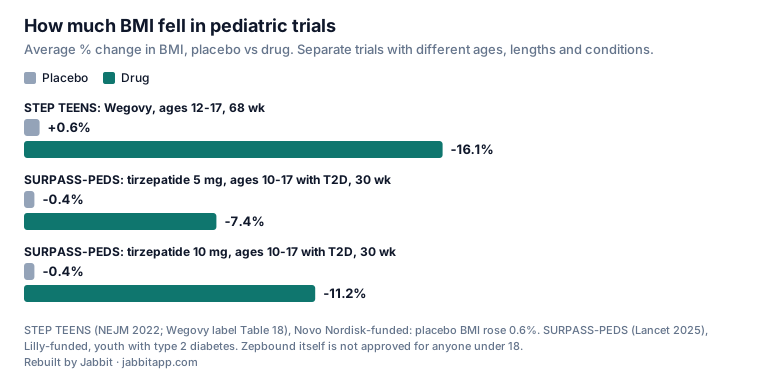
STEP TEENS randomized 201 teens aged 12 to 17 with obesity to weekly semaglutide or placebo for 68 weeks, after a 12-week lifestyle run-in. BMI fell 16.1% on semaglutide and rose 0.6% on placebo; 73% vs 18% lost at least 5%.[2][1] In a follow-up analysis, 44.9% on semaglutide moved below the obesity BMI cutoff, vs 12.1% on placebo, and the share with the most severe class of obesity fell from 37.3% to 13.6%.[3] Insulin resistance (HOMA-IR) fell 35.0% vs 5.3%, and the liver enzyme ALT fell 17.9% vs 3.3%.[4] The trial was funded by Novo Nordisk.[2]
The older daily drug did less. In the 2020 liraglutide (Saxenda) teen trial, the BMI difference vs placebo was 4.64 percentage points.[6] In SURPASS-PEDS, tirzepatide lowered blood sugar in youth aged 10 to 17 with type 2 diabetes, and BMI fell 7.4% and 11.2% on the 5 mg and 10 mg arms vs 0.4% on placebo at 30 weeks; the trial was funded by Eli Lilly.[10]
A 2025 JAMA Pediatrics meta-analysis pooled 18 placebo-controlled trials with 1,402 children and teens. GLP-1 drugs improved weight, blood sugar and blood pressure, but the median treatment time was about half a year (0.51 years), and the authors describe the follow-up as “relatively short.”[17]
Children under 12: STEP Young
STEP Young is the first large semaglutide obesity trial in children under 12. Novo Nordisk’s release describes 165 children aged 6 to under 12 treated for 68 weeks, with more than 85% having class II or III obesity at the start. Novo says 40.4% on semaglutide were no longer classified as having obesity, vs none on placebo, and that “no safety concerns were identified for growth or pubertal development.”[12] Three caveats. First, the 40.4% uses the “trial product estimand,” which Novo defines as the effect “if all children adhered to treatment.” Second, these are topline numbers from the company, with no peer-reviewed paper yet. Third, the registry record lists 212 participants aged 6 to 18,[13] while the release reports 165 children aged 6 to under 12. Public documents do not explain the gap, which may reflect cohorts not covered in the release. Novo says the trial is run under regulators’ post-marketing requirements.[12]
WHO’s guideline does not recommend drug treatment below age 10.[11] Whether regulators approve any drug for younger children will depend on their review of the full data.
Side effects: what is different for teens
The Wegovy label states it plainly: teens on Wegovy “had greater incidences of cholelithiasis, cholecystitis, hypotension, rash, and urticaria compared to adults.”[1] That means more gallstones, gallbladder inflammation, low blood pressure, rash and hives. In STEP TEENS, gallstones occurred in 3.8% on Wegovy vs 0% on placebo, and gallbladder inflammation in 0.8% vs 0%. In adult trials the gallstone rates were 1.6% vs 0.7%.[1] Vomiting affected 36% of teens on Wegovy vs 10% on placebo, compared with 24% vs 6% in adults.[1]
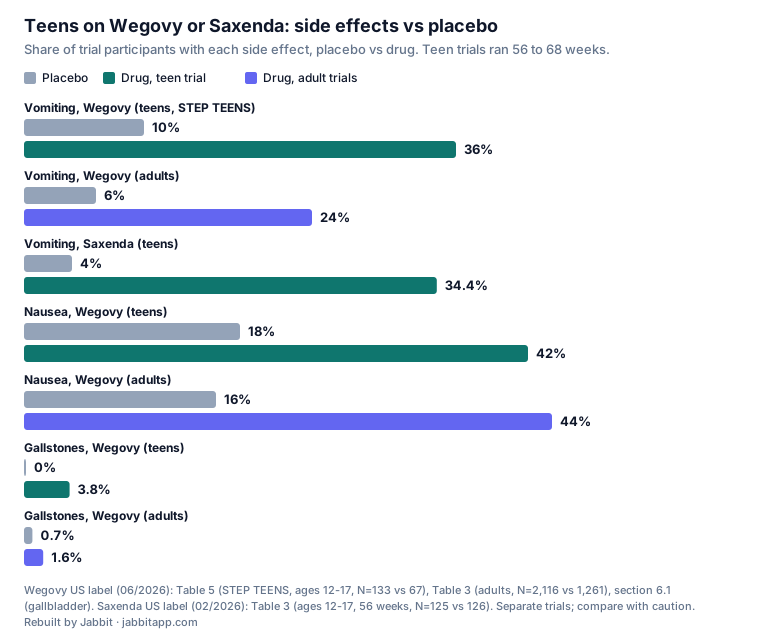
On Saxenda, 34.4% of teens vomited vs 4% on placebo, and low blood sugar with symptoms was reported in 15.2% vs 4%, even though none of these teens had diabetes. One teen on Saxenda (0.8%) had pancreatitis and stopped treatment.[5] In the liraglutide trial, 10.4% stopped because of side effects vs none on placebo.[6] In youth with type 2 diabetes, the Mounjaro label lists more vomiting, belly pain and low blood sugar than in adults.[9] For context on managing nausea in adults, see our teardown of tradipitant for GLP-1 vomiting.
Mood and suicidal thoughts
This is a common worry. The evidence so far is reassuring but limited. The 2025 meta-analysis of randomized trials found no significant difference in suicidal thoughts or behaviors vs placebo, over short follow-up.[17] A 2026 meta-analysis of 11 studies (about 10,175 adolescents) found GLP-1 drugs “were not associated with higher rates of suicidal behaviour or depression,” and said a possible lower risk “should be interpreted cautiously.”[19] Two health-record studies found lower rates of suicidal thoughts or attempts in teens starting a GLP-1 than in matched teens on lifestyle programs (hazard ratios 0.67 and 0.74).[18][20] These are observational. Teens who get a prescription may differ in ways the matching misses, and in one study the result was not significant when compared with metformin instead.[20] In the liraglutide trial, one suicide occurred in the drug group; the investigator assessed it as “unlikely to be related to the trial treatment.”[6] For adults, see our review of GLP-1 drugs and mood.
What happens when teens stop
The liraglutide teen trial followed participants for 26 weeks after stopping. BMI scores rose more in the liraglutide group than in the placebo group after discontinuation.[6] Emily Noble of the University of Georgia told UGA Today that “weight loss often rebounds when you go off the medication.”[23] A Novo Nordisk trial testing how to keep weight off in 12- to 15-year-olds, STEP TEENS Weight Maintenance, has an estimated primary completion in November 2028.[16] In practice, a teen who starts may face years of treatment or a likely regain. See also what happens when you stop Ozempic, Wegovy or Zepbound.
The longevity question
A drug started at 13 could be taken for decades, so the healthy-aging question is bigger here than in adults. WHO reports that obesity among 5- to 19-year-olds rose from 2% in 1990 to 8%, about 170 million young people in 2024.[11] Lowering BMI and insulin resistance in the teen years could plausibly matter for adult heart and metabolic health, but no pediatric trial has measured those long-term outcomes.[17] A 2026 review from the University of Georgia lists “critical knowledge gaps” on “growth, pubertal development, cognition, neural reward processing, and lifelong energy balance regulation.”[22] Noble also asked whether children losing weight on these drugs are “also losing muscle mass.”[23] That is Jabbit’s analysis of the gap: the short-term benefit is well measured, and the long-term trade-off is not. For adults, see muscle loss on GLP-1s and bone density.
What a careful reader should notice
- The main trials were funded by the companies that sell the drugs: STEP TEENS and the liraglutide trial by Novo Nordisk, SURPASS-PEDS by Eli Lilly.[2][6][10]
- STEP Young numbers come from a company release, not a peer-reviewed paper, and the headline figure assumes every child kept taking the drug.[12]
- Trials lasted about a year or less; the pooled median was 0.51 years.[17]
- STEP TEENS added a 12-week lifestyle run-in, and WHO expects supervised lifestyle care first. Results without that support may differ.[1][11]
- The mood findings that look protective are observational and could reflect who gets prescribed.[20]
- The 594% rise in dispensing covers ages 12 to 25, and the letter had no data on why the drugs were prescribed.[21]
Questions parents ask
- Can a 12-year-old take Wegovy?
- In the US, the Wegovy injection is approved for obesity from age 12. WHO advises that drugs for ages 10 to 19 be considered only after a supervised lifestyle program has not worked. The decision belongs to the family and the child’s doctor.
- Is Zepbound or Ozempic approved for teenagers?
- No. Both labels say safety and effectiveness have not been established in pediatric patients. Mounjaro, which contains the same drug as Zepbound, is approved for type 2 diabetes from age 10. Tirzepatide trials in teens with obesity are underway.
- How much weight do teens lose on Wegovy?
- In the STEP TEENS trial, BMI fell 16.1% on Wegovy over 68 weeks and rose 0.6% on placebo. About 45% moved below the obesity cutoff, compared with 12% on placebo.
- Are the side effects worse in teens than in adults?
- Some are. The Wegovy label says teens had more gallstones, gallbladder inflammation, low blood pressure, rash and hives than adults. Vomiting affected 36% of teens on Wegovy, compared with 24% of adults.
- Do GLP-1 drugs affect growth or puberty?
- Nobody knows the long-term answer yet. Novo Nordisk says STEP Young found no safety concerns for growth or puberty in children aged 6 to under 12, but full results are not published. Researchers list growth, puberty and brain development as open questions.
- Does the weight come back if a teen stops?
- In the liraglutide teen trial, BMI rose more after stopping the drug than after stopping placebo. A trial on keeping weight off in teens is not expected to finish its main phase until 2028.
Bottom line
For teens with obesity, Wegovy and Saxenda are approved from age 12, and the trials show large, real drops in BMI and improvements in insulin resistance. Teens also had more vomiting and gallbladder problems than adults, weight tends to return after stopping, and the trials are too short to show effects on growth, puberty, the brain or adult health. Zepbound and Ozempic are not approved for anyone under 18, and WHO advises against weight-loss drugs before age 10. Watch for the full STEP Young results in mid-November and the first SURMOUNT-ADOLESCENTS data.
References
- Wegovy (semaglutide) US prescribing information, Revised 06/2026 (FDA Reference ID 5819850). Indicated for “Adults and pediatric patients aged 12 years and older with obesity.” Table 5 (STEP TEENS, placebo N=67 vs Wegovy injection N=133): nausea 18% vs 42%, vomiting 10% vs 36%, diarrhea 19% vs 22%, abdominal pain 6% vs 15%, dizziness 3% vs 8%, anxiety 2% vs 4%, hair loss 0% vs 4%, cholelithiasis 0% vs 4%, rash 0% vs 3%, urticaria 0% vs 3%. Table 3 (adults, placebo N=1,261 vs N=2,116): nausea 16% vs 44%, vomiting 6% vs 24%. Section 6.1: in the pediatric trial “cholelithiasis was reported by 3.8% of WEGOVY injection-treated patients and 0% placebo-treated patients. Cholecystitis was reported by 0.8%” vs 0%; in adults, cholelithiasis 1.6% vs 0.7%. Section 8.4: “Pediatric patients aged 12 years and older treated with WEGOVY injection had greater incidences of cholelithiasis, cholecystitis, hypotension, rash, and urticaria compared to adults treated with WEGOVY.” “The safety of WEGOVY tablets and WEGOVY 7.2 mg injection have not been established in pediatric patients.” Section 14 (Study 10): “201 pubertal pediatric patients aged 12 years and older”; “After a 12-week lifestyle run-in period”; Table 18: BMI +0.6% vs −16.1%; body weight +2.7% vs −14.7%. https://www.accessdata.fda.gov/drugsatfda_docs/label/2026/215256s025lbl.pdf. Checked October 27, 2026.
- Weghuber D, Barrett T, Barrientos-Pérez M, et al. Once-Weekly Semaglutide in Adolescents with Obesity. N Engl J Med. 2022;387(24):2245-2257. PMID 36322838. STEP TEENS randomized trial, ages 12 to under 18, 68 weeks. Abstract: “A total of 201 participants underwent randomization, and 180 (90%) completed treatment”; “The mean change in BMI from baseline to week 68 was -16.1% with semaglutide and 0.6% with placebo (estimated difference, -16.7 percentage points”; 73% vs 18% lost 5% or more; “The incidence of gastrointestinal adverse events was greater with semaglutide than with placebo (62% vs. 42%)”; “Five participants (4%) in the semaglutide group and no participants in the placebo group had cholelithiasis”; serious adverse events 11% vs 9%. “(Funded by Novo Nordisk; STEP TEENS ClinicalTrials.gov number, NCT04102189.)” Abstract read. https://pubmed.ncbi.nlm.nih.gov/36322838/. Checked October 27, 2026.
- Kelly AS, Arslanian S, Hesse D, et al. Reducing BMI below the obesity threshold in adolescents treated with once-weekly subcutaneous semaglutide 2.4 mg. Obesity (Silver Spring). 2023;31(8):2139-2149. PMID 37196421. STEP TEENS post hoc analysis. Abstract: “44.9% of participants receiving semaglutide achieved weight reduction resulting in reclassification to a normal-weight or overweight BMI category versus 12.1% receiving placebo at week 68”; “The proportion of semaglutide-treated participants in obesity class III decreased from 37.3% to 13.6% but increased with placebo.” Abstract read. https://pubmed.ncbi.nlm.nih.gov/37196421/. Checked October 27, 2026.
- Arslanian S, Gies I, Goldman B, et al. Effect of Semaglutide on Insulin Sensitivity and Cardiometabolic Risk Factors in Adolescents With Obesity: The STEP TEENS Study. Diabetes Care. 2026;49(6):954-962. PMID 41296499. STEP TEENS secondary analysis, 193 participants without type 2 diabetes. Abstract: HOMA-IR insulin resistance “(-35.0% vs. -5.3%; P = 0.0002)” and liver enzyme “(ALT; -17.9% vs. -3.3%; P = 0.0232).” Abstract read. https://pubmed.ncbi.nlm.nih.gov/41296499/. Checked October 27, 2026.
- Saxenda (liraglutide) US prescribing information, Novo Nordisk, DailyMed set 3946d389-0926-4f77-a708-0acb8153b143, version effective February 25, 2026 (read via openFDA). Indicated for “Adults and pediatric patients aged 12 years and older with body weight greater than 60 kg and obesity.” Table 3 (pediatric patients, 56-week trial, placebo N=126 vs Saxenda N=125): nausea 14.3% vs 42.4%, vomiting 4% vs 34.4%, hypoglycemia 4% vs 15.2% (defined as blood glucose under 70 mg/dL with symptoms; “Pediatric patients did not have type 2 diabetes mellitus”), depression 2.4% vs 4%. “Pancreatitis was reported in 1 (0.8%) SAXENDA-treated patient and resulted in treatment discontinuation.” https://dailymed.nlm.nih.gov/dailymed/drugInfo.cfm?setid=3946d389-0926-4f77-a708-0acb8153b143. Checked October 27, 2026.
- Kelly AS, Auerbach P, Barrientos-Perez M, et al. A Randomized, Controlled Trial of Liraglutide for Adolescents with Obesity. N Engl J Med. 2020;382(22):2117-2128. PMID 32233338. Liraglutide in adolescents, 251 participants, 56 weeks of treatment then 26 weeks off. Abstract: BMI difference “-4.64 percentage points”; “After discontinuation, a greater increase in the BMI standard-deviation score was observed with liraglutide than with placebo (estimated difference, 0.15; 95% CI, 0.07 to 0.23)”; gastrointestinal adverse events “(81 of 125 [64.8%] vs. 46 of 126 [36.5%])”; stopping treatment for adverse events “(13 [10.4%] vs. 0)”; “One suicide, which occurred in the liraglutide group, was assessed by the investigator as unlikely to be related to the trial treatment.” “(Funded by Novo Nordisk; NN8022-4180 ClinicalTrials.gov number, NCT02918279.)” Abstract read. https://pubmed.ncbi.nlm.nih.gov/32233338/. Checked October 27, 2026.
- Zepbound (tirzepatide) US prescribing information, Eli Lilly, DailyMed set 487cd7e7-434c-4925-99fa-aa80b1cc776b, version effective August 28, 2026 (read via openFDA): “The safety and effectiveness of ZEPBOUND have not been established in pediatric patients.” https://dailymed.nlm.nih.gov/dailymed/drugInfo.cfm?setid=487cd7e7-434c-4925-99fa-aa80b1cc776b. Checked October 27, 2026.
- Ozempic (semaglutide) injection US prescribing information, Novo Nordisk, DailyMed set adec4fd2-6858-4c99-91d4-531f5f2a2d79, version effective June 1, 2026 (read from the DailyMed SPL file), section 8.4: “Safety and efficacy of OZEMPIC have not been established in pediatric patients.” https://dailymed.nlm.nih.gov/dailymed/drugInfo.cfm?setid=adec4fd2-6858-4c99-91d4-531f5f2a2d79. Checked October 27, 2026.
- Mounjaro (tirzepatide) US prescribing information, Eli Lilly, DailyMed set d2d7da5d-ad07-4228-955f-cf7e355c8cc0, version effective August 27, 2026 (read via openFDA). Indicated “as an adjunct to diet and exercise to improve glycemic control in adults and pediatric patients 10 years of age and older with type 2 diabetes mellitus.” Section 8.4: adverse reactions in these pediatric patients “were similar to those reported in adults with the exception of a higher incidence of vomiting, abdominal pain, and hypoglycemia”; “The safety and effectiveness of MOUNJARO have not been established in pediatric patients less than 10 years of age.” Mounjaro is not approved for weight loss. https://dailymed.nlm.nih.gov/dailymed/drugInfo.cfm?setid=d2d7da5d-ad07-4228-955f-cf7e355c8cc0. Checked October 27, 2026.
- Hannon TS, Chao LC, Barrientos-Pérez M, et al. Efficacy and safety of tirzepatide in children and adolescents with type 2 diabetes (SURPASS-PEDS): a randomised, double-blind, placebo-controlled, phase 3 trial. Lancet. 2025;406(10511):1484-1496. PMID 40975112. SURPASS-PEDS randomized trial of tirzepatide in youth-onset type 2 diabetes, 30 weeks plus a 22-week open-label extension. Abstract: 99 participants, “mean age 14·7 years”; HbA1c “(estimated treatment difference -2·28%; 95% CI -2·87 to -1·69; p<0·0001)”; “Tirzepatide also resulted in significant reductions in BMI of 7·4% and 11·2% for the 5 mg and 10 mg groups, respectively, compared with 0·4% in the placebo group at 30 weeks.” The abstract’s funding section lists “Eli Lilly and Company.” Abstract read. https://pubmed.ncbi.nlm.nih.gov/40975112/. Checked October 27, 2026.
- World Health Organization. “WHO issues first global guidelines on child and adolescent obesity.” News release, 7 October 2026: “WHO does not recommend pharmacological treatment, bariatric surgery (weight-loss surgery that changes the stomach or digestive tract) or weight-loss devices for children aged 0–9 years.” “For adolescents aged 10–19 years, treatment with approved medicines may be considered only when a supervized multimodal lifestyle programme has not achieved the desired results.” “WHO strongly recommends structured dietary, physical activity and behaviour-changing interventions.” “In 2024, 170 million children and adolescents aged 5–19 years were living with obesity”; “Obesity prevalence in this age group has quadrupled since 1990, rising from 2% to 8%.” Luz María De Regil, WHO: “The foundation of obesity care for children and adolescents is not medicine or surgery, but access to comprehensive support that enables healthy eating, physical activity and sustainable behaviour change.” https://www.who.int/news/item/07-10-2026-who-issues-first-global-guidelines-on-child-and-adolescent-obesity. Guideline publication page: https://www.who.int/publications/i/item/9789240123878. Checked October 27, 2026.
- Novo Nordisk. “40 percent of children living with obesity achieved a BMI below the obesity threshold with semaglutide and lifestyle modification.” Company announcement, Bagsværd, Denmark, 7 September 2026 (company-reported topline results; not peer-reviewed). STEP Young, 165 children aged 6 to under 12, 68 weeks: “40.4% * of those treated with semaglutide were no longer classified as having obesity ** at week 68, compared with none of those treated with placebo,” where * means “Based on the trial product estimand: treatment effect if all children adhered to treatment”; “At baseline, more than 85% of the children had either class II or III severe obesity”; “Furthermore, no safety concerns were identified for growth or pubertal development.” The trial “is conducted according to regulatory authorities’ post marketing requirements.” “Detailed STEP Young results will be presented at The Obesity Society’s annual meeting ObesityWeek 2026, 14-17 November in Washington DC.” https://www.novonordisk.com/news-and-media/news-and-ir-materials/40-percent-of-children-achieved-BMI-below-obesity-threshold-with-semaglutide.html. Checked October 27, 2026.
- ClinicalTrials.gov record NCT05726227 (STEP Young), API v2, read October 27, 2026: “A Research Study on How Well Semaglutide Helps Children and Teenagers With Excess Body Weight Lose Weight”; sponsor Novo Nordisk; ages 6 to 18; status Active, not recruiting; enrollment 212 (actual); primary completion October 15, 2025 (actual); study completion December 7, 2026 (estimated). https://clinicaltrials.gov/study/NCT05726227. Checked October 27, 2026.
- ClinicalTrials.gov record NCT06075667 (SURMOUNT-ADOLESCENTS), API v2, read October 27, 2026: “A Study of Tirzepatide (LY3298176) Once Weekly in Adolescent Participants Who Have Obesity or Overweight With Weight-Related Comorbidities”; sponsor Eli Lilly; ages 12 to 17; status Active, not recruiting; enrollment 160 (actual); primary completion June 2, 2026 (actual); study completion July 2029 (estimated); no results posted. https://clinicaltrials.gov/study/NCT06075667. Checked October 27, 2026.
- ClinicalTrials.gov record NCT06439277 (SURMOUNT-ADOLESCENTS-2), API v2, read October 27, 2026: sponsor Eli Lilly; ages 12 to 17; status Recruiting; estimated enrollment 300; estimated primary completion October 2027. https://clinicaltrials.gov/study/NCT06439277. Checked October 27, 2026.
- ClinicalTrials.gov record NCT06571383 (STEP TEENS Weight Maintenance), API v2, read October 27, 2026: “STEP TEENS Weight Maintenance: A Research Study on How Well Semaglutide Helps Teenagers With Excess Body Weight to Lose Weight and Maintain Weight Loss”; sponsor Novo Nordisk; ages 12 to 15; status Active, not recruiting; estimated enrollment 500; estimated primary completion November 15, 2028. https://clinicaltrials.gov/study/NCT06571383. Checked October 27, 2026.
- Kotecha P, Huang W, Yeh YY, et al. Efficacy and Safety of GLP-1 RAs in Children and Adolescents With Obesity or Type 2 Diabetes: A Systematic Review and Meta-Analysis. JAMA Pediatr. 2025;179(12):1308-1317. PMID 40952752. Systematic review and meta-analysis of randomized trials in children and adolescents under 18 with obesity, prediabetes or type 2 diabetes. Abstract: “In this systematic review and meta-analysis of 18 trials”; “A total of 18 RCTs (11 in obesity, 6 in T2D, and 1 in prediabetes) with 1402 participants”; “median [IQR] treatment duration, 0.51 [0.25-1.00] years”; body weight “(-3.02 kg; 95% CI, -4.98 to -1.06)” vs placebo; “Other AEs, including suicidal ideation or behaviors, showed no significant differences”; “Available data over a relatively short follow-up suggested suicidal ideation or behaviors were not significantly different, although GI AEs warrant attention in long-term management.” Abstract read. https://pubmed.ncbi.nlm.nih.gov/40952752/. Checked October 27, 2026.
- Kerem L, Stokar J. Risk of Suicidal Ideation or Attempts in Adolescents With Obesity Treated With GLP1 Receptor Agonists. JAMA Pediatr. 2024;178(12):1307-1315. PMID 39401009. Retrospective TriNetX health-record cohort, adolescents 12 to 18 with obesity. Abstract: “Propensity score matching resulted in 3456 participants in each balanced cohort”; “Prescription of GLP1R was associated with a 33% reduced risk for suicidal ideation or attempts over 12 months of follow-up (1.45% vs 2.26%; hazard ratio [HR], 0.67; 95% CI, 0.47-0.95; P = .02)” vs lifestyle intervention; and “a higher rate of GI symptoms (6.9% vs 5.4%”. Observational; cannot prove cause. Abstract read. https://pubmed.ncbi.nlm.nih.gov/39401009/. Checked October 27, 2026.
- Silva CFXCA, de Souza BL, Thomazini G, et al. GLP-1 Receptor Agonists and Psychiatric Outcomes in Adolescents: A Systematic Review and Meta-Analysis. Diabetes Obes Metab. 2026;28(8):6735-6743. PMID 42115753. Systematic review and meta-analysis of psychiatric outcomes in adolescents. Abstract: “We included 11 studies (9 RCTs, n = 1253; 2 observational, n = 8922; total n = 10 175)”; “GLP-1 RAs were not associated with higher rates of suicidal behaviour or depression in adolescents”; the possible lower risk of suicidal ideation “should be interpreted cautiously.” Abstract read. https://pubmed.ncbi.nlm.nih.gov/42115753/. Checked October 27, 2026.
- Liu TH, Shen YL, Kuo TH, et al. Psychiatric Safety of GLP-1 and Dual GIP/GLP-1 Receptor Agonists in Adolescents With Obesity. Diabetes Obes Metab. 2026. PMID 42736027. Retrospective TriNetX cohort of adolescents starting semaglutide, liraglutide or tirzepatide vs lifestyle intervention. Abstract: “After propensity score matching, 9222 adolescents were included in each group”; “lower risks of suicide-related events (HR, 0.74; 95% CI, 0.57-0.95)”; “No significant differences were observed for suicide attempt, insomnia, depression, or eating disorders”; the finding “should be interpreted cautiously given potential selection bias and the lack of a significant difference in the active-comparator analysis with metformin.” Abstract read. https://pubmed.ncbi.nlm.nih.gov/42736027/. Checked October 27, 2026.
- Lee JM, Sharifi M, Oshman L, et al. Dispensing of Glucagon-Like Peptide-1 Receptor Agonists to Adolescents and Young Adults, 2020-2023. JAMA. 2024;331(23):2041-2043. PMID 38776113. Research letter; IQVIA prescription data from 93.6% of US retail pharmacies, ages 12 to 25. Full text read via PMC: “Between 2020 and 2023, the number of adolescents and young adults with GLP-1RA dispensing increased from 8722 to 60 567 (594.4%)”; “The number of male adolescents with GLP-1RA dispensing increased from 692 to 4178 (503.8%) and the number of female adolescents increased from 961 to 6607 (587.5%)”; of dulaglutide, exenatide and liraglutide, “The first 3 are approved for type 2 diabetes in adolescents”; the authors cite “the absence of data regarding the health effects of long-term use”; “Limitations of this study include lack of data on prescription indication, including whether it was used off label.” Full text: https://pmc.ncbi.nlm.nih.gov/articles/PMC11112492/ https://pubmed.ncbi.nlm.nih.gov/38776113/. Checked October 27, 2026.
- Mills AM, Noble EE. GLP-1 receptor agonists in adolescent obesity: Incretin-based therapies during a sensitive developmental period. Appetite. 2026;227:108729. PMID 42508693. Narrative review, University of Georgia, published online July 27, 2026. Abstract: “However, the developmental implications and long-term effects have yet to be evaluated”; “critical knowledge gaps remain regarding long-term effects of GLP-1RAs on growth, pubertal development, cognition, neural reward processing, and lifelong energy balance regulation.” doi:10.1016/j.appet.2026.108729. Abstract read. https://pubmed.ncbi.nlm.nih.gov/42508693/. Checked October 27, 2026.
- Peat S. “Are GLP-1s practical and safe for obese adolescents?” UGA Today, University of Georgia, October 26, 2026. Interview with Emily Noble, PhD, co-author of the Appetite review: “They’re approved for 12-year-olds and older, but sometimes people are actually prescribing them even younger in special circumstances”; “When these medications cause weight loss, are these kids also losing muscle mass?”; “it’s also important to know that weight loss often rebounds when you go off the medication.” https://news.uga.edu/glp-1-medications-and-adolescents/. Checked October 27, 2026.
- Jabbit source extract for this page: label text and tables, abstract and release quotes, registry fields and chart values, checked against cached copies on October 27, 2026. https://jabbitapp.com/research/sources/glp1-kids-teens-2026-10-28.json. Checked October 27, 2026.
This page analyzes published trials, FDA labels, trial registries, a WHO guideline release, a company release and a university news article. It is not medical advice and does not recommend any product or dose for any child. Doses are named only as trial arms. Comparisons across separate trials are Jabbit’s analysis. Charts were rebuilt by Jabbit from the sources cited in each caption.