Study teardown · ARA-290 (cibinetide) · The animal studies, every human trial we found, the trial registry records and posted results, FDA and EU orphan designations, FDA’s compounding list, the WADA 2027 list and two 2026 reviews · Sources checked October 26, 2026
Published · Updated
ARA-290 (cibinetide): does the “nerve repair” peptide work, and is it safe? It eased nerve pain in rats, but in people it has been tested only in six small, short trials. Early trials in sarcoidosis and diabetes reported symptom gains; the largest met its main goal in one of three dose groups, and pain improved on placebo too. It is not approved anywhere, and we found no long-term safety data.
ARA-290, also called cibinetide, is an 11-amino-acid peptide built from part of the hormone erythropoietin (EPO). It was designed to keep EPO’s tissue-protecting effects without raising red blood cells.[2] In rats, it gave long-lasting relief of nerve pain.[3][4] Does it work in people? Six human trials, with 9 to 64 people each and 218 in all, mostly treated people for four weeks. Early trials in sarcoidosis and type 2 diabetes reported better symptom scores. In the largest, a 64-person phase 2b, the main nerve-fiber goal was met in one of three dose groups, and pain improved in every group, including placebo.[5][6][7][9] A mood study and an eye study found no benefit.[8][11] Is it safe? The short trials found no clear safety signal, but in two of them serious adverse events occurred only in people on the drug.[7][10] It is not approved anywhere, no trial is active, and FDA lists it among substances nominated for compounding “without adequate support.”[20][13][24]
Why this matters now
ARA-290 is now being grouped with BPC-157, TB-500 and GHK-Cu as a “regenerative peptide.” In August 2026, a review by authors including Brigham and Women’s Hospital affiliations of these peptides for chronic pain concluded that human evidence is limited and that most remain unapproved by FDA.[17] On October 15, 2026, a review of jaw nerve injury described three uncontrolled cases treated with a mix that included ARA-290; its authors say “causality cannot be established” and call peptide treatments “investigational.”[18] FDA’s compounding list, updated in May 2026, places cibinetide in its “without adequate support” category, and WADA’s 2027 list, in force January 1, 2027, bans the drug class it belongs to.[24][25][19] Our analysis: the human trials behind the interest are a decade old, and none has been followed by a larger trial.[13][14]
Timeline
| Date | Event |
|---|---|
| 2004 | Researchers report modified forms of EPO that protect tissue in animals without stimulating red blood cell production.[1] |
| 2008 | An 11-amino-acid peptide from EPO’s “helix B,” later called ARA 290, is reported to protect tissue in animals without raising red cells.[2] |
| 2011 | A rat study reports up to 15 weeks of nerve-pain relief; FDA grants orphan designation for neuropathic pain in sarcoidosis (September 13).[3][20] |
| 2012–2013 | Two small placebo-controlled sarcoidosis trials at Leiden report symptom gains; the EU grants orphan designation for sarcoidosis (October 7, 2013).[5][6][23] |
| 2014 | Araim Pharmaceuticals says FDA granted Fast Track designation for sarcoidosis-associated small fiber neuropathy.[21] |
| 2015 | A 49-person type 2 diabetes trial and a 36-person mood study are published; the sarcoidosis phase 2b finishes.[7][8][10] |
| 2016 | Araim says FDA granted orphan designation for sarcoidosis.[22] |
| 2017 | The phase 2b is published; the Belfast eye trial ends after its study drug expired.[9][12] |
| 2020 | The eye trial is published: no vision benefit in 9 people. This is the last human trial we found.[11][14] |
| 2026 | FDA keeps cibinetide in compounding category 3 (May 14); two reviews call the evidence limited (August, October).[24][17][18] |
What ARA-290 is
EPO is the kidney hormone that tells bone marrow to make red blood cells, and it also protects some tissues from injury. Making more red cells is a problem for that second use, because it can thicken the blood. In 2004 and 2008, researchers reported modified EPO and then a short EPO fragment that kept tissue protection in animals but did not raise red cells.[1][2] The fragment, ARA 290, is thought to act on the “innate repair receptor,” a pairing of the EPO receptor with the β-common receptor (CD131). In mice lacking the β-common receptor, it had no pain-relieving effect.[3][16] Its developer, Araim Pharmaceuticals, holds the FDA and EU orphan designations, and several authors of the trial papers disclose that they were Araim officers or employees with stock or stock options.[20][23][5][6][7]
The evidence, rung by rung
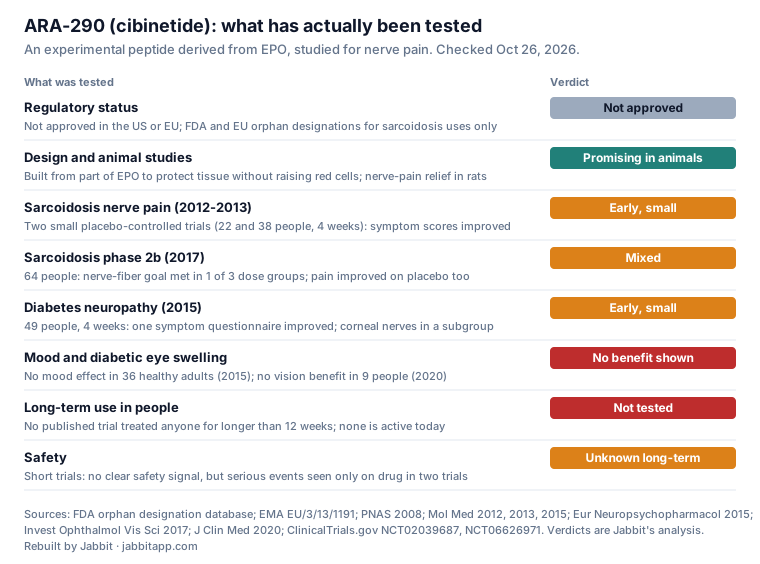
- Animals. In rats with nerve injury, ARA 290 relieved pain for up to 15 weeks, and a second rat study reported up to 20 weeks.[3][4]
- Sarcoidosis pilot (2012). In 22 people with sarcoidosis and small fiber neuropathy, one symptom checklist improved more on ARA 290 than placebo over 4 weeks. Pain and fatigue scores “improved significantly but equivalently in both patient groups,” and depression scores did not change.[5]
- Sarcoidosis trial (2013). In 38 people, 28 days of daily injections improved symptoms, raised corneal nerve fiber density and improved the 6-minute walk test.[6]
- Type 2 diabetes (2015). In 49 people with painful neuropathy, a pain questionnaire improved on ARA 290 vs placebo. Blood sugar (HbA1c) and lipids also improved, and corneal nerves grew in people who started with the fewest.[7]
- Mood (2015). In 36 healthy adults, ARA 290 had no effect on mood, and the authors say the results do not clearly support an antidepressant-like profile.[8]
- Sarcoidosis phase 2b (2017). This 64-person trial is the largest. Its main goal, a gain in corneal nerve fiber area, was statistically significant only in the middle of three dose groups. “Pain improved significantly in all groups,” including placebo.[9] The posted registry averages show pain and symptom changes on placebo in the same range as on the drug, with no statistical tests posted; walking distance rose more in the drug groups than on placebo.[10]
- Diabetic eye swelling (2020). In 9 people with no comparison group, vision, retinal thickness and tear production did not improve over 12 weeks; a questionnaire score did. The trial ended early because the study drug expired.[11][12]
The key trials, in one chart
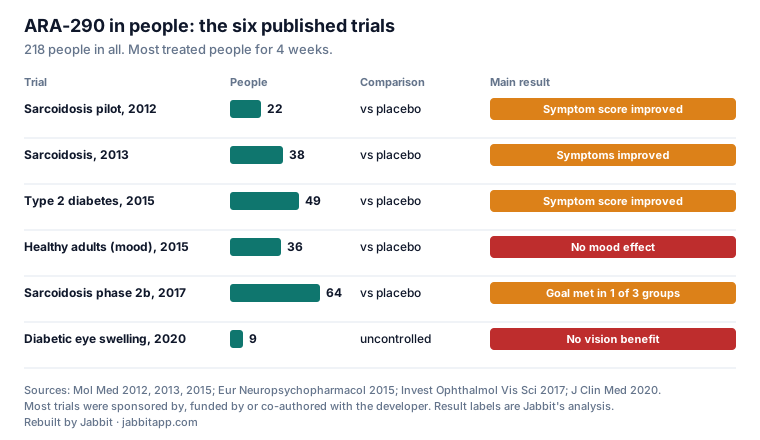
Our analysis: the human evidence is six small trials, almost all four weeks long, and most were run with the developer. The early trials reported gains on questionnaires and corneal nerve scans. When a larger trial came, the nerve-fiber result held in one dose group only, and pain improved about as much on placebo. No larger or longer trial has followed, and the last trial we found ended in 2017 and was published in 2020.[9][10][13][11]
The case for ARA-290, in fairness
The idea is reasonable: EPO protects tissue in animals, and ARA 290 was designed to keep that effect without EPO’s effect on red blood cells.[1][2] The rat pain results were long-lasting, and the effect disappeared in mice lacking the receptor it is thought to act on, which supports the proposed mechanism.[3] Most of the human trials were randomized and placebo-controlled.[5][6][7][9] A 2014 review by the Leiden group, with Araim-affiliated co-authors, said treatment “was consistently associated with a significant improvement of neuropathic pain symptoms” in the two early sarcoidosis trials.[15] Corneal nerve gains appeared in more than one trial, and in the phase 2b they tracked with skin nerve and walking-test changes.[6][9] Regulators in the US and EU granted orphan designations for sarcoidosis uses, which recognize a rare disease with few options; they are not approvals.[20][23] Our analysis: this is a reason for a larger, longer trial, not evidence that ARA-290 repairs nerves in people.
Safety
- Short trials. Most trials treated people for four weeks; the longest lasted 12 weeks. We found no long-term safety data.[6][7][9][11]
- Serious events. In the diabetes trial, all four serious adverse events occurred in the ARA 290 group, and two were judged possibly related, including a worsening of borderline kidney function that led the safety committee to stop the drug in that person; a death from a heart attack after severe cellulitis was judged unrelated. The paper’s abstract says “No potential safety issues were identified.”[7] In the phase 2b, the registry lists serious adverse events in 3 of 46 people on ARA 290, including one report of suicidal ideation, and in 0 of 16 on placebo; it does not say whether the drug caused them.[10]
- Immune reactions. The eye trial reported no serious adverse events and no antibodies against the drug.[11]
- What is unknown. A 2016 review co-written with the developer called for “long-term treatment and follow-up” trials, and a 2026 review lists unresolved questions about safety and long-term outcomes.[16][18]
Purity
No ARA-290 product is approved, so anything sold under that name is not a regulated medicine made to approved standards.[20][23] Our analysis: the trials used a developer-supplied study drug, and their results do not automatically apply to other products. We do not name or rate sellers.
Legal status
ARA-290 is not approved by FDA or in the EU. FDA’s orphan record says “Not FDA Approved for Orphan Indication,” and Araim said in 2014 that FDA granted Fast Track designation, a program for faster review, not an approval.[20][21][23] FDA lists cibinetide in 503A category 3, substances nominated for compounding “without adequate support.”[24] For athletes, WADA’s 2027 list bans “innate repair receptor agonists” at all times. It does not name ARA-290, but an anti-doping lab study calls ARA-290 a prohibited peptide.[25][19]
What a careful reader should notice
These points are our analysis of the sources cited.
- Check the placebo group. In two sarcoidosis trials, pain improved on placebo too, so “pain got better” is not evidence on its own.[5][9]
- Count the dose groups. The largest trial met its main goal in one of three, with no clear pattern of more drug giving more effect.[9]
- Nerve scans are stand-in measures. Corneal nerve area is a surrogate endpoint, not a measure of how people feel or function.[9]
- Read the abstract and the safety section. The diabetes trial’s abstract reports no potential safety issues, while its full text describes four serious events on the drug.[7]
- Read the disclosures. Most trial papers list developer officers or employees with stock or options, or developer funding. That does not make the results wrong, but independent replication matters.[5][6][7][11][16]
- Designations are not approvals. Orphan and Fast Track designations come early in development.[20][21][23]
Frequently asked questions
- What is ARA-290?
- An experimental 11-amino-acid peptide, also called cibinetide, built from part of the hormone EPO to protect tissue without raising red blood cells.[2]
- Does ARA-290 work for nerve pain?
- Not proven. Small early trials reported symptom gains, but in the largest trial pain improved in all groups including placebo, and the main nerve-fiber goal was met in one of three dose groups.[5][6][9]
- Is ARA-290 safe?
- Unknown beyond short use. Trials lasted 4 to 12 weeks; serious adverse events occurred only on the drug in two trials, some judged possibly related.[7][10][11]
- Is ARA-290 FDA approved?
- No. It holds an FDA orphan designation for neuropathic pain in sarcoidosis, and FDA lists it as nominated for compounding “without adequate support.”[20][24]
- Is ARA-290 banned in sport?
- WADA’s 2027 list bans innate repair receptor agonists at all times without naming ARA-290; an anti-doping lab study calls it a prohibited peptide.[25][19]
- Is ARA-290 the same as EPO?
- No. It is a short fragment of EPO designed not to raise red blood cells.[2]
- Are there new ARA-290 trials?
- We found none recruiting or active. The last published trial ended in 2017.[13][12]
Bottom line
ARA-290 has a clear scientific rationale and long-lasting pain relief in rats.[2][3] In people, it has six small, short trials, mostly run with its developer, with promising early signals that did not clearly hold up in the largest trial.[5][6][9][10] It is not approved, no trial is active, and its long-term safety is unknown.[20][13][16]
References
- Leist M, Ghezzi P, Grasso G, et al. Derivatives of erythropoietin that are tissue protective but not erythropoietic. Science. 2004;305(5681):239-42. PMID 15247477. Lab and animal study of modified erythropoietin (EPO); several authors list H. Lundbeck A/S affiliations: “Carbamylated EPO (CEPO) or certain EPO mutants did not bind to the classical EPO receptor (EPOR) and did not show any hematopoietic activity.” Abstract read. https://pubmed.ncbi.nlm.nih.gov/15247477/. Checked October 26, 2026.
- Brines M, Patel NS, Villa P, et al. Nonerythropoietic, tissue-protective peptides derived from the tertiary structure of erythropoietin. Proc Natl Acad Sci U S A. 2008;105(31):10925-30. PMID 18676614. Lab and animal study; authors list Warren Pharmaceuticals affiliations: “an 11-aa peptide composed of adjacent amino acids forming the aqueous face of helix B is also tissue protective”; “neither helix B nor the 11-aa peptide is erythropoietic in vitro or in vivo.” Abstract read. https://pubmed.ncbi.nlm.nih.gov/18676614/. Checked October 26, 2026.
- Swartjes M, Morariu A, Niesters M, et al. ARA290, a peptide derived from the tertiary structure of erythropoietin, produces long-term relief of neuropathic pain: an experimental study in rats and β-common receptor knockout mice. Anesthesiology. 2011;115(5):1084-92. PMID 21873879. Rat and mouse nerve-injury study: “ARA290 produced effective, long-term (as long as 15 weeks) relief of tactile and cold allodynia”; “In contrast, in βcR mice no effect of ARA290 was observed” (mice lacking the β-common receptor). Abstract read. https://pubmed.ncbi.nlm.nih.gov/21873879/. Checked October 26, 2026.
- Swartjes M, van Velzen M, Niesters M, et al. ARA 290, a peptide derived from the tertiary structure of erythropoietin, produces long-term relief of neuropathic pain coupled with suppression of the spinal microglia response. Mol Pain. 2014;10:13. PMID 24529189. Rat study: “ARA290 exerted a dose-response effect by significantly reducing mechanical allodynia up to 20 weeks when compared to vehicle.” Abstract read. https://pubmed.ncbi.nlm.nih.gov/24529189/. Checked October 26, 2026.
- Heij L, Niesters M, Swartjes M, et al. Safety and efficacy of ARA 290 in sarcoidosis patients with symptoms of small fiber neuropathy: a randomized, double-blind pilot study. Mol Med. 2012;18(1):1430-6. PMID 23168581. Leiden University Medical Center-led pilot: “A total of 22 patients diagnosed with sarcoidosis and symptoms of SFN were enrolled in a double-blind, placebo-controlled exploratory trial,” with intravenous ARA 290 or placebo for 4 weeks; “The ARA 290 group showed significant (p < 0.05) improvement at wk 4 in SFNSL score compared with placebo”; “The mean BPI and FAS scores improved significantly but equivalently in both patient groups”; “No change was observed in the IDS” (depression scale); “ARA 290 appears to be safe in patients with sarcoidosis and can reduce neuropathic symptoms.” Disclosure: “A Dunne, M Brines and A Cerami are employees and officers of Araim Pharmaceuticals and own stock and/or stock options.” Abstract and disclosure read: https://pmc.ncbi.nlm.nih.gov/articles/PMC3563705/. https://pubmed.ncbi.nlm.nih.gov/23168581/. Checked October 26, 2026.
- Dahan A, Dunne A, Swartjes M, et al. ARA 290 improves symptoms in patients with sarcoidosis-associated small nerve fiber loss and increases corneal nerve fiber density. Mol Med. 2013;19(1):334-45. PMID 24136731. “Here we show in a blinded, placebo-controlled trial that 28 d of daily subcutaneous administration of ARA 290 in a group of patients with documented SNFLD significantly improves neuropathic symptoms”; “ARA 290 administration was also associated with a significant increase in corneal small nerve fiber density”; the authors call it “a potential disease-modifying agent.” The full text reports 38 people randomized, 21 to ARA 290 and 17 to placebo. Disclosure: “A Dunne, A Cerami and M Brines are employees of Araim Pharmaceuticals and have stock or stock options in the company.” Abstract, full text and disclosure read: https://pmc.ncbi.nlm.nih.gov/articles/PMC3883966/. https://pubmed.ncbi.nlm.nih.gov/24136731/. Checked October 26, 2026.
- Brines M, Dunne AN, van Velzen M, et al. ARA 290, a nonerythropoietic peptide engineered from erythropoietin, improves metabolic control and neuropathic symptoms in patients with type 2 diabetes. Mol Med. 2015;20(1):658-66. PMID 25387363. Phase 2 trial in type 2 diabetes with painful neuropathy, 49 enrolled, 28 days of treatment then a month of follow-up. Abstract: “No potential safety issues were identified”; “Neuropathic symptoms as assessed by the PainDetect questionnaire improved significantly in the ARA 290 group”; HbA1c and lipids improved; corneal nerve density rose in the subgroup with the lowest baseline values; the drug “deserves continued clinical evaluation.” Safety section of the full text: “Four serious adverse events were observed in the ARA 290 treatment arm”; two were judged unlikely to be related and “The remaining two were judged to be possibly related to ARA 290 administration,” including a worsening of borderline kidney function, after which “The safety committee stopped ARA 290 administration”; a subject who developed severe cellulitis “suffered a fatal myocardial infarction. The safety committee judged the event to be unrelated to ARA 290 treatment.” Disclosure: “M Brines, AN Dunne, and A Cerami are officers of Araim Pharmaceuticals and own stock and/or stock options.” Abstract, full text and disclosure read: https://pmc.ncbi.nlm.nih.gov/articles/PMC4365069/. https://pubmed.ncbi.nlm.nih.gov/25387363/. Checked October 26, 2026.
- Cerit H, Veer IM, Dahan A, et al. Testing the antidepressant properties of the peptide ARA290 in a human neuropsychological model of drug action. Eur Neuropsychopharmacol. 2015;25(12):2289-99. PMID 26431906. Randomized, double-blind study in which “Healthy participants (N=36) received ARA290” or placebo, assessed one week later: “No effects were observed on mood and affective symptoms”; “the direction and the strength of its effects do not unequivocally support an antidepressant-like profile for ARA290.” Registry https://clinicaltrials.gov/study/NCT02070783 (lead sponsor Leiden University Medical Center; completed). Abstract read. https://pubmed.ncbi.nlm.nih.gov/26431906/. Checked October 26, 2026.
- Culver DA, Dahan A, Bajorunas D, et al. Cibinetide Improves Corneal Nerve Fiber Abundance in Patients With Sarcoidosis-Associated Small Nerve Fiber Loss and Neuropathic Pain. Invest Ophthalmol Vis Sci. 2017;58(6):BIO52-BIO60. PMID 28475703. “This phase 2b, 28-day, randomized trial of 64 subjects with sarcoid-associated SNFL and neuropathic pain” compared three dose levels of cibinetide with placebo; “The primary study endpoint was a change in CNFA at 28 days” (corneal nerve fiber area). The placebo-corrected change was statistically significant in the middle-dose group (P = 0.012); the confidence intervals for the low- and high-dose groups included zero. “Pain improved significantly in all groups”; in people with moderate-to-severe pain, the middle-dose group’s placebo-corrected decrease in pain had P = 0.157. Authors list affiliations including Cleveland Clinic and Araim Pharmaceuticals. Abstract read; the journal full text was not accessible to us. https://pubmed.ncbi.nlm.nih.gov/28475703/. Checked October 26, 2026.
- ClinicalTrials.gov, NCT02039687 (ARA 290 in sarcoidosis small fiber neuropathy), lead sponsor Araim Pharmaceuticals, Inc.; completed; 64 enrolled; results posted. Posted average changes at day 28, placebo vs the three ARA 290 groups (low, middle, high): Brief Pain Inventory pain severity −0.92 vs −0.59, −1.17, −1.12; pain interference −1.73 vs −1.19, −1.66, −1.31; SFNSL symptom score −7.3 vs −4.9, −8.7, −5.5; skin nerve fiber density (IENFD) +0.8 vs +0.5, +0.4, −0.3; 6-minute walk distance +1.2 vs +19.3, +17.7, +18.2 meters. The record posts no statistical comparisons for these outcomes. Serious adverse events: 3 of 46 people on ARA 290 (including one report of suicidal ideation) vs 0 of 16 on placebo; the registry does not say whether they were caused by the drug. https://clinicaltrials.gov/study/NCT02039687. Data: https://jabbitapp.com/research/sources/ara-290-2026-10-26.json. Checked October 26, 2026.
- Lois N, Gardner E, McFarland M, et al. A Phase 2 Clinical Trial on the Use of Cibinetide for the Treatment of Diabetic Macular Edema. J Clin Med. 2020;9(7). PMID 32674280. Belfast single-arm phase 2 trial in diabetic macular edema (swelling at the back of the eye), 12 weeks of treatment: “Nine patients were recruited; eight completed the study”; “There was no improvement in mean change baseline-week 12 in BCVA” (best corrected visual acuity), retinal thickness, retinal sensitivity or tear production, while a vision-function questionnaire score improved; “No serious adverse events/reactions or anti-cibinetide antibodies were seen.” Funding: “This research was funded in part by Araim Pharmaceuticals”; disclosure: four authors “are officers and own stock in Araim Pharmaceuticals, which is developing cibinetide for clinical use.” Abstract and disclosures read: https://pmc.ncbi.nlm.nih.gov/articles/PMC7408632/. https://pubmed.ncbi.nlm.nih.gov/32674280/. Checked October 26, 2026.
- ClinicalTrials.gov, NCT06626971 (cibinetide in diabetic macular edema), lead sponsor Belfast Health and Social Care Trust, collaborator Araim Pharmaceuticals, Inc.; status “Terminated”; why stopped: “Expiry of study drug - no replacement available.”; 9 enrolled; started April 2016, ended August 2017; first posted October 2024. https://clinicaltrials.gov/study/NCT06626971. Checked October 26, 2026.
- ClinicalTrials.gov API v2 searches for ARA-290, ARA 290, ARA290 and cibinetide, October 26, 2026: four relevant records, NCT02039687 (completed), NCT02070783 (completed), NCT06626971 (terminated) and NCT01933529 (type 2 diabetes and prediabetes; status “Unknown,” last updated 2015; no results posted). None is recruiting or active. One unrelated record that matched the number 290 was excluded. Statuses: https://jabbitapp.com/research/sources/ara-290-2026-10-26.json. Checked October 26, 2026.
- PubMed searches, October 26, 2026: ARA290, ARA 290, ARA-290 or cibinetide in title or abstract, 76 records; the same limited to clinical or randomized trials, 5 records (PMIDs 23168581, 24136731, 25387363, 26431906, 28475703). The 2020 eye trial (PMID 32674280) is not tagged as a trial in PubMed. Queries and IDs: https://jabbitapp.com/research/sources/ara-290-2026-10-26.json. Checked October 26, 2026.
- van Velzen M, Heij L, Niesters M, et al. ARA 290 for treatment of small fiber neuropathy in sarcoidosis. Expert Opin Investig Drugs. 2014;23(4):541-50. PMID 24555851. Review by Leiden University Medical Center authors with Araim-affiliated co-authors, of “recent data from two Phase II clinical trials”: “ARA 290 treatment was consistently associated with a significant improvement of neuropathic pain symptoms in sarcoidosis patients.” Abstract read. https://pubmed.ncbi.nlm.nih.gov/24555851/. Checked October 26, 2026.
- Dahan A, Brines M, Niesters M, et al. Targeting the innate repair receptor to treat neuropathy. Pain Rep. 2016;1(1):e566. PMID 29392190. Review: “Further clinical trials with long-term treatment and follow-up are needed to assess the full potential of IRR activation by ARA290 as a disease-modifying therapy in neuropathy of various etiologies.” Disclosure: “Leiden University received financial support from ARAIM Pharmaceuticals, Inc, to perform experimental and clinical studies on ARA290.” Abstract and disclosure read. https://pubmed.ncbi.nlm.nih.gov/29392190/. Checked October 26, 2026.
- Luansritisakul C, Chiang MC, Burns SL, et al. Peptides in Regenerative Medicine: A Comprehensive Review of Clinical Applications in Tissue Repair and Chronic Pain Management. Curr Pain Headache Rep. 2026;30(1). PMID 42635865. Narrative review by authors including Brigham and Women’s Hospital affiliations, of “regenerative peptides” for chronic pain, covering BPC-157, TB-500, GHK-Cu and cibinetide (ARA-290), among others; PubMed date August 2026: “evidence regarding the role of regenerative peptides in chronic pain management remains limited”; “because most of these therapies remain unapproved by the U.S. Food and Drug Administration (FDA) and clinical evidence in humans is limited,” their use “should be guided by careful clinical judgment.” “The authors declare no competing interests.” Abstract read. https://pubmed.ncbi.nlm.nih.gov/42635865/. Checked October 26, 2026.
- Froum S, Estrin N, Pico G, et al. Case Report: Regenerative peptides for Inferior alveolar nerve injury: a narrative review with hypothesis-generating three clinical cases. Front Oral Health. 2026;7:1907109. PMID 42876687. Narrative review with “three hypothesis-generating clinical cases” of jaw nerve (inferior alveolar nerve) injury treated with a multimodal approach that included peptide agents among them ARA-290; PubMed date October 15, 2026: “spontaneous recovery and other confounding factors cannot be excluded, and causality cannot be established”; “peptide-based interventions remain investigational, with unresolved questions concerning safety, delivery, optimal dosing, and long-term outcomes.” The authors report no commercial or financial relationships. Abstract read. https://pubmed.ncbi.nlm.nih.gov/42876687/. Checked October 26, 2026.
- Thomas A, Knoop A, Schänzer W, et al. Characterization of in vitro generated metabolites of selected peptides <2 kDa prohibited in sports. Drug Test Anal. 2017;9(11-12):1799-1803. PMID 28941172. Anti-doping laboratory study (German Sport University Cologne, Center for Preventive Doping Research): “The prohibited peptides ARA-290, GHRP-3, and Peforelin, with a to-date unknown metabolism, were chosen as model compounds.” Abstract read. https://pubmed.ncbi.nlm.nih.gov/28941172/. Checked October 26, 2026.
- U.S. Food and Drug Administration, Search Orphan Drug Designations and Approvals, record for the peptide L-pyr-L-glu-L-gln-L-leu-L-glu-L-arg-L-ala-L-leu-L-asn-L-ser-L-ser (ARA 290), sponsor Araim Pharmaceuticals, Inc.: date designated September 13, 2011; designation “Treatment of neuropathic pain in patients with sarcoidosis”; status “Designated”; “Not FDA Approved for Orphan Indication.” https://www.accessdata.fda.gov/scripts/opdlisting/oopd/detailedIndex.cfm?cfgridkey=349111. Checked October 26, 2026.
- Araim Pharmaceuticals press release (PR Newswire), October 28, 2014; company statement: Araim “today announced a Fast Track Designation from the FDA for its lead compound ARA290, for treatment of Sarcoidosis-associated Small Fiber Neuropathy (SFN).” https://www.prnewswire.com/news-releases/araim-pharmaceuticals-given-fda-fast-track-designation-to-ara-290-for-the-treatment-of-sarcoidosis-associated-small-fiber-neuropathy-280635872.html. Checked October 26, 2026.
- Araim Pharmaceuticals press release (PR Newswire), July 5, 2016; company statement: Araim “today announced that the US Food and Drug Administration (FDA) has granted Orphan Drug Designation for its lead product candidate, Innate Repair Receptor activator ARA 290, for the treatment of sarcoidosis.” https://www.prnewswire.com/news-releases/araim-pharmaceuticals-receives-orphan-drug-designation-from-the-us-fda-for-ara-290-for-the-treatment-of-sarcoidosis-300293773.html. Checked October 26, 2026.
- European Medicines Agency, orphan designation EU/3/13/1191: “On 7 October 2013, orphan designation (EU/3/13/1191) was granted by the European Commission to Araim Pharma Europe Ltd, United Kingdom” for the treatment of sarcoidosis; “This medicine is now known as cibinetide.”; “The sponsorship was transferred to Araim Pharmaceuticals Europe Limited, Ireland, in April 2019.” EMA: the assumption of significant benefit “will need to be confirmed at the time of marketing authorisation.” https://www.ema.europa.eu/en/medicines/human/orphan-designations/eu-3-13-1191. Checked October 26, 2026.
- FDA. Bulk Drug Substances Nominated for Use in Compounding Under Section 503A, updated May 14, 2026: “Cibinetide (ARA-290)” is listed in Category 3, “Bulk Drug Substances Nominated Without Adequate Support.” https://www.fda.gov/media/94155/download. Checked October 26, 2026.
- World Anti-Doping Agency, 2027 Prohibited List (in force January 1, 2027): class S2 is “PROHIBITED AT ALL TIMES (IN- AND OUT-OF-COMPETITION)” and lists “S2.1.5 Innate repair receptor agonists, e.g. asialo EPO; carbamylated EPO (CEPO).”; the class covers “other substances with similar chemical structure or similar biological effect(s).” ARA-290 and cibinetide are not named on the list. https://www.wada-ama.org/sites/default/files/2026-09/2027list_en_final_clean_26_august_2026_2.pdf. Text: https://jabbitapp.com/research/sources/ara-290-2026-10-26.json. Checked October 26, 2026.
This page analyzes published studies, regulator documents and registry data. It is not medical or legal advice and does not recommend any product or dose. ARA-290 is not approved to treat any condition. Charts were rebuilt by Jabbit from the sources cited in each caption.