Evidence teardown · Vilon · Vesugen · Cartalax · Bronchogen · Peptides · Healthy aging · Updated October 28, 2026
Published · Updated
Vilon, Vesugen, Cartalax and Bronchogen: what the evidence on Russian “bioregulator” peptides shows
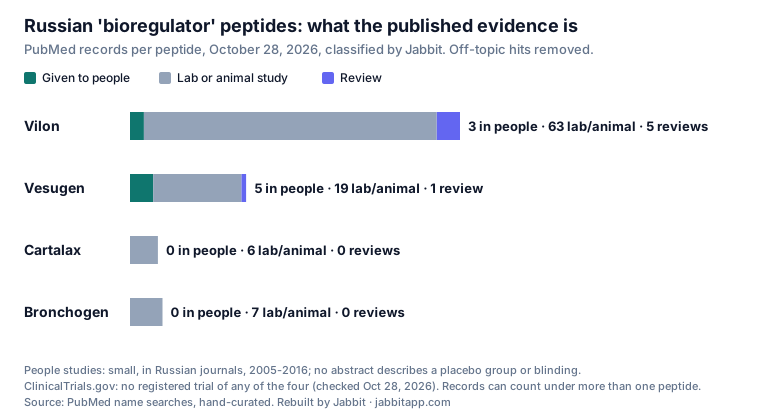
Short Russian peptides sold as “bioregulators” are having a moment on X. One October 23 post about taking “Russian peptides (pinealon, epitalon, vilon)” for deep sleep drew about 241,600 views.[1] Four of the names now circulating, vilon, vesugen, cartalax and bronchogen, are two- to four-amino-acid peptides developed in St Petersburg since the 1990s.[2][3] We sorted all 97 relevant PubMed records for the four names. Our plain answer: the research program is long and consistent, but almost all of it is cell, tissue or animal work. We found 8 small studies that gave vilon or vesugen to people, none of them describing a placebo group in its abstract. We found none for cartalax or bronchogen, and no registered trial of any of the four.[24][23]
Why this matters now
Mentions of these peptides, plus “Khavinson” and “bioregulator,” ran at 57 to 98 English-language X posts a day from October 22 to 27, 2026, rising to 98 on October 27.[1] Popular posts make claims about sleep, energy and aging, and some tell readers to start “cycles” of several peptides at once. This page does not repeat schedules or sellers. Instead, it traces the claims back to the original papers and patents, which are mostly in Russian journals and rarely summarized in English.[1][24] For epitalon and pinealon, see our epitalon and pinealon teardown.
| Date | Event |
|---|---|
| 1997 | A review from the program’s founders describes Thymalin, a calf-thymus extract, and a new synthetic dipeptide “termed Vilon”[2] |
| 1998 to 2003 | US patent for using the vilon dipeptide to stimulate repair, filed in 1998 and granted in 2003[5] |
| 2000 | Mouse study reports vilon prolonged lifespan and prevented spontaneous tumors[7] |
| 2005 to 2007 | Three Russian clinical reports with vilon in cancer and type 1 diabetes[9][10][11] |
| 2006 to 2010 | US patent on Lys-Glu-Asp (vesugen) for microcirculation disorders[6] |
| 2012 to 2016 | Five small human studies of vesugen, mostly combined with pinealon[16][12][13][15][14] |
| 2021 to 2022 | The institute’s English-language reviews on gene regulation and peptide transport[3][4] |
| Oct 22 to 27, 2026 | 57 to 98 X posts a day; one post passes 240,000 views[1] |
What the four peptides are
All four come from the same research group, led by Vladimir Khavinson, which sees short peptides as signals that switch genes on or off in specific tissues. The group’s 2021 systematic review lists these effects for each one:[3]
| Name | Amino acids | Effects listed in the 2021 review | Human studies we found |
|---|---|---|---|
| Vilon | Lys-Glu (KE) | Immune function, antioxidant, stress protection, “geroprotection” | 3 (2005 to 2007) |
| Vesugen | Lys-Glu-Asp (KED) | Cardiovascular function, brain protection | 5 (2012 to 2016) |
| Cartalax | Ala-Glu-Asp (AED) | Cartilage and skin cells, nerve-cell differentiation | 0 |
| Bronchogen | Ala-Glu-Asp-Leu (AEDL) | Lung cells | 0 |
The roots of the program are in thymus extracts. A 1997 review by Vladimir Morozov and Khavinson describes Thymalin, a calf-thymus extract used in Russia, and Thymogen, a synthetic dipeptide based on a molecule isolated from it. It then introduces vilon as “a novel immunomodulatory dipeptide.”[2] A 2022 paper from the group lists Thymogen as a “medicinal product,” while Russian studies describe vesugen and similar peptides as “cytogens” used in “preventive medical nutrition.”[4][15]
What the human studies show
The 8 studies we found that gave these peptides to people were all published in one Russian-language journal, Advances in Gerontology. In our reading of the abstracts, all were small and none describes a placebo group or blinding:[24]
- Vilon in elderly patients with colorectal cancer (2005): described as “pioneer experience” with “preliminary results.” The abstract gives no patient numbers.[9]
- Vilon in type 1 diabetes (2006, 2007): reported improvements in blood-clotting measures when vilon was added to usual treatment. PubMed tags the 2006 paper as a randomized trial, but its abstract does not describe how.[10][11]
- Vesugen for erectile dysfunction (2014): 41 men with vessel-related ED, comparing penile blood flow before and after treatment, with no control group described.[12]
- Vesugen and pinealon for “biological age” (2015, 2016): 32 people aged 41 to 83, and 110 people in a comparison with carbon dioxide baths, hyperbaric oxygen and massage.[13][14]
- Vesugen and pinealon in workers (2012, 2015): truck drivers and other workers exposed to occupational hazards.[16][15]
Most of these studies measured blood markers, blood flow, questionnaires or “biological age” scores. The colorectal cancer report mentions 2-year survival, but its abstract gives no figures. None of the abstracts reports hard outcomes such as heart attacks, disease or death from a placebo-controlled design.[13][14][12]
The animal and lab record
Most of the evidence is from rodents and cells. A 2000 study reported that vilon injected under the skin of female mice from 6 months of age “prolonged the lifespan, and prevented the development of spontaneous neoplasms.” It had no effect on “free radical processes.”[7] A 2010 review by two lead researchers of the program says long-term treatment with “some peptide preparations” increased mean lifespan by 20 to 40% in rodents.[8] For bronchogen, the main in-body studies are in rat models of obstructive lung disease.[20]
The proposed mechanism is that these peptides enter cell nuclei and bind DNA. A 2011 study showed fluorescent-labeled versions of related short peptides (epitalon, pinealon and testagen) inside the nuclei of HeLa cells, and test-tube assays suggested bronchogen binds certain DNA sequences.[18] A Tbilisi State University group reported that vilon loosened tightly packed chromatin in lymphocytes from older people, in cells grown in a dish.[19] These are plausible lab findings. They do not show that the same thing happens in a person who takes the peptide.[18][19]
One older paper goes further. It reports a second peak of activity in thymus cells at “super-low doses” of 10-17 to 10-15 mol/l and proposes that, at those levels, a signal is passed to cells “without the formation of any ligand-receptor complex,” with the “water medium” given an “active role.”[17] In Jabbit’s arithmetic, 10-17 mol/l is about 6 million molecules in a liter of fluid. A signal that needs no receptor is not an established mechanism in pharmacology, so we treat this as an unconfirmed hypothesis.[17]
Who did the research
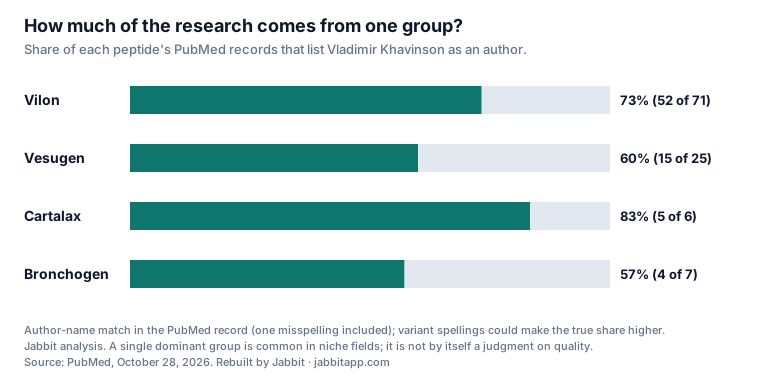
About two-thirds of the relevant records (65 of 97) list Khavinson as an author, and most of the rest come from Russian groups publishing in the same two journals.[24] Some authors of the human studies are also listed as inventors on the patents. For example, G. A. Ryzhak co-authored vilon clinical reports and is named on the vesugen patent.[9][10][6] Inventor-researchers are common in drug development, and this overlap says nothing about whether the results are right. What it does mean is that independent replication matters, and in our search we found little of it in people.[24][23]
Can they work by mouth?
Many posts describe taking these peptides by mouth. The patents describe injection: the vesugen patent says its composition “is intended for parenteral administration,” and the vilon patent lists routes “for example, parenteral, oral, intranasal or local.”[6][5] The group’s own 2022 paper says that taken orally, peptides “must be absorbed into the bloodstream through the intestinal barrier in their active forms,” and that “it is important to study the absorption mechanism.”[4] It reports that the vilon dipeptide was broken down in solutions and partly in tissues. Its case that these peptides can enter cells through transporters rests on computer modeling and literature review, not on blood levels measured in people.[4]
A widely shared X post argued that the gut transporter PEPT1 explains how these peptides work orally.[1] PEPT1 belongs to the transporter family the 2022 paper modeled, so the idea has a basis. But an independent 2009 study of 228 dipeptides in gut-lining cells concluded that their effects in the body are “most likely limited due to the very low intestinal permeability of dipeptides.” That study did not test these peptides specifically.[4][21] We found no published human study measuring how much oral vilon, vesugen, cartalax or bronchogen reaches the blood.[24]
Safety: what is and isn’t known
- The 2000 mouse study reported “no unfavourable effects on animal development” from long-term vilon.[7] Animal data do not establish human safety.
- The 2015 human study of vesugen and pinealon reported “prooxidant activity” and a drop in CD34+ blood stem-cell markers that the authors called “significant inhibition of hemopoiesis.” The authors also reported no change in chromatin packing and called the peptides safe “on nuclear genetic level,” adding: “This property should be studied in future.”[13]
- None of the four is an FDA-approved drug. None appears on FDA’s page of bulk drug substances that may present significant safety risks, which does list epitalon, citing a possible risk of immune reactions.[22] Not being on that page is not a sign of safety. It most likely reflects that no one asked FDA to review them for compounding.
- We found no registered trial and no systematic safety data for any of the four.[23][24] We did not test any product sold online, so we cannot say what those products contain.
What the program gets right
To be fair to the researchers: they have pursued one idea consistently for about three decades, published the mechanisms they propose, patented specific molecules, and in recent years written English-language reviews with international co-authors.[3][4][5][6] Short peptides can be real drugs. Thymogen is a dipeptide that the group describes as a medicinal product, and many approved drugs are peptides.[2][4] The lab findings could be pointers worth testing. In our view, the problem is that they have not been tested in the kind of controlled human trial that would show whether they help.[24][23]
The longevity question
The appeal is clear: a few amino acids that “reset” aging tissues. The strongest support is mouse lifespan data from the same program, and lifespan gains in mice often fail to carry over to people.[7][8] In the human studies, “biological age” was measured with the authors’ own scores, not with outcomes such as frailty, disease or survival.[13][14] In our analysis, these peptides are currently a hypothesis about aging, not a tested intervention.
What a careful reader should notice
- “Decades of Russian research,” as one widely shared post put it, is accurate, but about two-thirds of the records list one author, and most are lab or animal studies.[24]
- No human study we found describes a placebo group in its abstract. Before-and-after studies cannot separate the peptide from placebo effects or time.[12][13][10]
- The patents describe injection. Evidence that oral doses reach the blood is modeling, not measurement.[6][4]
- “Super-low dose” claims rely on a receptor-free signaling hypothesis that has not been confirmed.[17]
- Absence from FDA’s safety-risk list does not mean FDA reviewed these peptides.[22]
FAQ
- What are Khavinson peptide bioregulators?
- They are short peptides, two to four amino acids long, developed by Vladimir Khavinson’s group in St Petersburg. The group proposes that they regulate genes in specific tissues. Vilon (Lys-Glu), vesugen (Lys-Glu-Asp), cartalax (Ala-Glu-Asp) and bronchogen (Ala-Glu-Asp-Leu) are four of them.[3][2]
- Is there human evidence for vesugen?
- We found five small Russian studies from 2012 to 2016, including 41 men with erectile dysfunction and 32 people in a “biological age” study. Most combined it with pinealon, and none describes a placebo group in its abstract.[12][13][14][16][15]
- Does vilon extend lifespan?
- In mice, a 2000 study reported longer lifespan and fewer spontaneous tumors. No human study has tested lifespan, and the three human reports we found covered cancer treatment and diabetes markers.[7][9][10][11]
- Is there evidence for cartalax or bronchogen in people?
- We found no published human studies and no registered trials. The research is in cells, tissue cultures and rat models.[24][23][20]
- Do oral bioregulator peptides get absorbed?
- This has not been shown in people. The developers’ own 2022 paper says absorption still needs study and relies on computer modeling, and the patents describe injection.[4][6]
- Are these peptides FDA-approved or legal to compound?
- None is an FDA-approved drug, and none appears on FDA’s safety-risk page for compounding ingredients as of its April 2026 version. That page lists epitalon. Not being listed is not evidence of safety.[22]
Bottom line
Vilon, vesugen, cartalax and bronchogen come from a long-running Russian research program with patents, mouse lifespan data and many lab studies.[5][6][7][3] What is missing is the step that would show they help people: placebo-controlled trials, independent replication and data on whether oral forms are absorbed.[24][23][4] Until that exists, the viral claims on X go well beyond the evidence.[1][24]
References
- Jabbit count of English-language X posts (reposts excluded) mentioning vilon, vesugen, cartalax, bronchogen, pinealon, “khavinson” or “bioregulator(s)”, via X’s recent-counts endpoint, October 28, 2026: 68, 80, 57, 89, 86, 98 posts per full UTC day from October 22 to 27. The most-viewed post in a related search, dated October 23, 2026, described taking “Russian peptides (pinealon, epitalon, vilon)” and had about 241,600 views; an October 25 post urging readers to start a “cycle” of three of them had about 20,900. Posters are not named; counts and view figures are in the source extract. https://jabbitapp.com/research/sources/khavinson-bioregulators-2026-10-28.json. Checked October 28, 2026.
- Morozov VG, Khavinson VK. Natural and synthetic thymic peptides as therapeutics for immune dysfunction. Int J Immunopharmacol. 1997;19(9-10):501-5. PMID 9637345. Abstract: “Pharmaceutical containing natural peptides (Thymalin) was put into practice as immunocorrector”; “A novel immunomodulatory dipeptide was synthesized and termed Vilon.” Abstract read. https://pubmed.ncbi.nlm.nih.gov/9637345/. Checked October 28, 2026.
- Khavinson VKh, Popovich IG, Linkova NS, Mironova ES, Ilina AR. Peptide Regulation of Gene Expression: A Systematic Review. Molecules. 2021;26(22):7053. PMID 34834147. Table of peptides and reported effects, including “KE, Vilon regulation of immune system function, antioxidant effect, stress-protective effect, geroprotection”; “KED, Vesugen regulation of cardiovascular system function, neuroprotector”; “AED, Cartalax regulation of cartilage and skin fibroblasts functions, neuronal cell differentiation”; “AEDL, Bronchogen regulation of lung cells’ function and differentiation.” Full text read. https://pmc.ncbi.nlm.nih.gov/articles/PMC8619776/. Checked October 28, 2026.
- Khavinson V, Linkova N, Kozhevnikova E, Dyatlova A, Petukhov M, et al. Transport of Biologically Active Ultrashort Peptides Using POT and LAT Carriers. Int J Mol Sci. 2022;23(14):7733. PMID 35887081. Affiliations include the Saint Petersburg Institute of Bioregulation and Gerontology. Full text: “when administered orally, peptides must be absorbed into the bloodstream through the intestinal barrier in their active forms. It is important to study the absorption mechanism of bioactive peptides”; “KE peptide (to a greater extent) and AEDG peptide (to a lesser extent) were hydrolyzed in solutions and partially in tissues”; modeling and literature analysis suggest “a high probability of their transport into cells” via LAT1, POT family and L-system transporters; Thymogen (EW) is listed as “Immunoprotector, medicinal product.” Full text read. https://pmc.ncbi.nlm.nih.gov/articles/PMC9323678/. Checked October 28, 2026.
- Khavinson VKh, Morozov VG, Malinin VV, et al. US Patent 6,642,201 B1, “Use of a dipeptide for stimulating repair processes.” Assignee as listed: “Klinika Instituta Bioregulyatsii Gerontologii” OOO. Priority date 1998-06-23; published 2003-11-04. The description lists administration routes “for example, parenteral, oral, intranasal or local.” Google Patents page read (dose figures not reproduced here). https://patents.google.com/patent/US6642201B1/en. Checked October 28, 2026.
- Khavinson VKh, Grigoriev EI, Malinin VV, Ryzhak GA. US Patent 7,851,449 B2, “Peptide, pharmaceutical composition, and a method of treating microcirculation disorders.” Original assignee as listed: SIA Peptides OOO. Priority date 2006-05-23; published 2010-12-14. Claim 1: “An isolated peptide of the formula H-Lys-Glu-Asp-OH.” The description says the composition “is intended for parenteral administration.” Google Patents page read (dose figures not reproduced here). https://patents.google.com/patent/US7851449B2/en. Checked October 28, 2026.
- Khavinson VK, Anisimov VN, Zavarzina NY, et al. Effect of vilon on biological age and lifespan in mice. Bull Exp Biol Med. 2000;130(7):687-90. PMID 11140587. Abstract: “Subcutaneous administration of vilon (Lys-Glu) to female CBA mice starting from the 6th month of life increased physical activity and endurance, decreased body temperature, prolonged the lifespan, and prevented the development of spontaneous neoplasms”; “Vilon had no effect on age-related changes of estrous function and free radical processes.” Abstract read. https://pubmed.ncbi.nlm.nih.gov/11140587/. Checked October 28, 2026.
- Anisimov VN, Khavinson VKh. Peptide bioregulation of aging: results and prospects. Biogerontology. 2010;11(2):139-49. PMID 19830585. Review by two of the program’s lead researchers. Abstract: “It was shown that long-term treatment with some peptide preparations increased mean life span by 20-40%” in rodents. Abstract read. https://pubmed.ncbi.nlm.nih.gov/19830585/. Checked October 28, 2026.
- Ias'kevich LS, Krutilina NI, Kostetskaia TV, et al. [Application of peptide bioregulator in complex treatment of elderly cancer patients]. Adv Gerontol. 2005;16:97-100. PMID 16075684. Abstract describes “pioneer experience” adding Vilon to treatment of elderly patients with colorectal cancer; “The obtained preliminary results of investigation suggest recommendation of Vilon application to increase 2-year survival.” Patient numbers and a placebo group are not given in the abstract. Abstract read. https://pubmed.ncbi.nlm.nih.gov/16075684/. Checked October 28, 2026.
- Kuznik BI, Kolesnichenko LR, Kliuchereva NN, et al. [Effect of thymomimetic vilon on blood coagulation system and fibrinolisis in diabetes mellitus type 1 patients of different age]. Adv Gerontol. 2006;19:107-15. PMID 17152731. Abstract: “administration of thymomimetic Vilon (Lys-Glu) in these patients significantly reduces or even totally diminishes DIC syndrome.” PubMed tags it as a randomized controlled trial; the abstract does not describe randomization, blinding or a placebo. Abstract read. https://pubmed.ncbi.nlm.nih.gov/17152731/. Checked October 28, 2026.
- Kuznik BI, Isakova NV, Kliuchereva NN, et al. [Effect of vilon on the immunity status and coagulation hemostasis in patients of different age with diabetes mellitus]. Adv Gerontol. 2007;20(2):106-15. PMID 18306698. Abstract: Vilon “as an addition to the complex therapy” in elderly patients with type 1 diabetes “resulted in optimization of coagulation hemostasis.” Abstract read. https://pubmed.ncbi.nlm.nih.gov/18306698/. Checked October 28, 2026.
- Kitachev KV, Sazonov AB, Kozlov KL, et al. [The efficacy of peptide bioregulators of vessels in lower limbs chronic arterial insufficiency treatment in old and elderly people]. Adv Gerontol. 2014;27(1):156-9. PMID 25051774. Abstract: “Treatment results of erectile dysfunction in 41 patients were studied”; “A comparative analysis of clinical and instrumental parameters of blood flow in the main penile arteries before and after monotherapy was undertaken.” No control group described. Abstract read. https://pubmed.ncbi.nlm.nih.gov/25051774/. Checked October 28, 2026.
- Meshchaninov VN, Tkachenko EL, Zharkov SV, et al. [EFFECT OF SYNTHETIC PEPTIDES ON AGING OF PATIENTS WITH CHRONIC POLYMORBIDITY AND ORGANIC BRAIN SYNDROME OF THE CENTRAL NERVOUS SYSTEM IN REMISSION]. Adv Gerontol. 2015;28(1):62-7. PMID 26390612. Abstract: “32 people (18 men, 12 women) aged 41-83 years”; vesugen and pinealon “slows the rate of aging by biological age indicators”; “At the same time we've found the prooxidant activity through chemiluminescence”; “Decrease of markers CD34+ positive hematopoietic polypotent cells in blood has shown significant inhibition of hemopoiesis”; “Pinealon and Vesugen haven't affected the degree of chromatin condensation, so they are safe on nuclear genetic level. This property should be studied in future.” Abstract read. https://pubmed.ncbi.nlm.nih.gov/26390612/. Checked October 28, 2026.
- Myakotnykh VS, Torgashov MN, Egorin KV, et al. [Comparative analysis of different methods of geroprotective]. Adv Gerontol. 2016;29(4):594-601. PMID 28539017. Abstract: 110 people in a comparison of “the efficacy and safety of several geroprotective techniques,” including “dry carbon dioxide baths, hyperbaric oxygen therapy, therapeutic massage” and vesugen plus pinealon, judged by biological-age indicators. Abstract read. https://pubmed.ncbi.nlm.nih.gov/28539017/. Checked October 28, 2026.
- Bashkireva AS, Kachan EY. [Assessment of work ability index in evaluation of small peptides geroprotective effect]. Adv Gerontol. 2015;28(3):510-512. PMID 28509489. Abstract describes “small peptides (cytogens) used as geroprotectors in the system of preventive medical nutrition” for workers exposed to occupational hazards. Abstract read. https://pubmed.ncbi.nlm.nih.gov/28509489/. Checked October 28, 2026.
- Bashkireva AS, Artamonova VG. [The peptide correction of neurotic disorders among professional truck-drivers]. Adv Gerontol. 2012;25(4):718-28. PMID 23734521. Abstract: professional truck drivers; the best effect was with “combined application of several cytogens (pinealon and vezugen).” Abstract read. https://pubmed.ncbi.nlm.nih.gov/23734521/. Checked October 28, 2026.
- Grigor'ev EI, Khavinson VKh, Malinin VV, et al. [The study of the role of the water medium in the mechanism of action of peptides in low and ultra low doses]. Radiats Biol Radioecol. 2003;43(3):358-62. PMID 12881997. Abstract: in thymocyte tests “a bimodal curve with the second maximum were detected at super-low doses (10(-17)-10(-15) mol/l)”; “Authors propose a hypothesis that for superlow concentrations the formation and distance transmission of a signal from ligand to a target cell without the formation of any ligand-receptor complex take place.” Abstract read. https://pubmed.ncbi.nlm.nih.gov/12881997/. Checked October 28, 2026.
- Fedoreyeva LI, Kireev II, Khavinson VKh, et al. Penetration of short fluorescence-labeled peptides into the nucleus in HeLa cells and in vitro specific interaction of the peptides with deoxyribooligonucleotides and DNA. Biochemistry (Mosc). 2011;76(11):1210-9. PMID 22117547. Abstract: fluorescent-labeled epitalon, pinealon and testagen entered HeLa cell nuclei, so “short biologically active peptides are able to penetrate into an animal cell and its nucleus”; in test-tube assays, bronchogen and others “bind preferentially with deoxyribooligonucleotides containing CNG sequence.” Abstract read. https://pubmed.ncbi.nlm.nih.gov/22117547/. Checked October 28, 2026.
- Lezhava T, Khavison V, Monaselidze J, et al. Bioregulator Vilon-induced reactivation of chromatin in cultured lymphocytes from old people. Biogerontology. 2004;5(2):73-9. PMID 15105581. Tbilisi State University genetics department. Abstract: studied Vilon’s effect on “cultured lymphocytes from old people” (cells in a dish). Abstract read. https://pubmed.ncbi.nlm.nih.gov/15105581/. Checked October 28, 2026.
- Kuzubova NA, Lebedeva ES, Dvorakovskaya IV, et al. Modulating Effect of Peptide Therapy on the Morphofunctional State of Bronchial Epithelium in Rats with Obstructive Lung Pathology. Bull Exp Biol Med. 2015;159(5):685-8. PMID 26468022. Rat model of obstructive lung disease. Title read. https://pubmed.ncbi.nlm.nih.gov/26468022/. Checked October 28, 2026.
- Foltz M, van Buren L, Klaffke W, et al. Modeling of the relationship between dipeptide structure and dipeptide stability, permeability, and ACE inhibitory activity. J Food Sci. 2009;74(7):H243-51. PMID 19895477. Not a study of these peptides. Abstract: “A total of 228 dipeptides were synthesized”; permeability tested in Caco-2 intestinal cells; effects in the body “are most likely limited due to the very low intestinal permeability of dipeptides.” Abstract read. https://pubmed.ncbi.nlm.nih.gov/19895477/. Checked October 28, 2026.
- U.S. Food and Drug Administration. “Certain Bulk Drug Substances for Use in Compounding that May Present Significant Safety Risks.” Content current as of April 22, 2026. Jabbit search of the cached page: 0 mentions of vilon, vesugen (or vezugen), cartalax, bronchogen or Lys-Glu. Epitalon is listed: “Compounded drugs containing epitalon may pose risk for immunogenicity.” openFDA Drugs@FDA search: no approved product under any of the four names. https://www.fda.gov/drugs/human-drug-compounding/certain-bulk-drug-substances-use-compounding-may-present-significant-safety-risks. Checked October 28, 2026.
- ClinicalTrials.gov API v2 searches, October 28, 2026: intervention searches for vilon, vesugen and cartalax returned 0 studies; bronchogen returned 1 unrelated bronchoscopy study (NCT00746759); keyword searches for “khavinson” and “peptide bioregulator” returned 0. https://clinicaltrials.gov/. Checked October 28, 2026.
- Jabbit source extract for this page: every quote above asserted against cached copies; the full hand classification of each PubMed record (including excluded off-topic hits); author-share and journal counts; X daily counts. https://jabbitapp.com/research/sources/khavinson-bioregulators-2026-10-28.json. Generated October 28, 2026.
This page analyzes published studies, patents, registry and FDA searches, and counts of public X posts. It is not medical advice and does not recommend any product, dose or schedule. Small uncontrolled studies cannot show that a peptide caused an effect. Quality judgments and cross-study comparisons are Jabbit’s analysis. Charts were rebuilt by Jabbit from the sources cited in each caption.