Study teardown · Taurine (2-aminoethanesulfonic acid) · The October 23, 2026 Cell study, the 2023 Science study and its 2025 rebuttal, Japan’s drug approvals, human trials and meta-analyses, safety reviews, registry records and PubMed counts · Sources checked October 26, 2026
Published · Updated
Taurine for aging and longevity: does it work, and is it safe? A 2023 study said falling taurine drives aging and that taurine lengthened mouse lives; a Yale-led Cell study published October 23, 2026 found taurine rises with age in people and mice, and instead casts it as a brake on age-related inflammation. No human trial has tested lifespan, human results are modest and mixed, and short-term safety looks good.
Taurine is an amino acid the body makes and also gets from animal foods such as meat and fish; it is added to energy drinks and infant formula, and sold as a supplement.[28][27] Does it slow aging? In 2023, a Columbia-led team reported that blood taurine falls with age and that taurine lengthened average mouse life by 10 to 12%.[3][4] Since then, a 2025 NIA-led study and a Yale-led Cell study published October 23, 2026 found taurine rises or stays flat with age in people, and the Yale team says taurine “does not drive aging,” while reporting that raising it further made old mice healthier by calming inflammation.[5][1][2] No human trial has tested lifespan; one 6-month trial of biological age finished in November 2025 with no results posted.[29][31] Human trials show modest drops in blood pressure, blood sugar and lipids, no clear benefit for thinking, and misses in hip fracture and cirrhosis patients.[19][22][17][18] Is it safe? Short trials report few side effects, and in Japan it has been a prescription drug for heart failure since 1987.[20][14][11]
Why this matters now
On October 23, 2026, Cell published a study led by Yale School of Medicine with Pennington Biomedical among the affiliations; the authors declare no competing interests, and Yale says the work was supported by the NIH, among other funders.[1][2] It reports that “aging increases circulating taurine concentrations in humans and mice,” the opposite of the 2023 finding, and that immune cells called macrophages release taurine as they switch on the NLRP3 inflammasome, a driver of the chronic inflammation of aging (“inflammaging”).[1][2] Raising taurine further in old mice improved healthspan and reduced deaths from sepsis and inflammasome-driven inflammation.[1] In people, sustained calorie restriction, in a study lasting up to a year, raised taurine in fat tissue alongside lower inflammation.[1][2] In the same month, a Nutrition Reviews meta-analysis of 34 trials reported modest improvements in blood pressure and blood sugar, and an October 6 genetic study linked taurine levels to several diseases, pending validation.[19][26]
Timeline
| Date | Event |
|---|---|
| 1827 | German chemists describe the compound later named taurine, found in ox bile.[6] |
| 1975 | Cats fed a casein diet go blind from retinal damage linked to low taurine.[7] |
| 1985 | A 14-person double-blind crossover trial in heart failure reports no one worsened on taurine, while four did on placebo.[9] |
| 1987 | Japan’s taurine drug gains a congestive heart failure indication; a Science study ties a common heart disease in pet cats to low taurine, reversed with taurine.[11][8] |
| 1989 | A review notes infant formulas are now supplemented with taurine.[28] |
| 2009 | EFSA says taurine in energy drinks, at the levels it assessed, is not a safety concern.[27] |
| 2015-2016 | A hip fracture trial in older adults misses on complications and deaths; a prehypertension trial lowers blood pressure.[17][15] |
| 2019 | Japan adds MELAS, a rare mitochondrial disease, as an orphan-drug indication after a 10-patient trial.[10][11][13] |
| June 2023 | Science paper: taurine falls with age, and supplementing it extends mouse life.[3][4] |
| 2024-2025 | A Munich trial of biological age starts (September 2024) and finishes (November 2025); an NIA-led Science paper finds taurine does not fall with age in people; a Nature mouse study ties taurine to leukemia growth.[29][5][25] |
| April 2026 | A 220-patient cirrhosis trial finds no improvement in fatigue.[18] |
| October 2026 | A genetic study links taurine levels to several diseases (October 6); a 34-trial meta-analysis reports modest metabolic gains; the Yale-led Cell study finds taurine rises with age and curbs inflammation in mice (October 23).[26][19][1] |
What taurine is
Taurine is a sulfur-containing amino acid that is not used to build proteins. It was first described in ox bile in 1827.[6] In cats, low taurine was linked to blindness in 1975 and to a reversible heart failure in 1987.[7][8] People make it from other sulfur-containing amino acids and get it from animal foods, with cow’s milk a noted exception; infant formulas add it.[28] In the US and Europe it is not licensed as a medicine, while Japan approves it as a drug for three uses.[14][10]
The aging fight: does taurine fall or rise with age?
- 2023: “deficiency as a driver of aging.” The Columbia-led Science paper reported lower taurine with age in mice, monkeys and people, and longer life and better health in mice given taurine; it called for human trials.[3] Columbia’s release put the average mouse lifespan gain at 12% in females and 10% in males.[4] The paper discloses that Columbia filed provisional patent applications naming one of its authors as an inventor.[3]
- 2025: the rebuttal. A team including NIA scientists found taurine increased or stayed flat with age in three human groups, monkeys and mice, and concluded that falling taurine is “not a universal feature of aging.”[5]
- October 2026: a different role. The Yale-led Cell study found taurine rises with age and casts it as part of the body’s response to inflammation: macrophages released up to 80% of their taurine as an inflammasome formed, and adding taurine dampened that response.[1][2]
Our analysis: both camps report that extra taurine helped old mice; they disagree on whether a shortage of taurine is part of aging. Neither shows that it slows aging in people.[3][1][5]
The evidence, rung by rung
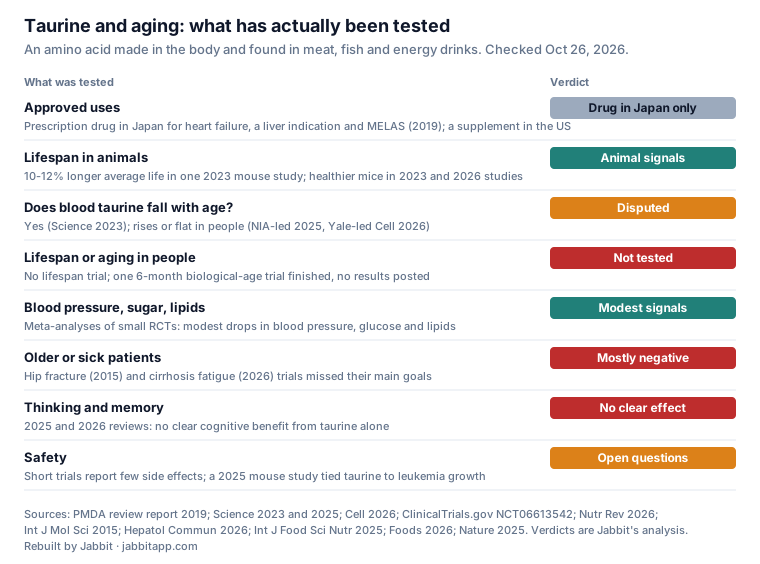
- Lifespan in people. We found no human trial that measured lifespan.[31][30] The closest is a Technical University of Munich trial of 90 adults aged 55 to 75, testing whether 6 months of taurine changes blood and DNA-methylation measures of “biological age”; it is listed as completed, with no results posted.[29]
- Heart and metabolism. In 120 people with prehypertension, systolic blood pressure fell 7.2 mmHg on taurine vs 2.6 on placebo over 12 weeks.[15] Meta-analyses report modest drops in blood pressure, blood sugar and lipids; the newest pooled 34 trials and found systolic pressure 4.38 mmHg lower and HbA1c 0.21 points lower.[19][21][20]
- Heart failure. Small trials and a 2024 meta-analysis report better symptoms and heart measures, but a 2022 review found only one high-quality study among 11 and said “A formal clinical trial is needed.”[9][20][14]
- Older and sick patients. In older hip fracture patients, taurine lowered oxidative-stress markers but did not reduce complications or deaths in the first year.[17] In 220 people with advanced cirrhosis, it did not improve fatigue.[18] In 24 women aged 55 to 70, it kept an antioxidant enzyme from falling, a lab marker rather than a health outcome.[16]
- Brain and exercise. Two reviews found no clear effect of taurine alone on thinking and memory; the benefits seen with energy-drink style mixes could not be pinned on taurine.[22][23] A single serving before exercise gave a small performance gain in pooled small trials, with low to very low certainty.[24]
The key trials, in one chart
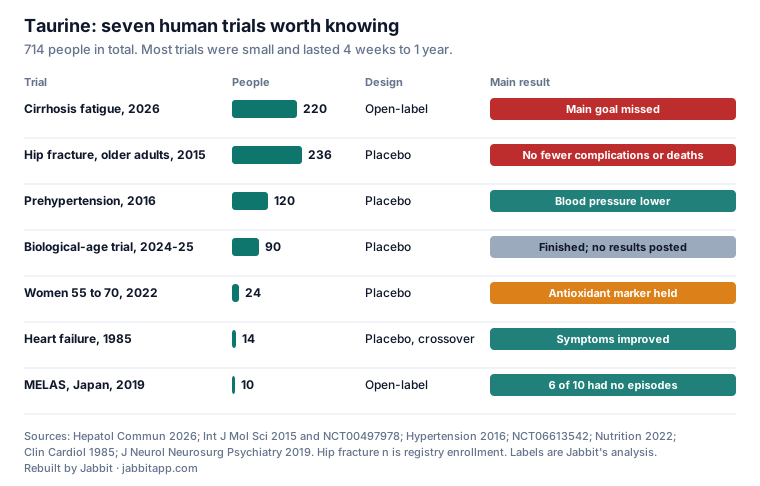
Our analysis: the two largest trials in our chart, both in older or sick patients, missed their main goals; the positive results come from smaller trials or from lab and blood-pressure measures.[18][17][15][16]
The case for taurine, in fairness
Taurine is not a fringe compound: Japan has approved it as a drug for heart failure since 1987, and in 2019 for MELAS, where 6 of 10 patients in an open-label trial had no stroke-like episodes over a year.[11][10][13] Cats proved that too little taurine can cause blindness and heart failure.[7][8] Its blood-pressure and metabolic effects are modest but repeat across meta-analyses.[19][21][20] Two independent mouse lines of work, from teams that disagree about the biology, both found extra taurine helped old mice.[3][1] Our analysis: that is a reason for the human trials already under way, not proof that it slows aging.[29]
Safety
- Short-term tolerability. Meta-analyses report no significant side effects compared with control groups; in the cirrhosis trial, 11.8% of patients on taurine had side effects, all mild; the MELAS trial reported no serious side effects tied to taurine.[20][18][13][14]
- Energy drinks. EFSA judged taurine in energy drinks, at the exposures it assessed, not a safety concern, and noted it assessed the ingredients, not energy drinks themselves.[27]
- An open question on blood cancers. A 2025 Nature study in mice and human cells found leukemia cells depend on taurine supplied by surrounding bone-marrow cells, and blocking its uptake slowed the disease in mice.[25] Our analysis: this does not show that taurine supplements cause or worsen leukemia in people, which has not been tested, but it is a reason for caution and for more study. An October 2026 genetic study also flagged possible links between taurine levels and cancers and blood pressure that need confirming.[25][26]
- What is unknown. Most trials were small and lasted weeks to a year; there are no long-term data in healthy older people taking it to slow aging.[14][29][31]
Purity
Japan’s approved product is a pharmaceutical-grade powder reviewed by its drug regulator.[10] Our analysis: supplements and energy drinks are regulated as foods, and the trial results do not automatically apply to products that mix taurine with caffeine or other ingredients.[23][27] We do not name or rate brands or sellers.
Legal status
Taurine is not licensed as a medicine in the US or Europe; it is sold in foods, energy drinks and supplements.[14][27] In Japan, Taisho’s taurine powder is a prescription drug for congestive heart failure, a liver-function indication and, since 2019, MELAS, with orphan-drug status for that use.[10][11][12]
What a careful reader should notice
These points are our analysis of the sources cited.
- “Extends lifespan” is a mouse result. No human trial has measured lifespan.[3][31]
- The deficiency story is disputed. Two later studies, including the October 2026 Cell paper, found taurine rises or stays flat with age in people.[5][1]
- Mechanism is not benefit. The Cell study is mostly mice and cells; its human data come from blood samples and a calorie-restriction study, not from giving people taurine.[1][2]
- Look for the main goal. The largest trials in older or sick patients missed theirs.[17][18]
- Energy drinks are not taurine trials. Benefits from taurine-caffeine mixes cannot be credited to taurine alone.[23]
Frequently asked questions
- Does taurine slow aging or extend lifespan?
- In mice, a 2023 study reported 10 to 12% longer average life. No human trial has measured lifespan, and a 6-month biological-age trial has no results posted yet.[4][29][31]
- Does taurine decline with age?
- It is disputed. A 2023 study said yes; a 2025 NIA-led study and the October 2026 Yale-led Cell study found it rises or stays flat in people.[3][5][1]
- What did the October 2026 Cell study find?
- Taurine rose with age in people and mice, immune cells released it as they switched on inflammation, and extra taurine made old mice healthier and less inflamed.[1][2]
- Is taurine safe?
- Trials of weeks to a year report few, mostly mild side effects. A 2025 mouse study tied taurine to leukemia growth, which has not been tested in people taking supplements.[20][18][25]
- Is taurine FDA approved?
- No. It is not licensed as a medicine in the US or Europe; it is sold in foods and supplements. Japan approves it as a drug for heart failure, a liver indication and MELAS.[14][10]
- Does taurine lower blood pressure?
- Modestly. A 34-trial meta-analysis found systolic pressure about 4 mmHg lower, and a 120-person trial found a larger drop.[19][15]
- Is the taurine in energy drinks good for you?
- EFSA found it is not a safety concern at the levels it assessed, but reviews could not credit taurine alone for energy-drink effects on thinking.[27][23]
Bottom line
Taurine made old mice healthier in studies from teams that disagree on why, and the newest, from Yale, says taurine rises with age rather than falls.[3][1][5] In people, it is an approved drug in Japan with modest blood-pressure and metabolic effects, but no trial has shown it slows aging, and the largest trials in older or sick patients missed their goals.[10][19][17][18] It looks safe in the short term; results from the first biological-age trial are the next thing to watch.[20][29]
References
- Guan C, Ryu S, Dong M, et al. Taurine lowers inflammaging by regulating the NLRP3 inflammasome in macrophages. Cell. 2026. PMID 42914977. Published online October 23, 2026 (doi 10.1016/j.cell.2026.09.061); author affiliations include Yale School of Medicine and Pennington Biomedical Research Center. Abstract: “Whether a decline in taurine drives aging is debated”; “Here, we show that aging increases circulating taurine concentrations in humans and mice”; “Further elevating taurine in aged mice enhances health span”; taurine “reduces mortality from sepsis and inflammasome-mediated inflammation”; NLRP3 “danger signals” “induce taurine efflux from macrophages as a proximal step to activate the inflammasome”; “In humans, sustained caloric restriction elevates adipose tissue taurine and is accompanied by lower inflammation”; the authors close by “suggesting taurine-based strategies to alleviate inflammaging and inflammasomopathies.” “The authors declare no competing interests.” Abstract read. https://pubmed.ncbi.nlm.nih.gov/42914977/. Checked October 26, 2026.
- Yale School of Medicine news, “Study Reveals Amino Acid Can Diminish Age-Related Inflammation,” by Kristel Tjandra, October 23, 2026: “researchers at Yale School of Medicine found that the amino acid taurine is key to the way the innate immune system senses danger signals”; comparing blood of young (20 to 40) and older (60 to 99) people, “his team found that taurine actually increased with age”; “The finding was surprising and suggested that taurine does not drive aging”; “macrophages released up to 80% of their taurine” as inflammasome complexes formed; interest began when taurine “increased as people restricted their calorie intake for up to one year as part of the CALERIE study”; next, the team plans to study “whether these findings could translate to something that can benefit older adults”; the work was “supported by the National Institutes of Health” and Yale University, with additional support from the American Federation for Aging Research and the Glenn Foundation for Medical Research. https://medicine.yale.edu/news-article/amino-acid-diminishes-age-related-inflammation/. Checked October 26, 2026.
- Singh P, Gollapalli K, Mangiola S, et al. Taurine deficiency as a driver of aging. Science. 2023;380(6649):eabn9257. PMID 37289866. Columbia University-led study published June 9, 2023. Abstract: “We find that concentrations of circulating taurine decline with aging in mice, monkeys, and humans”; supplementation “increased the health span (the period of healthy living) and life span in mice and health span in monkeys”; “In humans, lower taurine concentrations correlated with several age-related diseases”; “Clinical trials in humans seem warranted to test whether taurine deficiency might drive aging in humans.” Competing interests: “Columbia University has filed provisional patent applications for which VKY is an inventor.” Abstract and disclosure read. https://pubmed.ncbi.nlm.nih.gov/37289866/. Checked October 26, 2026.
- Columbia University Irving Medical Center release on EurekAlert, June 8, 2023: “taurine increased average lifespan by 12% in female mice and 10% in males”; “The researchers started with close to 250 14-month-old female and male mice”; “Only a randomized clinical trial in people will determine if taurine truly has health benefits, Yadav adds.” https://www.eurekalert.org/news-releases/990909. Checked October 26, 2026.
- Fernandez ME, Bernier M, Price NL, et al. Is taurine an aging biomarker?. Science. 2025;388(6751):eadl2116. PMID 40472098. Author affiliations include the National Institute on Aging. Abstract: “We found that circulating taurine concentrations increased or remained unchanged with age in three geographically distinct human cohorts as well as in nonhuman primates and mice”; “Our results suggest that changes in circulating taurine are not a universal feature of aging.” Abstract read. https://pubmed.ncbi.nlm.nih.gov/40472098/. Checked October 26, 2026.
- Tiedemann F, Gmelin L. Einige neue Bestandtheile der Galle des Ochsen [Some new constituents of ox bile]. Annalen der Physik. 1827;85:326-337. The paper describing the compound later named taurine, isolated from ox bile. https://doi.org/10.1002/andp.18270850214. Checked October 26, 2026.
- Hayes KC, Carey RE, Schmidt SY. Retinal degeneration associated with taurine deficiency in the cat. Science. 1975;188(4191):949-51. PMID 1138364. Cat study: “A degeneration of the retinal photoreceptor cells develops in cats when casein is the source of dietary protein,” with a “selective decrease in plasma and retinal taurine concentrations.” Abstract read. https://pubmed.ncbi.nlm.nih.gov/1138364/. Checked October 26, 2026.
- Pion PD, Kittleson MD, Rogers QR, et al. Myocardial failure in cats associated with low plasma taurine: a reversible cardiomyopathy. Science. 1987;237(4816):764-8. PMID 3616607. “Thousands of pet cats die each year with dilated cardiomyopathy, the cause of which is unknown”; low plasma taurine was found in affected cats, and “Oral supplementation of taurine resulted in increased plasma taurine concentrations and was associated with normalization of left ventricular function in both groups of cats.” Abstract read. https://pubmed.ncbi.nlm.nih.gov/3616607/. Checked October 26, 2026.
- Azuma J, Sawamura A, Awata N, et al. Therapeutic effect of taurine in congestive heart failure: a double-blind crossover trial. Clin Cardiol. 1985;8(5):276-82. PMID 3888464. Double-blind crossover trial in “14 patients with congestive heart failure for a 4-week period”: “No patient worsened during taurine administration, but four patients did during placebo.” Abstract read. https://pubmed.ncbi.nlm.nih.gov/3888464/. Checked October 26, 2026.
- Pharmaceuticals and Medical Devices Agency (PMDA), Japan. Review report for タウリン散98%「大正」 (Taurine Powder 98%, Taisho), applicant 大正製薬株式会社 (Taisho Pharmaceutical), 2019. Lists the existing indications (liver function in hyperbilirubinemia, excluding obstructive jaundice, and うっ血性心不全, congestive heart failure) and the added indication “MELAS)症候群における脳卒中様発作の抑制” (suppression of stroke-like episodes in MELAS), designated 希少疾病用医薬品 (orphan drug); committee date 平成 31 年1月 31 日 (January 31, 2019). We do not reproduce the label’s dosing. https://www.pmda.go.jp/drugs/2019/P20190215002/400059000_21900AMX00674_A100_1.pdf. Checked October 26, 2026.
- Japan Agency for Medical Research and Development (AMED), release of February 19, 2019, on the MELAS approval: the history lists “1987年:うっ血性心不全” (1987: congestive heart failure), and “タウリンは、日本で初めて、ミトコンドリア病の一種MELASに対して保険適用された治療薬となる予定です” (taurine is expected to become Japan’s first insurance-covered treatment for MELAS, a type of mitochondrial disease). https://www.amed.go.jp/news/release_20190219-01.html. Checked October 26, 2026.
- Schaffer S, Kim HW. Effects and Mechanisms of Taurine as a Therapeutic Agent. Biomol Ther (Seoul). 2018;26(3):225-241. PMID 29631391. Review: “Today, taurine has been approved for the treatment of congestive heart failure in Japan.” Abstract read. https://pubmed.ncbi.nlm.nih.gov/29631391/. Checked October 26, 2026.
- Ohsawa Y, Hagiwara H, Nishimatsu SI, et al. Taurine supplementation for prevention of stroke-like episodes in MELAS: a multicentre, open-label, 52-week phase III trial. J Neurol Neurosurg Psychiatry. 2019;90(5):529-536. PMID 29666206. “multicentre, open-label, phase III trial in which 10 patients with recurrent stroke-like episodes” took part for 52 weeks (registry UMIN000011908): “The proportion of patients who reached the primary endpoint (100% responder rate) was 60% (95% CI 26.2% to 87.8%)”; “Taurine reduced the annual relapse rate of stroke-like episodes from 2.22 to 0.72 (P=0.001)”; “No severe adverse events were associated with taurine.” Abstract read. https://pubmed.ncbi.nlm.nih.gov/29666206/. Checked October 26, 2026.
- McGurk KA, Kasapi M, Ware JS. Effect of taurine administration on symptoms, severity, or clinical outcome of dilated cardiomyopathy and heart failure in humans: a systematic review. Wellcome Open Res. 2022;7:9. PMID 35855073. Systematic review of taurine in dilated cardiomyopathy and heart failure: taurine “is currently unlicensed in Europe and the United States for human medical treatment”; 11 studies were included; “Only one paper was deemed "high quality" using the NOQAS tool”; “no study was specific to DCM”; “No significant safety concerns were reported”; “A formal clinical trial is needed.” Disclosure: “J.S.W. has consulted for MyoKardia, Inc. and Foresite Labs.” Abstract read. https://pubmed.ncbi.nlm.nih.gov/35855073/. Checked October 26, 2026.
- Sun Q, Wang B, Li Y, et al. Taurine Supplementation Lowers Blood Pressure and Improves Vascular Function in Prehypertension: Randomized, Double-Blind, Placebo-Controlled Study. Hypertension. 2016;67(3):541-9. PMID 26781281. Double-blind trial: “We randomly assigned 120 eligible prehypertensive individuals” to taurine or placebo “for 12 weeks”; “Mean clinic systolic BP reduction for taurine/placebo was 7.2/2.6 mm Hg, and diastolic BP was 4.7/1.3 mm Hg.” Abstract read. https://pubmed.ncbi.nlm.nih.gov/26781281/. Checked October 26, 2026.
- Abud GF, De Carvalho FG, Batitucci G, et al. Taurine as a possible antiaging therapy: A controlled clinical trial on taurine antioxidant activity in women ages 55 to 70. Nutrition. 2022;101:111706. PMID 35700594. “A double-blind study was conducted with 24 women (61.4 ± 4.2 y” aged 55 to 70, “for 16 wk” (NCT05149716): “Taurine supplementation prevented the decrease in the antioxidant enzyme SOD.” Abstract read. https://pubmed.ncbi.nlm.nih.gov/35700594/. Checked October 26, 2026.
- Van Stijn MF, Bruins AA, Vermeulen MA, et al. Effect of oral taurine on morbidity and mortality in elderly hip fracture patients: a randomized trial. Int J Mol Sci. 2015;16(6):12288-306. PMID 26035756. “A double blind randomized, placebo controlled, clinical trial was conducted on elderly hip fracture patients” (NCT00497978; registry enrollment 236): “Taurine supplementation did not improve in-hospital morbidity, medical comorbidities during the first year, or mortality during the first year”; “Taurine supplementation lowered postoperative oxidative stress.” Abstract read. https://pubmed.ncbi.nlm.nih.gov/26035756/. Checked October 26, 2026.
- Sasidharan S, Philips CA, Tharakan A, et al. A randomized controlled trial of L-taurine for fatigue in decompensated cirrhosis. Hepatol Commun. 2026;10(5). PMID 42043864. Published online April 24, 2026: “This single-center, parallel-arm, open-label randomized controlled trial”; “Of 220 randomized patients, 202 completed the study”; “L-taurine did not improve fatigue in unselected patients with decompensated cirrhosis”; a subgroup finding “should be considered hypothesis-generating”; “Adverse events occurred in 11.8% of patients treated with taurine, all of which were mild.” “The authors have no conflicts to report.” Abstract read. https://pubmed.ncbi.nlm.nih.gov/42043864/. Checked October 26, 2026.
- Nie Z, Liu Y, Zhang M, et al. Effects of Oral Taurine Supplementation on Cardiometabolic Risk Factors: A Meta-analysis and Systematic Review of Randomized Clinical Trials. Nutr Rev. 2026;84(10):2028-2051. PMID 41275513. October 2026 issue. Meta-analysis: “Thirty-four eligible RCTs were analyzed”; pooled changes included “systolic blood pressure (MD, -4.38 mmHg; 95% CI, -7.26 to -1.50)” and “glycated hemoglobin A1c (MD, -0.21%; 95% CI, -0.37 to -0.05),” with smaller drops in fasting glucose, triglycerides and cholesterol; “Taurine supplementation may effectively improve cardiometabolic risk factors in adults.” Abstract read. https://pubmed.ncbi.nlm.nih.gov/41275513/. Checked October 26, 2026.
- Tzang CC, Lin WC, Lin LH, et al. Insights into the cardiovascular benefits of taurine: a systematic review and meta-analysis. Nutr J. 2024;23(1):93. PMID 39148075. Meta-analysis: “The analysis included a pooled sample of 808 participants from 20 randomized controlled trials”; it reports lower heart rate and blood pressure and better heart-failure measures; “No significant adverse effects were observed compared to controls.” Abstract read. https://pubmed.ncbi.nlm.nih.gov/39148075/. Checked October 26, 2026.
- Tzang CC, Chi LY, Lin LH, et al. Taurine reduces the risk for metabolic syndrome: a systematic review and meta-analysis of randomized controlled trials. Nutr Diabetes. 2024;14(1):29. PMID 38755142. Meta-analysis of randomized trials in metabolic syndrome: “Taurine supplementation exhibits positive effects on multiple MetS-related factors,” including systolic blood pressure, triglycerides and fasting glucose; HDL cholesterol did not change significantly. Abstract read. https://pubmed.ncbi.nlm.nih.gov/38755142/. Checked October 26, 2026.
- Cao Q, Nie Z, Liu Y, et al. Effects of taurine supplementation on cognitive function: a systematic review and meta-analysis of randomised controlled trials. Int J Food Sci Nutr. 2025;76(4):370-380. PMID 40320621. “A total of 7 RCTs with 9 intervention trials involving 402 individuals were included”; “the findings of the present meta-analysis do not provide sufficient evidence to support the efficacy of taurine supplementation in enhancing cognitive function.” Abstract read. https://pubmed.ncbi.nlm.nih.gov/40320621/. Checked October 26, 2026.
- Moore JA, Cousins AL, Taylor RMJ, et al. Cognitive Effects of Taurine and Related Sulphur-Containing Amino Acids: A Systematic Review of Human Trials and Considerations for Plant-Based Dietary Transitions. Foods. 2026;15(4). PMID 41750826. “Eight RCTs involving 244 healthy participants met the inclusion criteria”; “Most cognitive outcomes showed no effect”; “Trials that combined taurine with caffeine showed more reliable performance benefits, but they did not isolate taurine’s independent effects.” Disclosure: an author “received research funding from Viridian Nutrition for unrelated work on taurine.” Abstract read. https://pubmed.ncbi.nlm.nih.gov/41750826/. Checked October 26, 2026.
- Deng H, Song T, Yin M, et al. Does One Shot Work? The Acute Impact of a Single Taurine Dose on Exercise Performance: A Meta-Analytic Review. Scand J Med Sci Sports. 2025;35(9):e70123. PMID 40852891. Meta-analysis of single-use taurine before exercise: “23 eligible randomized trials (k = 69, N = 308)” showed a small-to-moderate performance effect; “The overall certainty of evidence, assessed using GRADE, was rated low to very low.” Abstract read. https://pubmed.ncbi.nlm.nih.gov/40852891/. Checked October 26, 2026.
- Sharma S, Rodems BJ, Baker CD, et al. Taurine from tumour niche drives glycolysis to promote leukaemogenesis. Nature. 2025;644(8075):263-272. PMID 40369079. University of Rochester-led mouse and human-cell study: “These analyses identify the taurine-taurine transporter (TAUT) axis as a critical dependency of aggressive myeloid leukaemias”; “Blocking CDO1 expression in osteolineage cells impairs LSC growth and improves survival outcomes”; the work “identifies taurine as a key regulator of myeloid malignancies.” The study concerns taurine made in the bone-marrow niche; it did not test supplements in people. “The authors declare no competing interests.” Abstract read. https://pubmed.ncbi.nlm.nih.gov/40369079/. Checked October 26, 2026.
- Zhou S, Tan J, Li X, et al. Genome-wide meta-analysis dissects the genetic basis and health implications of circulating taurine. Funct Integr Genomics. 2026;26(1). PMID 42834262. Published online October 6, 2026. Genetic study of “circulating taurine levels in 36,490 European individuals”: “genetically predicted circulating taurine shows evidence consistent with potential causal impacts on cancers, hypertension, neurodevelopment” and other traits; the authors say the work “highlights high-priority disease phenotypes requiring subsequent experimental validation.” Abstract read. https://pubmed.ncbi.nlm.nih.gov/42834262/. Checked October 26, 2026.
- European Food Safety Authority (EFSA). News, February 12, 2009, on its opinion on taurine and D-glucurono-γ-lactone in energy drinks: exposure at the levels considered “was not of safety concern”; the opinion assessed these ingredients “as constituents of energy drinks, rather than energy drinks themselves.” https://www.efsa.europa.eu/en/news/efsa-adopts-opinion-two-ingredients-commonly-used-some-energy-drinks; opinion: https://doi.org/10.2903/j.efsa.2009.935. Checked October 26, 2026.
- Kendler BS. Taurine: an overview of its role in preventive medicine. Prev Med. 1989;18(1):79-100. PMID 2496406. Review: “With the exception of cow's milk, taurine is widely distributed in foods from many animal, but not plant, sources”; “Although taurine is synthesized from sulfur-containing amino acids, concern has been expressed about the adequacy of endogenous sources”; “Accordingly, proprietary milk formulas are now supplemented with taurine.” Abstract read. https://pubmed.ncbi.nlm.nih.gov/2496406/. Checked October 26, 2026.
- ClinicalTrials.gov API v2 records, October 26, 2026: Technical University of Munich trial https://clinicaltrials.gov/study/NCT06613542, “Effects Of Daily Taurine Intake For 6 Months On Biological Age and Body Metabolism Indicators As Well As Physical Fitness In 55-75-year-old Women And Men” (randomized, placebo-controlled; started September 25, 2024; 90 enrolled; status completed; primary completion November 13, 2025; primary outcomes: change in biological age by proteome analysis and by DNA methylation; no results posted; we found no publication on PubMed). Also https://clinicaltrials.gov/study/NCT00497978 (hip fracture; completed; 236 enrolled) and https://clinicaltrials.gov/study/NCT05149716 (older women; completed; 24 enrolled). Statuses: https://jabbitapp.com/research/sources/taurine-2026-10-26.json. Checked October 26, 2026.
- ClinicalTrials.gov API v2, intervention “taurine,” October 26, 2026: 154 records. The search is broad and includes energy-drink, multi-ingredient and infant-nutrition studies; we did not classify them all. Counts: https://jabbitapp.com/research/sources/taurine-2026-10-26.json. Checked October 26, 2026.
- PubMed searches, October 26, 2026: taurine[ti] AND randomized controlled trial[pt]: 123 records; taurine[tiab] AND (lifespan OR longevity)[tiab]: 76 records; taurine meta-analyses and systematic reviews by title: 29 records. We did not classify every record and found no trial that measured human lifespan. https://pubmed.ncbi.nlm.nih.gov/?term=taurine%5Bti%5D+AND+randomized+controlled+trial%5Bpt%5D; queries and IDs: https://jabbitapp.com/research/sources/taurine-2026-10-26.json. Checked October 26, 2026.
This page analyzes published studies, regulator documents, news releases and registry data. It is not medical or legal advice and does not recommend any product or dose. Taurine is not an approved drug in the US or Europe. Charts were rebuilt by Jabbit from the sources cited in each caption.